Entrepreneurship leadership is the ability to turn uncertainty into useful action. It’s not just managing people, giving speeches, or having a bold idea. It’s the work of spotting opportunities, making decisions before everything is obvious, building trust, and helping people move in the same direction while the business is still changing under their feet.
That skill matters because entrepreneurship is crowded, risky, and deeply human. The U.S. Census Bureau reported 523,971 business applications in May 2026 alone, adjusted for seasonal variation. In Canada, ISED’s 2025 small business statistics show that small businesses made up 98.2% of employer businesses as of December 2024 and employed 5.8 million people, or 46.6% of the private labour force.
Starting a business is common. Building one that lasts is harder. Entrepreneurial leadership is the difference between chasing ideas and building a company that can learn, sell, adapt, and keep going.
What entrepreneurship leadership means
Entrepreneurship leadership, often called entrepreneurial leadership, is a leadership approach built around opportunity, initiative, innovation, customer value, and responsible risk-taking.
Traditional management often starts with an existing system: protect the process, assign the work, improve efficiency, and keep operations stable. Entrepreneurship leadership starts with a moving target: find the opportunity, test the assumption, create value, and bring people with you before all the answers are known.
That doesn’t mean entrepreneurial leaders are reckless. The best ones are disciplined. They know the difference between a smart risk and a gamble. They’re willing to act without perfect certainty, but they don’t confuse confidence with evidence.
In practice, entrepreneurship leadership asks a few sharp questions:
What problem are we solving?
Who cares enough to pay attention, pay money, or change behavior?
What’s the smallest useful test we can run?
What are we learning from customers, the market, and the team?
What should we stop doing because it no longer creates value?
Those questions apply to startups, small businesses, family companies, agencies, solo operators, and internal teams trying to launch new ideas inside larger organizations.
Why entrepreneurial leadership matters now
Entrepreneurial leadership matters because the old comfort of slow planning rarely matches how businesses actually grow.
Customer expectations shift. Technology changes the cost of entry. AI makes it easier for competitors to produce content, automate tasks, and launch faster. Markets reward speed, but they punish sloppy execution. That puts founders and business owners in a hard position: they need to move quickly without creating chaos.
Leadership quality also affects the team, not just the strategy. Gallup reported that only 31% of U.S. employees were engaged in 2024, the lowest level in a decade. The same Gallup article found that only 46% of employees clearly knew what was expected of them at work. For a founder, that’s a warning. If your team doesn’t understand the goal, the customer, the standards, or the decision rights, speed won’t help much.
Gallup’s broader engagement research also connects engaged business units with stronger outcomes, including 23% higher profitability, 18% higher sales productivity, and 10% higher customer loyalty compared with bottom-quartile teams. That doesn’t mean engagement alone solves everything. It means leadership habits such as clarity, development, feedback, and trust show up in business results.
For entrepreneurs, the lesson is direct: your idea matters, but the way you lead the work around that idea matters too.
Entrepreneurship leadership vs. traditional management
Entrepreneurship leadership and traditional management aren’t enemies. A growing business eventually needs both. The mistake is using the wrong mode at the wrong time.
Area
Traditional management
Entrepreneurship leadership
Core focus
Stability, efficiency, consistency
Opportunity, learning, value creation
Planning style
Detailed plans before action
Action guided by tests and feedback
Risk posture
Reduce variation and avoid surprises
Manage risk while learning quickly
Team role
Execute assigned tasks
Own outcomes and surface insights
Customer role
Receives the finished offer
Shapes the offer through feedback
Early-stage businesses need entrepreneurial leadership because the business model is still being proven. Mature companies need it when they’re entering a new market, launching a new offer, responding to disruption, or trying to revive growth.
As the company grows, management discipline becomes more important. Systems, hiring, financial controls, service standards, and repeatable workflows keep the business from depending entirely on the founder. The goal isn’t to choose between leadership and management. The goal is to know which one the moment requires.
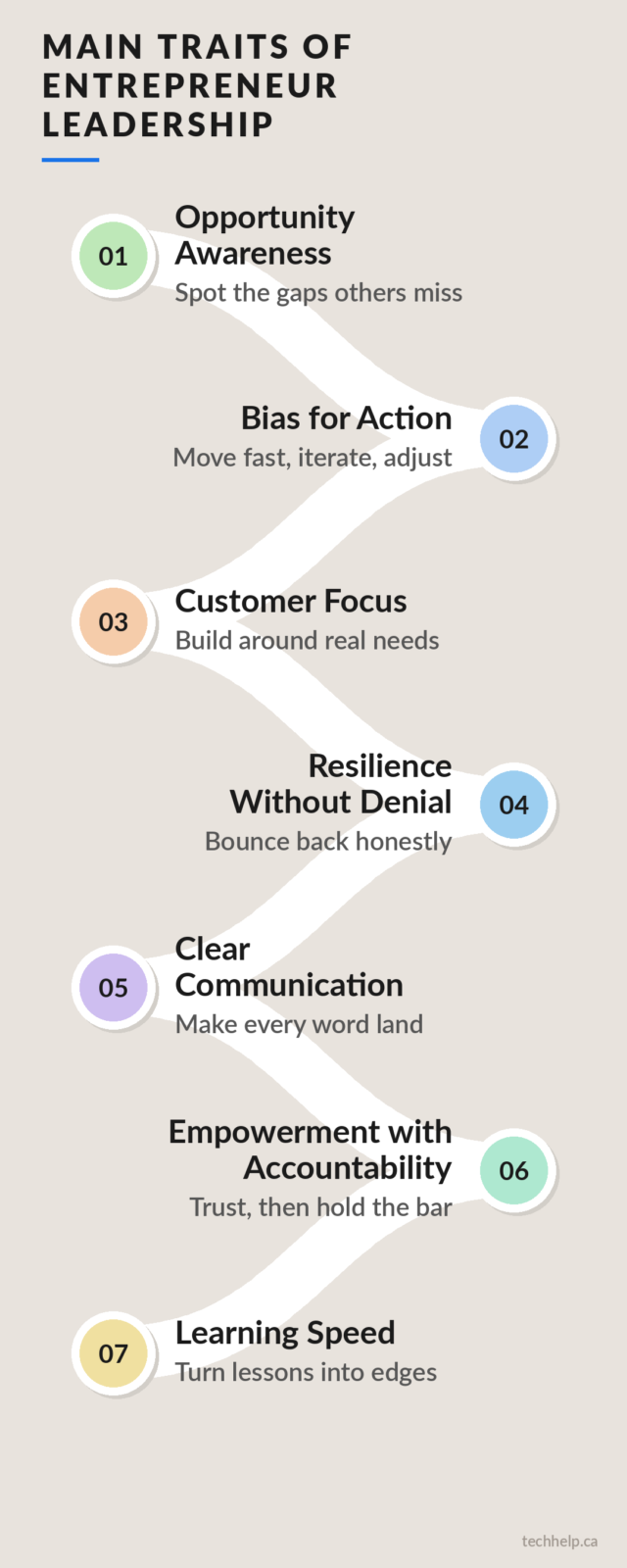
Core traits of entrepreneurship leadership
Strong entrepreneurial leaders usually share several traits. Some come naturally, but all of them can be practiced.
Opportunity awareness
Entrepreneurial leaders notice gaps before everyone else agrees they matter. They listen for customer frustration, inefficient workflows, underserved niches, price resistance, new regulations, technology shifts, and behavior changes. They don’t just ask, “What can we sell?” They ask, “Where is value being wasted, blocked, delayed, or ignored?”
This trait matters because good opportunities rarely arrive with a label on them. They often look like complaints, workarounds, delays, repeated questions, or small customer behaviors that others dismiss.
To build opportunity awareness, spend more time close to the market. Read customer reviews. Listen to sales calls. Track objections. Ask customers what they tried before finding you. Study competitors, but don’t copy them blindly. Look for what customers still dislike even after buying.
Bias for action
Entrepreneurial leaders don’t wait until every variable is known. They move when the next step is clear enough.
This doesn’t mean rushing. It means avoiding the trap where research becomes a hiding place. Many businesses stay stuck because the founder keeps refining the idea instead of testing whether the market cares. A simple landing page, prototype, customer conversation, waitlist, small ad test, or manual service version can reveal more than another month of private planning.
That overlaps with agile leadership. Short cycles reduce risk because you learn earlier. The leader’s job is to make the next test clear, small, and honest enough to produce evidence.
Customer focus
Customer focus isn’t a slogan. It’s a leadership discipline.
Entrepreneurial leaders keep the customer inside the decision-making process. They know what customers are trying to achieve, what they fear, what annoys them, what language they use, and what makes them hesitate before buying.
Founders can fall in love with their own ideas. Customer focus pulls the business back to reality. If people won’t pay, won’t return, won’t recommend, or won’t change behavior, the offer needs work.
To lead with customer focus, build feedback into the rhythm of the business. Review support questions. Watch where prospects drop off. Ask why customers chose you. Ask why others didn’t. Treat complaints as information before you treat them as irritation.
Resilience without denial
Resilience isn’t pretending everything is fine. It’s the ability to absorb setbacks, learn from them, and keep making clear decisions.
ISED’s 2025 small business statistics show how real the survival challenge is. In Canada, 68% of small businesses survived at least five years, and 48.2% survived at least 10 years. Those numbers aren’t meant to discourage entrepreneurs. They show why leadership can’t depend only on enthusiasm.
Entrepreneurial leaders need emotional stamina, but they also need honesty. If a campaign fails, they look at the message, offer, audience, timing, and sales process. If a hire doesn’t work out, they examine the role, onboarding, management, and fit. If cash gets tight, they don’t hide from the numbers.
Resilience turns pain into information. Denial turns pain into a bigger problem.
Clear communication
Uncertainty creates noise. People fill gaps with assumptions, rumors, and private interpretations. Clear communication gives the team something stable to work from.
Entrepreneurial leaders explain the goal, the reason, the trade-offs, and the current constraints. They don’t need to know everything. They do need to tell people what’s known, what’s still unknown, what decision has been made, and what will be reviewed next.
Many founders struggle here. They move fast in their own heads, then assume the team understands the same context. The result is rework, missed expectations, and people waiting for clarification.
Clarity isn’t over-explaining. It’s making sure the right people understand the decision well enough to act.
Empowerment with accountability
Entrepreneurial leaders give people room to think, not just room to complete tasks. That means sharing outcomes, decision rights, constraints, and standards.
Weak empowerment sounds like “just figure it out.” Strong empowerment sounds like “here’s the outcome, here are the boundaries, here’s what you can decide, here’s when to escalate, and here’s how we’ll measure success.”
That distinction matters. Autonomy without clarity creates anxiety. Control without autonomy creates dependency. Good entrepreneurial leaders build the middle path: people have enough context to act and enough accountability to stay aligned.
This connects closely with human-centric leadership, because people do better work when they’re trusted, supported, and treated as capable adults instead of replaceable task handlers.
Learning speed
Entrepreneurial leadership depends on learning faster than the cost of mistakes can compound.
Learning speed comes from short feedback loops. The leader doesn’t wait for an annual review, a perfect report, or a crisis. They create regular moments to ask what worked, what failed, what customers said, what slowed the team down, and what should change next.
The same discipline applies to the leader. Leaders need the humility to notice their own patterns. If you avoid hard conversations, over-control decisions, chase too many ideas, or delay financial reviews, the business will eventually reflect that. Regular reflective leadership keeps those patterns visible before they become expensive.
Practices that strengthen entrepreneurship leadership
Traits matter, but practices are what make leadership repeatable. You don’t become an entrepreneurial leader by liking innovation. You become one by building habits that help people create value under uncertainty.
Define the real problem before chasing the idea
Many entrepreneurs start with an idea because ideas feel exciting. Strong leaders start with the problem.
An idea might be “we should launch a subscription service.” The problem might be “customers forget to reorder and churn after one purchase.” Those are different. The first points to a product concept. The second points to a customer behavior, which may have several possible solutions.
Before committing to a new initiative, write the problem in one sentence. Include who has the problem, what it costs them, and why current options aren’t enough. If that sentence is vague, the idea isn’t ready.
Turn assumptions into tests
Every business idea contains assumptions. Customers will want this. They’ll pay this price. This channel will reach them. This feature will matter. This workflow will save time. This message will convert.
Entrepreneurial leaders identify those assumptions early and test the riskiest ones first. If the riskiest assumption fails, the rest of the plan may not matter.
A good test doesn’t need to be elaborate. It needs to be clear. Decide what you’re testing, what evidence would support it, what evidence would challenge it, how long the test will run, and what decision you’ll make afterward.
Build decision rules before pressure hits
Pressure makes decision-making messy. A founder who waits until the crisis to decide how to respond often reacts from fear, pride, or exhaustion.
Decision rules reduce that problem. For example, you might decide that no new offer launches without five customer interviews, no recurring tool stays unless someone owns it, no marketing campaign scales until cost per qualified lead is within target, and no role gets hired until the workflow has been documented.
These rules don’t remove judgment. They protect judgment when emotions are high.
Keep the team close to customer reality
Teams make better decisions when they hear the customer’s voice. If only the founder talks to customers, everyone else works from secondhand information.
Share customer stories in team meetings. Bring support patterns into planning. Let product, marketing, operations, and service teams see the same objections. When possible, let team members observe calls, review transcripts, or study feedback directly.
Customer reality keeps strategy grounded. It also reduces internal debates based only on opinions.
Create a cadence for reflection
Entrepreneurial work can become frantic if nobody pauses long enough to learn. A simple weekly or biweekly reflection rhythm can prevent that.
Ask what created value, what created friction, what surprised the team, what customers taught you, what decision needs more evidence, and what should be stopped. Keep the conversation practical. The goal isn’t a long meeting. The goal is to improve the next cycle of work.
Protect focus
Entrepreneurs often have too many ideas, not too few. That can look like energy, but it can quietly damage the business.
Every new idea uses attention, time, money, and team capacity. Entrepreneurial leaders protect focus by choosing fewer priorities and making trade-offs visible. They don’t let every interesting idea become active work.
One useful rule is to separate “capture” from “commit.” Capture all promising ideas in one place. Commit only to the few that match the current strategy, resources, and customer evidence.
Common entrepreneurship leadership mistakes
The first mistake is confusing motion with progress. Busy teams can still be avoiding the hard work: selling, shipping, measuring, following up, and talking to customers.
The second mistake is making every decision founder-dependent. This feels efficient early on because the founder has the most context. Over time, it slows the business down and trains the team to wait.
The third mistake is treating resilience as endless endurance. Pushing through can be useful, but sometimes the smart move is to change the offer, stop a weak initiative, narrow the market, or fix the operating model.
The fourth mistake is ignoring the numbers. Entrepreneurial optimism is powerful, but cash flow, margins, conversion rates, retention, and capacity still decide what the business can survive.
The fifth mistake is overusing inspiration. A clear vision helps, but people also need priorities, standards, tools, timelines, and feedback. Motivation without operating clarity fades quickly.
A simple 30-day leadership reset
If you want to strengthen entrepreneurship leadership in your business, start with one month of practical changes.
In week one, clarify the current business priority. Pick one outcome that matters most right now: more qualified leads, faster delivery, better retention, cleaner operations, improved cash flow, or a stronger offer. Write it clearly and share it with anyone involved.
In week two, talk to customers or prospects. Aim for patterns, not perfect research. Ask what they were trying to solve, what almost stopped them from buying, what they tried before, and what would make the experience better.
In week three, choose one small experiment. Test a message, offer, process, price, landing page, workflow, or follow-up sequence. Keep it small enough to run quickly but real enough to teach you something.
In week four, review what happened. Look at the evidence, decide what to keep, what to change, and what to stop. Then communicate the next move clearly.
That rhythm is simple, but it builds the muscle entrepreneurial leaders need most: turning uncertainty into learning, and learning into action.
Final takeaway
Entrepreneurship leadership isn’t about being fearless, charismatic, or constantly disruptive. It’s about creating value when the path is unclear.
The best entrepreneurial leaders combine opportunity awareness with discipline. They move quickly, but they don’t worship speed. They empower people, but they don’t abandon accountability. They listen to customers, but they don’t chase every request. They stay resilient, but they don’t deny reality.
That balance is what helps a business grow beyond the founder’s energy. Ideas start the business. Leadership keeps it alive.
Frequently Asked Questions
What is entrepreneurship leadership?
Entrepreneurship leadership is the ability to guide people, decisions, and resources toward opportunity under uncertain conditions. It combines vision, customer focus, initiative, risk judgment, learning speed, and team empowerment.
How is entrepreneurship leadership different from regular management?
Regular management usually focuses on stability, process, and efficiency inside an existing system. Entrepreneurship leadership focuses on finding opportunities, testing assumptions, creating value, and helping people act before every answer is known.
Can entrepreneurship leadership be learned?
Yes. Some people naturally lean toward initiative and risk-taking, but entrepreneurship leadership can be built through practice. Customer conversations, small experiments, decision rules, reflection, and clearer team ownership all strengthen the skill over time.
Why is resilience important for entrepreneurial leaders?
Resilience helps leaders stay clear when plans fail, customers reject an offer, cash gets tight, or the market shifts. It doesn’t mean pretending everything is fine. It means using setbacks as information and making the next decision with honesty.
What is the most important trait of an entrepreneurial leader?
The most important trait is disciplined opportunity awareness. Entrepreneurial leaders need to spot useful opportunities, but they also need enough discipline to test them, focus resources, and stop weak ideas before they drain the business.
How can a small business owner improve entrepreneurship leadership?
Start by clarifying one business priority, talking to customers, running one small test, and reviewing the result. Repeat that cycle often. Over time, this builds better judgment, stronger focus, and a team that learns instead of waiting for perfect certainty.
Tech Help Canada Staff researches, writes, and reviews practical content for business owners and professionals. Our coverage spans business, marketing, SEO, technology, and the tools and systems people use to grow and operate online. We focus on clear, useful information backed by research, hands-on experience, and editorial review. Learn more about our team and editorial standards. Need help with something? Contact Us