

Content marketing guide
Content marketing strategies: the ultimate guide
A complete working resource for planning, building, promoting, measuring, and improving a content marketing program.
Built as a resource you can use for strategy, planning, publishing, and content performance review.
Navigate the guide
Use the chapter links to move through the strategy, planning, formats, examples, measurement, and future trends sections.
- Introduction to content marketing
- Content marketing strategy fundamentals
- Types of content marketing
- Step-by-step guide to creating your content marketing strategy
- Advanced content creation techniques
- Content marketing strategies library
- Strategic implementation for different goals
- Real-world examples and case studies
- Measuring success
- Future trends in content marketing
- Conclusion
- Frequently asked questions
- Related
- References
Contents
1. Introduction to content marketing
What is content marketing?
Content marketing is how a business earns attention by publishing useful, relevant material for a defined audience. Instead of interrupting people with a pitch first, it helps them solve a problem, understand an opportunity, compare options, or make a better decision.
The Content Marketing Institute defines content marketing as a strategic approach focused on creating and distributing valuable, relevant, and consistent content to attract and retain a clearly defined audience, with the goal of driving profitable customer action. That definition is still useful because it contains the four parts many weak content programs miss: strategy, value, consistency, and business outcome.
Great content marketing isn’t just blogging, posting on LinkedIn, making videos, or sending newsletters. Those are formats and channels. The strategy underneath is the real work: understanding what your audience needs, deciding which problems your brand can credibly help with, creating assets that answer those needs better than competing sources, and distributing them where the audience already pays attention.
This guide is built as a complete working resource. You can use it to plan a content strategy from scratch, improve an existing program, choose better formats, build linkable assets, align content with the buyer journey, update measurement, and prepare for AI search and zero-click discovery.
The principle is simple but demanding: be useful before you ask for attention, trust, data, or money. When your content consistently helps people think, decide, or act, it becomes more than marketing material. It becomes a business asset.
How content marketing works
Content marketing builds relationships with potential customers through valuable content throughout their buyer’s journey. Rather than pitching products or services directly, you establish trust and authority by addressing audience needs before they’re ready to purchase.
The content marketing ecosystem
At the heart of content marketing is a cyclical system with interconnected components:
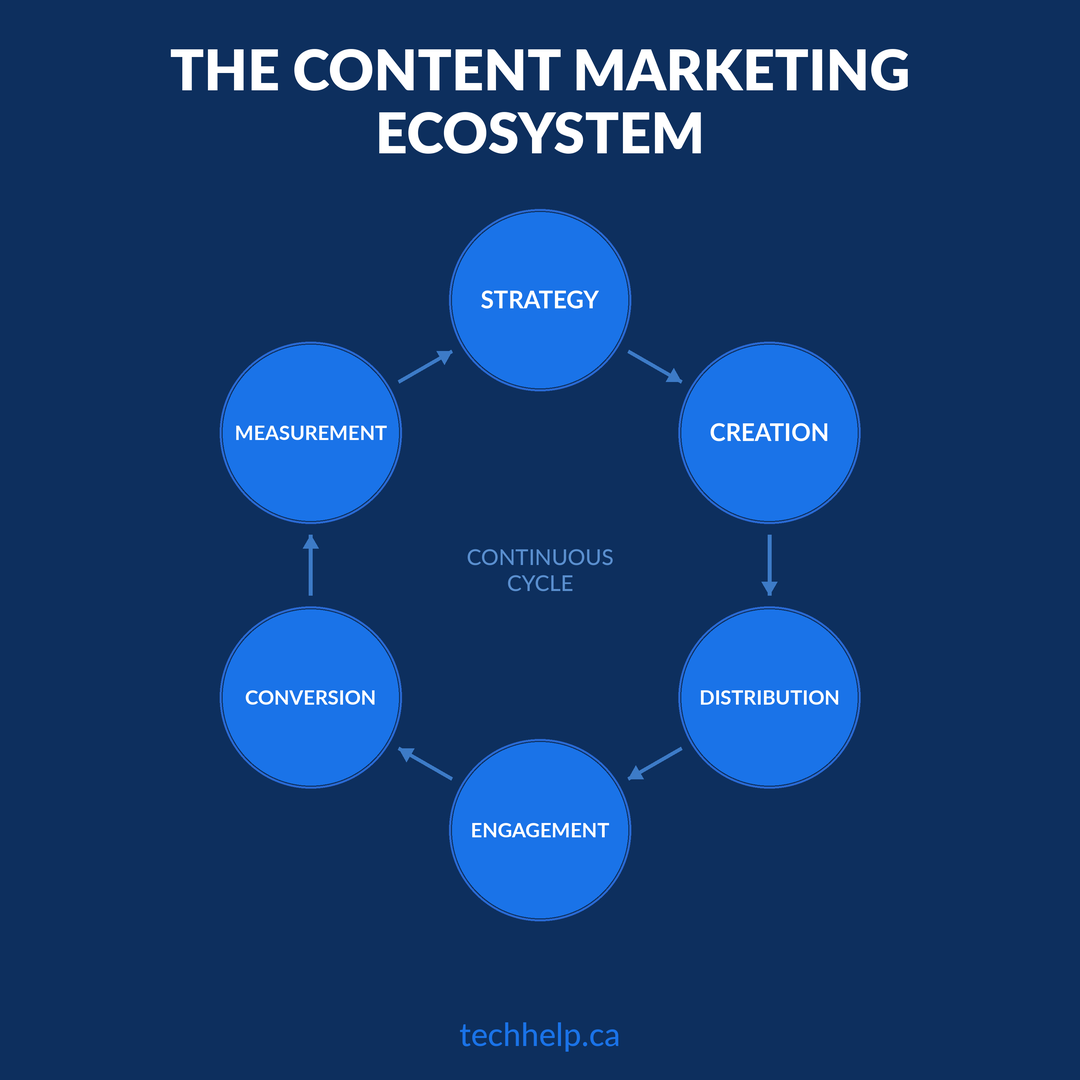
Strategy Development: Everything starts with clear objectives aligned to your business goals – whether that’s building brand awareness, generating leads, or driving conversions. You identify your target audiences through detailed buyer personas and establish key performance indicators to measure success.
Content Creation: Based on audience research and strategic goals, you develop content that addresses specific pain points, questions, or interests. This takes many forms – blog posts, videos, podcasts, social media updates – but always delivers genuine value.
Distribution and Promotion: Once created, your content reaches audiences through owned channels (your website, email lists), earned media (PR, organic social sharing), and paid promotion (paid partnerships, social ads). The most effective content marketing uses a multi-channel approach to maximize reach and engagement.
Audience Engagement: As audiences discover and consume your content, they start interacting with your brand through comments, shares, downloads, and other engagement signals. These interactions create opportunities for relationship-building and community development.
Conversion Optimization: Strategic calls-to-action and conversion paths within your content guide engaged audiences toward business objectives – whether that’s subscribing to newsletters, downloading resources, requesting consultations, or making purchases.
Measurement and Refinement: Analytics tools track content performance against your KPIs, providing insights that shape future content development. This creates a feedback loop that continuously improves relevance and effectiveness.
The content marketing funnel
Content marketing guides potential customers through awareness, consideration, and decision stages, with different content types serving different purposes:

Top of Funnel (Awareness): Blog posts, infographics, and videos attract attention by addressing broad industry topics and common challenges.
Middle of Funnel (Consideration): Case studies, webinars, and comparison guides help audiences evaluate potential solutions to their problems.
Bottom of Funnel (Decision): Product demos, customer testimonials, and free trials provide the specific information needed to make purchase decisions.
This alignment of content with buyer stages creates a seamless journey that nurtures prospects toward conversion while building brand loyalty that extends beyond the initial purchase.
Benefits of content marketing
While traditional marketing focuses on promoting products directly, content marketing delivers advantages that extend far beyond immediate sales. Here’s what a consistent, value-driven content program can do for your business.
Establishes brand authority and thought leadership
Content marketing positions you as an industry authority by demonstrating expertise through valuable insights. When you consistently publish high-quality, informative content that addresses your audience’s challenges, you build credibility that sets you apart from competitors.
This established expertise makes prospects more likely to trust your products or services when they’re ready to buy. Brands that share original research, unique perspectives, and actionable advice become go-to resources – earning media mentions, speaking opportunities, and partnerships that further amplify their authority.
Builds trust and stronger customer relationships
Unlike traditional advertising that interrupts and promotes, content marketing initiates relationships by providing value before asking for anything in return. This goodwill creates an emotional connection based on genuine helpfulness rather than sales pressure.
By addressing customer pain points and answering their questions, you demonstrate understanding and empathy that fosters trust. Stronger relationships lead to higher customer loyalty, increased retention rates, and more brand advocates who willingly recommend your business to others.
Generates qualified leads and conversions
Content marketing attracts more qualified prospects by naturally filtering for audience members interested in your subject matter. When someone discovers your brand through content relevant to their needs, they’re already partially qualified compared to cold prospects.
Strategic content designed for different buying stages guides these interested prospects through a natural progression toward conversion. Lead generation content like gated resources, webinars, and email courses creates permission-based marketing opportunities that outperform interruption-based tactics in both conversion rates and cost-effectiveness.
Improves SEO and organic visibility
Search engines reward websites that consistently publish relevant, valuable content addressing topics their target audiences search for. A robust content marketing program naturally creates the content diversity, keyword relevance, and freshness signals that search algorithms favor.
As your content library grows, so does your digital footprint – creating more entry points for organic discovery. This increased search visibility delivers compounding returns over time, reducing your dependency on paid advertising while providing sustainable traffic that doesn’t disappear when ad budgets get cut.
Provides compounding return on investment
Unlike paid advertising that stops delivering results when spending ends, content marketing assets continue working long after creation. A well-crafted blog post, video, or guide can generate traffic, leads, and conversions for years, making content marketing increasingly cost-effective over time.
This longevity creates a content library with cumulative impact – each piece builds upon previous work, expanding your authority, search presence, and audience relationships simultaneously. The compound effect means mature content marketing programs often achieve lower customer acquisition costs and higher marketing ROI than other digital marketing channels.
Offers valuable customer insights
Engagement with your content provides rich behavioral data that reveals audience preferences, pain points, and decision-making patterns. By analyzing which topics generate the most engagement, which questions arise in comments, and which content drives conversions, you gain actionable insights for product development, service improvements, and future marketing efforts.
Supports and amplifies other marketing channels
Content marketing doesn’t exist in isolation – it strengthens your entire marketing ecosystem. Social media campaigns perform better with compelling content to share. Email marketing becomes more effective with valuable content that recipients actually want to receive. Sales teams close deals more efficiently when prospects have already been educated through relevant content.
This synergistic effect maximizes the efficiency of your overall marketing investment while creating consistent messaging across touchpoints.
2. Content marketing strategy fundamentals
A well-defined strategy transforms content marketing from random acts of content into a coordinated system that delivers measurable business results.
Why you need a strategy
Without a clear strategy, content marketing often devolves into disconnected pieces that fail to serve either audience needs or business objectives. Content Marketing Institute and MarketingProfs’ 2025 B2B research found that only 29% of B2B marketers rated their content strategy as extremely or very effective. Among those who rated their strategy as moderately effective or worse, the leading reasons included a lack of clear goals and a weak connection to the customer journey.
A content marketing strategy serves as your roadmap, preventing the common pitfall of creating content simply for the sake of content creation. It helps you avoid wasted resources on pieces that don’t serve your audience or business. With clear strategic guidelines, your team can make confident decisions about content topics, formats, and distribution channels, ensuring consistency even as tactics evolve.
A documented strategy also facilitates measurement and optimization. By establishing specific objectives and success metrics from the start, you create accountability and the ability to demonstrate ROI. This evidence-based approach allows for continuous improvement rather than repeatedly starting from scratch.
Key components of successful content marketing
Building an effective content marketing strategy requires several elements working in harmony. Here’s an overview of the building blocks. We’ll go deeper into implementation in Section 4.
Clear Business Objectives: SMART goals that align with broader business priorities and specify what your content needs to accomplish.
Detailed Audience Understanding: Buyer personas and audience segments that go beyond demographics to include challenges, goals, content preferences, objections, and decision-making processes.
Content Value Proposition: A clear articulation of why your audience should choose your content over competitors’ – your unique perspective or expertise that serves as your content’s north star.
Strategic Content Pillars: Three to five core topics that define your content territory at the intersection of your expertise and your audience’s interests.
Channel Strategy: A plan for where and how your content will reach your audience across owned, earned, and paid media.
Content Production Framework: Sustainable systems for consistent creation and publishing, with defined workflows, responsibilities, and tools.
Measurement Plan: Relevant metrics that connect content activities to business outcomes like leads, sales, and retention – not just vanity metrics.
Content marketing strategy canvas
For a linkable, long-term content program, strategy needs to be simple enough to use and specific enough to guide trade-offs. Use this canvas before committing to topics, formats, or channels.

Swipe sideways to see the full table on smaller screens.
| Strategy Element | Question to Answer | Example Output |
|---|---|---|
| Business goal | What must content help the business achieve? | More qualified demos, lower support burden, more renewals |
| Audience | Who needs the content and what are they trying to solve? | CFOs comparing expense software, founders hiring first marketer |
| Journey stage | Where is the audience in the decision process? | Problem-aware, solution-aware, vendor-aware, customer |
| Core promise | Why should this audience trust your content? | Original benchmarks from your customer data |
| Content pillars | Which three to five topics will you own? | Pricing strategy, local SEO, customer retention |
| Differentiation | What will make your content harder to copy? | Field data, expert interviews, teardown examples, templates |
| Distribution | How will people actually find and revisit it? | Search, email, LinkedIn, partners, sales follow-up |
| Conversion path | What is the next logical step after value is delivered? | Subscribe, download, compare, book, test, ask for help |
| Measurement | Which signals show progress toward the goal? | Qualified leads, assisted pipeline, rankings, links, retention |
If you can’t fill out this canvas, you’re probably planning content volume rather than a content strategy.
Content marketing best practices
These proven best practices separate successful content marketing programs from ineffective ones.
Document your strategy
The most successful content marketers commit their strategy to writing rather than keeping it as an abstract concept. A documented strategy improves alignment across teams, maintains focus during execution, and provides a reference point for decision-making. This documentation doesn’t need to be elaborate – even a simple one-page strategic brief is more effective than an unwritten plan.
Quality over quantity
While consistency matters, value to the audience should never be sacrificed for volume. Creating fewer high-quality pieces that thoroughly address audience needs generates better results than producing a steady stream of superficial content. Focus on detailed resources that provide complete answers rather than thin content that leaves your audience wanting more.
Embrace the 80/20 rule
Devote approximately 80% of your content to educating, entertaining, or inspiring your audience and only 20% to promoting your products or services directly. This ratio respects your audience’s needs while still serving business objectives. When you do present promotional content, it’s received more favorably because you’ve already established credibility.
Maintain a consistent voice
Develop and adhere to a distinctive brand voice that resonates with your audience while reflecting your company’s values and personality. Document your voice guidelines with clear examples for content creators to follow, especially when multiple team members or external contributors produce content for your brand.
Repurpose strategically
Maximize the value of your content investments by thoughtfully repurposing existing content into different formats. A detailed blog post can become an infographic, video, podcast episode, email series, or social media campaign. Effective repurposing adapts content for each channel rather than simply reposting identical material.
Test and optimize continuously
Treat your content marketing as an ongoing experiment. A/B test headlines, content formats, publishing times, and calls to action to identify what resonates most with your audience. This culture of testing prevents stagnation and drives continuous improvement in both content quality and business results.
Focus on building owned assets
While distributing content through various channels is important, prioritize building content assets on platforms you control – your website and email list. These owned channels provide direct audience access that isn’t subject to algorithm changes or platform policies. Use third-party platforms to expand reach while directing audience members toward your owned properties for deeper engagement.
3. Types of content marketing
Content marketing encompasses a diverse range of formats, each with unique strengths and ideal applications. The most effective content strategies leverage multiple types to engage audiences at different touchpoints and stages of the buyer’s journey. Understanding each format’s advantages helps you select the right content types for your goals and audience preferences.
Here’s an overview of the primary content formats available to you:
- Blog posts and articles
- Video content
- Podcasts
- Social media content
- Infographics
- eBooks
- Whitepapers
- Case studies
- Webinars
- Interactive content
- Newsletters
- Templates and tools
- Email courses
- Community content/forums
- AR/VR experiences
Blog posts and articles
Blog posts and articles form the foundation of many content marketing programs. These written pieces typically range from 500 to 2,500 words and address specific topics relevant to your audience – from how-to guides and listicles to thought leadership pieces and industry news analysis.
Key Strengths: Excellent for SEO, establishing topical authority, and addressing audience questions comprehensively. Blogs provide evergreen value when optimized for search and can be easily updated to maintain relevance.
Best Uses: Educational content, answering common questions, sharing industry insights, and building search visibility. Blogs work particularly well for complex subjects that require detailed explanation.
Implementation Tips: Focus on solving specific problems, use scannable formats with headers and bullet points, incorporate relevant keywords naturally, and include compelling calls-to-action that guide readers to next steps.
Measurement: Track organic traffic, time on page, bounce rate, social shares, comment engagement, and conversion rates from blog visitors.
If you’re running a WordPress site, its built-in publishing tools, SEO plugins, and rich media support make it one of the most versatile platforms for building a content marketing engine around blog content.
Video content
Video has become increasingly dominant across digital platforms, engaging audiences through visual storytelling and demonstrations. Formats range from short social clips to in-depth tutorials, product demonstrations, interviews, webinar recordings, and brand stories.
Key Strengths: Higher engagement and retention rates than text-only content. Video works well for explaining complex concepts quickly, showcasing products in action, and creating emotional connections through visual and auditory elements.
Best Uses: Product demonstrations, tutorials, behind-the-scenes content, testimonials, and explanations of complex concepts. Video is particularly effective for awareness-stage content and building brand personality.
Implementation Tips: Start with a strong hook in the first few seconds, optimize for mobile viewing, include captions for accessibility, and keep videos focused on a single clear message. Consider creating versions of different lengths for various platforms.
Measurement: View count, watch time, completion rate, engagement (likes, comments, shares), click-through rates on calls-to-action, and conversion attribution.
Podcasts
Podcasts offer an intimate, convenient way to connect with your audience through audio content. Episodes typically feature conversations, interviews, storytelling, or educational content delivered in a format listeners can enjoy while multitasking.
Key Strengths: Creates deep engagement through regular listening habits and an intimate audio experience. Podcasts allow for in-depth exploration of topics and personality-driven content that builds strong audience relationships over time.
Best Uses: Thought leadership, industry interviews, educational series, and brand storytelling. Podcasts work exceptionally well for building community around niche interests and establishing expert status.
Implementation Tips: Maintain consistent publishing schedules, invest in decent audio quality, develop a distinctive hosting style, and incorporate listener questions or feedback to build community. Consider transcribing episodes for accessibility and SEO benefits.
Measurement: Download numbers, subscriber growth, average listen time, website traffic from podcast links, and sponsor conversion rates if applicable.
Social media content
Social media content spans multiple platforms and formats, from text updates and images to short videos and interactive polls. Each platform has distinct content requirements, audience expectations, and engagement patterns.
Key Strengths: Immediate audience reach, two-way engagement opportunities, and network effects through sharing. Social content works well for building community, increasing brand visibility, and driving traffic to longer-form content.
Best Uses: Timely updates, community building, content distribution, customer service, and showcasing brand personality. Social media works particularly well for awareness and consideration stage content.
Implementation Tips: Adapt content for each platform’s unique environment rather than cross-posting identical content. Focus on starting conversations rather than broadcasting messages, leverage trending topics when relevant, and incorporate visual elements even in text-based posts.
Measurement: Engagement rates, follower growth, reach, referral traffic to website, and conversion rates from social visitors.
Infographics
Infographics combine visual design with concise text to present information, data, or processes in an easily digestible format. They transform complex information into visual stories that can be quickly understood and shared.
Key Strengths: Communicates complex information at a glance, highly shareable, and retains value over time. Infographics are particularly effective for data visualization, process explanation, and comparison content.
Best Uses: Statistical overviews, survey results, step-by-step guides, timelines, comparisons, and hierarchies. Infographics work especially well for awareness-stage content and link building.
Implementation Tips: Start with a compelling headline, maintain a clear narrative flow, use consistent visual styling, and limit text to essential information. Focus on a single topic rather than trying to cover too much in one graphic.
Measurement: Social shares, backlinks, traffic from referral sources, time spent on page, and image downloads.
eBooks
eBooks are longer digital publications typically ranging from 15 to 50 pages. They offer in-depth coverage of specific topics, providing substantial value through detailed information, actionable advice, or original research.
Key Strengths: Demonstrates deep expertise, provides substantial value, and works well as gated content for lead generation. eBooks allow for fuller coverage that shorter formats can’t adequately address.
Best Uses: Comprehensive guides, industry reports, instructional content, and thought leadership pieces. eBooks work particularly well for consideration-stage content and lead qualification.
Implementation Tips: Design for digital reading with scannable layouts, visual elements, and interactive features where possible. Break content into logical chapters, use consistent formatting, and include actionable takeaways throughout.
Measurement: Download numbers, form completion rates, time spent reading, shares, and lead quality metrics for gated eBooks.
Whitepapers
Whitepapers are authoritative, data-driven documents that present research findings, technical explanations, or solutions to specific industry problems. They typically adopt a more formal tone than eBooks, focusing on objective analysis rather than promotional content.
Key Strengths: Establishes deep credibility, particularly in B2B contexts, and demonstrates thought leadership through substantive research. Whitepapers excel at influencing decision-makers with evidence-based arguments.
Best Uses: Original research presentation, complex solution explanations, and technical problem-solving. Whitepapers work best for consideration and decision stages in B2B buying processes.
Implementation Tips: Base content on solid research or data, maintain an objective tone, address specific industry challenges, and include executive summaries for busy readers.
Measurement: Download metrics, time spent reading, sharing among decision-makers, and influence on sales conversations.
Case studies
Case studies tell the story of a customer’s success with your product or service, typically following a problem-solution-results structure. They provide social proof through real-world examples of how your offerings create tangible benefits.
Key Strengths: Provides concrete evidence of value, answers “does this work for companies like mine?” questions, and builds credibility through customer validation. Case studies bridge the gap between promotional claims and proven results.
Best Uses: Demonstrating specific applications, overcoming objections, and providing social proof. Case studies work particularly well for decision-stage content when prospects are evaluating solutions.
Implementation Tips: Tell a compelling story with a clear narrative arc, include specific metrics where possible, incorporate customer quotes, and position the customer as the hero rather than your product. Create versions of different lengths for various uses.
Measurement: Influence on sales conversations, time spent reading, and conversion rates when used in lead nurturing.
Webinars
Webinars are live or recorded online presentations or workshops that combine slides, speaker video, and interactive elements like polls or Q&A sessions. They provide in-depth education on specific topics while creating direct engagement opportunities.
Key Strengths: Combines benefits of both video and interactive content, allows direct audience engagement, and positions presenters as accessible experts. Webinars excel at nurturing leads through educational content while creating personal connections.
Best Uses: Product demonstrations, industry education, expert interviews, and complex topic explanations. Webinars work well for mid-funnel lead nurturing and qualification.
Implementation Tips: Focus on providing value rather than pitching, use engaging visuals, incorporate interactive elements throughout, and allow sufficient time for audience questions.
Measurement: Registration numbers, attendance rates, engagement during webinar, poll responses, question volume, and post-webinar conversion actions.
Interactive content
Interactive content requires active participation from your audience rather than passive consumption. Formats include assessments, calculators, quizzes, configurators, interactive infographics, and augmented reality experiences.
Key Strengths: Higher engagement rates, personalized experiences, and valuable data collection opportunities. Interactive content stands out in a sea of static content and generates more memorable experiences.
Best Uses: Lead qualification, personalized recommendations, data collection, and engaging educational experiences. Interactive content works particularly well for middle and bottom-funnel conversion points.
Implementation Tips: Focus on delivering genuine value through the interaction, keep user experience simple and intuitive, provide immediate feedback or results, and design clear next steps based on outcomes.
Measurement: Completion rates, data collected, time spent engaging, sharing rates, and conversion actions following interaction.
Newsletters
Newsletters are regularly scheduled email publications that deliver curated content, updates, and insights directly to subscribers’ inboxes. They maintain ongoing connections with your audience through consistent, valuable communication.
Key Strengths: Creates a direct, owned communication channel, builds regular engagement habits, and drives traffic to other content. Newsletters excel at nurturing relationships over time through consistent value delivery.
Best Uses: Content curation, community building, regular updates, and maintaining top-of-mind awareness. Newsletters work well for audience retention and nurturing.
Implementation Tips: Establish a consistent schedule and format, focus on providing unique value in each issue, personalize content when possible, and maintain a conversational tone. Include clear calls-to-action without overwhelming recipients.
Measurement: Open rates, click-through rates, subscriber growth, unsubscribe rates, and forwarding/sharing metrics.
Templates and tools
Templates and tools are practical resources designed for immediate application – spreadsheets, checklists, worksheets, design templates, and software tools that help your audience complete specific tasks.
Key Strengths: Provides immediate, tangible value through practical application, demonstrates understanding of audience workflows, and creates regular usage opportunities that keep users coming back.
Best Uses: Lead generation, demonstrating product value, and creating practical extensions of educational content. Templates work particularly well for consideration and decision stages.
Implementation Tips: Focus on addressing common pain points with straightforward solutions, create clear instructions for use, design for easy customization, and connect templates to broader educational content.
Measurement: Download numbers, actual usage rates, sharing metrics, and influence on product adoption when relevant.
Email courses
Email courses deliver sequential educational content through a series of automated emails over a defined timeframe. They break larger topics into manageable lessons delivered at regular intervals – typically daily or weekly.
Key Strengths: Creates ongoing engagement over time, increases comprehension through spaced learning, and builds anticipation for next installments. Email courses excel at nurturing leads while establishing teaching authority.
Best Uses: Step-by-step guides, complex topic education, onboarding sequences, and lead nurturing. Email courses work particularly well for middle-funnel education and qualification.
Implementation Tips: Structure content as a logical progression with clear connections between lessons, incorporate action steps for application, maintain consistent formatting, and include review elements to reinforce learning.
Measurement: Completion rates, engagement patterns across the sequence, action completion rates, and conversion metrics following course completion.
Community content and forums
Community content encompasses user-generated discussions, questions, answers, and insights shared within brand-hosted spaces like forums, groups, or discussion boards. It leverages your audience’s collective knowledge while fostering connections.
Key Strengths: Creates self-sustaining engagement, provides authentic social proof, and generates insights into customer needs. Community content works well for building brand loyalty through peer-to-peer connections.
Best Uses: Customer support, product feedback, knowledge sharing, and building brand advocates. Community forums work particularly well for retention and advocacy stages.
Implementation Tips: Establish clear community guidelines, actively moderate discussions, recognize valuable contributors, and seed discussions with engaging questions. Create dedicated areas for different topics or user segments.
Measurement: Active users, post volume, question response rates, sentiment analysis, and influence on retention metrics.
AR/VR experiences
Augmented reality (AR) and virtual reality (VR) experiences create immersive interactions that blend digital content with the physical world (AR) or generate fully immersive digital environments (VR). These formats offer unique engagement opportunities that are becoming increasingly accessible.
Key Strengths: Creates memorable, novel experiences, enables product visualization in real-world contexts, and differentiates your brand as innovative. AR/VR works well for creating emotional connections through immersive storytelling.
Best Uses: Product demonstrations, virtual tours, training simulations, and interactive storytelling. AR/VR works particularly well for high-consideration products with spatial or physical elements.
Implementation Tips: Focus on solving specific problems rather than implementing technology for novelty alone, ensure experiences are accessible on common devices, and provide alternative content for users without AR/VR capability.
Measurement: Activation rates, time spent in experience, completion rates, social sharing, and influence on purchase decisions.
4. Step-by-step guide to creating your content marketing strategy
Developing an effective content marketing strategy doesn’t happen by accident. This systematic approach will guide you through the essential stages of creating a strategy that aligns with your business goals, resonates with your audience, and delivers measurable results.

Step 1: define your goals and objectives
Start by clarifying exactly what you want your content marketing to achieve. Your objectives should directly support broader business goals while being specific enough to guide content decisions and measure success.
Identify which stage of the marketing funnel needs the most attention – awareness, consideration, or decision. Then develop SMART goals (Specific, Measurable, Achievable, Relevant, Time-bound) that address these priorities. Common content marketing objectives include increasing brand awareness, generating qualified leads, nurturing prospects, driving conversions, improving customer retention, or establishing thought leadership.
Document these goals with specific metrics and timeframes. “Increase qualified leads from content by 25% over the next six months” is far more actionable than “get more leads.” This specificity creates accountability and provides clear direction for your content efforts.
Common Pitfalls: Setting too many goals simultaneously, choosing objectives disconnected from business priorities, or establishing metrics without baseline data.
Success Indicator: You have two to three documented SMART goals with specific metrics, timeframes, and clear connections to business priorities.
Step 2: identify your target audience
Your content strategy’s effectiveness depends on a deep understanding of who you’re trying to reach. This step involves researching, analyzing, and documenting detailed profiles of your ideal audience segments.
Gather data from multiple sources: customer interviews, sales team insights, support interactions, website analytics, social media data, and industry research. Look beyond basic demographics to understand psychographics – values, pain points, goals, objections, and information preferences.
Develop detailed buyer personas that capture these insights in an accessible format. Create two to four distinct personas representing your primary audience segments, giving each a name, job role, challenges, motivations, content preferences, and typical questions at each buying stage. These personas should feel like real people with specific needs your content can address.
Map your personas’ information needs across their buyer’s journey, identifying specific questions they ask during awareness, consideration, and decision stages. This journey mapping reveals critical content gaps and opportunities to influence decisions at key decision points.
Common Pitfalls: Creating too many personas, relying solely on assumptions rather than research, focusing only on demographics, or failing to distinguish between current and ideal customers.
Success Indicator: You have well-documented buyer personas based on research, with clear insights into what content each persona needs at different journey stages.
Step 3: conduct content research and competitor analysis
Before creating new content, assess your current assets and analyze competitors’ content strategies to identify opportunities and gaps in the market.
Start with a complete content audit of your existing materials. Categorize content by type, topic, target persona, funnel stage, and performance metrics. Identify your highest-performing content to understand what resonates with your audience, as well as underperforming content that needs improvement or retirement.
Then analyze three to five key competitors’ content strategies, examining their content types, topics, publishing frequency, distribution channels, and engagement levels. Look for patterns in their high-performing content and identify topics they’re missing or covering inadequately.
Use keyword research tools to discover what your target audience is searching for related to your industry, products, or services. Prioritize keywords based on relevance, search volume, competition, and alignment with your business goals.
Combine these insights to identify your content sweet spot – the intersection of your expertise, your audience’s interests, and market opportunities with manageable competition levels.
Common Pitfalls: Skipping the content audit, focusing only on direct competitors, ignoring search intent behind keywords, or trying to compete in oversaturated topic areas.
Success Indicator: You have a documented analysis revealing content gaps, competitive opportunities, and priority keyword targets aligned with audience needs.
Step 4: choose the right content types and formats
With clear goals and audience insights established, determine which content formats will most effectively engage your target audience and achieve your objectives.
Map preferred content formats to each buyer persona and journey stage. Consider how your audience consumes information, their context (work vs. home, desktop vs. mobile), and which formats best communicate your specific message types.
Balance audience preferences with your team’s production capabilities and resource constraints. It’s better to excel in fewer formats than produce mediocre content across many.
Prioritize content types based on their alignment with your goals. For brand awareness, consider blog posts, infographics, and short videos. For lead generation, invest in webinars, ebooks, and assessment tools. For conversion support, focus on case studies, comparison guides, and product demos.
Common Pitfalls: Selecting formats based on trends rather than audience preferences, attempting too many formats simultaneously, or ignoring production capacity limitations.
Success Indicator: You’ve identified three to five primary content formats aligned with both audience preferences and business goals, with clear rationale for each selection.
Step 5: develop a content calendar and distribution plan
Transform your strategy into an actionable roadmap with a structured content calendar and clear distribution plan.
Create a content calendar that schedules topics, formats, and publication dates at least three months in advance. Organize content themes around business priorities, seasonal relevance, industry events, and audience interests. Balance evergreen content with timely pieces, and assign clear responsibilities for creation, review, and publication.
Develop a systematic distribution plan for each content piece, identifying primary and secondary channels for publication and promotion. Map out owned channels (website, email, social profiles), earned opportunities (PR, guest posting, organic social), and paid promotion where appropriate. Tailor distribution approaches for different content types and audience segments.
Establish workflows that account for content creation, review, approval, publication, and promotion stages. Document realistic timeframes for each step, ensuring adequate preparation for complex content types like original research or video production.
Common Pitfalls: Creating schedules too rigid to accommodate opportunities, focusing on creation without equal attention to distribution, or developing unrealistic production timelines.
Success Indicator: You have a flexible three-month content calendar with assigned responsibilities and a documented multichannel distribution strategy for each content type.
Step 6: create high-quality, engaging content
Execution is where strategy becomes reality. This step focuses on content creation processes that consistently produce valuable, audience-centric content.
Establish clear content creation standards and guidelines, including voice and tone, formatting conventions, sourcing requirements, and quality benchmarks. Document these in a style guide accessible to all content creators, ensuring consistency across pieces and contributors.
Develop content briefs for each piece that specify the target persona, objective, core message, key points to cover, keywords to include, calls-to-action, and success metrics. These briefs align creators with strategic goals and reduce revision cycles.
Use this brief structure for any serious article, video, webinar, or downloadable asset:
| Brief Element | What to Define |
|---|---|
| Audience | Who the piece is for, what they already know, and what they need next |
| Search or discovery intent | The question, problem, or task that would lead someone to this content |
| Business goal | The measurable outcome the content should support |
| Core promise | The useful result the reader or viewer should get |
| Differentiation | The original data, examples, experience, or point of view that makes it worth choosing |
| Required sections | The major points the piece must cover to satisfy intent |
| Proof | Sources, examples, expert input, screenshots, customer stories, or product data |
| Conversion path | The next step that naturally follows after the content delivers value |
| Quality checks | Accuracy, freshness, readability, accessibility, internal links, and brand voice |
Implement a structured creation process that includes research, outlining, drafting, editing, design, and final approval stages. Build in quality checkpoints to ensure content meets audience needs, aligns with strategy, and maintains brand standards.
Focus on creating content that provides genuine value through education, entertainment, or inspiration before asking for anything in return. Each piece should have a clear purpose, address specific audience questions or challenges, and include a logical next step for the reader.
Common Pitfalls: Rushing production at the expense of quality, creating content that’s too self-promotional, overlooking SEO during creation, or failing to include strong calls-to-action.
Success Indicator: You consistently produce content that meets documented quality standards, addresses audience needs, and aligns with strategic goals.
Step 7: optimize for SEO and discoverability
Even exceptional content can’t perform if audiences can’t find it. This step ensures your content is discoverable through search engines and other channels.
Incorporate targeted keywords naturally into your content, especially in titles, headings, introductions, and conclusions. Optimize meta descriptions, URL structures, and image alt text to improve search visibility while maintaining readability.
Structure content for both human readers and search engines with clear headings, concise paragraphs, bulleted lists, and internal links to related content. Use schema markup where appropriate to help search engines understand your content’s context.
Beyond SEO, optimize for broader discoverability by adding appropriate tags, categories, and filters to your content management system. Create content hubs that organize related pieces around central topics, improving both user navigation and search engine understanding of your topical authority.
Ensure your content is accessible across devices with responsive design, fast page load speeds, and accessibility best practices like proper heading structure and descriptive alt text.
Common Pitfalls: Keyword stuffing that compromises quality, optimizing for search engines at the expense of user experience, ignoring mobile optimization, or failing to build internal links between related content.
Success Indicator: Your content consistently achieves first-page rankings for targeted keywords and shows increasing organic traffic over time.
Step 8: promote content through the right channels
Strategic promotion amplifies your content’s reach and impact. This step focuses on getting your content in front of the right audiences through the most effective channels.
Implement a multichannel promotion strategy for each content piece, adapting the approach based on content type, target audience, and business objectives. Schedule promotions across owned social media channels, email newsletters, and website features with messaging tailored to each platform.
Leverage relationship-based promotion through industry influencers, partners, employees, and existing customers. Provide easy sharing options and, where appropriate, create specific outreach campaigns to encourage content amplification from trusted voices.
Consider selective paid promotion for high-value content. Start with small budgets to test performance before increasing investment on proven channels and content types.
Don’t treat promotion as a one-time event. Implement a promotion calendar that includes initial launch promotion and scheduled resurface opportunities for evergreen content, connecting valuable content with new audience segments over time.
Common Pitfalls: Using identical messaging across all platforms, promoting content only once, relying exclusively on organic or paid promotion, or failing to track which promotion channels drive meaningful results.
Success Indicator: Your content consistently reaches target audience segments through multiple channels, with clear data on which promotion strategies drive engagement and conversions.
Step 9: measure performance and refine strategy
Continuous improvement requires systematic measurement and analysis. This final step creates a feedback loop that informs ongoing strategy refinement.
Implement tracking for both content-specific metrics (views, engagement, shares) and business impact metrics (leads, sales, retention) using analytics tools appropriate for your goals. Create dashboards that make performance data accessible to stakeholders and decision-makers.
Establish regular review cycles – typically monthly for tactical adjustments and quarterly for strategic changes – where you analyze performance patterns against goals. Look for correlations between content characteristics (topics, formats, lengths) and desirable outcomes to identify what truly resonates with your audience.
Document insights from these reviews and use them to refine your content approach. Update your strategy, personas, content types, or distribution channels based on actual performance data rather than assumptions. Create a culture of testing and optimization by systematically experimenting with different headlines, formats, promotion approaches, or calls-to-action – and documenting what you learn from both successes and failures.
Common Pitfalls: Focusing only on vanity metrics, analyzing data too infrequently, failing to act on insights, or making major strategy changes without sufficient data.
Success Indicator: You have a documented measurement framework that connects content activities to business results, with regular review processes that generate actionable insights for optimization.
5. Advanced content creation techniques
Once you’ve established the foundations of your content marketing strategy, it’s time to elevate your approach with techniques that can significantly increase engagement and effectiveness. These methods represent the difference between basic content that merely exists and exceptional content that drives measurable business results.
Storytelling methods that engage and convert
Stories create emotional connections that facts alone can’t achieve. Here are specific storytelling frameworks you can use to transform ordinary information into compelling narratives.
The Hero’s Journey Framework: Position your customer as the hero facing a challenge, your brand as the guide providing wisdom and tools, and your product or service as the solution that helps them overcome obstacles. This framework creates a narrative arc your audience sees themselves in.
The Problem-Agitate-Solve Method: Clearly identify a relevant customer problem, then intensify the emotional impact by describing the implications of leaving it unsolved, before introducing your solution. This approach is effective for emails, landing pages, and social media content.
Contrast Stories: Create powerful narratives by juxtaposing “before and after” scenarios or “with and without” comparisons. This makes abstract benefits tangible by showing concrete transformation – ideal for testimonials, demonstrations, and results-focused content.
Personal Anecdotes: Incorporate authentic experiences from team members, customers, or industry peers to add credibility and relatability. These human elements build trust while making complex or technical information more accessible.
Micro-Stories: Integrate brief narratives within longer content to maintain engagement. These short examples or scenarios illustrate key points without requiring the entire piece to follow a narrative structure – they work especially well in educational content.
Creating personalized content through audience segmentation
Personalization transforms generic content into tailored experiences that resonate with specific audience segments. By leveraging data and segmentation strategies, you can create content that speaks directly to individual needs, significantly improving engagement and conversion rates.
Effective personalization begins with robust audience segmentation based on demographics, behavioral patterns, purchase history, content preferences, and position in the buyer’s journey. These segments become the foundation for creating targeted content variations rather than one-size-fits-all materials.
The most practical approach starts with creating core content pieces, then adapting elements for different segments. This might involve customizing headlines, examples, case studies, or calls-to-action while maintaining the central message. Advanced systems can dynamically display different content versions based on user attributes or behaviors, delivering personalized experiences at scale.
The goal isn’t to create entirely different content for each segment, but rather to emphasize the most relevant aspects of your message for each audience group. When done well, recipients should feel the content was created specifically for people like them.
Content repurposing across multiple platforms
Content repurposing maximizes your return on investment by transforming existing assets into multiple formats tailored for different channels and audiences. This strategic approach extends content lifespan, reaches new audience segments, reinforces key messages, and improves overall efficiency.
The most successful repurposing begins with planning for multiple formats during initial content creation. Start with pillar content like detailed guides, research reports, or webinars containing substantial information. These become your source material for derivative pieces. A research report might spawn infographics highlighting key statistics, blog posts exploring specific findings, social media quote cards, slide decks, podcast episodes discussing implications, and video summaries.
Effective repurposing goes beyond simply reformatting content. Each derivative piece should be optimized for its specific platform and context, considering audience expectations, technical constraints, and consumption patterns unique to each channel. This often means adjusting tone, length, visual elements, and calls-to-action while maintaining consistent core messaging.
Track performance across formats to identify which types of content and platforms deliver the best results for specific topics or audience segments. These insights help you prioritize future repurposing efforts for maximum impact.
Incorporating user-generated content
User-generated content (UGC) represents a powerful opportunity to amplify your marketing efforts through authentic voices while building community around your brand. When your customers create content about your products or services – reviews, social media posts, testimonials, or creative submissions – they provide social proof that resonates with prospects far more effectively than brand-created content alone.
Successfully incorporating UGC starts with creating opportunities and incentives for customers to share their experiences. This might include branded hashtag campaigns, photo or video contests, customer story submission forms, or review incentives. The key is making participation simple while providing clear guidelines about how submissions may be used.
Once collected, UGC can be featured across multiple channels – from website testimonial sections and social media highlights to email campaigns and advertising. Always maintain proper attribution and permissions, and consider creating a content hub where prospects can browse authentic customer experiences in one location.
Beyond showcasing UGC, actively engage with contributors, creating two-way conversations that strengthen relationships and provide valuable feedback. This transforms content marketing from a broadcast activity into a community-building effort that generates continuous authentic content while deepening customer loyalty.
Using AI and automation in content creation
AI and automation tools can make content marketing faster, but speed isn’t the same as strategy. The strongest use cases are research support, outline development, content briefs, repurposing, formatting, personalization rules, performance analysis, and workflow automation.
The risk is producing more average content. AI can summarize common advice quickly, which means it can also make your content sound like everyone else’s. Your advantage still comes from original thinking, real examples, customer insight, expert judgment, editorial standards, and a point of view.
Automation is strongest in delivery and follow-up. Dynamic content systems can adapt messages based on user data, behavioral triggers, or lifecycle stage. Scheduling workflows can keep distribution consistent. Testing platforms can identify stronger headlines, images, or calls to action through data rather than guesswork.
Implementing AI successfully requires clear rules. Decide what AI can draft, what humans must review, which claims need verification, how brand voice is protected, and what content should never be automated. For high-stakes advice, original research, legal or financial content, and anything tied to reputation, human review is non-negotiable.
Data-driven content optimization
The most sophisticated content marketers continuously refine their work based on performance data, transforming content creation from a purely creative exercise into a strategic process guided by audience behavior and measurable outcomes.
Effective optimization starts with tracking that goes beyond basic metrics. Monitor detailed engagement patterns like scroll depth, time on page, and interaction with specific elements. These insights reveal which content characteristics – topics, formats, lengths, publishing times, promotional channels – consistently drive desired outcomes.
A/B testing provides the clearest path to improvements. Systematically test variables like headlines, introductions, visual elements, content structure, or calls-to-action to identify what resonates most effectively with your audience. Start with high-traffic content where small improvements yield significant results, then apply insights to new and existing assets.
Combine quantitative data with qualitative feedback. Supplement analytics with user surveys, comments analysis, sales team input, and direct audience research to understand not just what’s happening with your content but why. This fuller view enables optimization that addresses audience needs while advancing business goals. (We’ll cover the full measurement toolkit and analytics infrastructure in Section 9.)
Interactive content development
While we covered interactive content formats in Section 3, developing truly effective interactive content requires advanced techniques that go beyond choosing a format.
The most important principle is that great interactive content solves real problems. A mortgage calculator helps prospects understand affordability. An industry assessment helps businesses benchmark performance. A product configurator helps customers visualize customized solutions. Start every interactive project by identifying the specific decision or challenge your audience faces – then build the experience around solving it.
User experience design makes or breaks interactive content. Keep the interface intuitive with clear instructions and immediate feedback that rewards participation. Match complexity to your audience’s technical comfort level, and make mobile responsiveness non-negotiable for broad accessibility. Keep initial interactions simple, revealing additional complexity only as users progress through the experience.
Beyond the experience itself, think strategically about data collection, results presentation, and follow-up actions. Design interactive content to capture valuable user information naturally through participation, present personalized results that deliver immediate value, and create logical next steps that guide users toward deeper engagement or conversion based on their specific interactions.
6. Content marketing strategies library
This section turns the theory into strategic plays. You don’t need to use every strategy at once. The goal is to choose the few that match your audience, resources, business model, and buying journey.

1. Topic cluster strategy
A topic cluster builds authority around a central theme. It usually includes one pillar page that covers the broad subject and several supporting pages that answer narrower questions.
For example, a company selling accounting software might create a pillar guide on small business cash flow, then support it with pages on cash flow forecasting, invoice payment terms, expense tracking, late payment follow-up, and cash flow statement templates.
This strategy works because it helps readers move from broad understanding to specific decisions without leaving your content ecosystem. It also helps search engines understand the topical relationship between your pages.
Best for: SEO growth, topical authority, B2B education, and evergreen traffic.
How to use it: Choose one topic your business can credibly own. Build one pillar asset, then create supporting content for every major sub-question your audience asks.
2. Original research strategy
Original research is one of the strongest ways to create linkable content. It gives journalists, bloggers, analysts, creators, and internal teams something specific to cite.
Research doesn’t have to mean a massive survey. It can be a customer-data benchmark, pricing teardown, industry poll, content audit, expert roundup, trend analysis, or anonymized pattern from your own operations.
The strength is uniqueness. Generic advice competes with thousands of similar pages. Original data gives people a reason to reference your work instead of another summary.
Best for: Link earning, thought leadership, PR, sales enablement, and executive authority.
How to use it: Identify a question your audience cares about that lacks clear data. Collect or analyze the information, publish the findings, and create charts or summaries others can reference.
3. Linkable asset strategy
A linkable asset is content designed to be useful enough that other sites naturally reference it. It may be a statistics page, calculator, template, benchmark report, glossary, checklist, interactive tool, or deep definitive guide.
This article itself is built with that goal in mind. The value comes from completeness, structure, current information, and practical utility. A linkable asset shouldn’t feel like a sales page. It should feel like the resource someone would send to a coworker.
Best for: Backlinks, organic visibility, brand authority, and long-term compounding traffic.
How to use it: Choose a topic with recurring demand and citation potential. Make the asset easier to use than competing resources through tables, examples, definitions, templates, data, and clear sections.
4. Content repurposing strategy
Content repurposing turns one strong idea into multiple assets for different channels. A webinar can become a blog post, short clips, a newsletter, a LinkedIn carousel, a sales follow-up email, and an FAQ page.
Good repurposing isn’t copy-paste distribution. Each version should fit the platform and the audience’s level of attention. This is where content repurposing and a content waterfall strategy can help you produce more value without constantly starting from scratch.
Best for: Small teams, multi-channel distribution, founder-led content, and extending the life of strong assets.
How to use it: Start with a strong pillar piece. Break it into smaller ideas, then adapt each one for a specific channel, format, and audience context.
5. Thought leadership strategy
Thought leadership works when your content has a point of view that’s specific, earned, and useful. It isn’t just publishing opinions. It’s using experience, evidence, and judgment to help an audience see a problem differently.
This strategy is especially valuable in crowded categories where basic how-to content has become interchangeable. Strong thought leadership can make your brand more memorable because it gives the audience something to quote, debate, or build on.
Best for: Professional services, B2B, executive brands, category creation, and trust-building.
How to use it: Pair practical content marketing with a distinct point of view. Our guide to content marketing and thought leadership breaks down how the two work together.
6. Buyer enablement strategy
Buyer enablement content helps people make a decision, not just learn a topic. It gives buyers the proof, comparisons, numbers, and internal explanations they need to move forward.
This matters in B2B because buyers often make decisions in groups. Gartner has reported that 75% of B2B buyers prefer a rep-free sales experience, but self-service digital purchases can also increase regret when buyers lack the right support. That means content has to help buyers move with confidence when your sales team isn’t in the room.
Best for: B2B, high-consideration purchases, long sales cycles, and complex products.
How to use it: Create comparison guides, ROI calculators, implementation plans, security summaries, internal pitch decks, case studies, and objection-handling pages.
7. Zero-click content strategy
Zero-click content gives value where the audience already is, without requiring a click first. This can include LinkedIn posts, carousels, short videos, search snippets, email summaries, and social posts that teach one complete idea.
This matters because click behavior has changed. SparkToro and Datos found that most Google searches in the United States and European Union ended without a click in 2024, and Pew Research found users were less likely to click traditional results when AI summaries appeared.
Zero-click content doesn’t replace your website. It builds trust before the site visit happens. Our zero-click content guide goes deeper into this shift.
Best for: Social reach, trust-building, expert positioning, and demand creation.
How to use it: Make the useful part visible in the feed, inbox, or search result. Use the link as depth, not rescue.
8. Search everywhere strategy
Search no longer happens only on Google. People search on YouTube, TikTok, Reddit, LinkedIn, Amazon, app stores, marketplaces, AI assistants, review platforms, and industry communities.
Search everywhere optimization means adapting your content for the places your audience uses to discover and verify information. A blog post may support Google. A video may support YouTube. A discussion answer may support Reddit. A clear profile may support AI recommendations and branded search.
Best for: Brands facing declining organic clicks, audience fragmentation, and AI-assisted discovery.
How to use it: Identify the search surfaces your audience uses, then create platform-native assets that answer the same core questions in the right format. Use our guide to search everywhere optimization for a deeper process.
9. Email nurture strategy
Email remains one of the strongest owned channels because it lets you maintain a relationship beyond a single visit. A good email program doesn’t only announce new posts. It moves people through a sequence of useful ideas based on what they need next.
For B2B, that might mean educating a lead over several weeks. For ecommerce, it might mean post-purchase tips, replenishment reminders, or loyalty content. For media brands, it might mean curated insight that brings readers back regularly.
Best for: Lead nurturing, retention, customer education, launches, and owned-audience building.
How to use it: Build segmented email paths for new subscribers, researchers, comparison-stage buyers, customers, and inactive contacts. Our email marketing automation guide can support the execution layer.
10. Content refresh strategy
A content refresh strategy improves what already exists. Instead of only publishing new material, you update outdated facts, expand thin sections, improve internal links, fix search intent mismatches, add examples, and remove weak pages.
This strategy often produces faster returns than creating from scratch because the page already has history, links, impressions, or audience data.
Best for: Mature blogs, SEO recovery, outdated guides, and teams with limited production capacity.
How to use it: Audit pages by traffic, ranking, backlinks, conversion, and freshness. Update the assets with the strongest upside first.
11. Community and UGC strategy
Community content and user-generated content turn customers, members, employees, and fans into part of the content engine. Reviews, questions, forum discussions, customer examples, tutorials, and shared stories can all build trust because they come from outside the brand voice.
This strategy works best when the community has a real reason to participate. People rarely contribute because a brand asks nicely. They contribute when the space gives them identity, usefulness, recognition, or access.
Best for: SaaS, education, consumer brands, creator-led businesses, and products with active user communities.
How to use it: Invite specific contributions, set clear rules, get permission, credit people properly, and turn recurring questions into official content.
12. Lifecycle content strategy
Lifecycle content supports people before, during, and after the sale. It includes onboarding guides, education sequences, product adoption content, renewal reminders, advanced tutorials, community content, and customer success stories.
Lifecycle content is more than acquisition support. It can reduce churn, improve satisfaction, support upsells, and create advocates. Our lifecycle marketing guide covers this relationship between content, retention, and customer value.
Best for: Subscription businesses, SaaS, service providers, membership models, and high-retention categories.
How to use it: Map content to the customer journey after purchase: first value, habit formation, advanced use, renewal, expansion, and advocacy.
7. Strategic implementation for different goals
Content marketing strategies need to be tailored to specific business objectives. The same content approaches that excel for building brand awareness may fall flat when you’re trying to convert prospects or retain customers. Here’s how to align your content strategy with your primary goal.
Awareness campaigns and top-of-funnel strategies
Awareness-stage content introduces your brand to new audiences who likely don’t know they need your solution yet. Your primary goal is attracting attention, building recognition, and beginning to establish credibility.
Key strategies
The most effective awareness strategies focus on reaching the widest relevant audience rather than driving immediate conversions. Prioritize searchable, shareable content that provides value without requiring significant commitment. Educational content that addresses common questions or challenges within your industry typically performs best, establishing your brand as a helpful resource rather than just another vendor.
Focus on topics with broader appeal related to your audience’s interests rather than narrow product-specific content. Develop a keyword strategy targeting informational search queries with higher volume, and create content that genuinely satisfies the searcher’s intent. Supplement organic approaches with strategic paid promotion to expand reach beyond your existing audience.
Recommended content types
- Blog posts and articles optimized for search visibility with complete answers to common questions
- Infographics – visually appealing, shareable content that simplifies complex information
- Short videos – attention-grabbing explainers or entertaining content related to audience interests
- Social media content – highly shareable posts that spark conversation or provide unexpected value
- Podcasts – conversational content featuring industry experts discussing relevant topics
Awareness content should be easily accessible without forms or other barriers. The goal is maximum consumption and sharing, creating initial brand familiarity with as many potential customers as possible.
Distribution channels
For awareness content, prioritize channels with the greatest reach and discovery potential: SEO for capturing existing demand, social media platforms where your audience spends time, industry publications for guest content, content syndication partnerships, and paid social promotion to expand reach beyond organic limitations.
The most effective awareness distribution uses multiple channels simultaneously, creating multiple touchpoints that reinforce brand recognition.
Key metrics
Brand search volume growth, new website visitors, social media reach and follower growth, content consumption metrics (page views, video views, listen time), earned media mentions, and social sharing rates.
Example in action
A B2B software company selling project management tools built an awareness campaign centered around workplace productivity challenges. Rather than promoting their product directly, they developed an educational content hub addressing common productivity pain points, created shareable infographics about the real costs of workplace distractions, produced short “productivity hack” video series for social media, and launched a podcast featuring conversations with productivity experts. The content was distributed through search optimization, social media, and targeted paid promotion – all driving brand recognition without a hard sell.
Engagement and audience-building approaches
After capturing initial awareness, engagement strategies focus on deepening connections and transforming casual visitors into engaged followers. These mid-funnel approaches build relationships through ongoing value delivery.
Key strategies
Effective engagement strategies prioritize relationship-building over immediate conversion. Create “sticky” content experiences that encourage return visits and deeper exploration. Develop content series that build upon one another, creating anticipation for future installments while establishing consumption habits.
Community-building becomes essential at this stage. Create opportunities for audience members to connect not just with your brand but with each other around shared interests or challenges. Facilitate conversations, highlight audience contributions, and actively participate in discussions.
Personalization significantly enhances engagement by delivering increasingly relevant content based on audience behavior and preferences. Implement progressive profiling to learn more about audience members over time, using these insights to tailor content recommendations.
Recommended content types
- Email newsletters – regular, value-focused communications that maintain connection
- Webinars and live streams – interactive events that facilitate real-time engagement
- Deep-dive content series – multi-part explorations that reward continued attention
- Interactive assessments – self-discovery tools that provide personalized insights
- Online communities – moderated spaces for discussion and peer-to-peer connection
- User-generated content campaigns – initiatives that invite audience participation
Distribution channels
Engagement strategies prioritize channels that facilitate ongoing connection: email for regular touchpoints, community platforms for interaction, retargeting to reconnect with aware audiences, and social media focused on conversation rather than broadcasting.
Key metrics
Return visitor rate, email open and click-through rates, time spent with content, pages per session, content completion rates, community participation metrics, and subscriber growth.
Example in action
A direct-to-consumer fitness brand built engagement around helping customers succeed with their fitness goals. They created a members-only content hub with progressive workout programs, launched a weekly email series featuring expert advice and success stories, developed an active community group where members shared progress, and hosted monthly live Q&A sessions with fitness experts.
Conversion-focused content strategies
Conversion strategies target prospects who are actively evaluating solutions and approaching purchase decisions. These bottom-funnel approaches aim to overcome final objections, demonstrate concrete value, and make a compelling case for choosing your offering.
Key strategies
Effective conversion content directly addresses the considerations that impact purchase decisions. Focus on demonstrating specific value, differentiating from alternatives, reducing perceived risk, and creating urgency. Align content closely with sales processes, ensuring marketing materials support and enhance sales conversations.
Social proof becomes critical at this stage. Feature authentic customer experiences and results prominently, providing reassurance through the experiences of similar customers. Complement these stories with concrete data and specific examples that substantiate performance claims.
For higher-consideration decisions, focus on incremental conversions that move prospects gradually toward purchase – consultation requests, demos, and trials – rather than pushing immediately for sales.
Recommended content types
- Case studies – detailed examples of customer success with your solution
- Product demonstrations – visual showcases of your offering in action
- Comparison content – direct evaluations against alternative approaches
- ROI calculators – interactive tools demonstrating concrete value
- Testimonials and reviews – authentic customer perspectives
- FAQ content – addressing common objections and concerns
- Implementation guides – reducing perceived onboarding complexity
Distribution channels
Conversion-focused distribution targets channels where evaluation and decision-making occur: sales enablement content delivered through representatives, website conversion paths on key decision pages, email nurture sequences for prospects in evaluation, retargeting campaigns, and review platforms.
Key metrics
Conversion rates on calls-to-action, sales opportunity creation, content influence on closed deals, sales cycle velocity, and competitive win rates.
Example in action
A SaaS company selling enterprise HR software created a conversion-focused campaign targeting HR leaders evaluating solutions. They developed detailed case studies with quantifiable results from similar companies, built an interactive ROI calculator demonstrating three-year potential savings, produced video walkthroughs of actual implementation processes, published comparison guides highlighting differentiation, and established a resource center addressing common implementation concerns.
Customer retention and loyalty content
Retention strategies focus on strengthening relationships with existing customers to maximize lifetime value through continued engagement, expanded usage, and advocacy.
Key strategies
Effective retention content centers on helping customers extract maximum value from their purchase. Focus on education that drives product adoption, showcases advanced features, and highlights use cases customers may not have considered.
Community building becomes especially powerful for retention, creating connections that transcend the product itself. Facilitate peer learning and networking opportunities that add value beyond your core offering. Celebrate customer successes publicly, creating recognition that strengthens loyalty while simultaneously providing social proof for prospects.
Personalization reaches its highest potential with existing customers, where rich behavioral data enables highly relevant content. Segment customers based on usage patterns, goals, and lifecycle stage to deliver precisely targeted content.
Recommended content types
- Onboarding sequences – structured education ensuring successful implementation
- Advanced tutorials – guidance on sophisticated features and use cases
- Customer success stories – inspiration from peers achieving significant results
- Product update announcements – engaging information about new capabilities
- User community forums – spaces for customers to share insights and strategies
- Exclusive research and insights – high-value content available only to customers
Distribution channels
Customer-only portals for exclusive content, direct customer communication through email and in-app messaging, user communities, training platforms, customer events, and account-specific content for key accounts.
Key metrics
Product usage and adoption metrics, customer satisfaction and NPS scores, renewal rates and expansion revenue, customer lifetime value, referral program participation, and retention content engagement by successful vs. churned customers.
Example in action
A subscription-based marketing technology platform built retention around driving advanced feature adoption. They developed a tiered customer education program with certifications, created monthly “power user” webinars showcasing advanced techniques, launched a customer community where users shared templates and strategies, and established an annual virtual summit featuring customer speakers.
8. Real-world examples and case studies
Learning content marketing theory is valuable, but seeing strategies successfully implemented in real business contexts brings these concepts to life.
B2B examples
Case study: Mailchimp Presents content platform
Company Background: Mailchimp, an email marketing and automation platform, sought to expand beyond its core small business market while maintaining its distinctive, creative brand identity.
Challenge: In a crowded market dominated by enterprise-focused marketing platforms, Mailchimp needed to differentiate itself while moving upmarket – without alienating its loyal small business customer base.
Strategy: Rather than investing in traditional product-focused advertising, Mailchimp launched “Mailchimp Presents,” an original content platform featuring films, podcasts, and editorial series designed to inspire and entertain entrepreneurs. The initiative positioned Mailchimp as a brand that genuinely understood and championed the small business experience.
Content Approaches:
- Original Entertainment: Produced creative series like “All in a Day’s Work” – animated comedy shorts depicting the real ups, downs, and sometimes-painful truths of entrepreneurship
- Podcasts and Audio: Created podcast series exploring business culture, creativity, and the entrepreneurial journey
- Documentary-Style Films: Developed short films showcasing real entrepreneurs and their stories
- Editorial Content: Published magazine-style content covering business culture and innovation
What It Shows:
- The content reflected the audience’s lived experience instead of only promoting product features
- The platform gave Mailchimp a broader brand story around entrepreneurship and small business creativity
- Entertainment, audio, and editorial formats helped the brand reach people outside standard product-marketing channels
- The work created a clearer emotional association between Mailchimp and the small business community
Key Takeaways:
- Entertainment-first content that genuinely resonates with your audience builds brand affinity that traditional marketing can’t match
- Investing in creative quality pays off through organic sharing and earned media
- Content that reflects your audience’s real experiences creates stronger emotional connections than product-focused messaging
- A distinctive creative voice helps differentiate your brand in crowded markets
Quick win spotlight: IBM’s COVID-19 action guide
When the pandemic disrupted business operations globally, IBM developed COVID-19 action-guide resources with practical guidance for business continuity. Rather than creating only broad commentary, the resources focused on executive decisions, remote work, operations, cybersecurity, cost pressure, and public-sector response. The key lesson: timely, highly relevant content addressing urgent needs creates immediate value and long-term trust.
Apply this approach
- Start with research: Identify your audience’s most pressing challenges through surveys, interviews, and sales team insights
- Create flagship content: Develop cornerstone resources that demonstrate your deep understanding of industry issues
- Layer in authenticity: Incorporate real customer voices and experiences rather than relying solely on brand messaging
- Focus on application: Show specifically how concepts work in practice rather than presenting theoretical benefits
- Build connected pathways: Design content journeys that guide users from awareness pieces to more detailed implementation resources
B2C examples
Case study: Glossier’s user-generated content strategy
Company Background: Glossier, a digitally native beauty brand, built its business primarily through content marketing rather than traditional advertising. Founded from a beauty blog, the company maintained content at the core of its growth strategy.
Challenge: In the highly competitive beauty industry dominated by established brands with massive advertising budgets, Glossier needed to build trust and authenticity while creating a passionate community around its products.
Strategy: Glossier developed a content strategy centered on amplifying authentic customer voices rather than pushing polished brand messaging. They prioritized real customer experiences, reviews, and user-generated content across their marketing channels, making customers the heroes of their brand story.
Content Approaches:
- Customer-as-Creator: Featured real customers’ photos and testimonials prominently on product pages and social media
- Into The Gloss Integration: Maintained their original blog as a trusted editorial voice connected to product marketing
- Social Listening: Actively incorporated customer feedback and suggestions into product development and content creation
- Community Spotlights: Regularly highlighted community members across channels, creating a sense of belonging and recognition
What It Shows:
- A brand can turn customer voice into a major part of its content identity
- Editorial roots can support commerce when the content still feels useful and audience-led
- Customer stories often feel more believable than polished product claims
- Community participation can create a feedback loop between content, product, and loyalty
Key Takeaways:
- Authenticity resonates more powerfully than polished marketing, especially with younger audiences
- Customer stories create more credible and relatable content than brand-created messaging
- Community building creates a sustainable marketing advantage that competitors struggle to replicate
- Content that makes customers feel recognized and valued drives stronger emotional connections
Quick win spotlight: Spotify Wrapped
Spotify transformed user data into a highly anticipated annual content event. By packaging each user’s personal listening data into shareable, personalized content, Spotify created a widely shared moment that users distribute across their social networks each December. This demonstrates how transforming existing data into personalized, shareable content can create powerful marketing moments with broad organic reach.
Apply this approach
- Embrace authenticity: Feature real customer voices and experiences instead of overly polished brand messaging
- Create participation opportunities: Develop content formats that invite customers to contribute their own stories
- Highlight your community: Make customers the heroes of your content rather than your products
- Connect content to commerce: Create natural pathways between community content and product discovery
- Listen and respond: Actively incorporate customer feedback to demonstrate that you value their input
Enterprise examples
Case study: GE’s “Imagination at Work” content ecosystem
Company Background: General Electric (GE), a multinational conglomerate spanning healthcare, aviation, energy, and more, needed to transform its perception from a traditional industrial company to an innovative technology leader.
Challenge: GE faced the complex task of unifying its diverse business units under a cohesive brand story while making highly technical innovations accessible and exciting to investors, potential employees, business partners, and customers.
Strategy: GE developed a connected content ecosystem centered around the theme “Imagination at Work,” showcasing how their technologies solve some of the world’s toughest problems. Rather than creating separate content silos for each business unit, they built an integrated approach connecting all innovations to core brand themes.
Content Approaches:
- GE Reports: A brand journalism platform featuring stories about innovation across business units
- Visual Storytelling: Investment in stunning photography and videography to make industrial technology visually compelling
- Science Fiction Partnerships: Collaboration with science fiction writers to imagine future applications of GE technologies
- Social Media Innovation: Early adoption of emerging platforms with platform-native content
- Executive Thought Leadership: Strategic positioning of leadership voices across publications and platforms
What It Shows:
- Enterprise content can make technical work more accessible without oversimplifying it
- A shared editorial theme can connect separate business units under one brand narrative
- Visual storytelling can make industrial subjects easier to understand and remember
- Brand journalism can give complex companies a stronger publishing identity
Key Takeaways:
- Complex organizations benefit from unified content strategies that connect diverse business units
- Technical subjects can be made accessible through creative storytelling
- Consistent brand themes create coherence while allowing flexibility across channels
- Enterprise content can be creative and engaging when freed from traditional corporate constraints
Quick win spotlight: Microsoft Stories
Microsoft transformed its corporate storytelling into a source-style publishing experience featuring long-form journalism about the people, projects, and technologies behind the company. By adopting a journalistic approach with professional photography and in-depth reporting, Microsoft made enterprise content feel more editorial and less like a press-release archive. This demonstrates how investing in quality over quantity and adopting editorial standards can help enterprise content stand out in crowded digital environments.
Apply this approach
- Unify around themes: Develop core brand narratives that connect diverse products, services, or business units
- Invest in quality: Prioritize exceptional execution on fewer pieces rather than high volume of average content
- Embrace brand journalism: Adopt journalistic standards rather than traditional marketing communications
- Make technical content accessible: Find creative ways to translate complex innovations into compelling stories
- Balance consistency and innovation: Maintain cohesive brand identity while experimenting with new formats and platforms
9. Measuring success
The true power of content marketing emerges when you systematically measure performance, analyze results, and apply insights to continuously improve. Without effective measurement, you’re operating blind – unable to distinguish between what works and what doesn’t.
Key metrics to track
Measuring content marketing effectively requires tracking the right metrics for your specific goals. Rather than drowning in data, focus on these essential categories:
Swipe sideways to see the full table on smaller screens.
| Metric Category | What It Measures | Example Metrics | Best for |
|---|---|---|---|
| Consumption | How many people viewed or accessed your content | Page views, unique visitors, video views, downloads, time on page | Understanding reach and initial engagement |
| Engagement | How audiences interact with your content | Social shares, comments, likes, scroll depth, click-through rates, bounce rate | Assessing content resonance and quality |
| Lead Generation | How effectively content converts visitors to leads | Form completions, email signups, trial requests, conversion rates | Evaluating mid-funnel effectiveness |
| Sales | Content’s impact on actual revenue | Influenced pipeline, attributed revenue, deals touched, sales cycle influence | Demonstrating bottom-line impact |
| Retention & Loyalty | Content’s effect on existing customers | Repeat visits, retention rates, upsell rates, NPS impact | Measuring customer relationship value |
| Production | Content creation efficiency | Production time, cost per piece, resource utilization | Optimizing internal processes |
| SEO Performance | Content’s search visibility | Organic traffic, keyword rankings, backlinks, featured snippets | Improving discoverability |
When selecting specific metrics, always tie them directly to your content objectives. Awareness content should prioritize consumption and engagement metrics, while conversion-focused content should emphasize lead generation and sales metrics.
Tools for measurement
The right measurement stack depends on your business model, content maturity, traffic volume, and sales cycle. Avoid building a dashboard around every number you can collect. Build it around the decisions you need to make.
At minimum, most content teams need visibility into six areas:
Swipe sideways to see the full table on smaller screens.
| Measurement Area | What It Helps You See | Useful Questions |
|---|---|---|
| Web analytics | Traffic, engagement, conversions, and audience behavior on your site | Which pages attract useful visitors? Where do people drop off? |
| Search performance | Queries, rankings, impressions, backlinks, and technical visibility | Which topics earn discovery? Which pages need refreshes or internal links? |
| Content experience | Scroll depth, clicks, heatmaps, form behavior, and session patterns | Is the page easy to use? Are readers reaching the conversion path? |
| Social and platform analytics | Reach, engagement, retention, saves, shares, and referral traffic | Which platform-native formats create attention or demand? |
| Email and CRM reporting | Subscriber growth, segmentation, nurture performance, pipeline influence | Which content moves contacts closer to a useful next step? |
| Revenue attribution | Assisted pipeline, conversion paths, deal influence, renewals, and expansion | Which content is connected to business outcomes, not just traffic? |
Start with the smallest stack that answers those questions. For a small business, that may mean web analytics, search reporting, email reporting, and simple CRM tracking. For a larger B2B team, it may include multi-touch attribution, sales enablement analytics, content scoring, and account-level reporting.
The point isn’t tool complexity. The point is decision quality. If your dashboard can’t tell you what to keep, improve, retire, repurpose, or promote, it’s reporting activity rather than guiding strategy.
Analyzing and iterating
Collecting data is only the beginning. The true value emerges when you transform metrics into actionable insights that drive continuous improvement.
Start with regular performance reviews structured around your primary content objectives. Monthly tactical reviews should examine recent content performance and identify quick optimization opportunities. Quarterly strategic reviews should analyze broader patterns and inform content planning for upcoming periods. Both should compare performance against defined benchmarks and historical trends rather than viewing metrics in isolation.
Look beyond surface metrics to understand why certain content outperforms others. Analyze top-performing content for common characteristics – topics, formats, structures, promotion approaches – that can be replicated. Similarly, examine underperforming content to identify patterns to avoid.
Connect content metrics to audience behavior patterns throughout the customer journey. Map how audiences move between content pieces, which paths lead to desired outcomes, and where drop-offs occur. This journey analysis reveals not just how individual pieces perform, but how effectively your overall content ecosystem guides audience progression.
Implement systematic A/B testing on critical elements like headlines, formats, calls-to-action, and distribution approaches. Start with high-traffic content where small improvements yield significant results, then apply insights across your program. Document both successful and unsuccessful tests to build organizational knowledge that prevents repeating mistakes.
Transform analysis into action through a documented optimization process. For existing content, regularly update high-potential pieces based on performance data and search trends. For new content, apply insights from past performance to content briefs and creation guidelines.
Finally, share measurement insights with stakeholders throughout your organization. Regular reporting should translate complex metrics into clear narratives that demonstrate content marketing’s business impact and justify continued investment.
10. Future trends in content marketing
Content marketing is changing because discovery, trust, and production are changing at the same time. The next era will reward brands that can combine original expertise with smarter distribution and stronger content operations.
AI search and answer engines
Search is no longer only a list of links. AI Overviews, ChatGPT, Perplexity, Gemini, Claude, and other answer engines can summarize information before a searcher visits a website. That means content needs to be understandable, citeable, and specific enough to be used in answers.
Pew Research found that Google users were less likely to click traditional results when an AI summary appeared, and SparkToro and Datos found that most Google searches in the United States and European Union ended without a click in 2024. This doesn’t make content less important. It changes what content must do.
How to prepare: Write direct answers, use clear headings, cite credible sources, add original examples, strengthen author expertise, and make your brand/entity information consistent across the web.
Search everywhere optimization
People discover content through Google, YouTube, TikTok, Reddit, LinkedIn, newsletters, podcasts, AI assistants, marketplaces, and communities. Search behavior is fragmented, so the content strategy has to adapt.
The same idea may need several forms: a long-form guide for Google, a short explainer video for YouTube, a carousel for LinkedIn, a discussion answer for Reddit, and a summary for email.
How to prepare: Identify where your audience searches by task. Then adapt content by platform instead of posting the same asset everywhere.
AI-assisted content operations
AI will keep changing how content gets researched, outlined, repurposed, analyzed, and personalized. The risk is that more teams will publish more generic content faster.
The advantage will go to teams with better editorial judgment. AI can support speed, but your defensible value comes from original data, customer insight, expert review, real examples, and a voice that doesn’t sound interchangeable.
How to prepare: Create AI usage rules, require fact-checking, protect brand voice, and use AI for workflow support rather than unreviewed publishing.
First-party data and privacy-aware personalization
As third-party data becomes less reliable and privacy expectations rise, content teams need better first-party data practices. This includes email preferences, content behavior, survey responses, customer interviews, product usage insights, and CRM data.
Personalization should feel useful, not invasive. The goal is to send more relevant content because the audience has given signals, not because the brand is guessing too aggressively.
How to prepare: Collect data through real value exchanges, explain what subscribers will receive, segment based on meaningful behavior, and avoid personalization that feels uncomfortable or manipulative.
Video, audio, and visual learning
Video and audio keep expanding because they fit how people learn, multitask, and evaluate trust. Wyzowl’s latest video marketing statistics report that 91% of businesses use video as a marketing tool, which shows how standard the format has become.
The opportunity isn’t just “make videos.” The opportunity is choosing the right video type for the buyer’s task: demos, tutorials, customer stories, expert interviews, webinars, Shorts, explainers, onboarding clips, and product walkthroughs. Our guide to types of videos covers those formats in detail.
How to prepare: Turn high-performing written content into videos, add transcripts, use clips for distribution, and measure both engagement and business outcomes.
Content experience and interactive tools
Static content still matters, but interactive experiences can make complex decisions easier. Calculators, quizzes, assessments, product selectors, ROI tools, comparison engines, and guided checklists help people apply information to their own situation.
These assets can also become linkable because they do something readers can’t get from a generic article.
How to prepare: Look for decisions your audience struggles to make. Build tools that simplify those decisions and connect them to deeper educational content.
Editorial trust and human expertise
As AI-generated content increases, trust signals become more valuable. Readers, search engines, and AI systems need to know why your content deserves attention.
That means stronger author bios, expert review, original reporting, transparent methodology, better citations, updated dates, and clear distinctions between opinion, research, and promotional claims.
How to prepare: Build an editorial process that documents sources, review standards, update cadence, subject-matter expertise, and content ownership.
Content operations as a competitive advantage
The future of content marketing isn’t only about new formats. It’s also about operational discipline. Strong teams will have clear briefs, editorial calendars, review workflows, repurposing systems, update processes, governance rules, and measurement habits.
Without operations, content becomes dependent on heroic effort. With operations, content becomes a repeatable business capability.
How to prepare: Document roles, workflows, approval steps, content inventory, refresh cycles, and reporting routines. Keep the system simple enough that people actually use it.
Conclusion
Content marketing isn’t a campaign you launch and forget. It’s a long-term commitment to providing genuine value to your audience. The strategies, frameworks, and examples throughout this guide give you a strong foundation, but the real work happens when you start implementing them in the context of your own business.
Start with the fundamentals: define clear goals, understand your audience deeply, and create content that addresses their real needs. Then layer in the advanced techniques – storytelling, personalization, data-driven optimization – as your program matures. Measure relentlessly, learn from both wins and failures, and refine your approach based on what the data tells you.
The brands that win at content marketing aren’t necessarily the ones with the biggest budgets. They’re the ones that show up consistently with content their audience actually finds valuable. They build trust through helpfulness, earn authority through expertise, and grow their business as a natural result.
Your audience is out there right now, searching for answers to questions you can help with. The question isn’t whether content marketing works – it’s whether you’ll build the strategy to make it work for you.
Frequently asked questions
What is a content marketing strategy?
A content marketing strategy is a documented plan for using content to support business goals. It defines your audience, core topics, content formats, distribution channels, conversion paths, and measurement system so every piece of content has a clear reason to exist.
How long does content marketing take to work?
Content marketing usually takes months to compound, especially when search visibility, email growth, backlinks, and trust are part of the goal. Some assets can support campaigns immediately, but the strongest results come from consistent publishing, updating, distribution, and measurement over time.
Which content marketing strategies work best for small businesses?
Small businesses often get the best return from focused topic clusters, local expertise content, email nurturing, case studies, content refreshes, and practical templates. The key is to choose a few strategies that match your audience and resources instead of trying to publish everywhere at once.
How do you choose the right content formats?
Choose formats based on the audience’s task, not just the channel trend. Blog posts work well for search-driven education, videos help with demos and tutorials, case studies support evaluation, newsletters build repeat contact, and interactive tools help people make decisions.
How do you make content worth linking to?
Linkable content usually offers something hard to copy, such as original data, a useful framework, a complete guide, a calculator, a template, a benchmark, or expert analysis. It should be clear, well structured, updated, easy to reference, and useful enough that someone would send it to a coworker.
How should content marketing success be measured?
Measure content marketing based on the job each asset is supposed to do. Awareness content may be measured by reach, rankings, and engagement, while conversion content should be tied to leads, demos, sales opportunities, assisted revenue, retention, or renewal support.
Can AI help with content marketing?
Yes, AI can help with research support, outlines, briefs, repurposing, editing, workflow automation, and performance analysis. It still needs human review because strategy, original insight, fact-checking, brand voice, and expert judgment are what make content trustworthy.
References
- https://contentmarketinginstitute.com/what-is-content-marketing
- https://contentmarketinginstitute.com/b2b-research/b2b-content-marketing-trends-research-2025
- https://www.gartner.com/en/sales/insights/b2b-buying-journey
- https://sparktoro.com/blog/2024-zero-click-search-study-for-every-1000-us-google-searches-only-374-clicks-go-to-the-open-web-in-the-eu-its-360/
- https://www.pewresearch.org/short-reads/2025/07/22/google-users-are-less-likely-to-click-on-links-when-an-ai-summary-appears-in-the-results/
- https://wyzowl.com/video-marketing-statistics/
- https://mailchimp.com/presents/
- https://intothegloss.com/
- https://www.ibm.com/thought-leadership/institute-business-value/covid-19-action-guide
- https://www.ge.com/news/reports
- https://news.microsoft.com/source/
- https://support.spotify.com/us/article/spotify-wrapped/