
Funding gets easier to compare when you stop asking where to get money and start asking what the money needs to do.
Before you fill out an application, write one sentence that explains exactly what the funding will pay for. If you cannot explain the use of funds clearly, a lender, grant officer, or investor will struggle to say yes.
| Funding need | Options to compare | What to watch |
|---|---|---|
| Working capital | Line of credit, trade credit, short-term loan, CSBFP line of credit where available | Make sure repayment is tied to predictable receivables, sales cycles, or recurring revenue. |
| Equipment, vehicles, leaseholds, or property | Term loan, equipment lease, Canada Small Business Financing Program, BDC financing | Match the repayment term to the useful life of the asset. |
| Technology upgrades | Term loan, vendor financing, productivity programs, regional or sector funding | Budget for implementation, training, maintenance, and change management, not just the software or hardware. |
| Research, development, and innovation | SR&ED tax incentives, NRC IRAP, regional development programs, provincial programs | Track technical uncertainty, experiments, labour, materials, and project records from the start. |
| Startup or eligible asset-based business acquisition | Owner capital, Futurpreneur, seller financing, CSBFP, community lenders, friends and family agreements | Be realistic about early cash flow and document repayment or ownership terms carefully. |
| Fast growth or expansion | BDC, bank term loans, angels, venture capital, revenue-based financing, strategic investors | Compare the cost of debt against ownership dilution and control. |
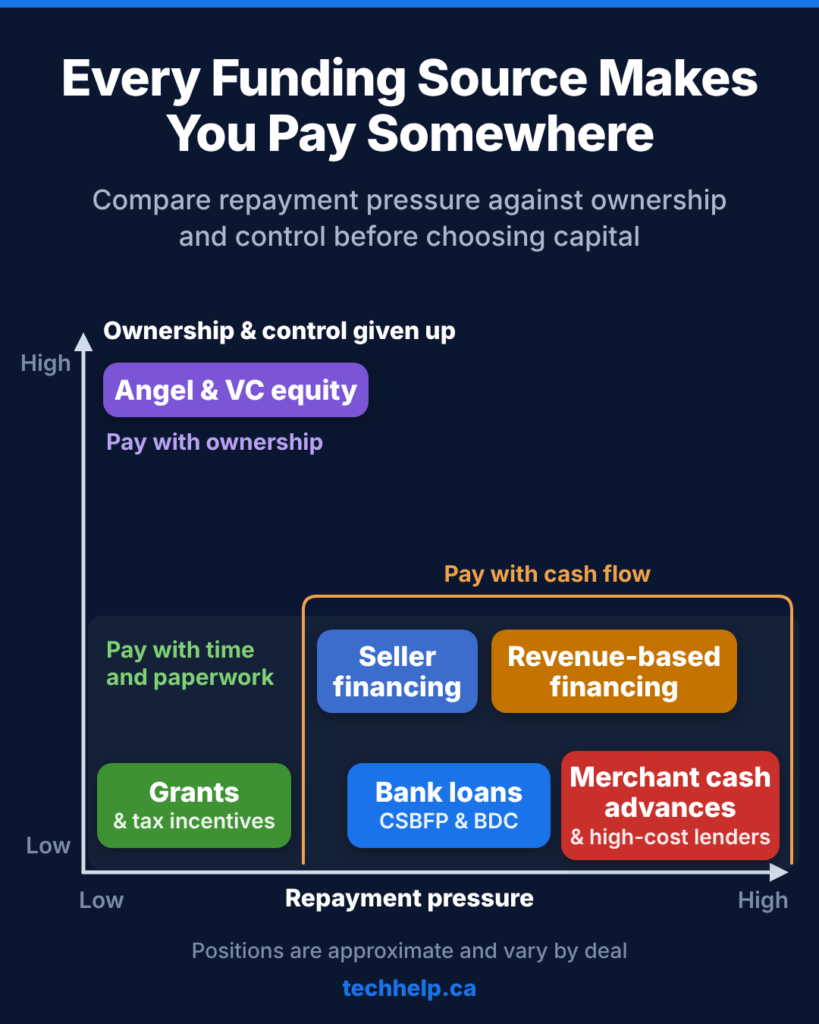
Debt is often the first practical option
Debt financing is common because it is straightforward. You borrow money, repay it over time, and keep ownership of the business. The trade-off is pressure on cash flow. Debt can be useful when the funded activity has a clear path to repayment, such as buying equipment that increases capacity or bridging a timing mismatch between invoices and collections.
Innovation, Science and Economic Development Canada reported that, among small businesses requesting debt financing in 2024, 49% intended to use it for working or operating capital and 21% for fixed assets. The same data showed an 89% debt-financing approval rate, while 66% of small businesses seeking debt financing had to pledge collateral.
A bank loan, credit union loan, caisse populaire loan, or line of credit may be the best starting point if the business already has revenue, records, and a clear purpose for the money. A line of credit can work for recurring cash-flow timing. A term loan is usually better for a defined purchase with a longer payback period.
The danger is using short-term debt to cover a long-term business model problem. If the business is losing money every month and nothing changes, a loan may only buy time while making the eventual problem larger.
CSBFP can help with lender-backed financing
The Canada Small Business Financing Program is not a direct government loan. Small businesses apply through a bank, credit union, caisse populaire, or another participating financial institution, and the lender makes the approval decision.
Most start-ups and existing for-profit, not-for-profit, and charitable small businesses in Canada with gross revenues of $10 million or less can apply under the program. Farming businesses are handled separately through an agriculture-focused loan program. The current maximum loan amount under CSBFP is $1.15 million, made up of a maximum $1 million for term loans and $150,000 for lines of credit.
Term loans can be used for eligible costs such as commercial real property, equipment, leasehold improvements, intangible assets, working capital, and the registration fee. A CSBFP line of credit can be used for working capital costs and the registration fee. The program cannot be used for everything, so the use of funds still has to match the rules.
BDC can be useful for growth projects
The Business Development Bank of Canada is another common financing path for Canadian entrepreneurs. BDC says its business loans range from $10,000 to several million dollars for larger growth projects, depending on needs and eligibility.
BDC can be a fit for expansion, commercial real estate, equipment purchases, technology upgrades, and cash-flow needs. Its own guidance says eligibility is based on factors such as financial health, credit profile, and growth potential. Loan requests under $100,000 may require fewer documents and generally move faster, but approval is still not guaranteed.
Treat BDC as a lender, not a grant source. The money must be repaid with interest, so the same cash-flow test applies.
Grants and contributions are useful, but they rarely fix urgent cash flow
Many owners search for grants first because grants feel safer than loans. That instinct makes sense, but it can waste time if the business needs cash quickly.
Government grants and contributions usually target specific outcomes such as hiring, training, exporting, innovation, productivity, regional growth, or research partnerships. They may reimburse eligible costs after spending, require matching funds, or limit what the money can cover. A program can be generous and still be the wrong fit if your project does not match its purpose.
The Government of Canada’s Business Benefits Finder is one of the better starting points because it pulls together more than 1,500 federal, provincial, and territorial supports and lets businesses narrow results by situation, location, and goal. Use it to build a shortlist, then read the actual program rules before you plan around the money.
If the funding is connected to technology, AI, or productivity upgrades, it may also be worth checking our coverage of Canadian AI funding programs so you can separate general business funding from project-specific support.
Innovation funding has stricter rules than many founders expect
Research and development funding is powerful when it fits, but it is not a catch-all for building a better product.
The CRA’s SR&ED tax incentives require eligible work to be conducted in Canada and to involve either the advancement of scientific knowledge or technological advancement. The work must also be carried out through systematic investigation or search by experiment or analysis. Routine development, market research, sales promotion, and normal quality control do not automatically qualify.
NRC IRAP is another key program for innovative, technology-driven products and services. NRC says IRAP funding supports research and development and other innovation activities, but it also states that working with an advisor or being invited to submit a proposal does not guarantee funding.
If innovation funding might apply, start documenting early. Keep records of technical problems, hypotheses, experiments, results, staff time, contractor work, materials, and decisions. Rebuilding that evidence months later is much harder.
Startup funding depends on your stage and age of business
New businesses face a difficult funding problem. They need money before they have much history, collateral, or predictable cash flow. That makes traditional debt harder to secure.
Futurpreneur can be a fit for entrepreneurs ages 18 to 39 who are starting, buying, or growing a business in Canada. In September 2024, Futurpreneur announced startup loan offerings of $75,000 in collateral-free financing with one-on-one mentorship, with eligibility expanded to entrepreneurs in their first 24 months of business. Program details vary by stream, so founders should check current requirements before assuming eligibility.
For an acquisition, seller financing may also be part of the structure. In that case, the seller finances a portion of the purchase price and the buyer repays over time. This can reduce the amount needed from a lender, but it still needs careful legal and accounting review.
Equity makes sense when the opportunity is too risky for debt
Equity financing means selling part of the business instead of taking on a repayment obligation. It can make sense when the company needs capital for high-growth plans, product development, market expansion, or a long path to profitability.
The upside is that equity does not usually require monthly repayment. The cost is ownership, control, and future upside. Investors may also expect reporting, governance rights, and a growth path that does not fit every owner’s goals.
If your business is steady, local, and cash-flow driven, equity may be more expensive than debt over time. If your business has a large market, fast growth potential, and a realistic path to scale, equity may be the funding that matches the risk. For broader context, see our look at global startup funding trends.
Alternative financing should be compared carefully
Invoice factoring, merchant cash advances, revenue-based financing, and other alternative options can move faster than traditional loans. Speed can be valuable when timing is the issue, but speed often comes with trade-offs.
Compare the total repayment amount, timing of deductions, personal guarantees, renewal terms, default triggers, and the effect on daily cash flow. A funding product that looks manageable on paper can become painful if repayment starts before the funded activity produces cash.
This is especially true for businesses with thin margins, seasonal sales, or slow receivables. Fast money can help if it solves a timing problem. It can hurt if it hides an operating problem.
Build a funding case before you apply
The strongest funding applications make the decision easy for the lender, program officer, or investor. They show what the money is for, why the timing makes sense, and how the business will be stronger afterward.
Prepare the basics before you start applying.
- A specific use of funds: Include quotes, budgets, project phases, or purchase details where possible.
- Recent financial statements: Lenders and funders want current numbers, not a stale snapshot from last year.
- A cash-flow forecast: Show how the business handles repayment, delays, slower sales, or higher costs.
- Tax and payroll status: Unresolved CRA issues can weaken a financing conversation quickly.
- Owner investment: Funders usually want to see that the owner has something at stake.
- A repayment or return story: Explain how the funding creates capacity, revenue, efficiency, or resilience.
If you are still working through the growth plan itself, our small and midsize enterprise guide can help you connect financing decisions to operations, people, systems, and scale.
Do not chase funding that pulls you off strategy
A grant can be a poor deal if it makes you reshape your project around someone else’s priorities. Equity can be expensive if you give away ownership to solve a short-term cash crunch.
Watch for these mistakes:
- Applying for every grant you find instead of targeting programs that fit your project.
- Borrowing for operating losses without a turnaround plan.
- Underestimating how long grant approvals, reimbursement, or loan underwriting can take.
- Asking for too little money, then running out before the project reaches payback.
- Ignoring taxes, owner draws, inventory cycles, and receivables timing in cash-flow forecasts.
- Using high-cost short-term financing for long-term assets or structural cash-flow problems.
A practical way to choose your funding path
Start with the cheapest source that fits the job, but do not judge cost by interest rate alone. Restrictions, speed, ownership dilution, required reporting, repayment timing, and management distraction all count.
A simple order of operations works for many small businesses. First, clarify the use of funds and cash-flow impact. Then speak with your existing bank or credit union about conventional lending and CSBFP availability. Next, check the Business Benefits Finder for grants, tax credits, wage subsidies, and contribution programs that match the project. If the project involves technology or innovation, review SR&ED, NRC IRAP, and regional development options. If the business is young, under-collateralized, or founder-led without a long track record, compare Futurpreneur, BDC, community lenders, and local economic development programs.
After that, consider whether equity or alternative financing fits the risk profile. If the money cannot be repaid from realistic cash flow and does not move the business toward a stronger position, pause before signing.

I can suggest related Tech Help Canada articles based on the topic you’re reading now.

Tech Help Canada Staff researches, writes, and reviews practical content for business owners and professionals. Our coverage spans business, marketing, SEO, technology, and the tools and systems people use to grow and operate online. We focus on clear, useful information backed by research, hands-on experience, and editorial review. Learn more about our team and editorial standards. Need help with something? Contact Us