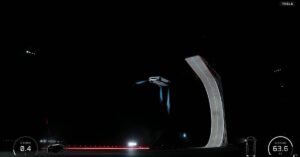
Tesla turned a prototype of its long-delayed Roadster into an airborne spectacle at a SpaceX test site in McGregor, Texas, on Oct. 15.
The Roadster event mixed electric-car reveal, rocket-site theatre and live stunt work. Reuters reported that the redesigned vehicle used a suction system to drive upside down on a ramp, then used built-in thrusters to turn in the air and land back on its wheels. A later sequence showed the car jumping over a truck and other Tesla vehicles while twisting midair.
AP reported that the demonstration combined cold-gas thrusters with a multi-mode suction system. The suction system helped the prototype cling to the inverted ramp, while the thrusters provided lift and controlled its movement in the air. Tesla CEO Elon Musk also said during the event that the demonstration was technically autonomous, with no human driver inside, for safety.
The event showed Tesla can make a Roadster-sized prototype leave the ground in a prepared setting. It did not show a production car operating as a normal street vehicle, nor did it answer how often, how far or under what conditions owners would be able to use the airborne functions.
The flying hardware is not standard Roadster equipment
Tesla’s Roadster page now promotes SpaceX-derived hardware alongside a multi-mode suction system and cold-gas thrusters. TechCrunch reported that Tesla is positioning the car in three configurations: Performance, Thrust and Rocket. The Rocket version is the one described as having a full flight system, and it is listed as invitation-only.
The road-oriented Roadster is not the same proposition as the single-seat Rocket version shown with the most dramatic airborne capability. Tesla’s own product materials also state that the Rocket version is not approved for public-road use.
Tesla and Musk have made aggressive performance claims around the Roadster, including sub-one-second zero-to-60 mph acceleration and speeds above 230 mph. Those remain manufacturer claims until independent testing of production vehicles is possible.
How the prototype got airborne
The Roadster’s airborne tricks appear to rely on two separate systems working together.
The first is suction. Tesla executives described a fan and ground-sealing system that pulls the car toward a surface, which is how the prototype was able to cling to the curved ramp while inverted. In ordinary track use, that kind of active downforce could matter more than the headline-grabbing flight, because extra grip affects acceleration, braking and cornering.
The second is cold-gas thrust. Car and Driver reported that the flight stunt used SpaceX-related cold-gas thruster technology and 250 kilograms of compressed air. TechCrunch reported that Tesla vehicle engineering chief Lars Moravy described 10 thrusters connected to 600 litres of compressed air, with carbon-fibre overwrapped pressure vessels packed into the vehicle.
Cold-gas thrusters use stored pressurized gas rather than rocket fuel. That makes the system very different from a rocket engine, but it still raises practical questions around storage, recharge time, heat, noise, debris, maintenance and safety around nearby people or vehicles.
The legal path is still unsettled
The public-road question may be harder than the stunt. CBS News reported that it asked U.S. Department of Transportation officials who would oversee a vehicle that can fly or hover, and the answer was not readily clear.
According to CBS News, the National Highway Traffic Safety Administration said the manufacturer must make sure the vehicle complies with applicable Federal Motor Vehicle Safety Standards and that drivers must obey local traffic laws. The FAA told CBS News that the Tesla vehicle does not meet the FAA definition of an aircraft.
Tesla’s reservation fine print keeps expectations grounded
Tesla has reopened Roadster reservations, but the reservation agreement is careful about what a deposit does and does not buy. The agreement says a reservation secures approximate priority for configuring and ordering a Roadster once available. It also says the reservation does not constitute a purchase or order.
The same agreement says Tesla cannot yet confirm the exact purchase price because options, features and hardware are still being worked out. Musk said production would begin in 2028, but the agreement says the Roadster is still under development and that Tesla cannot guarantee when the vehicle will be delivered or whether it will be delivered.
Why the demo still matters
The Roadster may not be a mass-market Tesla. It may not even be a major revenue driver. But it is a clear statement about how Tesla wants to frame its next era: not just as an EV maker, but as a company willing to fuse vehicle engineering, robotics-style control systems and SpaceX hardware into products that look closer to stunts than conventional cars.
For now, the Roadster has left the ground. The harder test is getting a finished version through production, safety validation, approval and customer delivery without the spectacle carrying more weight than the car itself.
Get new small business insights by email
Practical ideas and useful articles to help you make better business decisions.
Tech Help Canada Staff researches, writes, and reviews practical content for business owners and professionals. Our coverage spans business, marketing, SEO, technology, and the tools and systems people use to grow and operate online. We focus on clear, useful information backed by research, hands-on experience, and editorial review. Learn more about our team and editorial standards. Need help with something? Contact Us