

AI search benchmark report
The AI search benchmark report: how small businesses get found in the age of AI
AI-driven search is changing how customers find, compare, and choose small businesses across Google, ChatGPT, Perplexity, Bing, Amazon, Apple, and other discovery surfaces.
Key signals
Users clicked traditional results less often when AI summaries appeared.
BrightEdge found only a slice of citations came from top-10 organic results.
A 2026 study found some AI Overview claims were not supported by cited sources.
Similarweb estimated rapid year-over-year growth in AI platform referrals.
Explore the report
Jump into the executive summary, platform breakdown, data chapter, business-type risk analysis, action plan, measurement framework, methodology, and references.
- About this report
- Executive summary
- Chapter 1: the search revolution that’s already here
- Chapter 2: the platforms reshaping how customers find you
- Chapter 3: what the data actually shows
- Chapter 4: how your business type shapes your risk
- Chapter 5: five moves to make before your competitors do
- Chapter 6: measuring what actually matters
- Chapter 7: where AI search is headed
- Appendix A: methodology and benchmark framework
- Appendix B: limitations and reading notes
- Appendix C: evidence base
- Appendix D: glossary
- Related
- References
Contents
About this report
If you run a small business, the way customers find you is changing at the layer between the question and the click. AI-driven search is no longer a side experiment for early adopters. It now shapes answers inside Google, ChatGPT, Perplexity, Bing, Amazon, Apple, and other discovery surfaces that customers already use.
This report exists because small business owners deserve clear, evidence-based answers about what’s actually happening – not hype, not panic, and not a technical whitepaper written only for search specialists.
We built this as a reference you can come back to. Whether you’re a local service provider in Calgary, a DTC brand shipping across North America, or a B2B firm selling software to mid-market companies, you’ll find something here that applies directly to your business.
This is the inaugural edition of what will become an annual series. Future editions will include proprietary benchmark data from controlled testing across major AI search platforms. This edition draws on academic research, industry studies, and official platform documentation to give you the clearest practical picture of where things stand right now.
How to use this report:
If you’re short on time, start with the Executive Summary and Chapter 5 (your action plan). If you want the full picture, read straight through. If you’re data-minded, Chapter 3 has the numbers. If you want to understand how your specific business type is affected, jump to Chapter 4.
Scope note:
This report uses “AI search” to describe user-facing systems that retrieve, synthesize, summarize, recommend, or cite information in response to a search-like query. That includes Google AI Overviews and AI Mode, ChatGPT Search, Perplexity, Bing/Copilot search experiences, marketplace shopping assistants, and local discovery surfaces where AI changes how businesses are selected or described.
It does not treat every chatbot interaction as search. A private AI assistant drafting an email is outside this report. A customer asking an AI tool which accountant, software product, restaurant, agency, or supplier to choose is inside it.
Evidence note:
AI search data changes quickly, and different studies use different query sets, markets, devices, and collection windows. When numbers conflict, this report favors transparent methodology over the biggest headline. The point is not to pretend the field has already settled. The point is to give operators a reliable decision framework while the field is still moving.
Executive summary
AI search has moved from novelty to infrastructure. Google’s I/O 2026 opening keynote put AI Overviews at more than 2.5 billion monthly active users and AI Mode at more than one billion monthly active users. ChatGPT Search is available without an account in supported regions. Microsoft retired its legacy Bing Search APIs in favor of Grounding with Bing Search for Azure AI Agents. Amazon renamed Rufus to Alexa for Shopping and moved conversational shopping deeper into Amazon.com and the Amazon app. Apple is turning business listings, Maps, visual intelligence, and Maps ads into a more important local discovery stack.
This isn’t a trend you can wait out. It’s how your customers are already searching.
The evidence points to five findings:
1. AI search is compressing clicks. When Google shows an AI-generated answer, users click on a traditional result only 8% of the time – nearly half the 15% rate when no AI summary appears (Pew Research Center). Ahrefs found that AI Overviews correlate with a 58% lower click-through rate for the top-ranking page.
2. Traditional rankings no longer guarantee AI visibility. BrightEdge found that AI Overview citations increasingly overlap with pages that rank somewhere organically, but only 16.7% of citations came from top-10 results in its September 2025 snapshot. Ranking still matters, but the citation layer is not a simple copy of page one.
3. AI citations aren’t always trustworthy. A 2026 large-scale study found that 11% of factual claims in AI Overviews weren’t supported by the sources they cited. A separate audit found that roughly 16% of cited sources across major AI search engines may themselves be AI-generated. The presence of a citation doesn’t guarantee accuracy.
4. AI referral traffic is growing fast – but from a tiny base. BrightEdge reports that AI search referrals still account for less than 1% of referral traffic in its sample. Similarweb estimated that AI platforms generated more than 1.13 billion referrals to the top 1,000 websites globally in June 2025, up 357% year over year. The trajectory is steep even if the absolute share remains modest.
5. The measurement problem is real. Search Console and analytics tools capture parts of AI search behavior, but they do not give small businesses a dedicated, universal “AI visibility” report. Operators need a simple monitoring routine that combines traditional analytics, citation checks, referral tracking, and manual prompt tests.
The single biggest takeaway: classic SEO still matters, but it is no longer enough on its own. Your web presence needs to be crawlable, citable, trustworthy, and consistent across every platform where customers might encounter your business. The businesses that get this right early will have a real advantage.
Chapter 1: the search revolution that’s already here
Your customers haven’t stopped searching. They’ve stopped scrolling. AI now answers their questions before they ever see your website – and increasingly, before they even see a list of links.
What AI search actually is
Simple definition: AI search is when a system searches the web on your behalf, reads the results, and writes you a synthesized answer with links to its sources. Instead of giving you ten blue links and asking you to figure it out, it gives you an answer and tells you where it got the information.
That’s a fundamental shift. For decades, search engines were librarians – they pointed you to the shelf. Now they’re more like research assistants – they read the books and give you a summary. In practice, AI search shows up in four overlapping ways.
The first is standalone AI search tools – platforms like ChatGPT Search and Perplexity that search the web in real time, synthesize an answer, and show you exactly which sources they pulled from.
The second is AI answers embedded inside traditional search. Google’s AI Overviews and AI Mode are the biggest examples. You search on Google the way you always have, but now an AI-generated answer may appear before the traditional results. Broad query-coverage estimates vary sharply by study: Pew found AI summaries on 18% of tracked Google searches in March 2025, Semrush found AI Overviews on 15.69% of monitored queries in November 2025, and a 2026 academic study found 13.7% activation across trending queries, rising to 64.7% for question-form searches. The exact percentage matters less than the pattern: AI answers concentrate on the kinds of questions small businesses often answer with educational content.
The third is blended search, where AI-generated answers coexist with ads, maps, shopping modules, reviews, and business listings on the same page. This is where things get complicated for businesses, because your visibility now depends on multiple elements working together – not just your organic ranking.
The fourth is multimodal search – searching with images, voice, your camera, or a mix of inputs. Google’s Lens lets you search by pointing your phone at something. Apple’s visual intelligence can summarize what you’re looking at and search across your apps. This type of search is still emerging, but it’s growing quickly and it changes what “being findable” means.
How fast this moved
The speed of adoption is hard to overstate.
In 2023, Google previewed its generative search experiment in Search Labs, and Microsoft normalized AI-generated answers inside Bing. It felt experimental. Most businesses could safely ignore it.
By 2024, the experimentation phase was over. Google launched AI Overviews broadly across the United States. Amazon launched Rufus, its AI shopping assistant. Apple announced Apple Intelligence. OpenAI launched ChatGPT Search.
In 2025, things accelerated. Google introduced AI Mode – a deeper, more conversational search experience that lives alongside traditional search. ChatGPT Search became available to everyone in supported regions, with no account required. Anthropic added web search to Claude. Microsoft retired its legacy Bing Search APIs and pushed developers toward AI-grounded alternatives.
And in 2026, the scale became undeniable. Google’s I/O 2026 opening keynote put AI Overviews above 2.5 billion monthly active users and AI Mode above one billion monthly active users. Amazon renamed Rufus to Alexa for Shopping. Research published this year shows that AI search exposure expanded from 7 countries in 2024 to 229 countries in 2025. DuckDuckGo also reported renewed demand for AI-optional search experiences after Google’s AI-heavy Search announcements, a reminder that not every customer wants the same level of AI mediation.
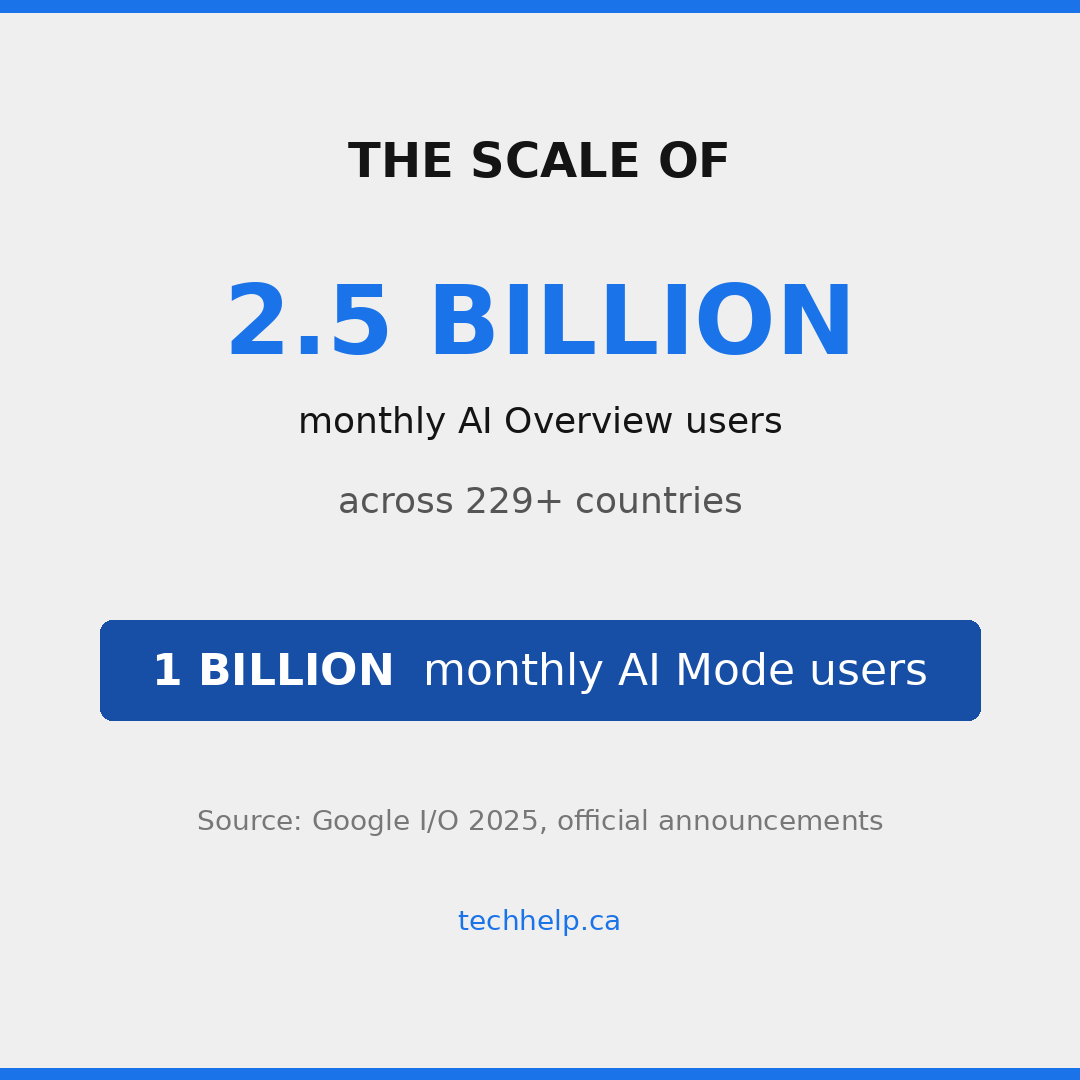
This timeline points to one practical reality: most businesses are no longer early to this shift. If you have not thought about how AI search affects your business, you are already catching up.
Business impact
The core shift is simple. For twenty years, the game was about ranking. Get your website to the top of Google, and customers would find you. That model still matters, but it is no longer the whole story.
Now, the game is increasingly about being cited. When a customer asks ChatGPT “What’s the best accounting software for a small Canadian business?” or asks Google “Who does managed IT in Vancouver?”, the AI doesn’t just show a list of links. It writes an answer. It names specific companies. It cites specific sources.
If your business isn’t in that answer, it effectively doesn’t exist for that customer in that moment.
The rest of this report will show you exactly what the data says about this shift, how it affects different types of businesses, and what you can do about it.
Chapter 2: the platforms reshaping how customers find you
You keep hearing about AI search, but nobody tells you which platforms actually matter for your business. The answer depends on what you sell, who you sell it to, and how your customers search. Some platforms affect nearly everyone. Others are critical for certain business types and irrelevant for others.
Here is the platform map as of 2026.
Google Search: AI Overviews and AI Mode
Google is still the center of gravity for online discovery, and it now has two major AI search surfaces.
AI Overviews are the AI-generated summaries that appear at the top of regular Google search results. They’ve been broadly available since 2024, Google expanded them to more than 200 countries and territories in 2025, and Google’s I/O 2026 opening keynote put usage above 2.5 billion monthly active users. When an AI Overview appears, it typically pushes traditional results further down the page – and as we’ll see in Chapter 3, that changes click behavior.
AI Mode is a separate, more conversational search experience that Google introduced in 2025. Think of it as Google’s answer to ChatGPT: you can ask complex, multi-part questions and get detailed, synthesized responses with links. Google says it has already crossed one billion monthly users. One notable design choice: when Google’s confidence in an AI response is not high enough, AI Mode may return traditional web links instead, which is a useful trust signal.
Google also continues to invest in multimodal search through Lens, where users can search using images, their camera, and combinations of text and visual input.
For virtually every small business, Google is the highest-priority platform to understand and optimize for.
ChatGPT Search
OpenAI’s ChatGPT Search gives users timely, web-grounded answers with inline citations and a sources panel. Since February 2025, it’s been available to anyone without requiring an account, which means its reach has expanded well beyond the early-adopter crowd.
Two things matter for businesses. First, ChatGPT Search can show inline citations that link directly to your pages – making the quality and crawlability of your content directly relevant. Second, ChatGPT’s Memory feature can influence how it rewrites and personalizes searches, which means the same question asked by two different users may surface different results.
ChatGPT Search is especially important for B2B discovery and research-heavy purchase decisions. When executives, analysts, and consultants are evaluating vendors or researching solutions, ChatGPT is increasingly part of that workflow.
Microsoft Bing and Copilot
Microsoft has been aggressive about integrating AI into its search ecosystem. Bing grounding provides real-time web data with citations, freshness filters, and specific market and language parameters. Microsoft’s Copilot products – used across the enterprise suite – lean on Bing for web-grounded answers.
A telling signal: in 2025, Microsoft retired its legacy Bing Search APIs and pushed developers toward AI-based alternatives. That’s a clear institutional bet that AI-grounded search is the future, not a feature bolted onto the old model.
For businesses with enterprise customers or significant Microsoft ecosystem exposure, Bing/Copilot visibility matters more than the general market share numbers might suggest.
Perplexity
Perplexity has positioned itself as a search-native AI answer engine, meaning it was designed from the ground up to search the web in real time and return cited answers rather than retrofitting AI onto an existing search product.
Its key differentiator is citation transparency. Perplexity emphasizes real-time ranked web results, and its interface makes sources visually prominent. Its API also exposes structured controls such as domain filtering, search filters, and user-location context, which gives agencies and power users more precision than most competitors.
Perplexity runs separate crawlers for indexing and user-initiated requests – a distinction that matters for businesses managing their crawl permissions and content access policies.
While Perplexity’s overall user base is smaller than Google’s or ChatGPT’s, it has strong mindshare among AI-forward professionals and tech-savvy decision-makers. If your customers are in that category, Perplexity deserves attention.
Apple: the local discovery powerhouse
Apple’s AI search play is less about competing with Google on general web search and more about owning the local discovery and device-integrated experience.
Apple Intelligence – launched in 2024 – combines on-device AI with visual intelligence features that can summarize what you’re looking at and search across apps. Apple Business lets companies claim their locations on Apple Maps, control hours, images, key details, and gain insights about customer discovery.
For local businesses, this is one of the highest-risk AI-search shifts. Apple Maps is the default mapping and navigation experience for many iPhone users. If your business listing on Apple Maps is inaccurate – wrong hours, wrong address, or worse – the consequences can be immediate. In 2024, a restaurant owner publicly reported a significant sales hit after Apple Maps incorrectly marked the business as permanently closed. That is a warning about what happens when entity data breaks down on a platform your customers rely on.
Apple has also brought Maps advertising to the United States and Canada, adding a paid discovery layer for local businesses.
Amazon: the shopping search revolution
If you sell products on Amazon, the AI search shift is happening inside your marketplace too. Amazon launched its Rufus AI shopping assistant in 2024 and renamed it Alexa for Shopping in May 2026, moving the assistant more directly into Amazon.com and the Amazon app.
This isn’t general web search – it’s conversational shopping. Customers can now ask natural-language questions about products, compare options, and take purchase actions through an AI interface. For sellers and brands on Amazon, this represents a new discovery layer that operates differently from traditional keyword-based Amazon search.
This is a high-priority surface for ecommerce businesses selling on Amazon, but it’s not a substitute for general web search benchmarking.
DuckDuckGo: the privacy alternative
DuckDuckGo offers Duck.ai as an optional AI search interface, but its most interesting role in 2026 is as a counterpoint. After Google’s AI-heavy announcements at I/O 2026, DuckDuckGo saw renewed interest from users actively seeking search experiences without AI summaries.
This signals something businesses should pay attention to: not every customer wants an AI-mediated experience. There’s a growing segment that prefers traditional search, and DuckDuckGo is capturing some of that demand. For benchmarking purposes, it’s a useful comparison surface – not a primary optimization target.
Open-source search stacks
For businesses that want to build their own AI-driven search – on their website, in their help center, across internal documents, or inside a product catalog – open-source tools like Elastic, OpenSearch, Vespa, and Haystack provide the building blocks.
These aren’t platforms your customers search on directly. They’re tools for building search experiences you control. Elastic and OpenSearch support semantic and hybrid search workflows. Vespa handles vector search and retrieval-augmented generation. Haystack provides modular retrieval pipelines across multiple backends.
This matters most for agencies building client solutions, mid-market businesses with complex product catalogs, or any company that wants to run AI search on its own terms rather than depending entirely on public platforms.
Quick reference: which platforms matter most for your business
Swipe sideways to see the full table on smaller screens.
| Business Type | Highest Priority | High Priority | Worth Watching |
|---|---|---|---|
| Local services | Google, Apple | Bing/Copilot | Perplexity, DuckDuckGo |
| Ecommerce / retail | Google, Amazon | ChatGPT, Bing | Perplexity |
| B2B | Google, ChatGPT, Perplexity | Bing/Copilot | Apple (if you have offices) |
| Multi-location | Google, Apple, Bing | ChatGPT, Amazon (if applicable) | All others |
Chapter 4 breaks down how each business type is specifically affected, with the risks and opportunities unique to your model.
Chapter 3: what the data actually shows
Set aside the speculation and look at the numbers. The strongest available research paints a clear picture, and it is more nuanced than headlines that declare SEO over.
A note on geography: most large-scale AI search studies to date have been U.S.-centric or global in scope. Canadian-specific data remains limited, which is one reason future editions of this report will include benchmark data run from Canadian IPs. The behavioral patterns described below are directionally applicable to the Canadian market, but the specifics – particularly around local discovery and regional source preferences – will vary.
The click compression effect
The most immediate impact of AI search is on click behavior. When an AI answers the question directly, fewer people click through to websites. The evidence here is strong and comes from multiple independent sources.
Ahrefs ran a large-scale analysis of 300,000 keywords – 150,000 that triggered AI Overviews and 150,000 that didn’t – comparing December 2023 (before the broad AI Overview rollout) against December 2025. The finding: AI Overviews correlate with a 58% lower average click-through rate for the top-ranking page. That’s up from a 34.5% reduction measured in April 2025, which means the effect has intensified as users have gotten more comfortable with AI-generated answers.
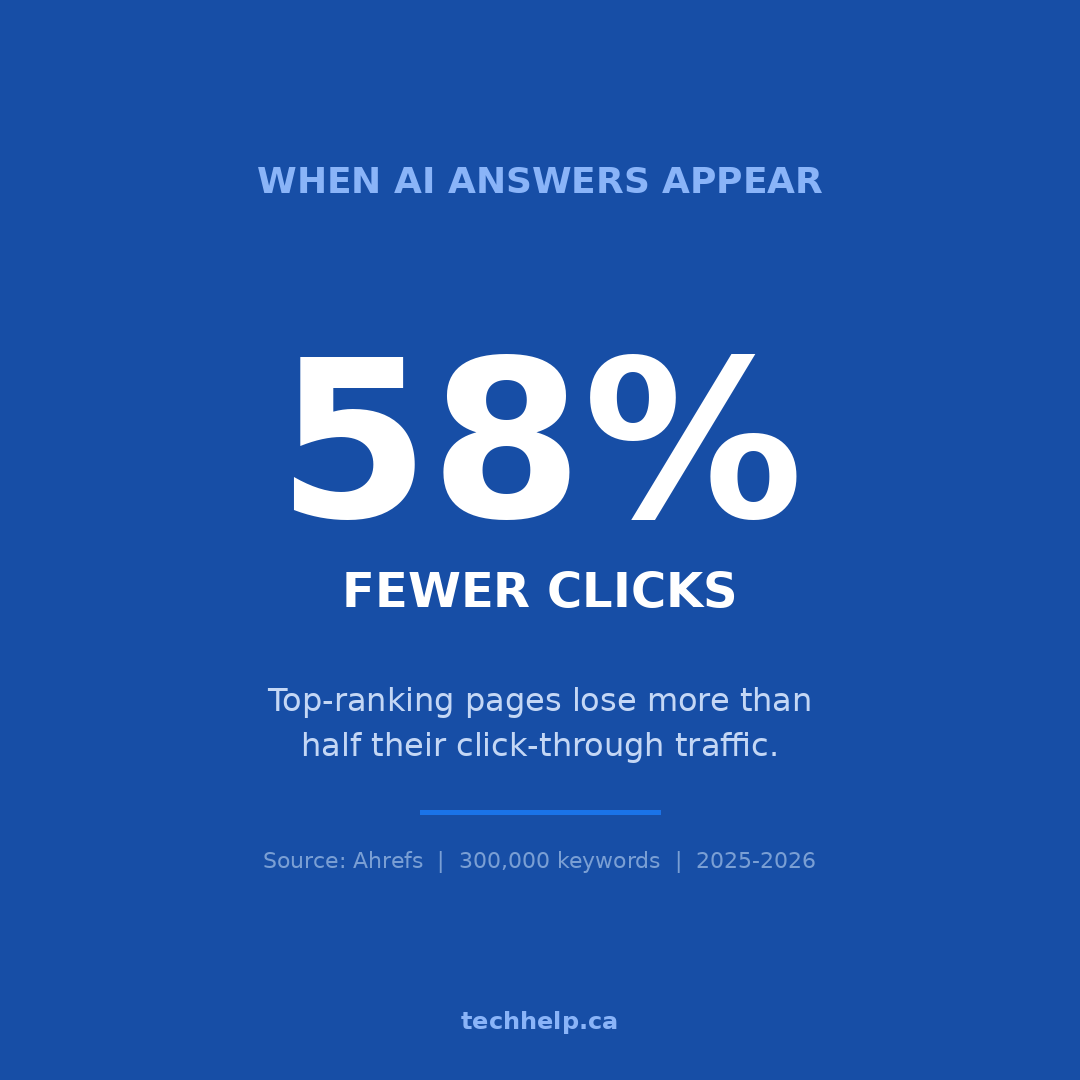
There is a stabilization signal worth noting. By February 2026, organic click-through rates for AI Overview queries had climbed from 1.3% to 2.4% – not a recovery, but a flattening. The initial shock may be wearing off slightly, even if the overall trend is clear.
Pew Research Center provided independent behavioral confirmation. In a study of 900 U.S. adults’ actual browsing data, users clicked on a traditional search result in just 8% of visits when an AI summary appeared – compared to 15% when no summary was present. Clicks on the links within AI summaries themselves were even rarer, at just 1% of all visits.
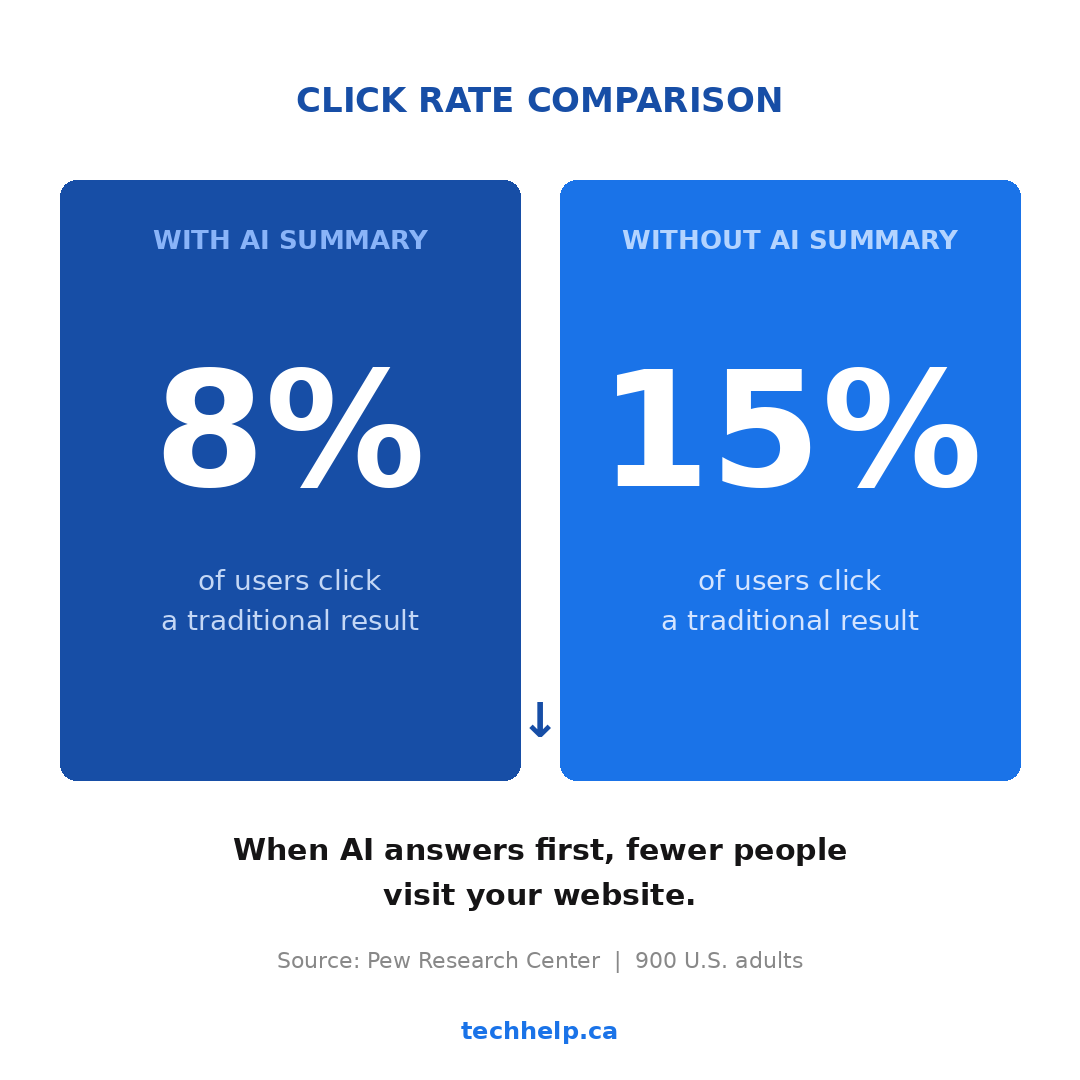
Perhaps the most striking finding from Pew: users were more likely to abandon their search session entirely after seeing an AI summary (26% of visits) compared to searches without one (16%). In other words, many users are getting what they need from the AI answer and leaving – without visiting any website at all.
Pew also found that the type of query matters enormously. Question-based searches – queries starting with “who,” “what,” “why,” or “how” – triggered AI summaries 60% of the time. Single-word or two-word searches triggered them only 8% of the time. If your business depends on customers asking questions that AI can answer directly, you’re more exposed.
AI referrals: growing fast, still small
While AI search is changing attention patterns, direct referral traffic from AI platforms remains modest in absolute terms.
BrightEdge reported that AI search referrals were growing rapidly through 2025 but still represented less than 1% of total referral traffic in its sample. That’s a useful reality check for anyone who thinks AI search has already replaced traditional organic traffic.
But the growth rate tells a different story. Similarweb estimated that AI platforms generated over 1.1 billion referral visits in a single month, up 357% year over year. That’s a small share of total web traffic, but the trajectory is steep. Dismissing AI referrals because they’re currently small would be like dismissing mobile traffic in 2010 because it was a small share of total web visits.
The practical read: AI referrals probably aren’t a major traffic source for most small businesses yet. But the trend line suggests they will be, and the businesses that are already visible in AI answers will have a head start.
The citation-organic overlap collapse
This is where the data gets especially important for business owners who’ve invested in traditional SEO.
The conventional assumption was that if you rank well in Google’s organic results, you’ll also show up in AI-generated answers. That assumption is too simple.
BrightEdge’s 16-month overlap study found that AI Overview citations increasingly come from pages that rank somewhere organically: overlap grew from 32.3% in May 2024 to 54.5% in September 2025. That means classic SEO still feeds the AI layer.
But the same study found that only 16.7% of citations came from top-10 organic results. Most overlap growth came from pages ranking in positions 21 through 100, not from the first page. In other words, Google may use its organic index as a source pool while still selecting citations differently from the traditional ranking order.
The practical takeaway is direct. Your SEO rankings and your AI visibility overlap, but they are not the same thing. Being number one on Google is still valuable for the clicks it generates, but it is not a guarantee that you’ll appear in the AI answer. AI systems are selecting content based on different signals: relevance to the specific question, clarity of information, freshness, source trust, and structural factors that make content easy to extract and cite.
Source quality and the trust problem
AI citations look authoritative. They appear with links, source names, and the visual formatting of careful research. But the evidence shows that this appearance of trustworthiness isn’t always earned.
A 2026 large-scale study of Google AI Overviews analyzed 55,393 trending queries and found that 13.7% triggered an AI Overview, rising to 64.7% for question-form queries. Among the AI-generated responses, 11% of specific factual claims were not supported by the sources they cited. Nearly 30% of cited domains didn’t even appear in the co-displayed first-page results.
An earlier verifiability audit of generative search engines found that only 51.5% of generated sentences were fully supported by their citations, and 74.5% of citations supported the sentences they were attached to. That gap means a significant share of what AI search presents as “sourced” information isn’t fully backed by the sources it links to.
A 2026 audit added another layer of concern. Roughly 16% of cited sources across major AI search engines were found to be AI-generated themselves. In other words, AI systems are sometimes citing other AI-generated content as evidence – a loop that can amplify errors and create a false sense of sourced authority.
A cross-country study across 243 countries found that AI search tends to surface fewer long-tail information sources and lower response variety than traditional search. This can disadvantage smaller publishers and niche businesses that historically relied on discovery through specialized content.
For businesses in trust-sensitive categories – health, finance, legal services, security, education – these findings aren’t academic. If an AI answer inaccurately describes your services, cites a competitor’s page when discussing your brand, or presents unsupported claims about your industry, the business impact is real.
What this all means in plain business terms
AI search is already reshaping how attention flows online, even where direct referral traffic from AI platforms is still modest. The click compression effect means fewer people are clicking through to websites when AI answers appear – and that effect is getting stronger, not weaker.
Traditional search rankings are becoming less predictive of who gets visibility in AI-generated answers. The old assumption that ranking high means getting cited is no longer reliable.
Citation quality is a live issue. AI systems present answers with the appearance of careful sourcing, but a meaningful share of those citations don’t fully support the claims they’re attached to. Businesses need to monitor not just whether they’re cited, but how accurately they’re represented.
The businesses that win in this environment are the ones that are visible across multiple AI surfaces – not just Google – and whose content is structured to be easy for AI systems to find, read, trust, and cite accurately.
Chapter 4: how your business type shapes your risk
A plumber in Toronto, a DTC skincare brand, and a B2B cybersecurity firm all face AI search disruption – but the risks hit differently depending on how your customers find you and what they’re looking for when they do.
Local service businesses
If you run a local business – a dental practice, a plumbing company, a restaurant, a law firm, an accounting office – your exposure to AI search is primarily through maps, local business listings, review ecosystems, and answer-style queries like “best dentist near me” or “emergency plumber in Ottawa.”
AI is changing this in two ways. First, comparison and recommendation queries that used to generate a list of ten links now often get a direct AI-generated answer. The AI names specific businesses, describes what they offer, and sometimes makes explicit recommendations. If you’re not in that answer, a potential customer may never see you.
Second, the accuracy of your business data across platforms has become operationally critical. It’s no longer just about Google Business Profile. Apple Maps, Bing Places, and other platforms all feed into AI answers. When that data is wrong – incorrect hours, a missing phone number, an outdated address – the consequences can be immediate. The Apple Maps restaurant incident we covered in Chapter 2 is an extreme example, but the underlying risk applies to any local business that depends on accurate discovery across multiple surfaces.
Your priority platforms are Google (AI Overviews and AI Mode), Apple (Maps and Business), and Bing/Copilot.
Ecommerce and retail
If you sell products online, AI search disruption looks different. Your exposure comes through AI shopping assistants, product comparison answers, and marketplace-native AI search.
Amazon’s shift from Rufus to an integrated Alexa for Shopping experience means that product discovery on the world’s largest marketplace is becoming conversational. Customers can ask natural-language questions about products, compare options, and take purchase actions through an AI interface – which changes what it takes to be surfaced. Product detail quality, review depth, and competitive positioning all feed into AI-generated shopping recommendations.
Outside Amazon, AI search engines like Google and ChatGPT increasingly answer product comparison queries directly. “Best wireless earbuds under $100” or “most reliable dishwasher brands in Canada” are the kinds of queries where AI answers are replacing the click-through-and-browse behavior that used to drive organic traffic.
Your priority platforms are Google (AI Overviews and AI Mode), Amazon (Alexa for Shopping), ChatGPT Search, and Bing.
B2B companies
If you sell services or software to other businesses, your AI search exposure comes primarily through educational queries, vendor comparison prompts, and synthesis-style answers.
When a CFO asks ChatGPT “What’s the best cloud accounting software for a 50-person Canadian company?” or a CTO asks Perplexity “How do I evaluate managed IT providers in Ontario?”, the AI reads guides, reviews, documentation, pricing pages, and case studies – then writes a recommendation. If your content isn’t part of what it reads, you won’t be part of what it recommends.
This makes thought leadership and educational content a direct discovery asset, not just a brand-building exercise. The depth, clarity, and freshness of your published content directly influence whether AI systems include you in the answers that matter.
Your priority platforms are Google (AI Overviews and AI Mode), ChatGPT Search, Perplexity, and Bing/Copilot.
The common thread
The details differ by business model, but the direction is the same: every type of business now needs to be visible across multiple AI surfaces, not just one. Chapter 5 lays out the specific moves you can make – regardless of your size or budget.
Chapter 5: five moves to make before your competitors do
You don’t need a six-figure SEO budget to respond to AI search. These five priorities work for businesses of any size, and the sooner you act on them, the further ahead you’ll be.
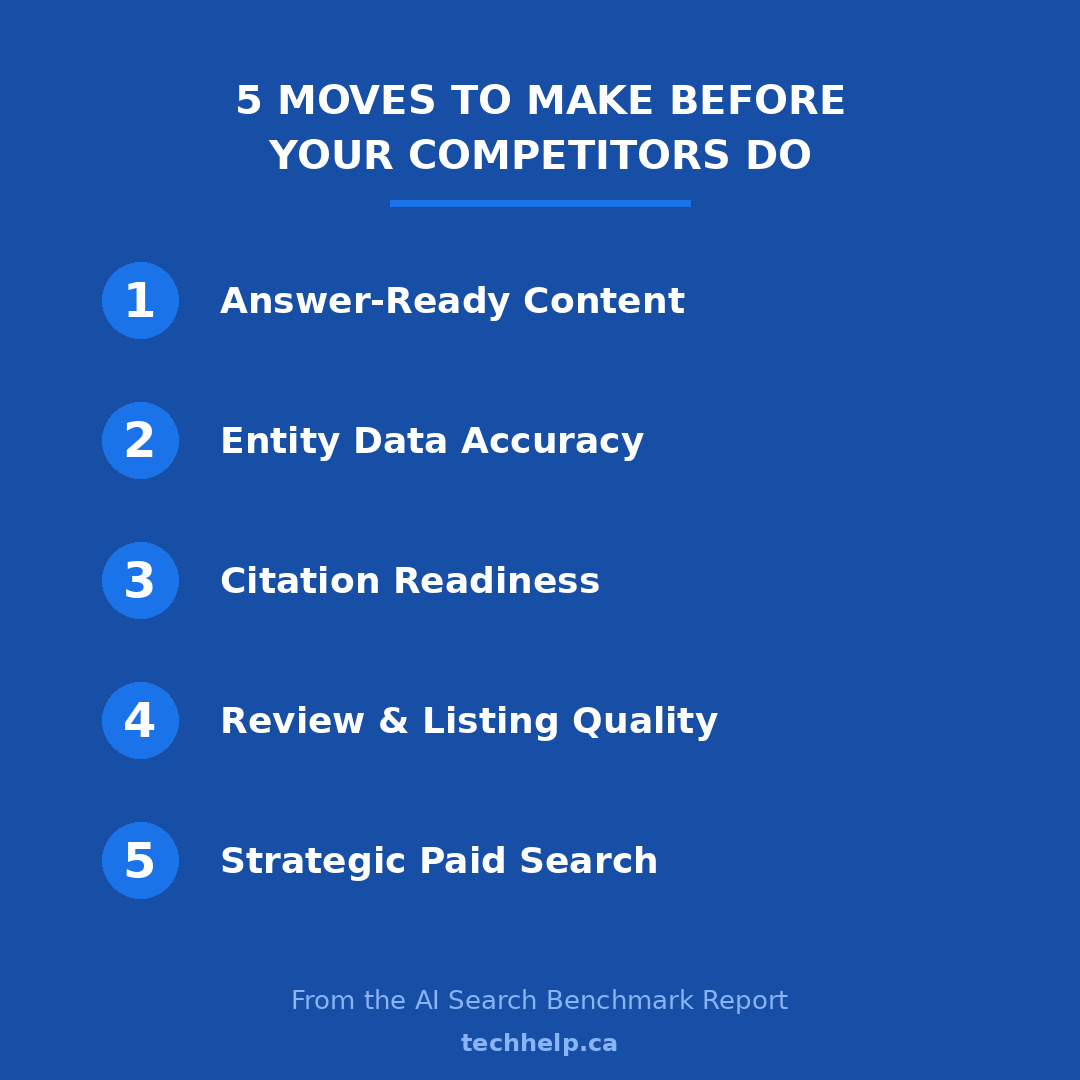
1. Make your content answer-ready
AI search systems are built to answer questions. They consume pages that clearly answer questions, define terms, compare options, and lay out tradeoffs in direct, accessible language. Google explicitly describes its AI search features as handling complex, conversational, multi-part queries. ChatGPT Search emphasizes natural conversational prompts.
That means your most important pages should be written the way your customers actually talk when they’re looking for what you offer. If you’re an IT company, don’t just have a “Services” page with bullet points. Have content that directly answers “What does a managed IT company actually do?” or “How much does outsourced IT support cost for a 30-person company?”
Structure your content with clear headers, direct answers near the top of each section, and enough detail that an AI system can extract a useful, accurate summary. Include comparison-friendly information – feature breakdowns, pricing tiers, service area details – because AI answers frequently involve comparisons.
What to fix first: update your most important service, product, pricing, and comparison pages before rewriting low-traffic blog posts. AI search systems need clear facts about what you sell, who it is for, where you operate, and why your business is credible.
The businesses that do this well are essentially making it easy for AI to recommend them. The ones that don’t are leaving that recommendation to chance.
2. Get your entity data right
Entity data is the factual backbone of your business identity online: your name, address, phone number, hours, service areas, categories, and key attributes. It needs to be accurate and consistent everywhere a customer might encounter it.
This goes beyond Google Business Profile. You need to claim and maintain your Apple Business listing, your Bing Places profile, and any industry-specific directories that feed into AI answer systems. Keep hours updated. Make sure your address is formatted consistently. Confirm that your phone number works and routes correctly.
This isn’t optional anymore. Inaccurate entity data doesn’t just hurt your listing – it can make you ineligible to appear in AI-generated answers. AI systems that don’t trust the accuracy of your basic information won’t recommend you.
What to fix first: audit your name, address, phone number, categories, hours, service areas, appointment links, photos, and review profiles across Google, Apple, Bing, Yelp, Facebook, industry directories, and any marketplaces where customers discover you.
3. Build citation readiness
Citation readiness means making your web pages technically easy for AI systems to crawl, read, and cite accurately.
Start with the basics: your site should be crawlable (avoid hiding critical content behind JavaScript rendering that search bots can’t execute), have descriptive page titles and meta descriptions, and include complete product or service detail on relevant pages.
Beyond that, focus on structural clarity. Use clear headers and subheaders. Include FAQ sections where appropriate. Make your key claims explicit rather than buried in marketing language. Add authorship information and update timestamps where relevant – freshness signals influence whether AI systems consider your content current enough to cite.
BrightEdge’s research suggests that strong classic SEO practices still pay dividends in the AI era, while citation-audit research indicates that structural clarity, metadata quality, and freshness signals often correlate with citation likelihood. In other words, the fundamentals still matter – they just need to be executed with AI readability in mind, not just human readability.
What to fix first: make sure your site allows the crawlers that matter for your business goals. Blocking every AI crawler may protect content from some forms of reuse, but it can also reduce your chance of appearing in AI search products that use those crawlers for retrieval or indexing. Treat crawler policy as a business decision, not a default checkbox.
Use a crawler policy review rather than a blanket rule.
| Crawler or Control | What to Review |
|---|---|
| Googlebot / Google Search controls | Whether important pages are crawlable and eligible for Google Search features, including AI features shown inside Search |
| Google-Extended | Whether you want to control use of site content in some Google AI training and product contexts while preserving normal Search crawling |
| OAI-SearchBot | Whether ChatGPT Search can access pages that you want surfaced in ChatGPT search results |
| GPTBot | Whether OpenAI can use your content for model training, which is a different decision from search visibility |
| PerplexityBot | Whether Perplexity can index content for its answer engine |
| ClaudeBot / Claude-SearchBot / Claude-User | Whether Anthropic systems can train on, index, or retrieve your content depending on the crawler and use case |
Do not copy an AI-crawler blocklist from another site without understanding the tradeoff. A publisher, a SaaS company, a local plumber, and an ecommerce store may make different decisions.
4. Maintain review and listing quality
Your reviews, ratings, and photos aren’t just “map pack hygiene” anymore. They’re inputs that AI systems use to form judgments about your relevance and credibility.
Active review management across Google, Apple, Bing, and industry-specific platforms matters more than ever. So does operational accuracy – correct hours, current menus or service offerings, up-to-date photos, and accurate inventory where applicable.
This is especially true in the United States and Canada, where a single customer’s decision journey might cross Google Search, Apple Maps, a ChatGPT query, and an Amazon search in the same session. Each of those touchpoints is a chance to either reinforce trust or create friction.
5. Use paid search strategically
Paid search isn’t a substitute for the organic work described above, but it can play a stabilizing role while organic patterns are shifting.
Google’s AI-enhanced search pages still coexist with ad inventory. Apple has brought Maps ads to the U.S. and Canada. Microsoft’s AI-grounded search surfaces still serve sponsored results.
The strategic approach isn’t “replace SEO with ads.” It’s to use paid programs as a hedge while you measure where AI answers are redirecting attention. If AI Overviews are absorbing clicks that used to go to your top-ranking organic pages, a well-placed ad can recapture some of that visibility while you build longer-term citation readiness.
Think of it as insurance while the market shifts – not as a long-term substitute for being the kind of business that AI systems trust enough to recommend.
A 30-day AI search readiness sprint
If you want a practical starting point, run this as a 30-day sprint.
Swipe sideways to see the full table on smaller screens.
| Week | Focus | Output |
|---|---|---|
| Week 1 | Baseline visibility | A list of 20 branded, category, comparison, and local prompts tested across Google, ChatGPT, Perplexity, and Bing/Copilot |
| Week 2 | Entity correction | Updated business data across Google Business Profile, Apple Business, Bing Places, core directories, marketplaces, and social profiles |
| Week 3 | Answer-ready content | Revised priority pages with direct answers, clear service/product details, comparison sections, authorship, and update dates |
| Week 4 | Measurement setup | A monthly prompt log, referral-source tracking in analytics, and a simple dashboard for traffic, leads, calls, and citations |
The output does not need to be complicated. A spreadsheet is enough. The goal is to move from guessing to monitoring.
The minimum prompt set to test monthly
Most businesses can start with 20 prompts:
| Prompt Type | Example |
|---|---|
| Branded | “What does [your company] do?” |
| Branded comparison | “[Your company] vs [competitor]” |
| Category | “Best [service/product] for [customer type]” |
| Local | “[Service] near [city/neighborhood]” |
| Problem-led | “How do I solve [problem your business fixes]?” |
| Price-led | “How much does [service/product] cost in [market]?” |
| Trust-led | “Is [your company/category] reliable?” |
| Next-step | “Who should I contact for in [location]?” |
Record whether your business appears, which competitors appear, which sources are cited, whether the description is accurate, and what action the platform suggests next.
Chapter 6: measuring what actually matters
Most small businesses have no idea whether they’re showing up in AI search answers – or what’s being said about them when they do. Fixing that doesn’t require expensive tools. It requires knowing where to look.
The metrics that matter
The biggest mistake you can make is looking for one overall “AI search score.” Different platforms perform differently across different dimensions, and what matters most depends on your business type. A balanced scorecard approach is far more useful.
Focus on four metric families.
Trust and grounding: Are your pages being cited by AI search platforms? When they are, do the AI-generated statements accurately represent what your pages say? As Chapter 3 showed, a significant share of AI citations don’t fully support the claims they’re attached to. You want to be cited, but you also want to be cited accurately.
Visibility and reach: When someone asks an AI platform a question relevant to your business, do you show up? How often is your brand mentioned in the answer? How often are you in the recommended shortlist? Tracking branded queries across platforms monthly will give you a baseline.
Search quality: Are the AI-generated answers about your industry – and about your business specifically – stable and accurate? If the same question generates different answers every time, or if AI answers about your category contain errors, that’s something you need to know.
Business impact: Ultimately, you care about whether AI search drives traffic, leads, calls, and purchases. Track this through your existing analytics (Search Console, GA4, Apple Business insights, seller reporting) and specifically look for changes in the referral sources and landing pages that are growing or shrinking.
A practical framework
Start with what you already have. Google Search Console includes sites appearing in Google’s AI features inside overall Search traffic, but it does not give small businesses a dedicated, universal AI Overview or AI Mode filter. GA4 tracks referral traffic by source. Apple Business provides discovery insights for local businesses. Amazon seller reports show how your products perform in marketplace search.
Then add AI-specific monitoring. At minimum, run your most important branded and category queries across Google, ChatGPT, and Perplexity once a month and record whether you appear, what’s said about you, and which sources are cited. This doesn’t need to be automated to be useful – a monthly manual check gives you a practical baseline.
The most important thing is to look at both sides of the ledger. Track losses in classic organic traffic and gains in AI referrals or branded mentions. Focusing on only one side gives you an incomplete picture.
A simple AI visibility log
Use one row per prompt per platform.
| Field | What to Record |
|---|---|
| Date | When the test was run |
| Platform | Google, ChatGPT, Perplexity, Bing/Copilot, Amazon, Apple, or another surface |
| Prompt | The exact question or search phrase |
| Location/context | City, country, signed-in status, device, language, and any relevant settings |
| Brand mentioned? | Yes/no, plus position in the answer if a shortlist appears |
| Owned source cited? | Whether your website, listing, product page, or documentation was cited |
| Third-party source cited? | Reviews, directories, media, Reddit, YouTube, marketplaces, or other sources |
| Accuracy | Accurate, partly accurate, inaccurate, or missing important context |
| Next step suggested | Website visit, call, directions, comparison, purchase, demo, or no action |
| Follow-up needed | Page update, listing correction, review response, content gap, technical issue |
Over time, this log becomes more useful than a one-time audit. You will see which platforms change, which competitors keep appearing, which sources influence answers, and where your business is being misrepresented.
Match metrics to your business type
If you’re a local business, focus on map and listing visibility, local action rates (calls, directions, website visits from listings), and entity accuracy across platforms.
If you’re in ecommerce, focus on product citation rates, inclusion in comparison answers, and presence in AI shopping assistant results.
If you’re B2B, focus on brand mention rates in research queries, citation quality for your content, and whether your thought leadership is being surfaced in the platforms your buyers use.
Chapter 7: where AI search is headed
Everything covered here describes a market that’s still shifting. The platforms, the data, and the rules of visibility are changing faster than most businesses can track. Here is where things are headed and what that means for decisions you make today.
Trends to watch
AI answers are becoming more common, but coverage varies by query type. Broad public studies do not agree on a single AI Overview coverage number. Pew found AI summaries on 18% of tracked Google searches in March 2025, Semrush found 15.69% coverage in November 2025, and a 2026 academic study found 13.7% activation across trending queries. The important pattern is concentration: question-form, long-tail, educational, and comparison-style searches are much more exposed than simple navigational queries.
Traditional search volume is under pressure. Industry analysts are projecting meaningful declines in traditional search volume as more users get answers directly from AI. The specific numbers vary by source and methodology, but the directional trend is consistent: AI search is absorbing demand that used to flow through traditional results.
Multimodal search is expanding. Visual search through tools like Google Lens, voice search through AI assistants, and camera-based search through Apple’s visual intelligence are growing. “Being findable” increasingly means your content and business information need to work across text, images, and voice – not just typed keywords.
Platform divergence is increasing. What works on Google may not work on ChatGPT, Perplexity, or Amazon’s shopping assistant. Each platform has its own crawlers, its own indexing decisions, its own retrieval logic, and its own presentation format. Optimizing for one platform at the expense of others is increasingly risky.
Regional behavior differences matter. Canadian searches and American searches don’t always produce the same AI answers, even for similar queries. Google personalizes based on location and language. ChatGPT uses location-derived context. Claude infers location from IP. If you serve Canadian customers, you need to understand how these platforms behave in the Canadian market specifically – not just assume U.S. results apply to you.
How this report will evolve
This is Edition 1. Future editions will add proprietary benchmark data from a controlled, 180-prompt cross-platform test covering Google (AI Overviews and AI Mode), ChatGPT Search, Bing/Copilot, Perplexity, and a classic Google search control – run from Canadian IPs with U.S. comparison subsets.
The methodology framework for that benchmark is outlined in Appendix A. Our goal is to make this the reference that Canadian businesses trust when they need to understand how AI search is evolving and what it means for their visibility, their traffic, and their revenue.
The bottom line
Classic SEO still matters. It remains relevant, and anyone telling you to abandon it is wrong. But it is no longer enough on its own.
The winning strategy for the AI search era is not complicated, but it does require intentional effort: make your content easy for AI to find and trust, keep your business information consistent everywhere it appears, and build the kind of web presence that earns citations – not just rankings. Treat AI search as infrastructure, not an experiment.
The businesses that get this right in 2026 will have a meaningful head start. The ones that wait will be playing catch-up in a game where the rules are still being written.
Appendix A: methodology and benchmark framework
How this edition was built
This report uses a curated evidence model. We synthesized findings from the strongest available peer-reviewed academic research, large-scale industry studies, and official platform documentation. All major claims are sourced, and we’ve noted confidence levels and methodological caveats where relevant.
This approach was chosen deliberately for the inaugural edition. A curated evidence model lets us present the most rigorous findings from multiple independent sources rather than relying on a single proprietary dataset. It also provides a foundation against which future proprietary benchmark results can be compared.
Planned benchmark design for future editions
Starting with the next edition, this report will include proprietary benchmark data from a controlled cross-platform test.
The planned design uses a core set of 180 prompts, run three times per platform within a 14-day window, across five AI search surfaces plus a traditional Google search control. The benchmark is designed to be black-box and observational – testing the public user experience, not internal APIs.
The prompt set is stratified across six categories, each testing different aspects of AI search performance: evergreen informational queries (20%), comparative commercial queries (20%), brand and reputation queries (15%), local and regional discovery queries (15%), transactional and next-step queries (15%), and freshness-sensitive queries (15%).
Geography defaults to Canada-first, with a U.S. comparison subset for measuring regional bias and source displacement. Regional testing is necessary because AI search behavior varies meaningfully by location, and Canadian businesses deserve data specific to their market.
Platform-specific controls
Benchmarking AI search requires controlling for personalization, which every major platform applies in some form.
For ChatGPT Search, the benchmark uses Temporary Chat with Memory disabled, no custom instructions, and a fresh browser session. For Google AI Overviews, tests run signed-out in incognito or fresh browser profiles with fixed locale and language settings. For Google AI Mode, a fresh Google account with minimal history and personalized recommendations disabled. For Perplexity, fixed plan tier, language, and country context with no Spaces or saved context. For Claude with web search, a new account with web search enabled and IP country logged.
These controls can’t eliminate personalization entirely – Google’s own documentation notes that perfect depersonalization isn’t possible across all surfaces. But they constrain it enough to produce comparable results.
Scoring model
The benchmark will use a balanced scorecard rather than a single composite score. A single “best AI search engine” ranking would be attention-grabbing but misleading, because different platforms excel at different things.
The scorecard evaluates four dimensions: trust and grounding (citation frequency, citation support accuracy, official-source rate), visibility and market impact (brand presence, owned-source citation rate, recommendation concentration), search quality (answer stability, source diversity, direct-answer versus link rate), and regional relevance (regional bias, local business inclusion, Canadian-domain share).
This structure lets the report tell a more useful story – one platform may be strongest for direct answers, another for source diversity, and another for local relevance.
Appendix B: limitations and reading notes
This report should be read as a high-confidence market synthesis, not a proprietary benchmark dataset. Edition 1 is based on external research, official platform documentation, and industry measurement. That makes it useful for decision-making, but it also means the numbers should be interpreted with context.
Different studies measure different things. Pew measured real browsing behavior from 900 U.S. adults. Ahrefs compared large keyword sets and click-through rates. Semrush measured AI Overview presence across more than 10 million monitored keywords. Academic papers often use controlled prompt or query sets. These studies answer related questions, but they are not interchangeable.
Platform disclosure is uneven. Google, OpenAI, Microsoft, Amazon, Apple, Anthropic, Perplexity, and DuckDuckGo publish different levels of detail about usage, crawler behavior, personalization, and search infrastructure. Where official documentation exists, this report uses it. Where only credible third-party reporting exists, claims are framed more cautiously.
Canadian data remains limited. Most public studies are U.S.-centric or global. Because Tech Help Canada’s audience includes Canadian small businesses, future editions should include Canada-first prompt testing, Canadian IPs, local-business queries, and French/English comparison where relevant.
AI search behavior changes quickly. A platform can change layouts, citation logic, crawler policies, ad placement, and personalization within weeks. Treat this report as a strategic baseline, then update your own monitoring monthly.
Visibility is not always the same as value. A brand mention in an AI answer may build trust even without a click. A citation may send no traffic. A referral may convert well but arrive in low volume. Good measurement should track visibility, accuracy, traffic, and business outcomes together.
Appendix C: evidence base
Academic research
Google AI Overviews large-scale study (2026) – Analysis of 55,393 trending queries measuring AI Overview activation rates, source divergence from organic results, and unsupported claim rates. Found 13.7% activation overall, 64.7% for question queries, and 11% of atomic claims unsupported by cited sources.
Global AI search expansion study (2026) – Cross-country analysis of 243 countries showing rapid expansion of AI search, fewer long-tail sources, and lower response variety than traditional search.
Synthetic sources audit (2026) – Found approximately 16% of cited sources across major generative search engines were AI-generated, raising concerns about AI-citing-AI feedback loops.
Generative search engine verifiability audit (2023) – Found 51.5% of generated sentences fully supported by citations and 74.5% of citations supporting their associated sentence, establishing baseline expectations for citation quality.
Industry studies
Ahrefs AI Overviews CTR study (February 2026 update) – 300,000-keyword analysis finding 58% lower average CTR for top-ranking pages on queries triggering AI Overviews. Methodology: compared December 2023 vs. December 2025 using aggregated Google Search Console data.
Seer Interactive AIO CTR study (April 2026 update) – 53-brand analysis across 5.47 million tracked queries and 2.43 billion organic impressions, finding early 2026 stabilization signals after 2025 click compression.
Pew Research Center Google AI summaries study (July 2025) – Behavioral analysis of 900 U.S. adults finding 8% click rate with AI summaries vs. 15% without, 1% click rate on summary links, and 26% session abandonment with summaries vs. 16% without.
BrightEdge AI search referral and citation-overlap studies (2025) – Reported AI search referrals at less than 1% of referral traffic in its sample, with organic search remaining the dominant referral source. A separate 16-month overlap study found that 54.5% of AI Overview citations ranked somewhere organically by September 2025, but only 16.7% came from top-10 organic results.
Similarweb generative AI referral data (2025) – Estimated AI platforms generated over 1.1 billion referral visits in a single month, up 357% year over year. Note: Similarweb states its metrics are estimates based on its data methodology.
Semrush AI Overviews study (2025) – Found AI Overviews settled around 15.69% of queries by November 2025, expanding into commercial, transactional, and navigational intents.
Official platform documentation
Google Search – AI Overviews, AI Mode, Search crawler, and I/O 2026 documentation. Confirmed AI Overviews availability in more than 200 countries and territories, while Google’s I/O 2026 opening keynote put AI Overviews above 2.5 billion monthly active users and AI Mode above one billion monthly active users.
OpenAI – ChatGPT Search documentation, Memory feature documentation, OAI-SearchBot crawler documentation. Confirmed broad availability without signup since February 2025.
Microsoft – Bing Search API retirement announcement (2025) and Grounding with Bing Search documentation for Azure AI Agents / Microsoft Foundry.
Apple – Visual intelligence support documentation, Apple Business documentation, Apple Maps ads documentation for the U.S. and Canada, and third-party reporting on business-listing accuracy issues.
Amazon – Rufus and Alexa for Shopping documentation and announcement materials confirming the May 2026 rename and deeper shopping-assistant integration.
Perplexity – Search and answer engine documentation, PerplexityBot crawler documentation, and API filter documentation.
Anthropic – Claude web search documentation, Claude location documentation, and Claude crawler documentation for ClaudeBot, Claude-SearchBot, and Claude-User.
DuckDuckGo – Optional AI and AI-free search documentation, plus third-party reporting on user growth after Google I/O 2026.
Appendix D: glossary
AI Mode – Google’s conversational AI search experience, separate from AI Overviews, offering deeper multi-turn interactions with web-grounded answers.
AI Overviews – AI-generated summary answers that appear at the top of Google search results, drawing on web sources and displaying links.
Answer Engine Optimization (AEO) – The practice of structuring content to be easily discovered, extracted, and cited by AI answer systems. Sometimes called Generative Engine Optimization (GEO).
Black-box benchmark – A testing method that evaluates a system’s outputs without access to its internal workings, testing only the public user experience.
Citation precision – The proportion of AI-generated citations that actually support the claims they’re attached to.
Citation readiness – The degree to which a webpage is structured to be easily crawled, understood, and cited by AI search systems.
Citation recall – The proportion of claims in an AI-generated answer that are backed by at least one citation.
Entity data – Factual information about a business’s identity: name, address, phone number, hours, service areas, categories, and attributes.
Generative Engine Optimization (GEO) – See Answer Engine Optimization.
LLM (Large Language Model) – The AI models that power AI search systems, trained on large datasets to understand and generate human language.
Multimodal search – Search that accepts or combines multiple input types: text, images, voice, camera, and device context.
RAG (Retrieval-Augmented Generation) – A technique where an AI system retrieves relevant information from external sources before generating an answer, rather than relying solely on its training data.
SERP (Search Engine Results Page) – The page displayed by a search engine in response to a query, now often including AI-generated answers alongside traditional results.
Source diversity – The breadth of unique domains cited across an AI system’s answers, indicating whether it draws from a wide range of sources or concentrates on a narrow set.
This report was published by Tech Help Canada (techhelp.ca) as a public resource for small businesses. You’re free to reference and cite it with attribution. For questions, updates, or to be notified when Edition 2 is released, visit techhelp.ca.
References