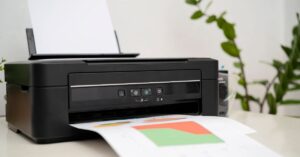
Printing has evolved far beyond ink on paper, offering a vast range of techniques that bring designs to life in unique ways. From traditional methods like offset and screen printing to cutting-edge 3D and digital printing, each type serves a specific purpose.
Whether you’re a designer, business owner, or just curious about the craft, this guide breaks down the main types of printing to help you choose the best method for your next project. Dive in and discover the power of print!
Types of Printing
Here are the main types of printing, along with a few closely related print-finishing techniques that are often discussed alongside them—each suited to different materials, goals, and production needs.
1. Digital Printing
Digital printing operates similarly to your home printer but on a grander scale. This method directly transfers digital images onto the chosen medium. It’s the best option for situations requiring quick turnaround times and smaller quantities, such as business cards, flyers, and personalized invitations.
Digital printing offers unparalleled flexibility, allowing for easy customization and on-demand printing. This makes it ideal for projects with variable data, where each piece might have unique elements like names or addresses. This technique has also made significant strides in color accuracy, rivaling traditional methods in many applications.
Pros: Quick setup with high customization.
Cons: Not ideal for large-scale print runs.
Best used for: Business cards, flyers, personalized invitations.
2. Screen Printing
Screen printing involves creating a stencil (or screen) and applying layers of ink to the printing surface. This technique is particularly favored for clothing, posters, and banners due to its ability to produce bright colors and durable prints.
The versatility of screen printing extends beyond fabrics and paper. It’s also employed for printing on glass, wood, and even electronics, making it a go-to method for a wide range of industries.
Screen printing also allows for the use of specialty inks, such as glow-in-the-dark or textured finishes, adding unique dimensions to your printed materials.
Pros: Vibrant colors and durable prints.
Cons: Time-consuming setup for small orders.
Best used for: Clothing, posters, banners.
3. Flexography
Flexography, often called flexo, utilizes flexible plates to print on various materials, including plastics, metallic films, and paper. Its functionality resembles a rubber stamp, making it perfect for packaging and labels.
This method shines in its ability to print on uneven surfaces, a feature particularly valuable in the food and beverage industry for printing on bottles and irregular containers. Its quick-drying inks make it suitable for high-speed production lines, enhancing efficiency in large-scale manufacturing processes.
Pros: Fast, efficient for uneven surfaces.
Cons: Setup costs make it less efficient for short runs.
Best used for: Packaging, labels, food containers.
4. Lithography
Lithography is a planographic printing process based on the principle that oil and water do not mix. Traditional lithography is strongly associated with artistic printmaking, while modern commercial lithography is most commonly carried out as offset lithography.
One of lithography’s standout features is its ability to reproduce fine details and subtle tones, making it a preferred choice for artistic reproductions and high-quality photographic prints. The technique offers excellent color consistency across large print runs, ensuring uniformity in mass-produced materials like magazines and catalogs.
Pros: High detail and color consistency.
Cons: Expensive for short runs.
Best used for: Fine art prints, artistic reproductions, specialty prints.
5. 3D Printing
3D printing, also known as additive manufacturing, creates three-dimensional objects by layering material. This innovative technique has transformed prototyping, medical device production, and custom part creation.
The applications of 3D printing continue to expand, reaching into fields such as architecture, where it’s used to create detailed models, and even culinary arts, with chefs using it to craft intricate food designs.
3D printing is also adopted in sustainable manufacturing, allowing for the creation of complex structures with minimal waste.
Pros: Creates complex, custom objects.
Cons: Slow production speed.
Best used for: Prototypes, medical devices, custom parts.
6. Offset Printing
Offset printing stands as the most common method for high-volume printing. It employs plates, typically made of aluminum, that transfer ink onto a rubber blanket and then onto the printing surface. This technique is ideal for producing high-quality prints like books, newspapers, and brochures.
One of offset printing’s key advantages is its cost-effectiveness for large print runs. As the quantity increases, the cost per unit decreases significantly. It also offers unparalleled control over color balance and ink distribution, resulting in crisp, clean prints that maintain their quality even in extensive production runs.
Pros: Cost-effective for large volumes.
Cons: Long setup time for small orders.
Best used for: Newspapers, books, brochures.
7. Sublimation Printing
Sublimation printing uses heat to transfer dye onto fabric, plastic, or metal. This method creates bright, long-lasting designs on items such as t-shirts, mugs, and signs.
A notable benefit of sublimation printing is its ability to produce full-color images with no raised surfaces, resulting in a smooth, seamless finish that’s resistant to cracking or peeling. This technique also allows for edge-to-edge printing on products, maximizing the design area and creating striking, all-over prints.
Pros: Full-color, durable designs.
Cons: Limited to polyester or coated surfaces.
Best used for: T-shirts, mugs, signs.
8. Large Format Printing
Large format printing produces prints on a grand scale, such as banners, posters, and billboards. This method employs special printers capable of handling oversized materials, delivering high-impact visuals for advertising and displays.
Beyond traditional applications, large format printing has found its place in interior design, creating custom wallpapers and murals that transform spaces. It’s also become integral in trade show and event marketing, allowing companies to create immersive brand experiences through expansive, high-quality graphics.
Pros: High-quality, large-scale prints.
Cons: Expensive for small-scale projects.
Best used for: Banners, posters, billboards.
9. Pad Printing
Pad printing transfers ink from an etched plate to a silicone pad, which then applies the image to the final surface. It’s especially useful for printing on curved, uneven, or small objects that are difficult to handle with other methods.
Because the silicone pad can conform to tricky shapes, pad printing is widely used for items like pens, bottle caps, medical components, and small electronic parts. It’s not the best choice for large graphics. But for compact products with awkward surfaces, it’s one of the most practical printing methods available.
Pros: Works on irregular and 3D surfaces.
Cons: Limited image size compared to flat-sheet methods.
Best used for: Promotional products, electronics, medical devices, bottle caps.
10. Letterpress Printing
Letterpress printing involves pressing inked, raised surfaces onto paper. As one of the oldest printing techniques, it’s cherished for its tactile quality and classic look, often employed for wedding invitations and business cards.
The charm of letterpress extends beyond its visual appeal; the deep impressions left by the press create a three-dimensional effect that engages the sense of touch. This technique has seen a resurgence in the digital age, with artisans combining traditional methods with modern design software to create unique, handcrafted prints that stand out in a sea of mass-produced materials.
Pros: Tactile, elegant finish.
Cons: Higher costs and longer setup times.
Best used for: Wedding invitations, business cards, stationery.
11. Heat Transfer Printing
Heat transfer printing uses heat and pressure to move a printed design from transfer paper or film onto the final surface. It’s a broad category that includes several apparel and promotional-product applications.
One reason this method remains popular is its flexibility. It works well for short runs, photo-heavy designs, and jobs where you want to decorate items without setting up a more labor-intensive process like screen printing.
Results can vary depending on the paper, film, printer, and substrate, so it’s best described as a flexible category rather than one single standardized process.
Pros: Good for full-color designs and short runs.
Cons: Durability varies depending on the transfer type and substrate.
Best used for: Custom apparel, promotional items, short-run decorated goods.
12. Inkjet Printing
Inkjet printing uses tiny droplets of ink to create images on paper. Its versatility makes it suitable for everything from office documents to photo printing.
Recent advancements in inkjet technology have expanded its capabilities to include printing on fabrics, creating opportunities in the textile and fashion industries for small-batch, customized fabric production.
Industrial inkjet printing is also widely adopted in areas like ceramic tile decoration and even in printing electronic circuits, showcasing the technique’s adaptability across various sectors.
Pros: Versatile, affordable for small batches.
Cons: Slower for high-volume jobs.
Best used for: Office documents, photo prints, textiles.
13. Light-Emitting Diode (LED) Printing
LED printing is a toner-based variation of electrophotographic printing that works much like laser printing, but uses a fixed LED array instead of a moving laser beam to form the image on the drum.
In practice, it delivers many of the same strengths as laser printing, so the main distinction is in the imaging system rather than the end use.
Pros: Energy-efficient with sharp prints.
Cons: Limited in media types.
Best used for: Office documents, technical drawings, brochures.
14. Direct-to-Garment (DTG) Printing
DTG printing uses specialized inkjet technology to print designs directly onto fabric. It works especially well for short runs and detailed full-color artwork on garments.
DTG is especially attractive when you want a print-on-demand workflow or need strong image detail without building screens for each color. It’s commonly used for small apparel orders, test designs, and businesses that want flexibility more than maximum bulk efficiency.
Pros: Great for detailed, full-color apparel prints.
Cons: Less economical for bulk orders than screen printing.
Best used for: T-shirts, hoodies, tote bags, short-run apparel.
15. Engraving
Engraving involves carving designs into a surface to create a print. Its precision and luxurious finish make it a popular choice for high-end stationery, wedding invitations, and fine artistic prints.
Through the depth and texture it achieves, engraving creates a unique visual and tactile experience that digital methods struggle to replicate. It is also valued in security printing for items like banknotes and official documents, where the raised ink provides a tangible anti-counterfeiting measure.
Pros: Luxurious, detailed finish.
Cons: Expensive and time-consuming.
Best used for: High-end stationery, wedding invitations, certificates.
16. Gravure Printing
Gravure printing involves engraving the image onto a cylinder, which is then used to transfer ink onto the printing surface. This method is utilized for high-volume printing, such as magazines, catalogs, and packaging.
The ability of gravure printing to lay down a thick ink film results in rich, saturated colors, making it particularly effective for photographic reproductions. This technique also excels in printing on a wide range of substrates, including thin plastics and foils, making it invaluable in the flexible packaging industry.
Pros: Rich, vivid colors for large prints.
Cons: High setup cost.
Best used for: Magazines, catalogs, packaging.
17. Embossing
Embossing is a print-finishing technique that creates a raised design on paper or other printable substrates, giving a three-dimensional effect. It’s often used for business cards, invitations, and packaging to add a touch of sophistication.
Beyond its decorative applications, embossing serves functional purposes in various industries. For instance, it’s used to create Braille text on packaging and signage, enhancing accessibility.
Embossing is also employed in the creation of secure documents, where raised seals or patterns provide an additional layer of authenticity.
Pros: Adds texture and elegance.
Cons: Limited to certain materials.
Best used for: Business cards, invitations, packaging.
18. Thermal Printing
Thermal printing uses heat to create an image, either on heat-sensitive paper or through a ribbon-based transfer process. It’s widely used when speed, simplicity, and low maintenance matter more than premium full-color output.
That’s why you see it so often in receipts, shipping labels, tickets, and barcode systems. It’s built for utility and speed rather than high-end visual reproduction. That makes it valuable in retail, logistics, and other fast-moving environments.
Pros: Fast, simple, and low maintenance.
Cons: Often limited to receipts, labels, and mostly monochrome output.
Best used for: Receipts, shipping labels, barcodes, tickets.
19. Monoprinting
Monoprinting creates unique, one-of-a-kind prints using a single template. Each print varies slightly, making it ideal for artistic projects where individuality is key.
The spontaneity of monoprinting appeals to artists looking to combine painterly techniques with printmaking. This method also lends itself well to experimentation, allowing for the incorporation of various materials and textures into the printing process, resulting in prints that blur the line between traditional printmaking and mixed media work.
Pros: Unique, one-of-a-kind prints.
Cons: Time-consuming and less predictable.
Best used for: Artistic projects, experimental designs, mixed media.
20. UV Printing
UV printing uses ultraviolet light to cure or dry the ink as it is printed. This technique allows printing on non-porous materials like plastics and metals, producing bright and durable prints.
The quick-curing nature of UV printing contributes to its eco-friendliness, as it produces minimal volatile organic compounds (VOCs). This method is widely used in the electronics industry for printing circuitry and in the automotive sector for creating durable, fade-resistant instrument panels and controls.
Pros: Durable and fast curing.
Cons: Higher cost of inks.
Best used for: Plastic, metal, glass.
21. Laser Printing
Laser printing is a digital process that uses a laser and toner to produce sharp text and graphics. It’s a strong choice for fast document printing and clean, consistent output in office settings.
This method belongs to the broader electrophotographic, or xerographic, family of printing. That’s part of why it excels at crisp text, forms, reports, and other business documents where speed and clarity matter more than rich photographic output.
Pros: Sharp text and fast page speeds.
Cons: Less ideal for premium photo printing than some inkjet workflows.
Best used for: Office documents, reports, forms, marketing handouts.
22. DTF Printing (Direct-to-Film)
DTF printing involves printing a design onto a special film and then transferring it onto fabric using heat. This new method has gained popularity for custom apparel due to its flexibility and bright colors.
One of DTF printing’s key advantages is its ability to produce high-quality prints on a wide range of fabric types, including those traditionally challenging for other methods, such as nylon and polyester blends. Also, DTF prints offer excellent durability and wash resistance, maintaining their brightness even after multiple laundry cycles.
Pros: Works on a wide variety of fabrics.
Cons: Slower process for bulk orders.
Best used for: Custom apparel, sportswear, promotional items.
23. Foil Stamping
Foil stamping is a print-finishing technique that uses heat and pressure to apply metallic or pigmented foil to a surface. It’s often used to create premium-looking packaging, stationery, and print pieces with a reflective finish.
Pros: Premium look and strong shelf appeal.
Cons: Extra setup cost compared to standard ink printing.
Best used for: Packaging, invitations, certificates, premium business cards.
24. Pigment Printing
Pigment printing uses pigment-based inks rather than dye-based colorants. In fine art and photo printing, pigment inks are valued for their longevity and archival potential. In textile printing, pigment-based systems sit more on the surface of the fabric and rely on binders to help the color adhere.
Because of that, pigment printing can refer to slightly different applications depending on the context. You can think of it mainly as a method used for archival art prints, photo reproductions, and certain textile workflows where durability and substrate flexibility matter.
Pros: Bright, long-lasting colors.
Cons: Limited fabric compatibility.
Best used for: Artistic prints, high-quality photo reproductions, textiles.
25. Rotary Screen Printing
Rotary screen printing uses a cylindrical screen instead of a flat one, allowing ink to flow continuously onto the substrate during production. Because the screen rotates as the material moves through the press, this method is especially effective for high-speed printing of repeating patterns.
It is commonly used in textile and wallpaper production, where consistency and speed matter more than one-off customization. Compared with standard flat screen printing, rotary screen printing is better suited to continuous manufacturing environments and long runs.
Pros: Fast for continuous patterned production.
Cons: Best suited to repetitive designs rather than one-off graphics.
Best used for: Textiles, wallpaper, decorative materials.
26. Woodcut Printing
Woodcut printing is a relief printing method in which the design is carved into a wood block, inked on the raised surface, and then pressed onto paper or fabric. It is one of the oldest printing methods and remains an important part of artistic printmaking and traditional craft work.
What makes woodcut printing stand out is its handmade character. The grain of the wood, the carved lines, and the pressure of the print all contribute to a look that feels more tactile and expressive than many modern commercial methods.
Pros: Distinct handmade character.
Cons: Less suited to fine commercial precision.
Best used for: Art prints, handmade cards, traditional craft printing.
27. Direct-to-Object Printing
Direct-to-object printing applies graphics straight onto the final item instead of printing onto a separate label or transfer first. It is commonly used for bottles, promotional products, industrial parts, and other items where direct decoration improves appearance, branding, or production efficiency.
This method is especially useful for customizing shaped or rigid objects that would be difficult to decorate with conventional flat printing. In many cases, it helps reduce the need for labels or secondary application steps, which can simplify production for certain products.
Pros: Eliminates labels and supports direct customization.
Cons: Equipment can be specialized and substrate compatibility matters.
Best used for: Bottles, cylindrical products, promotional goods, industrial parts.
Choosing the Right Printing Technique
When selecting a printing technique, consider these factors:
Quantity: For large runs, offset printing proves most cost-effective, while digital printing suits smaller quantities and allows for easy customization.
Material: Screen printing excels on textiles, while flexography adapts well to various materials, including plastics and paper.
Quality: Gravure printing delivers exceptional image quality, making it ideal for detailed prints and photographic reproductions.
Turnaround Time: Digital printing offers quick turnaround times, perfect for urgent projects or those requiring frequent updates.
Budget: Consider not just the upfront costs but also the long-term value. Some methods, like offset printing, become more economical as quantities increase.
Environmental Impact: UV and LED printing often have lower environmental footprints due to their energy efficiency and reduced waste.
Conclusion
Understanding the different types of printing can help you make informed decisions for your projects. Whether you need high-volume prints or custom designs, there’s a printing technique that fits your needs.
Explore these options and choose the best match for your goals, materials, budget, and print volume.
Tech Help Canada Staff researches, writes, and reviews practical content for business owners and professionals. Our coverage spans business, marketing, SEO, technology, and the tools and systems people use to grow and operate online. We focus on clear, useful information backed by research, hands-on experience, and editorial review. Learn more about our team and editorial standards. Need help with something? Contact Us