Most AI model launches follow the same script: smarter, faster, better on benchmarks. That framing is starting to wear thin. What businesses actually want to know is simpler: can this model do useful work for longer stretches without constant checking, steering, or cleanup afterward?
That’s what makes Claude Opus 4.7 worth paying attention to. Anthropic isn’t just pitching a stronger model. It’s pitching one that can handle harder software engineering work, stick with longer multi-step tasks, follow instructions more carefully, and verify its own work before reporting back. The company also says Opus 4.7 has substantially better vision, including higher-resolution image understanding, and produces better interfaces, slides, and documents.
But the more interesting signal is where the competition is going: frontier AI companies aren’t only selling raw capability anymore. They’re increasingly selling reliability, autonomy, and more usable performance in real workflows.
What Anthropic Actually Released
Anthropic says Claude Opus 4.7 is now generally available and improves on Opus 4.6 in advanced software engineering, especially on harder tasks. The pitch is that users can hand off tougher coding work with more confidence because the model handles complex, long-running jobs with more rigor and consistency. This isn’t being sold as a casual chatbot improvement. It’s being positioned as a model for serious work, the kind that used to fall apart once tasks got long, messy, or technical.
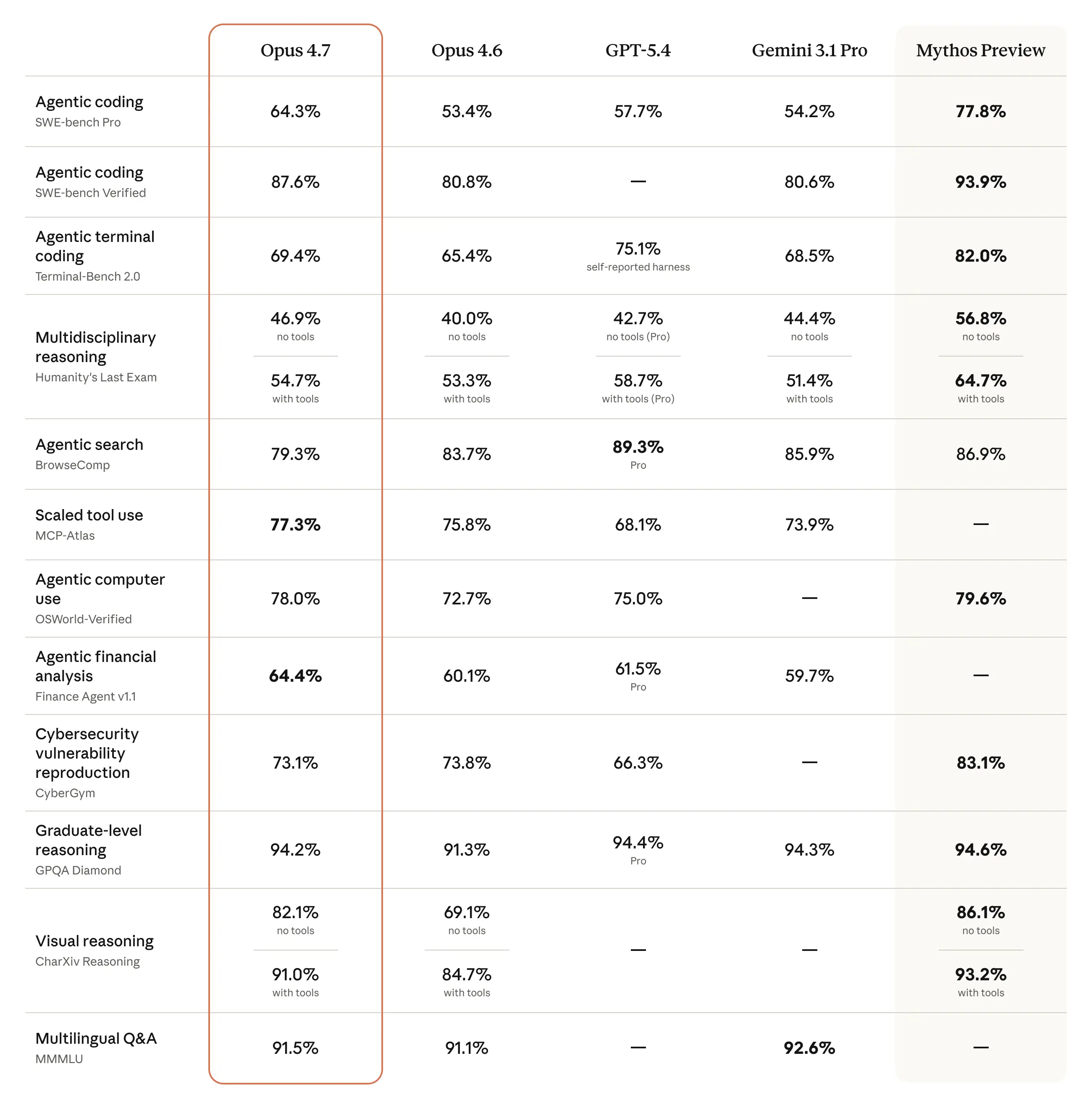
Anthropic’s benchmark table compares Opus 4.7 with Opus 4.6, GPT-5.4, Gemini 3.1 Pro, and Mythos Preview across coding, reasoning, tool use, and other tasks.
Anthropic also says Opus 4.7 follows instructions more precisely and devises ways to verify its own outputs before reporting back. If that holds up in real use, it’s a meaningful shift. A lot of AI frustration doesn’t come from models being obviously useless. It comes from them being useful enough to tempt you into relying on them, then quietly slipping on details that still need a human to catch.
The company also highlights stronger high-resolution vision and better output quality for professional tasks like interfaces, slides, and docs, which pushes Opus 4.7 closer to a general-purpose work model rather than a developer-only tool. And there’s a practical business detail worth noting: Anthropic kept pricing the same as Opus 4.6, at $5 per million input tokens and $25 per million output tokens. More capability without a price increase makes the value proposition easier to understand.
The Bigger Story Is Lower Supervision Cost
The strongest way to read this launch is through supervision cost: not just what the model costs to run, but how much human attention it burns while doing the work. A model that writes quickly but needs constant course correction can still be expensive. One that produces decent first drafts but falls apart halfway through a long task can be expensive, too.
Anthropic’s release, along with several of the early-access reactions it chose to feature, keeps pointing to the same cluster of gains: long-running tasks, tighter instruction-following, self-checking behavior, and more reliable execution. That suggests the next phase of the AI race may center less on raw intelligence in the abstract and more on whether a model can stay useful once the work gets annoying, technical, or expensive to supervise.
What Small Businesses and Lean Teams Should Notice
For smaller teams, the appeal of AI has never been theoretical brilliance. It’s leverage: can one person get more done, can a small team move faster without adding headcount right away, and can certain kinds of technical, research, documentation, or production work be pushed further forward before a human needs to step in?
If Opus 4.7 is more dependable across long tasks, that could show up well beyond writing prompts in a chat window: bug investigation that doesn’t stall halfway through, internal documentation that holds together on the first pass, slide creation, technical summaries, workflow support, data-heavy reasoning, or agent-style work that used to break once too many moving parts got involved.
That doesn’t mean businesses should treat AI like a fully autonomous coworker and walk away. We’re not there. But the amount of oversight required for certain kinds of work may keep dropping, and when that happens, the value proposition changes. A faster answer is nice; a more dependable answer within a longer workflow is more useful. That distinction is especially relevant for growth-minded teams that don’t have time to babysit every tool they adopt. In a small business, a tool earns its keep when it reduces drag in real work.
Stronger Models Are Arriving with Tighter Guardrails
Anthropic says Opus 4.7 is the first model it’s using to test safeguards that automatically detect and block requests indicating prohibited or high-risk cybersecurity uses, ahead of any broader Mythos-class release. It’s also inviting legitimate security professionals into a Cyber Verification Program for approved work such as red-teaming, penetration testing, and vulnerability research.
This makes sense given the direction of capability gains. A system that can investigate, reason, recover from errors, and keep going for hours is more valuable for real work, but it also raises the stakes. Anthropic is effectively signaling that broader access now has to be paired with tighter controls, especially around cybersecurity-related use.
The Next AI Race May Be About Reliability
A lot of AI coverage still treats model launches like hardware launches—more power, better scores, new records.
But businesses usually care about something more grounded: whether a model can stay useful further into the job, with stronger follow-through, better error recovery, tighter instruction handling, and output that doesn’t create extra work downstream. Claude Opus 4.7 looks like a sign that major AI companies understand that shift.
The models still need humans, boundaries, and careful evaluation inside real workflows. But the standard is changing. The real dividing line may not be who can produce the flashiest demo, but who can stay useful deeper into the workflow without creating more review work, more risk, or more downstream surprises.
Update: Early User Feedback on Claude Opus 4.7
Since this article first went live, early user feedback on Claude Opus 4.7 has been more mixed than Anthropic’s launch framing might suggest.
Across Reddit, many users say the model feels worse than expected in everyday use, especially when adaptive reasoning seems to default to less effort unless they push it harder. The same complaints keep coming up: hallucinations, skipped steps, missing details, wordier output, and heavier token usage.
One Reddit user said 4.7 has a “nasty habit of hallucinating after compressing the conversation.” Another said that when a task involved multiple parts, “it only does X and does it wonderfully, but it oversights Y and Z.” A third user who uses Opus for financial analysis said version 4.7 was “quite poor” because it “misses numbers and hallucinates frequently.”
Some users say they’ve already gone back to Opus 4.6 or even 4.5 for parts of their workflow, especially for planning, chat, or certain analytical tasks. One user summed up the split this way: “4.6 for planning and prompting, 4.7 for implementation.” Another said, “Anything where I am talking to the model or planning, then I am using 4.6,” while using 4.7 mostly for coding and implementation.
That said, the reaction isn’t uniformly negative. Some users say Opus 4.7 follows instructions better, runs longer in guided coding sessions, solves harder implementation problems, and stays on track more effectively once the workflow is tightly structured.
In one detailed Reddit post after 14 hours of use, a user wrote that “Opus 4.7 follows instructions better than Opus 4.6” and said it “ran well and longer than Opus 4.6.” The same user also said Opus 4.7 solved a difficult quant-system bug after Opus 4.6 and GPT-5.4 had failed to solve it over several days.
So far, this doesn’t look like a case of Claude Opus 4.7 performing worse across the board. It’s that the model seems to perform very differently depending on how people use it. People doing guided implementation work often sound more positive, while users relying on broader reasoning, planning, chat, or certain analytical tasks sound more frustrated.
That doesn’t necessarily invalidate Anthropic’s pitch, but it does make the picture more complicated. A model can look strong in benchmarks and still feel uneven in real-world use if the gains show up more clearly in some workflows than others. Right now, that seems to be where early user feedback is landing.
If this pattern holds, the better question may not be whether Opus 4.7 is better in the abstract, but whether it’s better for the work you’re actually asking it to do.
Tech Help Canada Staff researches, writes, and reviews practical content for business owners and professionals. Our coverage spans business, marketing, SEO, technology, and the tools and systems people use to grow and operate online. We focus on clear, useful information backed by research, hands-on experience, and editorial review. Learn more about our team and editorial standards. Need help with something? Contact Us