
Disney’s latest D23 fan event looked like a flood of entertainment announcements: an X-Men cast reveal, Lilo & Stitch 2, The Bluey Movie, Tangled, Coco 2, Avengers Campus expansion details, Villains Land updates, Monstropolis, and more.
Taken alone, it was fan-service theater. Taken beside Disney’s August 5 earnings release, it was a business plan in costume.
Disney is not simply announcing more movies, shows, rides, games, and merchandise. It is tightening a system where every franchise is supposed to earn more than once. A film can sell tickets, feed Disney+, move licensed products, justify park expansions, refresh cruise-ship experiences, and give the company more reasons to stay close to fans between releases.
That is the part business owners should study. Disney’s most visible products are not always its strongest profit engines. A movie may get the attention. Parks, cruises, merchandise, subscriptions, and licensing can turn that attention into repeat spending.
Disney’s profit mix explains the strategy
Disney’s headlines usually revolve around box office performance. The financials point somewhere more interesting.
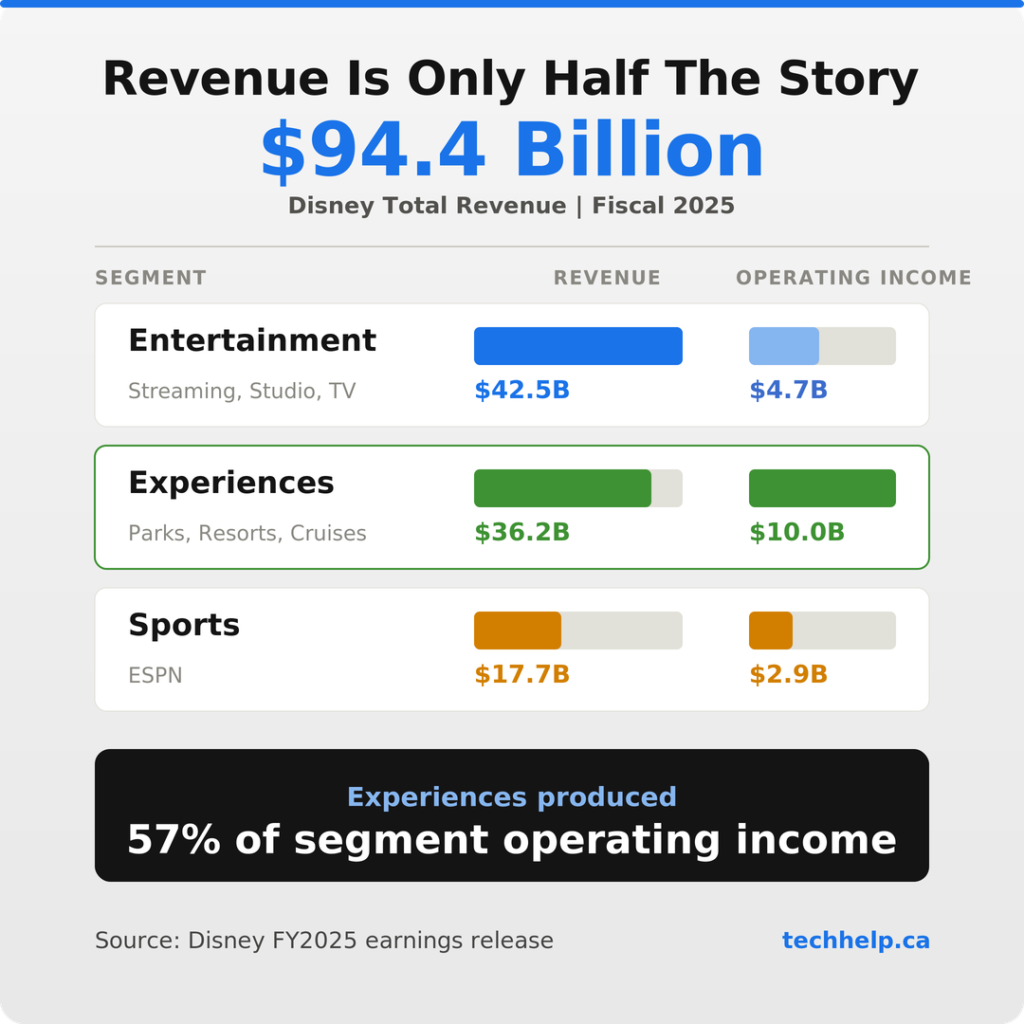
In fiscal 2025, Disney reported $94.4 billion in total revenue. Entertainment generated the most revenue at $42.5 billion, but Experiences produced the largest operating income at nearly $10.0 billion. Sports generated $2.9 billion in operating income, while Entertainment generated $4.7 billion.
| Disney segment | Fiscal 2025 revenue | Fiscal 2025 operating income |
|---|---|---|
| Entertainment | $42.5 billion | $4.7 billion |
| Experiences | $36.2 billion | $10.0 billion |
| Sports | $17.7 billion | $2.9 billion |
Experiences includes theme parks, resorts, cruises, and consumer products. It produced more than half of Disney’s segment operating income in fiscal 2025, even though Entertainment brought in more revenue.
The pattern continued in the third quarter of fiscal 2026. Disney reported $25.2 billion in revenue, up 7% year over year, and total segment operating income of $5.6 billion, up 21%. Experiences revenue rose 10% to nearly $10.0 billion, and Experiences operating income rose 20% to $3.0 billion.
Consumer Products had a smaller revenue base inside Experiences, but it punched above its weight. Revenue rose 7% to $1.1 billion, while operating income rose 26% to $560 million.
That is why the D23 parks announcements deserve more than fan reaction. A new ride or themed land is not just a reward for existing fandom. It is a long-lived asset attached to characters and stories people already care about.
The old Disney map still works
Disney’s current strategy has roots in one of the most famous diagrams in business history.
In 1957, Walt Disney created a strategy map showing theatrical films at the center of the company. Around that center were television, music, merchandise, publications, comic strips, Disneyland, and other parts of the business. Arrows connected the pieces, showing how each one supported the others.
The point was not diversification for its own sake. The point was reinforcement.
Films created characters. Characters sold merchandise. Television promoted the films and the park. The park brought the worlds to life, sold more merchandise, and deepened affection for the characters. Music extended the memory of the films. Publications kept characters in circulation.
The boxes have changed. The logic has not.
Disney+ replaces part of what television used to do. Games and Fortnite integrations add new digital touchpoints. Cruise ships carry IP into vacations. Theme parks turn stories into physical places. Licensed products put characters into homes, closets, backpacks, kitchens, bedrooms, and holiday traditions.
The modern version is larger, but the operating question is the same: how does each part of the business make every other part more valuable?
Toy Story 5 shows the machine working
Toy Story 5 gave Disney a timely proof point.
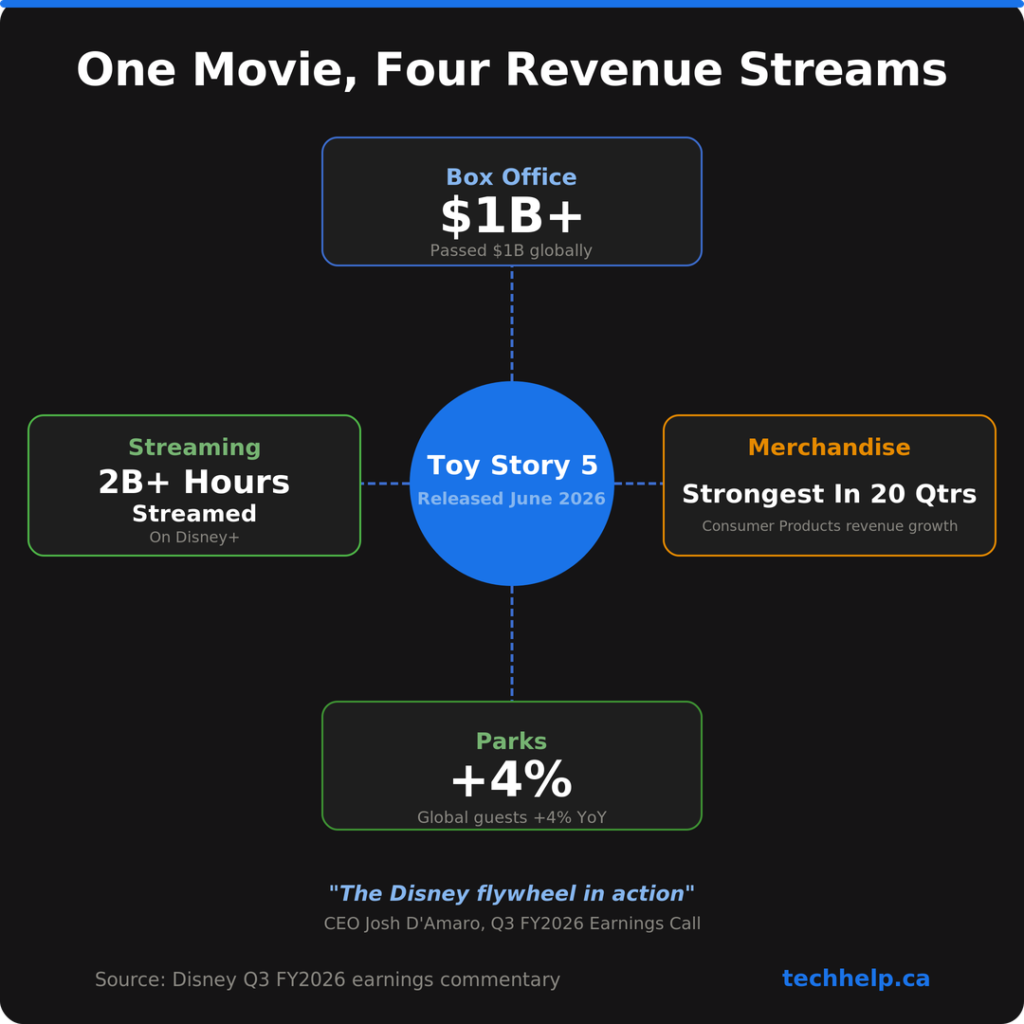
According to Disney’s Q3 fiscal 2026 earnings release, the film surpassed $1 billion at the global box office after its June 19 theatrical release. Disney also said the Toy Story franchise has generated more than two billion hours streamed on Disney+.
The theatrical result was only one layer. Disney said Toy Story merchandise helped deliver the company’s strongest quarter of year over year Consumer Products revenue growth in 20 quarters. Toy Story also has a presence at every Disney park and on every Disney cruise ship the company operates.
One franchise touched theaters, streaming, retail, parks, and cruise vacations in the same reporting period.
That is why Disney can think about some movies differently than a standalone studio would. Box office still matters, but Disney can recover value in more places. Even when a franchise film underperforms in theaters, it may still support streaming engagement, merchandise sales, park traffic, games, and future licensing.
Disney said as much in the same Q3 release. Star Wars: The Mandalorian and Grogu and the live-action Moana came in below box office expectations, but Disney pointed to value created beyond theatrical release, including retail growth, park attraction updates, gaming engagement, and future Disney+ performance.
The financial lesson is blunt: Disney’s movie slate is not just a slate. It is inventory for the whole company.
The merchandise reorg is the clearest signal
The most important Disney business news this month may not be the D23 sizzle reel. It may be an org-chart move.
In its August 5 earnings release, Disney said it intends to shift much of its Consumer Products business from Experiences to Entertainment beginning in the first quarter of fiscal 2027. That means the move starts in October 2026.
Disney’s stated rationale was direct: bring the monetization of IP through consumer products closer to the studios that create that IP.
That is a quiet sentence with a lot inside it.
Under the old reporting structure, consumer products sat with Experiences. Under the new one, much of that business sits closer to film and TV development. The commercial team that turns characters into licensed products will be nearer to the creative teams creating those characters in the first place.
For a company built on IP, timing matters. Character design, release windows, licensing calendars, retail partnerships, park merchandise, and streaming promotion all work better when they are planned earlier.
License Global’s 2026 ranking shows the size of the prize. Disney ranked as the world’s top global licensor with an estimated $63 billion in 2025 retail sales of licensed consumer products. That is retail sales, not revenue Disney books directly. Even with that distinction, it shows the power of Disney IP once characters move beyond the screen.
Putting much of Consumer Products under Entertainment is Disney making the old map more literal: the people creating the stories and the people commercializing the stories need to work closer together.
Parks turn attention into pricing power
Disney’s $60 billion Experiences investment makes sense once you see the company through that system.
Disney announced in 2023 that it planned to invest roughly $60 billion over about 10 years in parks, resorts, cruises, and related experiences. The company said the investment would expand and enhance domestic and international parks and cruise line capacity.
D23 2026 showed what that money is buying. At Walt Disney World, Disney shared details on Villains Land, Piston Peak, Monstropolis, Tropical Americas, and updates to attractions such as Spaceship Earth. At Disneyland Resort, Disney highlighted the first-ever Coco attraction, a Tomorrowland reimagining, the Avatar destination in early development, and the Avengers Campus expansion that will double the size of that land with two new attractions opening in 2028.
These projects are expensive because they are built to earn for years. A movie has an opening weekend. A successful land, ride, hotel, restaurant, cruise experience, or retail program can produce revenue through tickets, stays, food, merchandise, premium access, repeat visits, and family traditions.
That also changes how Disney can think about risk.
A standalone movie studio may need a film to earn back its budget mainly through theaters, licensing, and later windows. Disney has more places for the same IP to work. A film can become a streaming retention tool. A character can become a Halloween costume. A location can become a ride. A song can become a live show. A franchise can become a reason families plan vacations years later.
That does not make Disney immune to bad bets. Expensive films can still miss. Parks can face demand swings, labor costs, inflation, construction delays, and consumer pushback over pricing. Disney’s own Q3 release pointed to softer advertising in domestic streaming and weakness at Asia parks.
The advantage is not that every bet works. The advantage is that one winning asset can work in more places than competitors can easily copy.
Smaller businesses can use the same logic
Most businesses cannot copy Disney’s scale. They can copy the discipline behind the model.
Disney asks a sharper question than “Did this product sell?” It asks what else the product makes more valuable.
| Disney pattern | Smaller business version | Question to ask |
|---|---|---|
| A movie creates attention | A guide, event, podcast, workshop, or signature product attracts the right audience | What gets people to notice and trust us? |
| Parks and cruises deepen the relationship | Retainers, memberships, communities, or premium services create repeat engagement | What gives customers a reason to stay close? |
| Merchandise extends the IP | Templates, courses, physical products, licensing, or partner offers extend the core idea | What can this become after the first sale? |
| Streaming keeps the catalog alive | Email, content libraries, customer portals, and owned communities keep attention warm | How do we keep value alive between launches? |
| Data from many touchpoints improves the system | Customer behavior, support questions, churn signals, and sales calls inform better offers | What does each channel teach the next one? |
For a service business, the “movie” might be a strong point of view that attracts leads. The “park” might be a retainer or implementation program that delivers the deeper value. The “merchandise” might be a template library, paid workshop, certification, or lower-cost product that lets people buy into the method before they hire the firm.
For an ecommerce brand, the “movie” might be social content that creates demand. The repeat value may come from a subscription business model, replenishment offer, loyalty program, or community. The long-term value depends on making the customer relationship stronger after purchase, not only buying more ads.
For a media or education business, the visible work may be articles, videos, research, or events. The compounding value may come from memberships, advisory work, licensed materials, sponsorships, speaking, or software tools. The key is to avoid treating each channel as a separate island.
That is also where customer acquisition and retention become connected. Attention brings people in. Retention turns that attention into a business that does not have to restart from zero every month.
Stop measuring channels like they are separate businesses
Disney is not spending billions on parks because it stopped caring about movies. It is spending billions on parks because movies create demand that physical experiences can monetize for decades.
The same principle applies at a smaller scale. If your blog brings in leads but does not feed your email list, offers, sales calls, customer research, or product development, it is weaker than it should be. If your flagship product creates happy customers but does not create testimonials, referrals, repeat purchases, or new content ideas, the system is leaking value.
A strong business model has arrows between the pieces.
- Your content should feed your offer.
- Your offer should create proof.
- Your proof should improve sales.
- Your customer questions should improve content.
- Your service work should reveal product opportunities.
- Your events should create relationships that strengthen retention.
- Your retention work should reduce pressure on acquisition.
That is the practical lesson inside Disney’s latest news. D23 created the spectacle. The Q3 earnings release showed the economics. The Consumer Products move showed the operating system being tightened.
Before your next launch, draw the arrows. The product that gets attention may not be where profit compounds, but it should make every other part of the business easier to sell, easier to trust, and harder to replace.
Frequently asked questions
Why does Disney invest so much in theme parks?
Disney invests heavily in theme parks because parks turn its stories and characters into long-running physical experiences. A movie may create attention for a few months, while a popular attraction, themed land, hotel, restaurant, or cruise experience can generate revenue for years through tickets, stays, food, merchandise, and repeat visits.
Does Disney make more money from parks than movies?
Disney’s Entertainment segment generated more revenue than Experiences in fiscal 2025, but Experiences generated more operating income. Disney reported nearly $10.0 billion in Experiences operating income in fiscal 2025, compared with $4.7 billion from Entertainment and $2.9 billion from Sports.
What is Disney’s business flywheel?
Disney’s business flywheel is the way its movies, shows, streaming platforms, parks, cruises, merchandise, games, and licensing reinforce each other. A film can introduce characters, Disney+ can keep those characters in circulation, merchandise can extend daily exposure, and parks can turn the same IP into repeat physical experiences.
Why is Disney moving Consumer Products closer to Entertainment?
Disney said it intends to shift much of Consumer Products from Experiences to Entertainment beginning in fiscal 2027 so product monetization sits closer to the studios creating the IP. The move should make it easier to plan merchandise, licensing, retail timing, and franchise strategy earlier in the creative process.
What can small businesses learn from Disney’s strategy?
Small businesses can learn to connect their offers instead of treating every channel separately. The product that earns attention should feed a stronger system: email, sales, retention, referrals, proof, customer research, repeat offers, and long-term brand value.

I can suggest related Tech Help Canada articles based on the topic you’re reading now.

Tech Help Canada Staff researches, writes, and reviews practical content for business owners and professionals. Our coverage spans business, marketing, SEO, technology, and the tools and systems people use to grow and operate online. We focus on clear, useful information backed by research, hands-on experience, and editorial review. Learn more about our team and editorial standards. Need help with something? Contact Us