
Canada’s federal government is trying to make public contracts less hostile to small businesses.
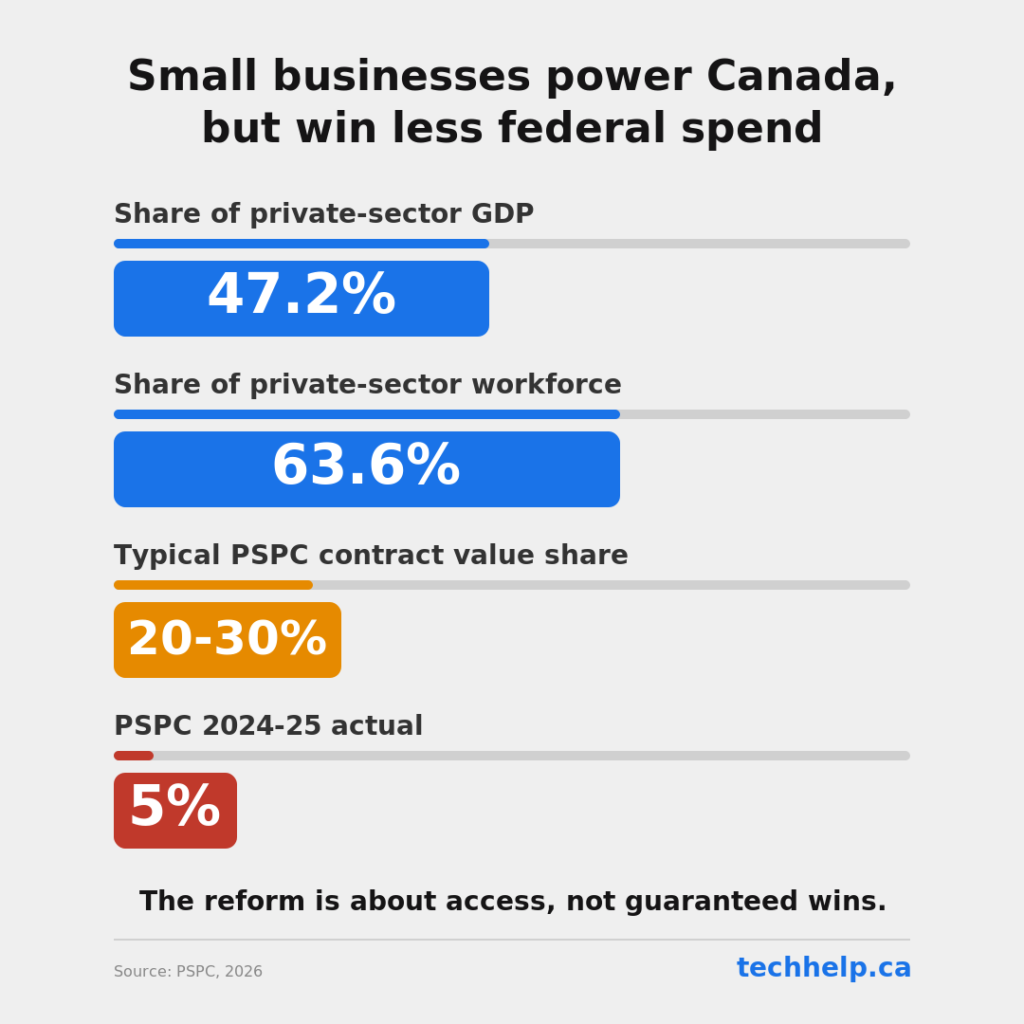
In the 2024-25 fiscal year, the federal government awarded $66.9 billion in contracts for goods, services, and construction. Small and medium-sized businesses account for 47.2% of Canada’s private-sector GDP and 63.6% of its private-sector workforce, yet they have typically captured only 20% to 30% of the value of contracts awarded through Public Services and Procurement Canada.
Some years are even more uneven. PSPC’s own 2026-27 departmental planning material shows the small-business share of PSPC contract value fell to 5% in 2024-25, partly because several high-value defence procurements limited small-business participation.
That is the problem Ottawa says it is trying to address.
On July 6, 2026, the federal government announced the Small Business Procurement Program, or SBPP, a set of changes designed to make federal procurement easier for smaller suppliers to enter. The announcement lands beside two other changes: a lower Buy Canadian threshold and new funding for Innovative Solutions Canada.
For business owners, the message is not that federal contracts are suddenly easy. They are not. The message is that a market many small firms have ignored may now be worth watching more closely.
The contract market is large, but access has been uneven
Federal procurement can look like it belongs to large companies with bid teams, compliance staff, and years of government-sales experience. That perception did not come from nowhere.
Smaller suppliers have long faced barriers that make bidding feel expensive before a contract is even in sight. Requirements can be more complex than the work demands. Tender language can make it hard to know whether the opportunity fits. Documentation can be repetitive. A company may have to resubmit the same certifications, attestations, and business details across multiple bids.
That burden hits smaller firms harder because the cost of bidding is not spread across a large sales department. If a small company spends days preparing a proposal for a modest contract, the pursuit itself becomes a meaningful business cost.
The result is predictable: qualified small firms stay away, and larger suppliers with more procurement capacity keep winning a disproportionate share of the work.
The SBPP is meant to reduce that friction.
What the Small Business Procurement Program changes
The SBPP is rolling out in two phases.
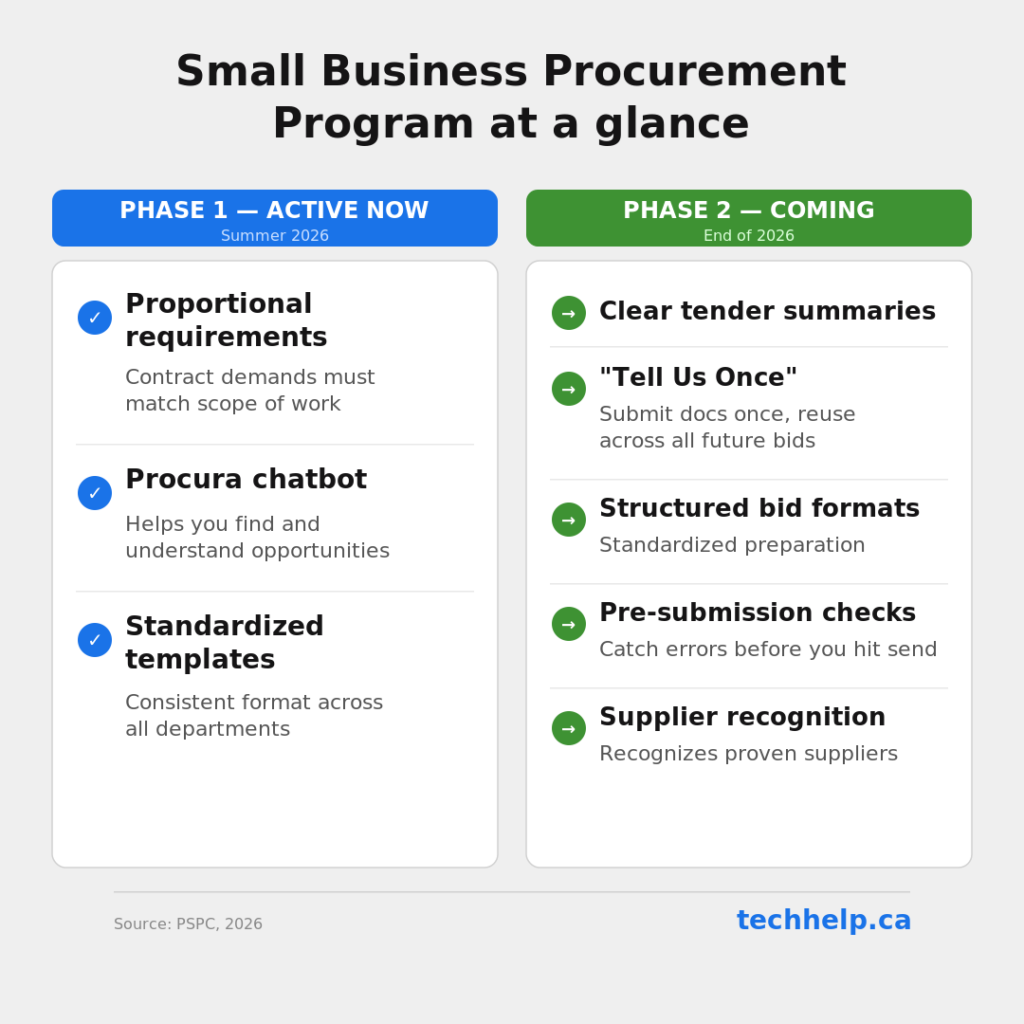
The first phase is active as of summer 2026. Federal buyers are expected to use requirements and evaluation methods that are proportionate to the work being purchased. A smaller contract should not demand the same procurement burden as a major infrastructure or defence project.
That change sounds procedural, but it matters for small firms. If mandatory requirements become more reasonable, more capable suppliers can clear the first hurdle.
The first phase also expands the information available through Procura, the federal procurement chatbot available through CanadaBuys. Procura is not a replacement for reading a solicitation, but it can help suppliers understand the process, find guidance, and get oriented before they spend time on a bid.
Standard solicitation and contract templates are also part of the first phase. That should make opportunities easier to compare across departments, especially for suppliers that are still learning how federal procurement documents work.
The second phase is expected by the end of 2026 and is aimed at repeat friction.
Clear tender summaries are supposed to make opportunities easier to understand quickly. The “Tell Us Once” approach is intended to reduce repeated documentation by allowing supplier information to be reused. Structured response formats should make bids easier to prepare and evaluate. Mandatory pre-submission completeness checks should help suppliers catch missing pieces before a bid is filed.
The government also plans to introduce a supplier recognition program for Canadian small businesses with a track record of quality work. If that program is implemented well, it could help smaller suppliers earn credibility inside the procurement system without starting from zero every time.
The key phrase is “implemented well.” Procurement reform can look good on paper and still disappoint in practice. The opportunity for small businesses depends on whether departments actually change how they write, score, and manage smaller procurements.
The Buy Canadian threshold is lower now
The SBPP is not happening in isolation. Ottawa has also expanded the reach of its Buy Canadian procurement rules.
As of June 15, 2026, the minimum contract value for Canadian preference measures under the federal policy dropped from $25 million to $5 million. That lower threshold is important because it brings more mid-sized federal opportunities into the range where Canadian suppliers and Canadian content may receive priority treatment.
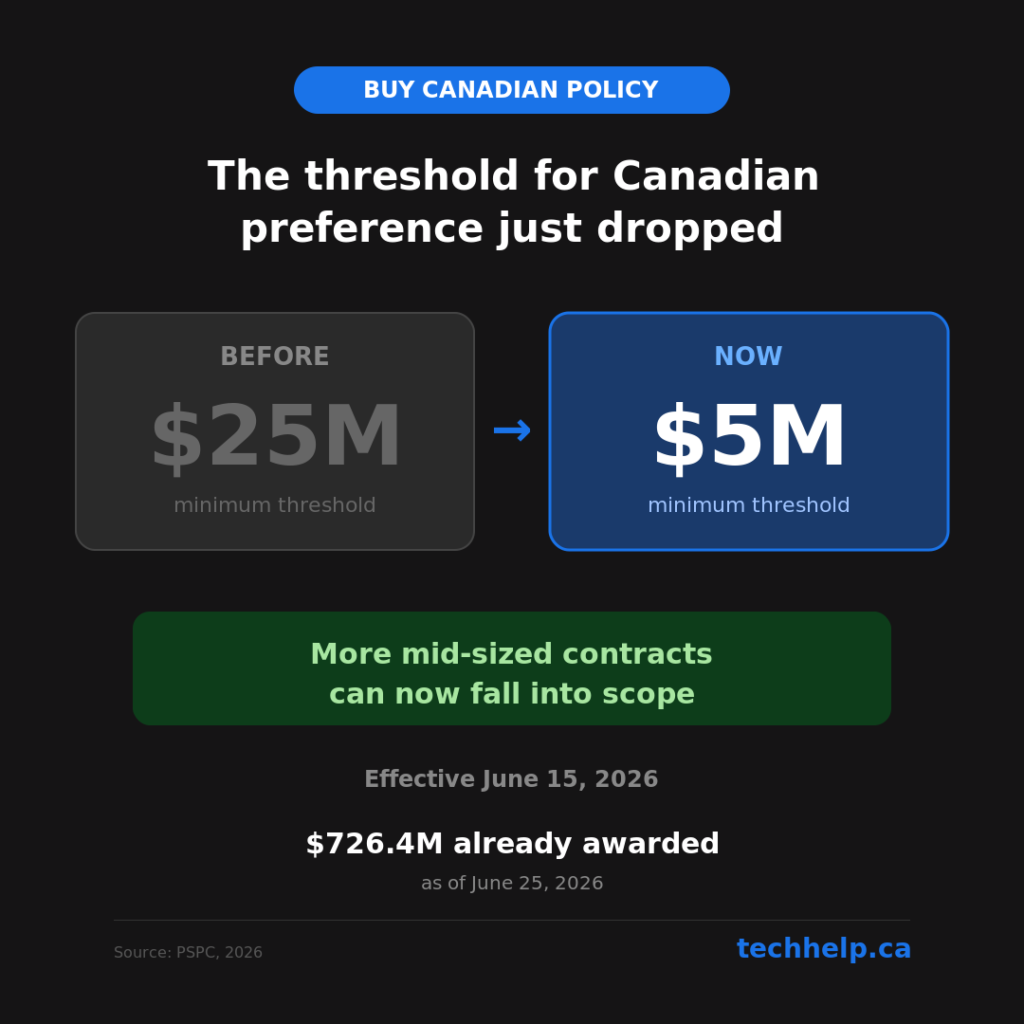
CanadaBuys reported that, as of June 25, 2026, PSPC had awarded 14 contracts under the Buy Canadian Policy with a total value of $726.4 million.
This does not mean every $5 million contract is automatically reserved for Canadian companies. Trade agreements, procurement category, contract structure, and policy scope still matter. But the threshold change does mean more federal buying decisions can now place greater weight on Canadian suppliers, Canadian content, and domestic economic activity.
That shift arrives at a sensitive time. As new U.S. tariffs reshape cross-border trade, federal procurement is becoming one more place where Canadian businesses may have to pay closer attention to domestic preference rules, supply chains, and where work is performed.
For Canadian suppliers that already sell into government-like buyers, the lower threshold is worth watching. Contracts that previously felt too large or too internationally exposed may now deserve a second look.
Innovative Solutions Canada gives new products a different path
If your business is building a new technology, product, or process, the regular procurement route may not be the only option.
Innovative Solutions Canada is receiving $79.9 million over five years starting in 2026-27. The program is designed to connect Canadian companies with federal departments that can test, buy, or help commercialize new solutions.
The premise is straightforward: the government can act as an early customer.
For many startups, the first serious buyer is often the hardest one to win. A small company may have a strong product but no major reference customer. ISC can help bridge that stage by creating a path for pilot projects, testing, and follow-on procurement.
The program has already partnered with more than 60 federal departments and agencies and has delivered more than 1,650 grants and contracts since launch. More than 95% of award recipients have been Canadian small and medium-sized businesses.
The 2026 funding is meant to make that path easier to use. Planned improvements include clearer entry points, a more direct route from a successful project to a federal procurement contract, and more support around intellectual property.
For software companies, environmental technology firms, advanced manufacturers, research-driven businesses, and other innovation-led suppliers, ISC may be a better starting point than a traditional open tender.
How to start competing for federal contracts
If you have never bid on a federal contract, start with the system before you start with the bid.
CanadaBuys is the federal government’s main procurement platform. Supplier registration now runs through SAP Business Network rather than the older Supplier Registration Information flow. In many SAP Business Network opportunities, a Procurement Business Number is no longer the first step for bidding, though some professional services tools and non-SAP processes can still require one.
That distinction can save you from delaying yourself at the wrong stage. Follow the instructions for the specific opportunity instead of assuming every procurement path uses the same setup.
You should still prepare the basics early: your legal business name, business address, CRA Business Number or foreign equivalent, banking information, and category details that describe what you sell.
The category setup matters because it affects which opportunities you notice. CanadaBuys lets suppliers browse and align with product and service categories, then monitor opportunities that match their work. If your categories are too broad, the system becomes noisy. If they are too narrow, useful opportunities may never cross your desk.
Once the account is in place, use a simple screening process:
- Look for opportunities that match work you already deliver.
- Check whether the contract size fits your capacity.
- Read the mandatory requirements before the nice-to-have criteria.
- Estimate the time needed to prepare the bid.
- Decide whether the contract is worth pursuing before you start writing.
That last step is where many small businesses lose time. A federal contract can be attractive, but not every opportunity is a smart use of your week. The best starting point is often a smaller contract where the scope is clear, the requirements are manageable, and your proof of capability is already strong.
Procura can help you get oriented, and Procurement Assistance Canada can help suppliers understand how to sell to the federal government. Neither removes the need to read the solicitation carefully. They simply make the first steps less intimidating.
If your offer is innovative rather than routine, review Innovative Solutions Canada as a parallel route. A company trying to sell a new technology may be better served by an innovation challenge than by competing in a standard tender built around existing solutions.
The reform still has to prove itself
The direction is encouraging, but the outcome is not guaranteed.
Canada has announced procurement modernization efforts before. The government has introduced initiatives around contract modernization, CanadaBuys, prompt payment, and supplier access over several years. Those efforts addressed valid problems, but they did not permanently solve the imbalance between small-business capacity and federal contract access.
The latest numbers show why implementation matters. If small and medium-sized businesses are responsible for nearly half of private-sector GDP but can swing down to a small share of PSPC contract value in a defence-heavy year, process changes alone will not be enough. Departments have to design accessible opportunities, apply proportionate requirements, and avoid writing tenders that only established incumbents can realistically satisfy.
Small businesses should treat the SBPP as an opening, not a guarantee.
The practical move is to get ready before the simpler parts of the system arrive. Register on CanadaBuys. Learn the category structure. Watch opportunities in your field. Build a reusable document set. Try a small, relevant opportunity before chasing a large one. If you have an innovative product, check whether ISC fits before you force yourself through a standard procurement path.
Federal contracting will still require patience. It will still involve rules, forms, and deadlines. But the combination of small-business procurement reform, a lower Buy Canadian threshold, and renewed innovation funding creates a stronger reason for Canadian suppliers to pay attention now.
For small firms that have treated federal contracts as something other companies win, the next few months are a good time to test that assumption.
Frequently asked questions
Who qualifies as a small business under the SBPP?
Under the Small Business Procurement Program, a small business has 499 employees or fewer, including employees of its affiliates. Joint ventures can also qualify if the total number of employees across all participants and affiliates does not exceed 499.
Is CanadaBuys registration free?
Yes. CanadaBuys supplier registration is free. Supplier registration now runs through SAP Business Network. A Procurement Business Number is not always the first step in the newer SAP Business Network flow, but some professional services tools and non-SAP processes can still require one.
When do the Phase 2 procurement changes take effect?
Phase 2 measures are expected by the end of 2026. Those changes include clearer tender summaries, the Tell Us Once approach, structured response formats, pre-submission completeness checks, and a supplier recognition program.
Does the Buy Canadian Policy mean only Canadian companies can bid?
No. The Buy Canadian Policy does not automatically exclude every non-Canadian supplier. It gives greater priority to Canadian suppliers, Canadian content, and domestic economic activity in covered federal procurements. Trade agreements and contract details can still affect how a specific opportunity is handled.
What is the Procura chatbot?
Procura is an AI chatbot available through CanadaBuys. It helps suppliers find general procurement information, understand how to do business with the federal government, and get oriented before reviewing specific opportunities.
What should a small business set up first on CanadaBuys?
Start by creating your supplier account through SAP Business Network, preparing your legal business details, and choosing the product or service categories that match what your business sells. Those categories help you monitor opportunities that fit your work.
How is Innovative Solutions Canada different from the SBPP?
The SBPP is meant to make regular federal procurement easier for small businesses to access. Innovative Solutions Canada is a separate program for companies with innovative products or technologies that federal departments may want to test, buy, or help commercialize.

I can suggest related Tech Help Canada articles based on the topic you’re reading now.

Tech Help Canada Staff researches, writes, and reviews practical content for business owners and professionals. Our coverage spans business, marketing, SEO, technology, and the tools and systems people use to grow and operate online. We focus on clear, useful information backed by research, hands-on experience, and editorial review. Learn more about our team and editorial standards. Need help with something? Contact Us