People say please to ChatGPT. They thank it. Some apologize when they think they have been unclear.
But politeness is cheap when everything is working. The more revealing moment comes after the machine disappoints us.
We analyzed 179,569 real ChatGPT conversations to see what users did after the AI refused a request. Among conversations that continued, the clearest change was not a burst of rudeness. It was a contraction in how much users wrote.
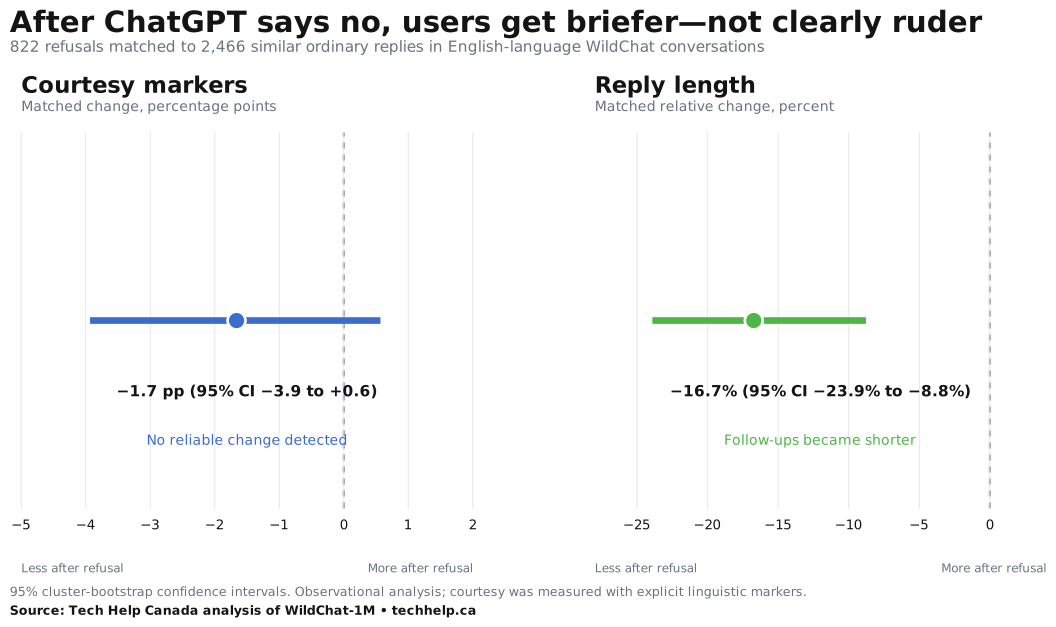
After matching 822 refusals with 2,466 similar ordinary exchanges, continuing users wrote follow-up messages that were approximately 16.7% shorter. We did not detect a statistically reliable change in explicit courtesy markers such as “please,” “thank you,” and “appreciate.”
Put simply, people did not obviously turn hostile. They wrote less.
What changed after a refusal?
Matched estimate
95% confidence interval
What the result supports
Reply length
−16.7%
−23.9% to −8.8%
Follow-ups became shorter
Courtesy markers
−1.7 percentage points
−3.9 to +0.6
No reliable change detected
Gratitude markers
−0.2 percentage points
−1.2 to +0.9
No reliable change detected
Direct corrections
+0.9 percentage points
−0.1 to +2.0
Inconclusive
Frustration markers
−0.4 percentage points
−1.0 to +0.1
No increase detected in the cleaned dataset
People may forgive AI less than we think
Do people forgive LLM errors more readily than human errors?
The best current answer is probably not.
Our analysis cannot answer the human comparison by itself because every conversation we analyzed involved a person talking to ChatGPT. It does show something the laboratory studies miss: what people naturally type when an AI blocks the path they were on.
Other controlled research supplies the comparison.
In a 2026 paper, Ofir Turel and Tingru Cui ran two experiments in which participants received advice from either an AI or a human expert. After the advisor made a noticeable error and apologized, participants reduced their reliance more when the error came from AI. A simple AI apology did not restore reliance or confidence.
That result follows an older pattern known as algorithm aversion. In five studies published in 2015, participants lost confidence in algorithmic forecasters faster than human forecasters after seeing them make a mistake, even when the algorithm performed better overall.
A 2025 experiment involving 1,684 participants found something similar in everyday language. Politeness toward an AI declined across repeated tasks and eroded faster than politeness in a human-to-human benchmark. A human-looking avatar slowed the decline, but did not reverse the underlying pattern.
So the interesting question is no longer whether people can act socially toward machines. Clearly, they can. The question is how long those social habits survive friction.
How we measured what users did next
We used WildChat-1M, a public research dataset of real conversations between online users and GPT-3.5 or GPT-4 systems. The original researchers offered free chatbot access in exchange for affirmative consent to collect conversations anonymously.
WildChat gives us real user behavior at scale, but it is not a representative sample of all ChatGPT users.
We selected three held-out portions of the dataset before calculating the final results. They contained 179,569 conversations. We limited the analysis to English-language, non-redacted conversations with at least one complete sequence of:
a user message;
an assistant response;
another user message.
That left 107,521 eligible transitions.
We then used a deliberately strict detector to identify responses that opened with an explicit refusal. Examples include language such as “I can’t help with that,” “I’m unable to provide,” or “As an AI language model, I cannot…”
The detector looked only near the beginning of the assistant response. This mattered because an earlier development version made a classic text-analysis mistake: it sometimes treated dialogue inside AI-generated fiction as though the assistant itself were refusing. We corrected that problem before the held-out analysis and quarantined the development data.
A blind audit of 120 detected responses found that all 120 genuinely opened with the kind of refusal, limitation, or correction language the rules were designed to catch. That does not prove the detector found every refusal. It supports high precision for the ones it did find.
For the most defensible analysis, we focused on the first refusal in each conversation. Each refusal was matched to three ordinary assistant responses with the same model, a similar task, a similar place in the conversation, and comparable message lengths.
We compared how the same user’s language changed from before to after the assistant response. This difference-in-differences approach helps separate the effect of the interaction from stable differences between naturally polite and naturally brief users.
After a refusal, users wrote less
Courtesy changed too little to call
Before a refusal, 7.7% of treated user messages contained one of our courtesy markers. After the refusal, 6.0% did.
That raw decline is not the final estimate because courtesy also changes during ordinary conversations. After matching and comparing the before-and-after movement in both groups, the estimated difference was −1.7 percentage points, with a 95% confidence interval from −3.9 to +0.6.
Because that interval crosses zero, the data does not establish a reliable courtesy decline.
The distinction keeps the result honest. “We did not detect a change” is not the same as “we proved there was no change.” The estimate leans negative, but the held-out sample leaves meaningful uncertainty.
Gratitude and apology markers were similarly inconclusive. Direct corrections may have increased slightly after refusals, but that estimate also crossed zero.
Reply length fell
Message length gave us a clearer signal.
After accounting for the matched ordinary exchanges, post-refusal messages were approximately 16.7% shorter. The 95% confidence interval ranged from 8.8% to 23.9% shorter.
The median user message moved only from 11 words before a refusal to 10 words after it. That sounds minor, but medians hide the larger contraction among longer messages. The log-transformed analysis, which reduces the influence of extreme outliers, still found a substantial drop.
Among users who continued the conversation, the next message contained less language once the AI said no.
That could mean impatience. It could also mean efficient reformulation: remove the setup, narrow the request, and try again. Some users may have decided the original task was not worth pursuing. Others may have learned what kind of answer the system would permit and adjusted.
The data shows contraction. It does not tell us which motive produced it.
Shorter is not the same as meaner
It would be tempting to turn this into a claim about people becoming rude to machines. The data does not support that conclusion.
Explicit courtesy did not reliably collapse. Frustration markers did not rise. We also did not publish or inspect raw user messages as anecdotes, because hand-picking a few spicy exchanges would be a poor substitute for the aggregate result.
There is another major limitation: the public WildChat release removed conversations flagged as toxic. That makes it inappropriate to use this version to estimate severe hostility or abuse. Our frustration measure can identify mild phrases in the remaining data, but it cannot tell us how often users become abusive after an AI refusal.
The safer interpretation is that the clearest measured shift was in interactional effort, not social tone.
For product teams, this is not academic. A customer does not need to insult a support bot to signal that the experience is failing. Shorter replies, stripped-down commands, repeated corrections, immediate escalation, or abandonment can all reveal that patience is running out.
Politeness can be habit, strategy, or both
“Please” and “thank you” are useful signals, but they are not proof that a user feels moral concern for an AI.
People may be polite to ChatGPT because the habit is automatic. They may prefer the way polite prompts sound. They may believe politeness improves the answer. A 2024 cross-lingual study found that prompt politeness can change LLM performance, although maximum politeness was not consistently best and the effect differed by language.
Politeness can also be strategic if the user thinks the model is nothing more than software.
At the same time, people increasingly describe AI in warmer and more human-like terms. A nationally representative U.S. study collected more than 12,000 metaphors about AI and found that attributions of warmth and human-likeness increased after ChatGPT’s release. Those perceptions predicted trust and willingness to adopt AI.
Humanization can also affect forgiveness. Research on chatbot errors has found that greater anthropomorphism can increase forgiveness through both emotional and cognitive pathways. The 2025 politeness experiment likewise found that a human-looking avatar helped sustain polite behaviour.
These findings do not show that users grant a chatbot the same moral standing as a person. Interface cues, expectations, habits, and perceived usefulness can all influence the language people use.
What this means for companies using AI
A refusal is a product event
Teams often monitor whether a chatbot produced an answer. They should also monitor what happens on the next turn.
A shorter follow-up, abrupt reformulation, repeated correction, escalation request, or conversation exit can reveal more than a thumbs-up widget. These behaviours cost the user effort, which makes them harder to dismiss as empty politeness.
“Sorry” is not a recovery strategy
The controlled evidence suggests that a simple apology does not repair trust in AI as reliably as it does for a human expert.
A useful recovery response needs to do more:
say what failed clearly;
distinguish a policy boundary from a temporary technical limitation;
offer the closest workable next step;
preserve any useful work the user has already supplied;
hand the task to a person when the system has reached its limit.
The goal is not to make the machine sound more remorseful. It is to reduce the amount of work the failure pushes back onto the user.
Do not confuse a friendly interface with earned grace
Human-like avatars and warm language can sustain social behaviour. They can also raise expectations the system cannot meet.
If a chatbot looks and sounds capable, users may punish obvious failures more strongly. A friendly face is not a substitute for a clear recovery path.
What the shorter reply suggests
People are perfectly capable of extending social habits to machines. They say please. They thank the system. They sometimes apologize to it.
But the evidence does not show that LLMs receive more grace than humans after a failure. Controlled experiments point in the opposite direction: equivalent machine errors can produce a larger loss of reliance, and AI apologies may repair less trust.
Our real-world analysis adds a quieter piece to that picture. Among conversations that continued after ChatGPT refused, users did not clearly become ruder. Their next messages became briefer.
The pattern may reflect impatience, efficient reformulation, or both. Either way, sometimes a failure shows up not as cruelty, but as a user giving the interaction fewer words.
Methodology and attribution
This article reports an observational secondary analysis, not a randomized experiment. The methodology page describes the detection rules, matching specifications, robustness checks, aggregate results, and limits of the analysis. We are not publishing raw conversation text, identifying metadata, downloadable analysis files, or derived data files.
Dataset attribution: WildChat-1M by Zhao et al., used under the Open Data Commons Attribution License (ODC-BY).
Get new small business insights by email
Practical ideas and useful articles to help you make better business decisions.
Tech Help Canada Staff researches, writes, and reviews practical content for business owners and professionals. Our coverage spans business, marketing, SEO, technology, and the tools and systems people use to grow and operate online. We focus on clear, useful information backed by research, hands-on experience, and editorial review. Learn more about our team and editorial standards. Need help with something? Contact Us