Potential customers can now ask an AI tool which products, services, or companies they should consider before they ever reach a Google results page.
If your brand never appears in those answers, rank tracking alone won’t warn you.
LLM prompt tracking gives you a practical way to test the prompts buyers might use in ChatGPT, Gemini, Perplexity, Google AI Mode, Copilot, and other AI search experiences, then record whether your brand is mentioned, recommended, cited, ignored, or beaten by competitors.
The key is to measure it without pretending AI answers work like fixed search rankings.
LLM prompt tracking is the practice of repeatedly testing a defined set of prompts across large language model platforms and recording how your brand, competitors, and content appear in the answers.
For example, an accounting software company might track:
What are the best accounting software options for a small construction company?
Each time the company runs the prompt, it records the result under consistent conditions, then compares that result with later runs.
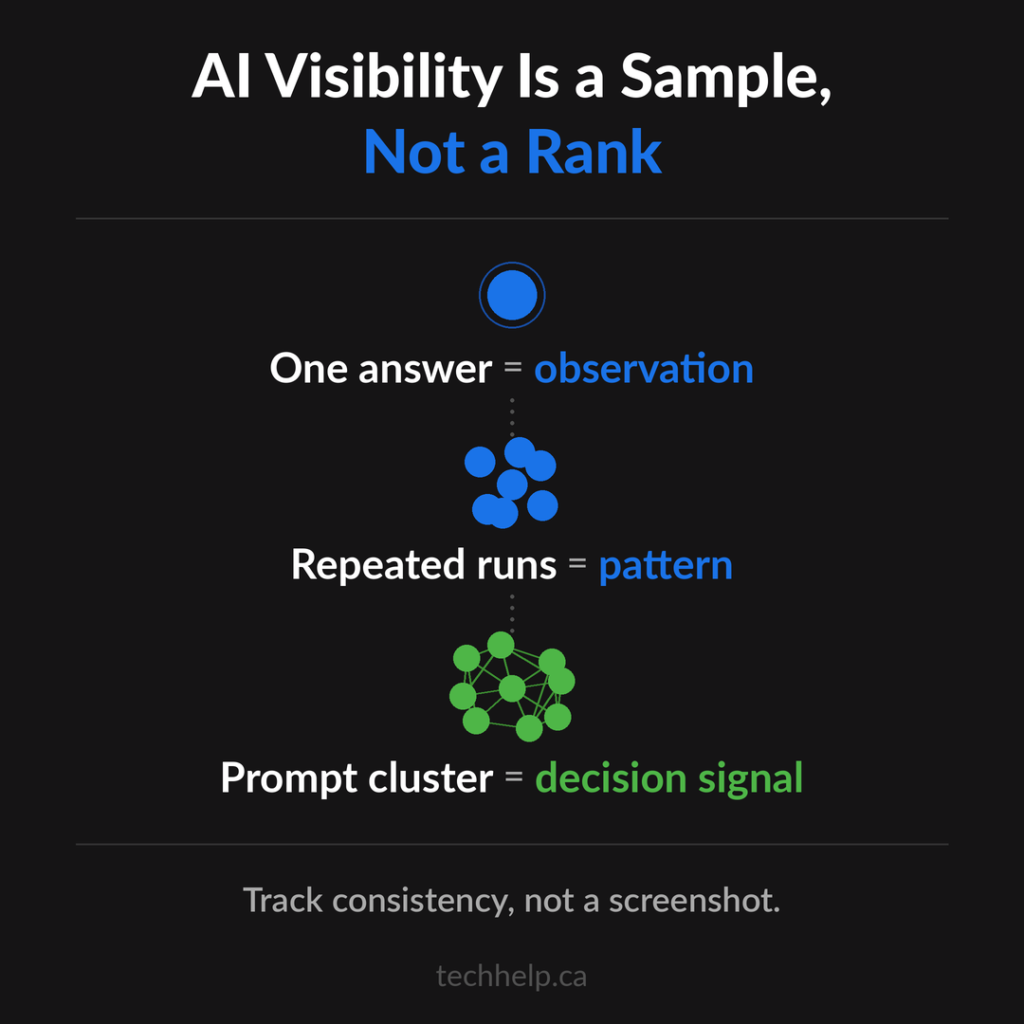
The useful part isn’t the screenshot. The useful part is the pattern.
Does the brand appear at all? Is it recommended or only mentioned? Does the AI cite the brand’s website? Are competitors appearing more often? Are third-party review pages influencing the answer? Is the brand visible for broad prompts but absent from industry-specific prompts?
Those are the signals worth tracking.
Prompt tracking helps you turn AI answers into observations you can compare, instead of relying on a few one-off searches and hoping they represent what buyers see.
Prompt tracking is sampling, not rank tracking
Google rank tracking usually deals with an ordered set of results. A page might move from position seven to position four.
AI-generated answers are more variable. The same prompt may return different wording, brands, recommendations, and citations across sessions, platforms, locations, and product settings. Ahrefs has written about this variability in its prompt-tracking work, and Search Engine Land has argued that prompt tracking works best when treated as sampled observation data rather than a precise ranking system.
One ChatGPT response is an observation, not a ranking position.
If your company appears first once, record it. But the stronger question is:
Across repeated tests of commercially important prompts, how often does our brand appear?
That answer is more useful than celebrating one good result.
The four signals you should track separately
Not every AI appearance has the same business value.
Start by separating four signals.
Signal
What it tells you
Mention
The AI named your brand somewhere in the answer.
Recommendation
The AI presented your brand as an option worth considering.
Citation
The AI used your website as a source.
Competitor appearance
A competing brand appeared in the same answer set.
These signals can move in different directions.
Your website might be cited while a competitor gets recommended. Your brand might appear in a neutral list but not in the final shortlist. A competitor might be recommended because review sites, directories, Reddit threads, or comparison pages consistently connect that competitor with the use case.
If you collapse all of this into one vague “AI visibility score,” you lose the part that tells you what to fix.
Step 1: Build your prompt set around buyer decisions
Don’t begin with hundreds of loosely related questions.
Start with the decisions your customers make.
Maybe you want to know whether AI surfaces your company during category discovery. Maybe product recommendations matter more. Maybe you care about service comparisons, local discovery, reputation questions, pricing concerns, or problems customers research before buying.
A cybersecurity company might test:
What are the best cybersecurity companies for small businesses?
It could also test:
How can a 20-person company protect itself from ransomware without hiring a full security team?
And:
Acme Security vs. Example Security: which is better for a small business?
The first prompt tests category discovery. The second tests visibility around a problem the company solves. The third tests direct comparison.
Your core set should include unbranded prompts too. Someone who asks about your company by name has already discovered you. Unbranded prompts show whether AI introduces you to buyers who don’t know you yet.
Broad informational prompts can still matter. Just don’t let them crowd out prompts tied to buying decisions.
Step 2: Find prompts customers might actually use
Good prompt sets come from customer language, not only SEO tools.
Sales calls, support tickets, contact form messages, customer interviews, reviews, survey responses, Google Search Console queries, keyword research, People Also Ask results, Reddit threads, industry forums, and competitor pages can all reveal useful phrasing.
Classic keyword optimization still helps, but prompts and keywords aren’t identical.
People can talk to AI conversationally. They add circumstances, budget limits, objections, preferences, and use cases that might otherwise require several separate searches.
Instead of tracking only:
Best CRM software
you might also track:
What CRM is easiest for a five-person sales team without a dedicated administrator?
or:
What’s the best CRM under $50 per month for a small real estate company?
Those variations expose different parts of the buying journey.
A starter prompt library
Use this as a starting point, then replace the placeholders with your market, audience, and offer.
Prompt Type
Starter Prompt
Category discovery
What are the best [category] tools for [audience]?
Problem-aware
How can [audience] solve [problem] without [constraint]?
Use case
What is the best [category] for [specific use case]?
Comparison
[Brand] vs. [competitor]: which is better for [audience]?
Alternatives
What are the best alternatives to [competitor] for [need]?
Local
Who are the best [service] providers in [city] for [audience]?
Budget
What is the best [category] under [budget] for [audience]?
Risk
What should I watch out for before choosing [category]?
Evidence
Which [category] providers have the strongest proof for [outcome]?
Implementation
Which [category] is easiest to set up for [team type]?
The best prompts sound like something a buyer would ask when money, time, trust, or risk is involved.
Step 3: Group related prompts into clusters
Individual prompts can get extremely specific. Grouping them helps you see the bigger pattern.
You might organize prompts around:
Category discovery
Problems
Use cases
Comparisons
Alternatives
Budget constraints
Local intent
Reputation
Implementation
Risk
Several questions about inexpensive CRM platforms can form a low-cost CRM cluster. Prompts aimed at real estate companies can form a real estate CRM cluster.
Ahrefs recommends analyzing groups of related prompts instead of relying too heavily on isolated AI queries. It’s the right instinct because a single prompt can be noisy.
If your brand performs poorly on one prompt but strongly across the rest of the cluster, the single result deserves less weight. If your brand is absent across the whole cluster, you have a clearer visibility problem to investigate.
Step 4: Treat AI prompt volume as an estimate
Some platforms estimate how frequently AI prompts or topics are used. Those numbers can help you prioritize, but they aren’t the same as keyword search volume.
Exact demand for individual AI prompts is hard to observe from outside the platforms. Semrush explains that its AI Visibility Toolkit uses different data sources for different reports, including large prompt datasets, topic-level estimates, and daily prompt tracking for custom prompts.
Estimated demand is one input. Business value is another.
A specific prompt may show modest estimated volume and still matter if the person asking it is close to making a large purchase.
Step 5: Keep the test conditions consistent
Your testing environment can influence what you see.
An AI account may have memories, previous conversations, custom instructions, location information, plan limits, workspace settings, or other context.
If you’re trying to approximate what an unfamiliar prospect might encounter, reduce that existing context as much as practical.
With ChatGPT, Temporary Chat can help because it doesn’t access or create memories for personalization. OpenAI’s Temporary Chat FAQ also says enabled custom instructions still apply, so don’t assume Temporary Chat removes every influence.
For a more controlled manual test:
Use a fresh conversation.
Disable custom instructions when practical.
Avoid long-running chats that already include your brand.
Record whether memory, personalization, or location may have affected the response.
Keep platform, model, language, and region consistent.
Perfect neutrality isn’t realistic. Consistency is the goal.
Record the platform and model
Keep track of the platform and, when available, the model used for each test.
A ChatGPT result from one month may not be directly comparable with a later result from a different model or product experience. The same is true across Gemini, Google AI Mode, Perplexity, Copilot, Claude, and other AI search products.
If you automate testing through an API, keep those results separate from consumer-app tests unless you know the conditions are equivalent.
Search Engine Land has highlighted this distinction in AI visibility measurement. API results may not reproduce the exact environment a person gets from the consumer product.
Record whether web search was involved
Search grounding can change the test too.
OpenAI says ChatGPT can search the web for current information and may include citations. Google’s Gemini API documentation says grounding with Google Search connects Gemini models to current web content and can provide citations.
A response produced with current web retrieval isn’t necessarily comparable with one generated without it.
Record whether search was involved when you can. Avoid mixing different conditions and treating them as one dataset.
Geography and language deserve the same attention. “Best accountant” in Toronto and “best accountant” in Miami are different questions. Record the target market whenever location could affect the answer.
Step 6: Repeat the prompts that can change a decision
For high-value prompts, run the same test more than once under the same conditions.
There isn’t a universal number of runs that removes all variability. If you’re doing this manually, three to five runs is a practical starting point for your highest-value prompts. You can test less important prompts fewer times and put the extra effort where a misleading result would cost you.
Suppose you test:
What are the best email marketing platforms for creators?
five times.
Your brand appears in four responses.
Now you have something measurable:
Mention rate: 80%.
Search Engine Land recommends repeated runs, fixed sampling rules, and journey tracking to reduce the weight of single-answer noise.
Follow important conversations past the first question
Buyers don’t necessarily stop after the opening prompt.
They may start with:
What are the best CRM platforms for a 20-person sales team?
Which one is better if I don’t have a dedicated administrator?
Your brand might appear during discovery and disappear once the buyer narrows the options.
For your most valuable prompt clusters, test a few realistic follow-up questions as one conversation. Record whether your brand remains visible as the buyer moves from discovery into comparison and selection.
You don’t need to build a journey around every prompt. Save the extra work for conversations that can affect pipeline, sales, or trust.
Step 7: Turn AI answers into a tracking sheet
You don’t need specialized software to start. A spreadsheet is enough.
The important part is recording different types of visibility separately.
A useful LLM prompt tracking sheet could include:
Field
What to Record
Prompt
Exact wording tested
Prompt cluster
Topic or intent group
Intent
Informational, commercial, comparison, local, etc.
Platform
ChatGPT, Gemini, Perplexity, Google AI Mode, etc.
Model
Model used, if known
Search used
Whether web retrieval or grounding was involved
Location
Target geography
Date
When the test occurred
Run number
First run, second run, third run, etc.
Brand mentioned
Yes or no
Brand recommended
Yes or no
Domain cited
Yes or no
Citation URL
Page cited, if available
Competitors
Competing brands that appeared
Appearance order
Where the brand appeared, when useful
Sentiment
Positive, neutral, negative, or mixed
Repeated sources
Third-party domains that keep appearing
Response record
Link, copied response, or screenshot
Notes
Anything unusual
You won’t need every field for every project.
The goal is to turn individual AI answers into observations you can compare later. Saving the underlying response also lets you revisit a result when something changes.
Step 8: Use simple metrics you can explain
You don’t need one mysterious “AI visibility score.”
A few straightforward calculations can tell you plenty.
Mention rate
Brand mentions / total runs x 100
If your company appeared in 18 of 30 tests, its mention rate was 60%.
Recommendation rate
Responses recommending your brand / total runs x 100
Citation rate
Responses citing your domain / total runs x 100
Competitor appearance rate
Run the same calculation for major competitors.
If your recommendation rate is 35% while the closest competitor sits at 20%, that’s very different from discovering that three competitors appear in more than 70% of your tests.
Source influence
Track which outside sources appear repeatedly. If the same comparison page, review site, forum thread, or industry directory keeps influencing answers, that source may deserve attention.
These metrics become more useful when you calculate them by prompt cluster instead of averaging everything together.
Step 9: Diagnose the visibility problem behind the numbers
Suppose your company appears in 80% of small-business prompts and 60% of low-cost prompts, but only 10% of construction-specific prompts.
You now have a specific weakness to investigate.
Maybe competitors have dedicated construction pages. Maybe industry publications routinely connect them with construction customers. Maybe reviewers discuss their products in that context while barely mentioning yours.
An overall score could hide that difference. Prompt clusters expose it.
Use this diagnosis matrix
What You See
Likely Problem
Next Move
Your site is cited, but competitors are recommended
Your content informs the answer, but your offer isn’t winning selection
Improve comparison, proof, positioning, and use-case fit
Competitors appear across a cluster and you don’t
AI systems see stronger category association elsewhere
Build stronger pages and earn relevant third-party mentions
Your brand appears only in branded prompts
You’re visible to people who already know you
Add unbranded problem, category, and comparison content
Your brand appears with weak or outdated details
The source material may be stale or unclear
Update key pages, product details, profiles, and cited sources
Review sites or directories dominate citations
Off-site sources are influencing recommendations
Improve review presence, listings, partnerships, and earned mentions
AI mentions you negatively
Reputation or proof may be shaping the answer
Audit reviews, public complaints, outdated comparisons, and support issues
Your visibility changes by location
Local source signals differ by market
Strengthen local pages, profiles, citations, and regional proof
This is where LLM SEO becomes practical. You’re not trying to trick an AI system. You’re making your brand easier to understand, verify, cite, and match to the right buyer question.
Follow the sources behind recommendations
Pay close attention to sources that appear repeatedly.
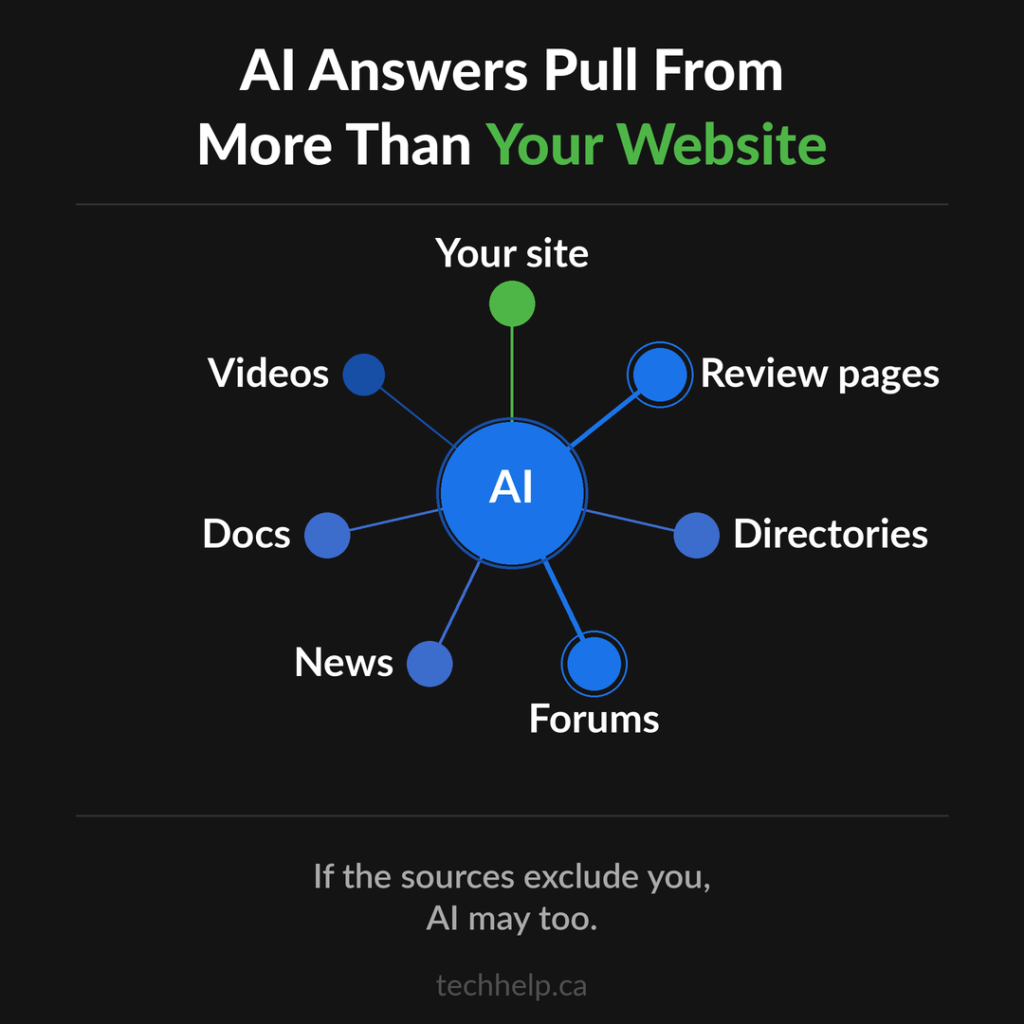
AI answers may rely on company websites, product documentation, review sites, industry publications, comparison pages, directories, Reddit discussions, YouTube videos, research studies, or best-of lists.
Sometimes your website might not be the main issue.
Imagine several AI tools repeatedly rely on the same “10 Best Accounting Platforms” article. Three major competitors are included. Your company isn’t.
Publishing another article on your own website may leave the visibility problem untouched. The better opportunity may be getting included in the sources influencing the recommendation.
That could mean digital PR, partnerships, reviews, expert contributions, comparison-page updates, or inclusion in relevant directories.
Prompt tracking helps you separate a content issue from an off-site visibility issue.
Step 10: Connect AI visibility with business results
Prompt tracking measures whether you’re present in AI-generated conversations. Your business data tells you whether that presence is worth anything.
Watch branded searches, AI referral traffic, engaged sessions, leads, signups, sales, assisted conversions, and customer-reported discovery sources alongside your prompt-tracking data.
Attribution will be imperfect. You can still look for relationships between stronger AI visibility and stronger business signals over time.
If AI referral traffic suddenly drops or a key page loses visibility after a technical change, our website traffic loss audit can help you investigate before you change too many things at once.
The practical question isn’t “What is our exact AI rank?”
Ask better questions:
Are we appearing more often across important prompt clusters?
Are we being recommended, or only mentioned?
Are our pages being cited?
Which competitors keep appearing with us?
Which sources seem to influence the answers?
Are AI visitors turning into engaged sessions, leads, or sales?
Those answers are far more useful than a single screenshot.
Step 11: Keep a stable baseline
Your first test gives you a baseline. Later tests show whether the pattern is changing.
Weekly tracking may make sense if you’re actively working on AI visibility. Monthly testing may be enough for a smaller business or a more stable market.
Consistency matters more than frequency.
Keep a stable core set of prompts so later results remain comparable. Add new prompts when you find worthwhile opportunities, but avoid constantly replacing the original dataset.
Automation becomes useful as the project grows. Semrush supports daily custom prompt tracking, while Ahrefs lets Brand Radar users refresh tracked prompts daily, weekly, or monthly depending on setup.
Manual testing is still valuable early because it forces you to inspect the actual responses, citations, and competitive patterns. Move to automation when the scale makes manual collection impractical.
What not to do with LLM prompt tracking
LLM prompt tracking is useful, but it can mislead you if the method is weak.
Avoid these mistakes:
Don’t treat one AI answer as a ranking.
Don’t average every platform into one blended score.
Don’t mix API results and consumer-app results without noting the difference.
Don’t track only branded prompts.
Don’t keep changing the prompt set before you have a baseline.
Don’t count every mention as a win.
Don’t ignore the sources shaping the answers.
Don’t separate AI visibility from leads, sales, and customer discovery data.
Prompt tracking doesn’t give certainty. It gives you a disciplined way to see whether buyers are encountering your brand in AI answers, where competitors are winning attention, and which content or source problems deserve your next move.
Start with one high-value prompt cluster. Run it under consistent conditions. Record the mentions, recommendations, citations, competitors, and sources. Then improve the places where buyers are being influenced before they ever reach your website.
Frequently Asked Questions
What is LLM prompt tracking?
LLM prompt tracking is the process of testing specific prompts in AI tools and recording whether your brand, competitors, website, and third-party sources appear in the answers. It helps you see how your business shows up in ChatGPT, Gemini, Perplexity, Google AI Mode, and similar AI search experiences.
Is LLM prompt tracking the same as rank tracking?
No. Rank tracking usually measures ordered search results. LLM prompt tracking measures sampled AI answers that can vary by platform, model, location, account context, and whether web search is used. Treat it as directional measurement, not a fixed ranking position.
How many times should you run each prompt?
For important prompts, three to five manual runs is a practical starting point. Higher-value prompts may deserve more repetition, especially if the answers vary heavily or the result could affect a major content, PR, or positioning decision.
Which AI platforms should you track?
Start with the AI platforms your buyers are most likely to use. For many businesses, that means ChatGPT, Google AI Mode or AI Overviews, Gemini, Perplexity, and Copilot. Track platforms separately because strong visibility in one tool doesn’t guarantee strong visibility in another.
What should you record in a prompt tracking sheet?
Record the prompt, prompt cluster, platform, model, date, location, whether search was used, run number, brand mention, recommendation, citation URL, competitors, sentiment, repeated sources, and a copy or screenshot of the response. You can simplify the sheet for smaller projects.
What should you do if AI tools cite your website but recommend competitors?
That usually means your content is useful as a source, but your brand isn’t winning the selection part of the answer. Review your comparison pages, proof, use-case content, third-party mentions, reviews, and positioning to see why competitors are being treated as stronger options.
We empower people to succeed through practical business information and essential services. If you’re looking for help with SEO, copywriting, or getting your online presence set up properly, you’re in the right place. If this piece helped, feel free to share it with someone who’d get value from it. Do you need help with something? Contact Us