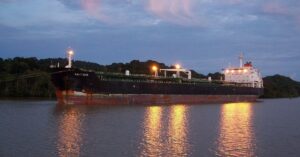
On August 25, 2026, The Maritime Executive reported that SK Gas paid $5.3 million for a single Panama Canal transit slot. The ship, an LPG carrier called G. Spirit, needed to reach the Houston Ship Channel to load propane. Without the payment, Bloomberg reported, the vessel could have waited up to 11 days.
That is an extreme number. For business readers, it is useful because it shows where freight cost pressure is moving.
Most companies will never bid millions of dollars to move one ship through Panama. But if your products, materials, packaging, or suppliers depend on Asia-to-U.S. East Coast or Gulf Coast routes, the canal problem may already be moving toward your landed cost.
Carrier surcharges are live. Draft restrictions are limiting how much some vessels can carry. Reservation slots are being adjusted. And the Panama Canal Authority has made clear that a confirmed reservation is still the only way to guarantee a specific transit date.
The auction made the news. The invoice is where many businesses will feel it.
The record bid shows the price of certainty
The $5.3 million payment bought G. Spirit a September 1 transit through the canal. It also broke a record set earlier in August, when SK Shipping paid $4.6 million for another LPG carrier, G. Arete, to reach the same Houston terminal.
Those bids look irrational until you look at the constraint. The ships were moving in a market where energy routes have been disrupted, LPG demand has shifted, and Panama Canal capacity has tightened. A vessel sitting at anchor loses time, burns operating cost, and can miss a more valuable cargo window.
A $5.3 million canal slot is still abnormal. The useful part is what it reveals: certainty has become expensive.
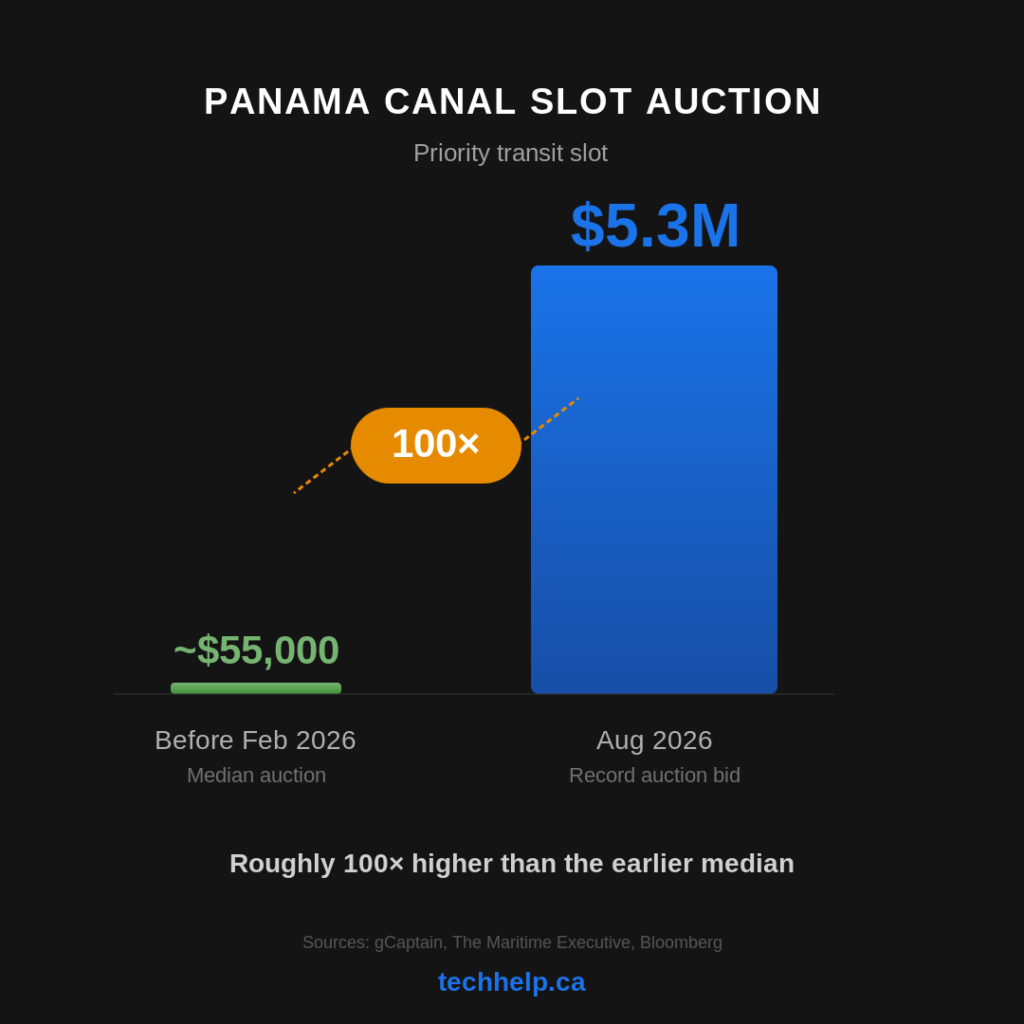
Before February, gCaptain reported that Panama Canal auction medians had been around $55,000. By late August, a single priority slot could sell for nearly 100 times that amount. When access to a crossing window gets repriced that violently, the cost rarely stays inside the shipping industry.
The canal is being squeezed from more than one direction
The Panama Canal problem is congestion colliding with water limits.
The canal depends on freshwater from the Gatun Lake system. When rainfall drops, the canal has to protect water levels by limiting vessel draft, reducing available slots, or changing how bookings are allocated. A deeper-loaded ship carries more cargo. A draft restriction can mean less cargo per crossing, which raises the cost of moving each container.
The Panama Canal Authority announced temporary measures for September because of reduced precipitation in the canal watershed. The update adjusted daily lock capacity, organized auction access by vessel group, and warned that vessels arriving without reservations may face delays. The authority later introduced temporary booking-system changes taking effect August 30 for booking dates beginning September 13, giving Neopanamax customers more flexibility while the water deficit continues.
Those changes may help allocation. They do not create new water.
Geopolitics is adding pressure. Reporting on the record LPG bids tied the surge to disrupted energy flows from the Arabian Gulf, which pushed some Asian buyers toward U.S. Gulf supply. The U.S. Maritime Administration also continues to warn commercial vessels about risks around the Persian Gulf, Strait of Hormuz, Gulf of Oman, southern Red Sea, Bab el-Mandeb Strait, and Gulf of Aden.
For shippers, every alternative carries friction. If the Panama route gets tight, the Suez route, the Cape of Good Hope route, U.S. West Coast ports, and rail all come with different costs, delays, risk profiles, and capacity limits.
The surcharge phase has already started
The multimillion-dollar auction bids are not the main business cost. The more practical issue is that major container lines have already started charging Panama Canal-related fees on relevant routes.
Supply Chain Dive reported that ocean carriers have been raising surcharges as the canal manages water-saving measures and draft restrictions. The details vary by carrier, route, container size, and effective date:
MSC introduced a $100 per TEU Panama Canal Surcharge for shipments from Southeast Asia, China, Korea, and Japan to the U.S. East Coast and Gulf Coast via Panama, effective August 19. MSC later revised the surcharge for September 12 gate-in dates to $149 per 20-foot container, $297 per 40-foot container, and $376 per 45-foot container.
CMA CGM announced a $320 per TEU Panama Canal Adjustment Factor from the Far East to the U.S. East Coast and Gulf via Panama, effective July 25. It later updated that amount to $500 per TEU, effective September 10, excluding Bangladesh to the U.S. East Coast.
Hapag-Lloyd announced a $130 per TEU surcharge from the Far East to North America via Panama, effective August 15.
Ocean Network Express updated its Panama Canal Transit Fee to $150 per TEU for certain eastbound transpacific services routed through the canal, effective August 10, according to Supply Chain Dive.
For a business buyer, the exact number is only part of the problem. The basis matters too.
Is the fee per TEU or per container? Does it apply on gate-in date, sailing date, or another tariff trigger? Does it apply only if cargo moves through Panama? Can it stack with fuel, congestion, peak-season, or general rate increases?
Those questions decide whether a quote still protects your margin.
The business risk is timing
The worst mistake is treating this as a shipping headline that only matters to carriers.
Many companies do not see the exposure until the cost has already moved downstream. A supplier absorbs one increase, then changes pricing on the next purchase order. A distributor adds a freight adjustment. A retailer keeps old pricing live while replacement inventory costs more. A project quote goes out before a material delay becomes obvious.
That is how a supply-chain problem turns into a pricing problem, a margin problem, and sometimes a cash flow problem.
Canadian and U.S. businesses can be exposed even if they do not import directly. If you buy through a North American wholesaler, a U.S. distributor, a private-label supplier, or a manufacturer that sources components from Asia, your cost base may still touch the canal.
This is where business uncertainty becomes operational. You do not need perfect foresight. You need earlier questions, better assumptions, and fewer surprises baked into your next order.
What to check before your next order
Start with your highest-margin-risk products: seasonal goods, private-label items, low-margin inventory, heavy products, bulky products, and anything with a long replenishment cycle.
Then ask specific questions before the next quote becomes a commitment:
Does this product, component, material, or package move through the Panama Canal at any point?
Which carrier, route, service string, and port pair are being used?
Are Panama Canal surcharges included in the quote, listed separately, or still subject to change?
What is the fee basis: TEU, container, gate-in date, sailing date, or another trigger?
What happens if the cargo is rerouted through Suez, the Cape of Good Hope, or a U.S. West Coast port?
Does your customer quote, supplier agreement, or wholesale contract let you pass on freight adjustments?
Which orders should be placed earlier because a one-week delay would hurt revenue?
The point is to stop making pricing, promotion, and delivery promises on old freight assumptions.
If you sell products with canal exposure, build a landed-cost scenario using the current surcharge and the next announced surcharge. For 40-foot containers, a per-TEU fee can be materially different from a per-container fee. Confirm the basis before you use the number in a margin model.
If you rely on a supplier that controls freight, ask for surcharge transparency now. You do not need every operational detail. You do need to know whether the supplier plans to absorb, split, or pass through canal-related costs.
This is not likely to clear in one news cycle
The canal is adjusting bookings and managing water use, but the larger issue is structural. Panama is trying to balance customer demand, weather volatility, vessel size, and long-term water supply.
Longer-term projects may help. The Panama Canal Authority has discussed an energy corridor pipeline that could move propane, butane, and ethane across Panama without using the locks. It has also advanced the Rio Indio reservoir project as a way to strengthen water availability for the canal and the country.
Those are not immediate fixes for September invoices.
For now, the practical takeaway is narrower: if your goods depend on routes that use the Panama Canal, treat canal exposure as a live cost variable. Ask where your freight moves. Check how surcharges apply. Model the next purchase before you price the next sale.
The $5.3 million bid will fade from the news cycle. The cost pressure behind it may stay on your invoice longer.
Frequently asked questions
Why did a ship pay $5.3 million to cross the Panama Canal?
SK Gas paid $5.3 million for a priority Panama Canal transit slot so the LPG carrier G. Spirit could avoid a long wait and reach Houston to load propane. The bid reflected a tight market for canal access, disrupted energy routes, and water-related capacity limits at the canal.
Are Panama Canal costs already affecting importers?
Yes, some importers are already seeing Panama Canal-related costs through carrier surcharges. The impact depends on the carrier, route, container size, effective date, and whether the cargo moves through the canal.
Which shipping lines have announced Panama Canal surcharges?
MSC, CMA CGM, Hapag-Lloyd, and Ocean Network Express have announced or updated Panama Canal-related fees on relevant routes. Businesses should confirm the current fee, basis, and effective date directly with their carrier, freight forwarder, or supplier.
How can a business tell whether it has Panama Canal exposure?
A business has Panama Canal exposure if its products, components, materials, packaging, or supplier shipments move through the canal at any point. The fastest check is to ask suppliers and freight forwarders for the carrier, route, service string, and surcharge basis on upcoming shipments.
What should businesses do about Panama Canal shipping costs?
Businesses should review affected SKUs, confirm canal routing, ask how surcharges are calculated, model landed costs before pricing the next sale, and build extra time into orders where a delay would hurt revenue. The goal is to make buying and pricing decisions with current freight assumptions.
Get new small business insights by email
Practical ideas and useful articles to help you make better business decisions.
Tech Help Canada Staff researches, writes, and reviews practical content for business owners and professionals. Our coverage spans business, marketing, SEO, technology, and the tools and systems people use to grow and operate online. We focus on clear, useful information backed by research, hands-on experience, and editorial review. Learn more about our team and editorial standards. Need help with something? Contact Us