Statistics Canada’s June payroll data looks calm at first glance. Payroll employment rose by 4,800 positions, which rounds to almost no change nationally, after a stronger gain of 45,000 in May.
The sector split is less comfortable.
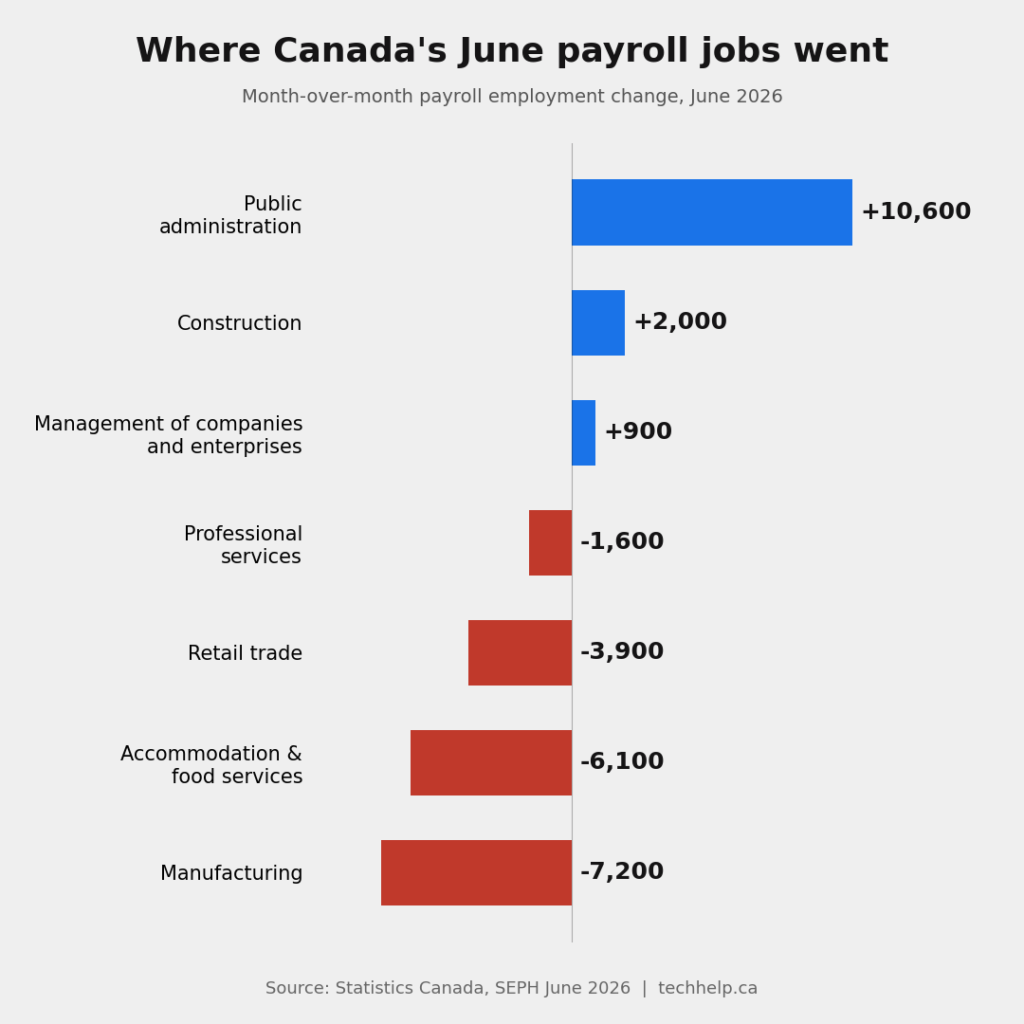
Public administration added 10,600 payroll jobs in June. Construction added 2,000. Management of companies and enterprises added 900. Those three gains were enough to hide declines in manufacturing, accommodation and food services, retail, and professional services.
For business owners, that’s the useful signal. Canada’s labour market isn’t moving as one block. Some employers are still fighting for workers. Others are cutting payroll before the newest tariff shock appears in the data.
The headline gain leaned on public administration
Statistics Canada’s Survey of Employment, Payrolls and Hours, or SEPH, measures employees receiving pay and benefits from employers. It differs from the Labour Force Survey, and it excludes groups such as self-employed workers, owners and partners of unincorporated businesses, and agricultural employees.
That distinction matters because this release is about payroll employment, not every person working in Canada.
In June 2026, payroll employment was little changed, rising by 4,800. Year over year, payroll employment was up 155,000, or 0.8%.
The gain looks steadier than it feels once the sector detail comes in. Public administration alone added more than twice the net national increase. Statistics Canada said recent federal public administration gains were associated with hiring census enumerators and crew leaders.
That hiring was temporary by design. Statistics Canada had announced roughly 32,000 census jobs across the country, with opportunities running between March and July 2026 depending on position and location.
So June’s headline number was supported by work that was always expected to fade.
The private-sector pain was concentrated
The weak spots were specific.
Manufacturing lost 7,200 payroll jobs in June, its first decline since December 2025. The drop erased a meaningful share of the 18,600 jobs the sector had added from December 2025 through May 2026. Machinery manufacturing, fabricated metal manufacturing, and primary metal manufacturing led the monthly decline.
Accommodation and food services lost 6,100 positions, with full-service restaurants and limited-service eating places accounting for most of the drop. That matches the pressure Restaurants Canada has been warning about: weak profitability, rising costs, and thinner room for operators to absorb setbacks.
Retail trade lost 3,900 positions after three straight monthly gains. Grocery and convenience retailers and general merchandise retailers posted the largest declines, while clothing and accessories retailers moved higher.
Professional, scientific and technical services slipped by 1,600 jobs. It’s a small monthly move, but it matters because this category includes outside expertise many companies use when they are investing, building, marketing, modernizing, or trying to solve operational problems.
Put together, the release points to an uneven economy rather than a collapse. Construction still added jobs. Public administration rose. Some retail categories held up. But several business-facing sectors moved backward at the same time.
Wages rose, but averages can flatter the picture
Average weekly earnings reached $1,343.86 in June, up 3.4% from a year earlier and 0.6% from May.
That sounds stronger than the payroll detail. It may still be good news for many workers, but Statistics Canada warns that average weekly earnings can move for several reasons: wage changes, employment composition, hours worked, and base-year effects.
In other words, an average can rise even when the labour market is not broadly strengthening. If lower-paid roles are reduced faster than higher-paid roles, the average can look better without every worker receiving a meaningful raise.
Average weekly hours worked were little changed at 33.4. That makes the wage number useful, but not enough on its own to call the labour market healthy.
Vacancies show a mismatch, not simple strength
Job vacancies edged up by 10,500 in June to 509,100. The vacancy rate held at 2.8%, unchanged from May and from June 2025. The unemployment-to-job-vacancy ratio fell to 2.9, down from 3.0 in May and 3.1 a year earlier.
At first glance, that sounds like employers are still hungry for labour.
The sector detail is more complicated. Manufacturing vacancies were up 17.3% year over year even as manufacturing payrolls fell in June. Retail vacancies were up 8.3% year over year. Professional, scientific and technical services vacancies were up 9.1%.
Those two facts can sit beside each other. Employers can cut some roles while still struggling to fill others. A manufacturer may reduce general headcount while still needing specialized technicians. A retailer may reduce hours in one location while trying to hire for another. A services firm may delay broad hiring while still competing for people with specific skills.
For employers, the takeaway is practical: don’t assume a softer labour market means every role becomes easier to fill.
Tariffs make June a pre-shock reading
The June payroll release doesn’t capture the late-August trade shock.
On August 22, 2026, the United States imposed 50% tariffs on a range of Canadian imports under Section 338 of the Tariff Act of 1930. The Government of Canada said the U.S. tariffs cover $27.6 billion of Canadian goods.
Canada has announced counter-tariffs on $27.6 billion in U.S. products, effective September 8, 2026. The targeted countermeasures are concentrated in sectors such as steel and aluminum, dairy, appliances, agricultural equipment, pulp and paper, plastics, and electronics. Finance Canada also announced a $7.5 billion package of new and expanded support for affected workers and businesses, including measures aimed at small and medium-sized enterprises.
The Trade Commissioner Service says the new U.S. Section 338 tariffs don’t include an exemption for goods that qualify for preferential duty-free treatment under CUSMA. That’s a serious detail for exporters who assumed compliance with the trade agreement would protect the shipment.
CFIB’s tariff survey shows how exposed small exporters feel. Among exporters with affected products, 77% expected revenue losses if the tariffs were implemented, and 35% expected revenue to fall by at least half.
The timing is the problem. Manufacturing was already down in June. Retail and hospitality were already softer. Business confidence had already weakened in August, with CFIB’s short-term optimism index falling to 52.4 and more employers planning layoffs than hiring.
The next payroll releases will show whether the tariff shock turns a sector split into a deeper hiring pullback.
What business owners should watch now
One number won’t give you the answer in this labour market.
If you’re hiring, separate roles into two groups: roles you can fill more easily because the market is softer, and roles that will still be hard to hire because the skills are scarce. Construction, specialized manufacturing, and technical roles may not follow the national headline.
If you’re in manufacturing, retail, hospitality, wholesale, logistics, or business services, update your hiring plan against demand and margin, not last quarter’s assumptions. A role that made sense before a tariff change, supplier increase, or sales slowdown may need a different start date now.
If your cash flow is already tight, watch the timing between higher costs and customer payments. Tariffs, wage pressure, inventory costs, and slower sales can stack faster than a monthly payroll headline will show.
If you sell into tariff-exposed sectors, ask customers earlier about delayed orders, revised budgets, and payment timing. The payroll data will lag those conversations. Your receivables may not.
And if you’re making a Q4 plan, build trigger points instead of waiting for certainty. Decide now what you will do if July payrolls weaken, if September counter-tariffs raise input costs, or if customers delay orders. That kind of planning is how business uncertainty becomes manageable.
Canada’s June payroll gain was thin.
The public sector lifted the headline. Census hiring added temporary support. Several business-facing sectors moved backward. And the biggest trade shock arrived after the data window closed.
For business owners, one payroll release should not become a recession forecast. It should stop you from reading the national number as if every sector is living the same economy.
Frequently asked questions
What did Statistics Canada report for June 2026 payroll employment?
Statistics Canada reported that payroll employment rose by 4,800 positions in June 2026, which was effectively flat nationally. The increase followed a gain of 45,000 in May, while payroll employment was up 155,000 from a year earlier.
Why can a 4,800 payroll-job gain still be weak?
The national gain was small, and public administration added 10,600 positions by itself. Several business-facing sectors moved lower, including manufacturing, accommodation and food services, retail trade, and professional, scientific and technical services.
Why did public administration add so many jobs?
Statistics Canada said recent federal public administration gains were associated with the hiring of census enumerators and crew leaders. Earlier in 2026, Statistics Canada announced plans to hire roughly 32,000 temporary census workers across the country.
Which sectors lost payroll jobs in June 2026?
Manufacturing lost 7,200 payroll jobs, accommodation and food services lost 6,100, retail trade lost 3,900, and professional, scientific and technical services lost 1,600. Construction, public administration, and management of companies and enterprises posted gains.
How should business owners read the June payroll data?
Business owners should treat the national number as a starting point, then look at sector exposure. Hiring, pricing, cash flow, and inventory decisions should be based on the industry they operate in, tariff exposure, customer demand, and whether key roles are still hard to fill.
Get new small business insights by email
Practical ideas and useful articles to help you make better business decisions.
Tech Help Canada Staff researches, writes, and reviews practical content for business owners and professionals. Our coverage spans business, marketing, SEO, technology, and the tools and systems people use to grow and operate online. We focus on clear, useful information backed by research, hands-on experience, and editorial review. Learn more about our team and editorial standards. Need help with something? Contact Us