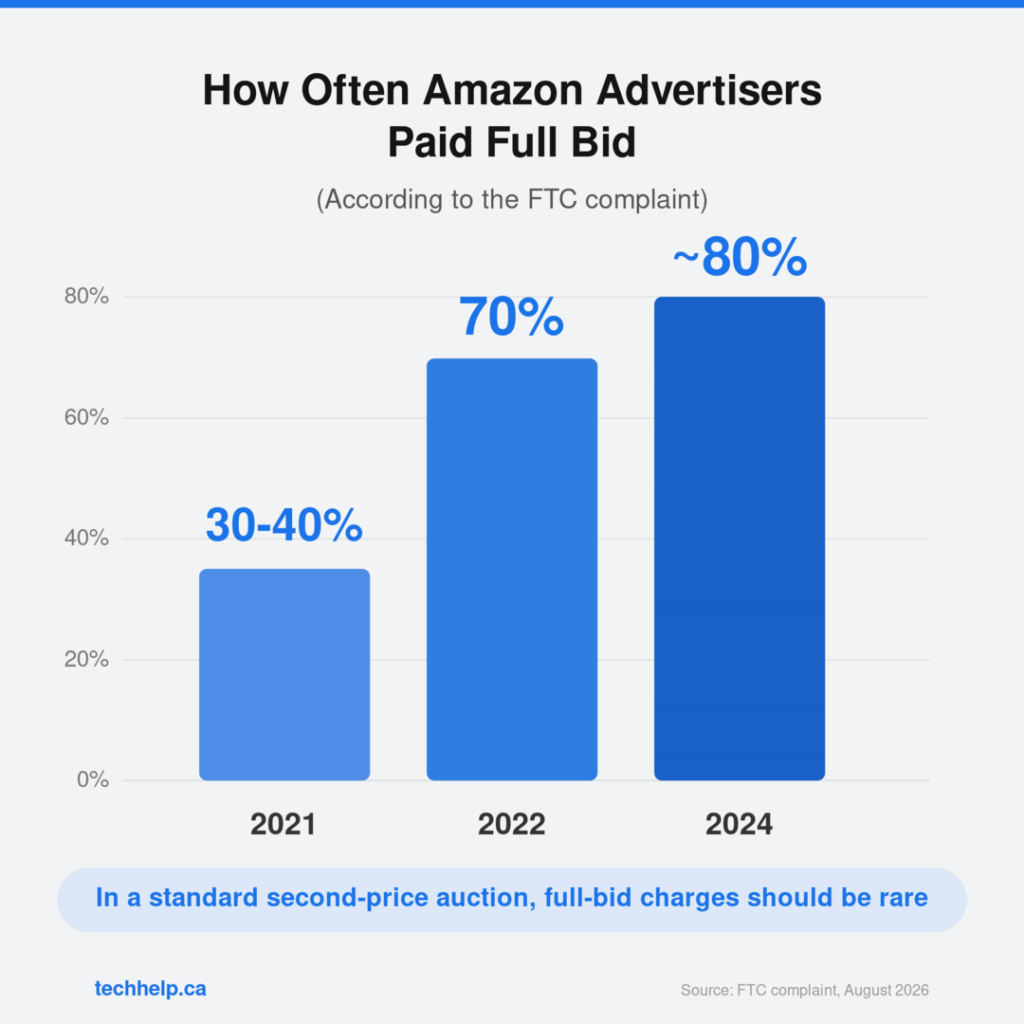
The lawsuit claims Amazon told advertisers they were in a second-price auction while using hidden reserve pricing that pushed many sellers closer to their full bid.
If you sell on Amazon, rising cost per click can feel like the price of staying visible. More brands enter the category, more sellers chase the same keywords, and the ad bill climbs while margins get thinner.
The Federal Trade Commission now says competition may not explain all of it.
On August 31, 2026, the FTC and 22 states sued Amazon in the U.S. District Court for the Western District of Washington. The complaint alleges that Amazon secretly inflated prices in its advertising auctions and extracted more than $20 billion from about 1.2 million U.S. advertising customers, including more than 500,000 small and medium-sized businesses.
Amazon denies the allegations. The company says the FTC is mischaracterizing how its ad auctions work, and argues that advertisers have benefited from better ad relevance, lower average winning bids, and stronger performance.
For sellers, the case raises a practical question before the court decides anything: are you bidding as if Amazon’s auction will protect you from your own ceiling bid?
The auction sellers thought they were bidding in
Amazon’s sponsored ads have long been described as a version of a second-price auction. That structure is familiar to many sellers running Amazon PPC campaigns.
In a simple second-price auction, you set the most you’re willing to pay for a click. If you bid $2 and the next competitor bids $1.10, you do not pay your full $2. You pay just enough to beat the next bidder, often one cent more.
That design changes bidder behavior. If sellers believe the auction will discount the final price, they have an incentive to bid closer to their true maximum. The ceiling bid feels safer because the system is supposed to charge less when competition is lower.
The FTC says Amazon repeatedly represented its auctions that way through public materials, training content, sales teams, and partner messaging.
The FTC says the system no longer worked that way.
The FTC says Amazon added a hidden price floor
According to the complaint, Amazon began changing its ad pricing system in late 2018 and allegedly overcharged advertisers from 2019 forward.
The FTC says Amazon used undisclosed reserve pricing, including what internal materials called a “soft reserve price,” to replace the price produced by the auction with a higher number chosen by Amazon’s system. The agency describes that reserve as a hidden surcharge, not a normal second-price auction result.
The complaint cites internal Amazon language saying the second price was not set by an actual bidder, but by Amazon as a calculated “proxy 2nd price.” It also cites a reference to an “invented auction participant.”
In plain business terms, the FTC’s allegation is this: sellers thought another advertiser was setting the price they needed to beat, but Amazon was allegedly inserting its own price into the outcome.
The FTC says the effect grew over time. For Sponsored Products ads, the complaint alleges advertisers paid their own bid amount between 30% and 40% of the time in 2021. That rose to 70% in 2022 and about 80% in 2024.
If those numbers hold up in court, the bidding lesson is uncomfortable. A system where winners pay their full bid most of the time behaves much more like a first-price auction than the second-price model many sellers thought they were using.
The secrecy claim may matter as much as the surcharge
The FTC’s lawsuit is not only about whether Amazon used reserve pricing. It is also about disclosure.
The complaint alleges Amazon knew advertisers believed they were bidding in a genuine generalized second-price auction. It also says Amazon concealed the surcharge system because revealing it could damage advertiser trust and cause advertisers to lower their bids.
The agency claims Amazon tested surcharge increases to see how much it could raise prices without detection. It also alleges Amazon increased surcharges around high-volume shopping periods, including Prime Day and Black Friday, when sellers might assume rising CPCs were caused by seasonal competition.
This part of the case turns an auction-design dispute into a trust dispute. Sellers can accept higher ad costs when the rules are clear. The risk is making bid decisions under one set of assumptions while the platform is allegedly using another.
Amazon says the FTC has it wrong
Amazon’s response is direct. The company calls the lawsuit misguided and says the FTC is leaning on a small number of simplified internal communications to suggest a companywide deception effort.
Amazon says no advertiser pays more than their bid. It also argues that its ad system gives more weight to relevance than raw bid amount, which can place better-matched ads ahead of higher bidders.
The company says roughly 92% of selected Sponsored Products ads in 2024 did not go to the highest bid. It also says average winning bids for Sponsored Products search ads fell 50% from 2019 through 2024, average cost per click stayed flat when adjusted for inflation, and conversion rates for individual Sponsored Products advertisers increased more than 24% from 2021 through 2025.
Amazon also estimates that advertisers saved more than $8 billion from 2021 to 2025 because its auction system prioritized ad relevance instead of simply awarding placements to the highest bid.
Those claims do not erase the FTC’s case, but they do frame Amazon’s defense: the company is arguing that advertiser outcomes, not the FTC’s reading of auction mechanics, show the system worked.
Sellers should audit bids before the case is resolved
The lawsuit may take years. Sellers do not need to wait that long to learn from it.
The immediate move is to compare your actual CPCs against your bid ceilings, especially on Sponsored Products campaigns. If your click costs regularly land close to your maximum bid, the auction is not giving you much pricing distance. That should change how aggressively you set bid caps.
A seller who believes a second-price system will protect them may bid higher to win placement. A seller who treats the auction like a first-price environment will usually bid closer to what the click is actually worth.
Do not cut every bid automatically. Tighten the math instead. Look at CPC, conversion rate, average order value, contribution margin, and ACoS by campaign, keyword, match type, and product. If ad spend is eating into variable costs and profit, the bid ceiling may be too generous for the economics of the product.
Peak shopping periods deserve a separate look. If Prime Day, Black Friday, or holiday campaigns show CPC spikes without matching improvements in conversion or order value, treat that as a pricing signal, not just a traffic signal.
This reaches beyond one marketplace
Amazon’s advertising business is too large for sellers to ignore. Amazon reported $68.635 billion in advertising-services revenue in 2025, and EMARKETER has estimated that Amazon holds roughly four-fifths of U.S. retail media digital ad spending.
The scale raises the stakes. A retail media network is not just another ad channel when it controls the shopping shelf, the auction, the reporting, and the checkout environment. For many brands, Amazon ads are not optional in the same way a display campaign might be optional.
The structural risk is not unique to Amazon. Any platform that runs the auction, writes the rules, measures the result, and sells access to buyers has an incentive to maximize its own take. Advertisers have to manage that tension with their own reporting, not just the platform’s dashboard.
The FTC still has to prove its case. Amazon still gets to defend its system. Sellers, meanwhile, can protect themselves by treating bid ceilings as money they may actually spend.
If your Amazon CPCs have been rising, do not assume the market is giving you the full explanation. Pull the bid data, compare it to actual click costs, and rebuild your bid limits around profit instead of hope.
Frequently asked questions
What is the FTC accusing Amazon of doing?
The FTC and 22 states allege that Amazon secretly inflated advertising auction prices through undisclosed reserve pricing. The complaint says the practice affected about 1.2 million U.S. advertising customers and likely extracted more than $20 billion from advertisers.
Has Amazon admitted wrongdoing?
No. Amazon denies the allegations and says the FTC is mischaracterizing its ad auction system. The company says advertisers do not pay more than their bids, average winning bids fell, cost per click stayed flat after inflation, and ad relevance improved results.
What is a second-price ad auction?
In a second-price auction, the winning bidder does not usually pay the full amount they bid. They pay the minimum amount needed to beat the next eligible bidder, often one cent more. That structure can encourage advertisers to bid closer to their true maximum because they expect the auction to discount the final price.
What should Amazon sellers check now?
Sellers should compare actual CPCs against bid ceilings by campaign, keyword, match type, and product. If actual click costs often sit close to the bid cap, sellers should treat the bid as a price they may pay and rebuild limits around contribution margin, conversion rate, ACoS, and profit.
Does this mean Amazon ads no longer work?
No. Amazon ads can still drive sales for sellers with strong products, margins, targeting, and conversion rates. The lawsuit is a reminder that sellers should not rely only on platform-reported performance or assume the auction will protect them from high bids.
Get new small business insights by email
Practical ideas and useful articles to help you make better business decisions.
Tech Help Canada Staff researches, writes, and reviews practical content for business owners and professionals. Our coverage spans business, marketing, SEO, technology, and the tools and systems people use to grow and operate online. We focus on clear, useful information backed by research, hands-on experience, and editorial review. Learn more about our team and editorial standards. Need help with something? Contact Us