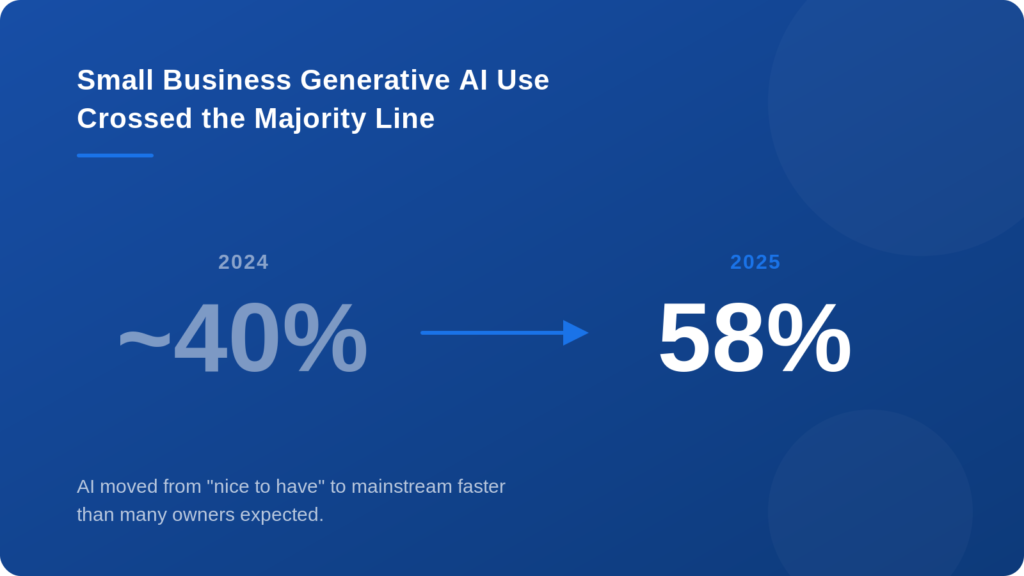
One stat stands out: in 2024, fewer than half of small businesses were using generative AI. By 2025, that number had crossed the majority line. In roughly a year, AI went from a “nice to have” to a mainstream part of small business operations. Broader AI adoption in business has become harder for owners to ignore.
But a number by itself doesn’t help you make a decision. So this isn’t just a list of stats. We pulled out the numbers worth using and paired each one with a practical takeaway. Whether you’re already using AI or still figuring out where to start, this roundup will help you see where you stand and which opportunities are worth testing first.
The Big Picture: How Many Small Businesses Are Actually Using AI?
The shift has been dramatic. According to the U.S. Chamber of Commerce, 58% of small businesses now use generative AI, up from roughly 40% in 2024. That’s a fast shift in a short window.
And that figure only captures generative AI specifically. When you broaden the view, the Reimagine Main Street survey found that 76% of small businesses are either actively using AI or exploring it. The undecided group is shrinking fast.
Another strong signal comes from the U.S. Chamber’s 2025 technology report: 96% of small business owners plan to adopt emerging technologies, including AI. That level of interest suggests many remaining holdouts aren’t anti-AI. They just haven’t found the right first use case yet.
What This Means for You
If you haven’t started experimenting with AI, you’re now in the minority among your peers. The good news is that getting started is now easier and cheaper than it used to be, and the adoption numbers show AI has become practical for everyday small business use. The goal isn’t to transform your entire operation overnight. It’s to get your first win with a single tool and build from there.
The Gap Is Closing: Small Businesses Are Catching Up Fast
For years, AI felt like a big-company advantage. Enterprise firms had the budgets, the tech teams, and the infrastructure. Small businesses? Most were still trying to figure out what ChatGPT was.
One caveat is worth keeping in mind: these studies don’t all measure AI adoption the same way. Some count self-reported generative AI use or exploration, while Census-style and transaction-based studies often capture narrower forms of operational or paid AI use.
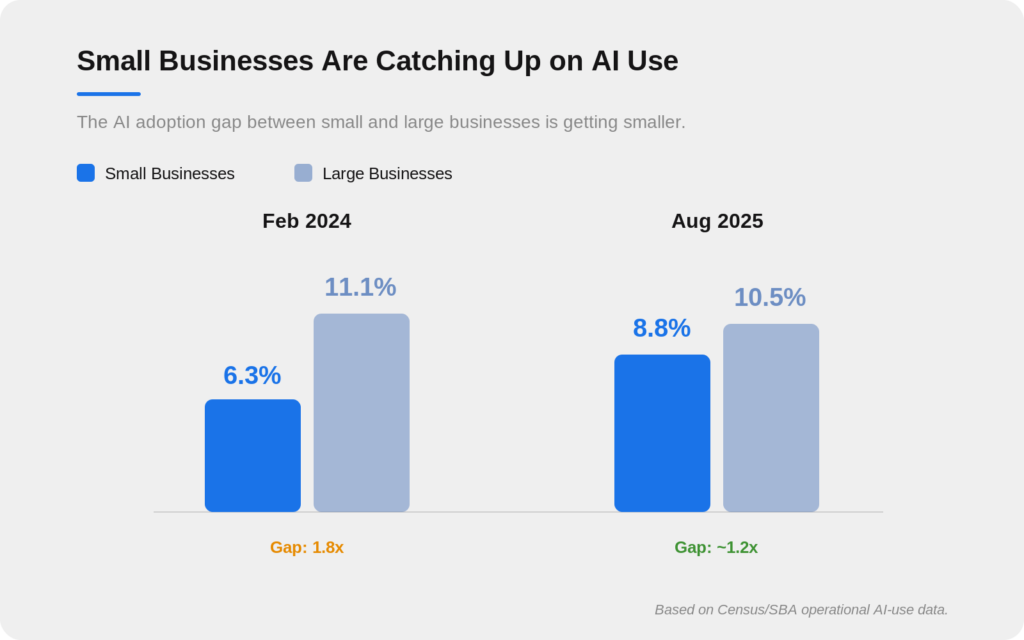
Even with that caveat, the “AI is only for big companies” narrative is outdated. An SBA Office of Advocacy analysis of Census Bureau Business Trends and Outlook Survey data found that in February 2024, large businesses used AI at about 1.8 times the rate of small businesses: 11.1% versus 6.3%. By August 2025, small business usage had climbed to 8.8%, while large business adoption had dipped slightly to 10.5%. The gap went from nearly double to much narrower in eighteen months.
There’s one useful wrinkle here. Sole proprietors are much less likely to use AI than businesses with more employees: Service Direct’s small business AI report puts adoption at 47% for sole proprietors versus 85% for businesses with employees. Having even one other person on your team seems to make a significant difference, likely because it gives you someone to share the learning curve with and bounce ideas off.
What This Means for You
The idea that AI is “only for big companies” simply doesn’t hold up anymore. If you’re a solo operator, consider joining a small business community or mastermind group where AI use is discussed. The data suggests solo operators may need more support around experimentation, tool choice, and confidence-building than businesses with teams.
Where the Money’s Going: AI Spending Patterns
Now, let’s talk dollars. One concern you might have is that AI adoption requires a massive investment. The data tells a different story.
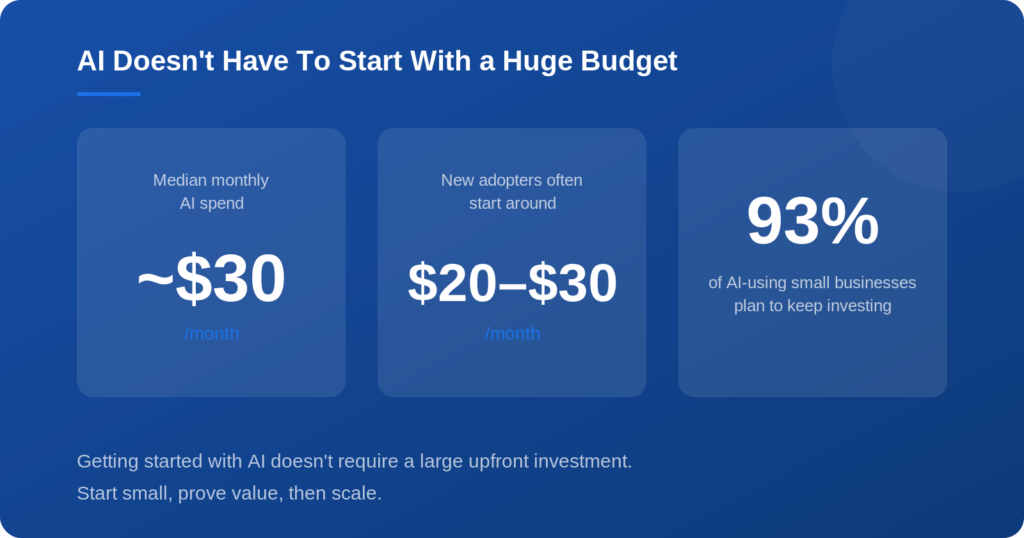
According to JPMorgan Chase’s research on small business AI spending, the median monthly spend on AI tools is approximately $30. That’s less than many common business software subscriptions. The research also found that newer adopters tend to enter at price points between $20 and $30 per month, which means the barrier to entry is remarkably low.
SBE Council also reports that 93% of small businesses using AI plan to continue investing in it over the next year. The scale of that reinvestment varies by size, though. Service Direct’s small business AI report found that 62% of businesses with more than 20 employees plan to spend over $5,000 on AI in the next two years, compared to 25% of businesses with 20 or fewer employees. The pattern is clear: start small, prove the value, then scale up. For Canadian businesses, programs like BDC’s $500M AI program for SMEs also show how AI adoption is becoming a financing and implementation priority, not just a software trend.
What This Means for You
You don’t need to commit thousands upfront. Many newer adopters appear to start with a single tool at $20 to $30 per month and scale from there. Start with a free tier or trial, prove the value on one specific task, and then expand. Businesses that see results often increase their investment over time. You may too.
Where Small Businesses Are Actually Using AI
So where are small businesses using AI first? Depending on the survey, marketing, content generation, customer engagement, and data analysis all show up near the top.
Marketing and customer-facing work are common entry points. SBE Council identifies marketing and content creation as one of the leading small-business AI use cases. Thryv’s 2025 survey also found that among current AI-using small businesses, 62% use AI for data analysis, 55% use it for content generation, and 46% use customer engagement tools like chatbots.
The typical small business in the SBE Council’s survey now uses a median of five AI tools across its operations, combining assistants, marketing platforms, and automation tools. That number might sound high, but it adds up quickly: an AI-powered email platform, a website chatbot, a content tool, a scheduling assistant, and an AI-enhanced CRM would already put a business at five.
What This Means for You
If you’re not sure where to start, marketing is a sensible first place to look. It’s one of the strongest entry points for good reason. Content creation, social media scheduling, and email campaigns are tasks that eat hours every week, produce measurable results, and are well-suited to AI assistance. You don’t need to overhaul your entire operation. Start with the function where you spend the most time on repetitive work.
The ROI That Matters: Time and Money Saved
For small business owners, time is often the scarcest resource.
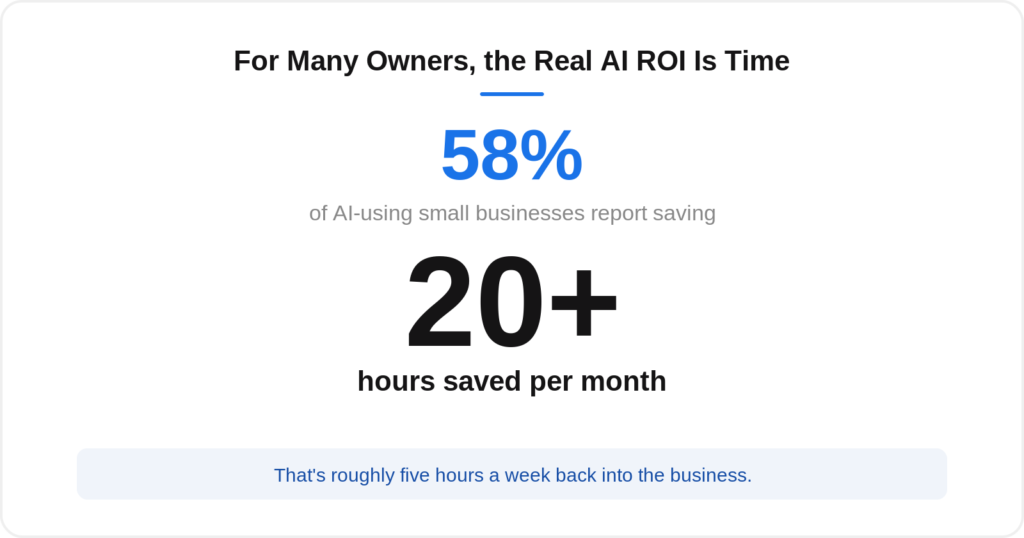
In Thryv’s survey, 58% of small businesses using AI reported saving more than 20 hours per month. For context, that’s roughly five hours a week, nearly a full workday redirected to higher-value tasks.
And the time savings aren’t distributed evenly: managers save an average of 7.2 hours per week, more than double the 3.4 hours individual contributors save. That makes sense when you consider how much of a manager’s or owner’s day is consumed by administrative coordination, communications, and decision-support tasks that AI handles well.
On the marketing side specifically, the time-savings case is easy to see: content generation, email drafts, campaign ideas, and customer messages are all repeatable work where AI can reduce manual effort. In one UK government Microsoft 365 Copilot trial, users reported saving an average of 26 minutes per day, showing how quickly AI-assisted document and admin work can add up.
The financial returns can be meaningful too. A Microsoft-sponsored IDC study found that companies were realizing an average return of $3.50 for every $1 invested in AI overall, though AI customer service is one of the clearer areas where businesses often look for measurable savings. In the same Thryv survey, 66% of respondents said AI saves their business between $500 and $2,000 per month.
What This Means for You
Twenty hours a month isn’t a marginal improvement. For a small business owner wearing five hats, it’s transformative. Calculate what your time is worth per hour, multiply it by 20, and that gives you a rough sense of the potential monthly value AI could deliver. The data also suggests the time savings may be especially noticeable if you’re the owner or a manager, since AI can free up coordination and administrative time at the top.
The Growth Connection: AI Users Are Outpacing Non-Users
The growth data is one of the strongest parts of the story.
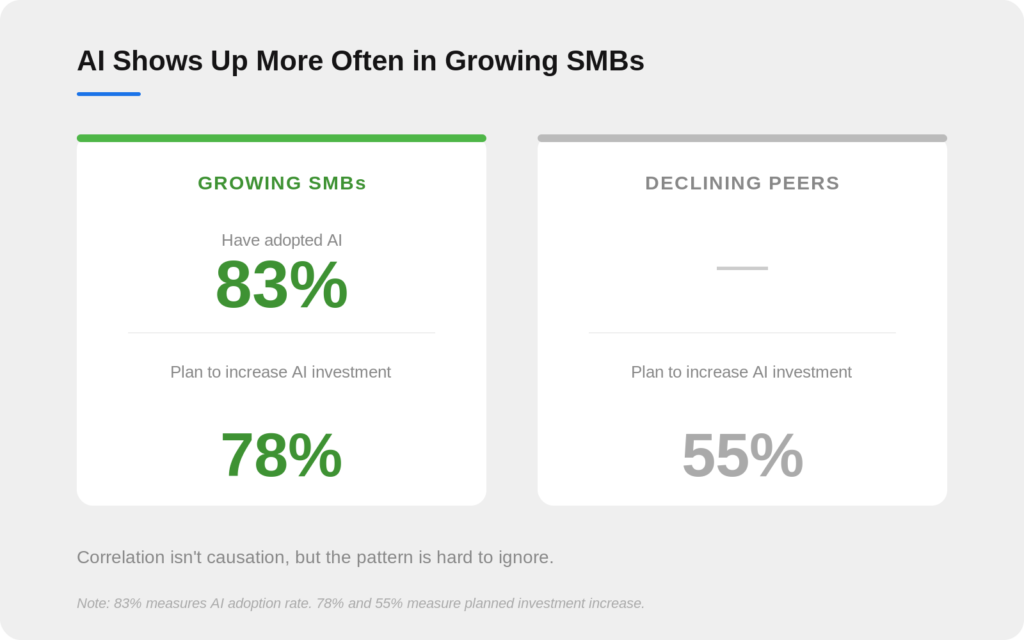
Salesforce found that 83% of growing SMBs have adopted AI, while 78% of growing SMBs plan to increase AI investment next year, compared with 55% of declining peers. Now, correlation isn’t causation. It could be that healthier businesses simply have more resources to invest in new tools. But the pattern is consistent across multiple studies and worth taking seriously.
The forward-looking numbers reinforce the trend: Goldman Sachs found that 74% of surveyed small business owners plan to grow their business in the next year. For some businesses, that can create a useful cycle: adopt AI, see results, reinvest, and build more capacity for growth.
Supporting this, 91% of SMBs with AI say it boosts their revenue, while 87% say it helps them scale operations and 86% report improved margins. Those are unusually high positive-response rates, which is rare for any business tool.
What This Means for You
The link between AI adoption and growth is showing up clearly in the data, even if the data doesn’t prove AI caused the growth by itself. If your business is in a growth phase, AI can help you scale without proportionally scaling your headcount or hours. If your business has stalled, AI might be the operational lever that frees up enough time and resources to refocus on growth. Either way, AI use is increasingly common among businesses that report growth, which makes it hard to treat these tools as optional background noise.
What’s Holding Businesses Back
Not every small business is on board yet, and the reasons why are revealing.
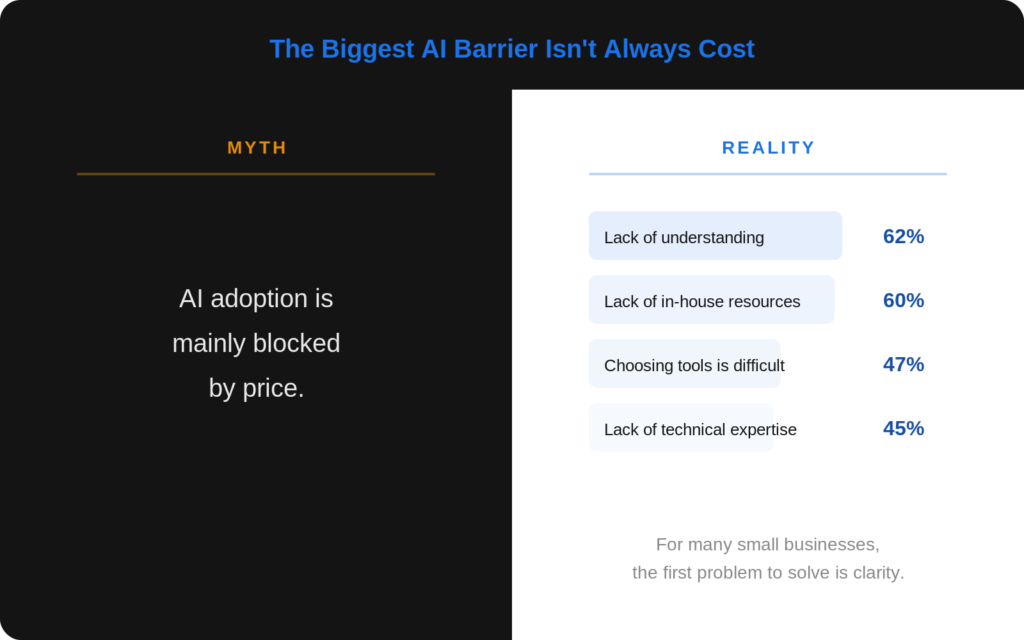
The biggest barrier isn’t cost. It’s knowledge. 62% of non-adopters cite a lack of understanding about AI’s benefits, and 60% say they lack the in-house resources to implement it. Even among businesses that are already using AI, challenges persist: 45% cite a lack of technical expertise, and 47% say it’s difficult to choose the right tools from the overwhelming number of options available.
The most striking stat in this category comes from the smallest businesses. 82% of SMBs with fewer than five employees say AI “isn’t applicable” to their business. But that number drops sharply as business size increases, suggesting this is more of an education gap than a real applicability issue. Many of these micro-businesses likely could benefit from AI. They just don’t know where it would fit.
Among current adopters, the top challenges are AI integration and usage (72%) and concerns about data and privacy (70%). These are legitimate concerns that deserve thoughtful solutions, not dismissal. That’s also why small businesses need to understand the do’s and don’ts of using AI responsibly before handing sensitive work to a tool.
What This Means for You
If you’ve been hesitant, you’re not alone. But the data strongly suggests the barrier is knowledge, not applicability. The 82% of micro-businesses saying “AI isn’t for me” are likely underestimating what’s possible. Most businesses have repetitive tasks that AI can help with. The first fix isn’t a massive investment. It’s education: understanding where AI fits, what it can safely handle, and which tool is worth testing first.
AI and Your Team: The Workforce Reality
Let’s deal with the workforce concern directly. When small business owners hear “AI adoption,” many immediately think “job cuts.” The data paints a much more nuanced picture.
Among small business owners who use AI, 81% say it’s augmenting their workforce, not replacing it. People are using AI to handle the tedious parts of their jobs, such as drafting first versions, sorting through data, and answering routine questions, while humans focus on relationship-building, creative problem-solving, and strategic decisions.
Broader labor market projections add context, though they’re not small-business-specific. The World Economic Forum projects that AI will displace approximately 92 million jobs globally but create roughly 170 million new ones, for a net gain of 78 million positions. There’s still hiring activity in parts of the small business labor market: approximately 974,000 recent graduates are expected to be hired by small businesses during the 2026 hiring season, a slight increase from the previous year.
AI skills may also become a retention and hiring advantage. PwC’s AI Jobs Barometer found that workers with advanced AI skills commanded a 56% wage premium compared with peers in similar roles. A 2026 hiring experiment found that AI skills increased interview-invitation probabilities and could partially or fully offset disadvantages tied to age or lower formal education in some roles.
What This Means for You
Rather than viewing AI as a threat to your team, treat it as a development opportunity. Encourage your employees to experiment with AI tools in their daily work. Many businesses getting value from AI aren’t replacing people. They’re upskilling them. An employee who can use AI effectively is often better positioned to move faster, handle higher-value work, and become more valuable in the job market. Investing in your team’s AI literacy is an investment in retention too.
Industry Breakdown: Who’s Leading and Who’s Lagging
AI adoption varies dramatically depending on what industry you’re in.
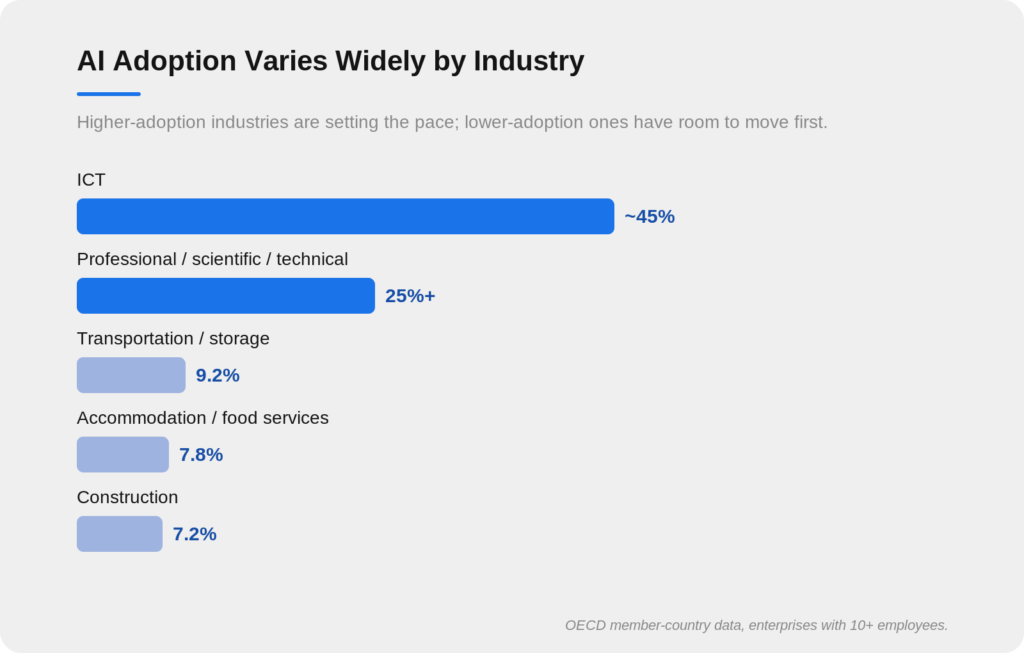
In OECD member-country data for enterprises with 10 or more employees, the ICT sector leads at roughly 45%, followed by professional, scientific, and technical services at more than 25%. These knowledge-intensive industries were natural early adopters because their work, including analysis, communication, and research, aligns closely with what current AI tools do best.
At the other end of that same OECD breakdown, construction sits at 7.2% adoption, accommodation and food services at 7.8%, and transportation and storage at 9.2%.
These labor-intensive sectors have been slower to find applications, though that’s changing as AI tools expand beyond text-based tasks into scheduling, logistics, and project management.
What This Means for You
If you’re in a high-adoption industry, AI is getting harder to ignore. Many of your competitors are likely already testing or using it. But if you’re in a lower-adoption industry like construction or hospitality, there’s a genuine first-mover advantage waiting. When adoption in your sector is still in the single digits, even a basic implementation for scheduling, customer communication, or project estimates can put you ahead of much of the field. The businesses that move early in underserved industries may have more room to stand out.
What the Numbers Point To
The story these 25+ statistics tell is straightforward: AI adoption among small businesses is already here, and the businesses using it are reporting measurable gains.
The entry cost is low. The time savings are substantial. The connection with business growth is worth taking seriously. And the biggest barrier is often the most fixable one: not knowing where to start.
You don’t need to become a tech company or hire a data scientist. The smartest starting point is still simple: pick one repetitive task, test one tool, and measure whether it gives you time back, saves money, or helps you make better decisions. If you need a practical starting point, learning the basics of business automation can help you spot the tasks most worth improving first.
Tech Help Canada Staff researches, writes, and reviews practical content for business owners and professionals. Our coverage spans business, marketing, SEO, technology, and the tools and systems people use to grow and operate online. We focus on clear, useful information backed by research, hands-on experience, and editorial review. Learn more about our team and editorial standards. Need help with something? Contact Us