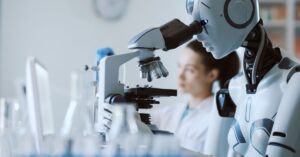
MIT’s latest robotics demonstration is a reminder that automation is no longer confined to chat windows, office workflows, or software agents. In a Sept. 17 MIT News report, researchers described a robotic, reconfigurable laser laboratory that can assemble, tune, dismantle, and repair parts of an optics experiment with limited human intervention.
The system is not a general-purpose scientist. It is a research-stage platform focused on free-space optics, where mirrors, lenses, lasers, cameras, crystals, and filters must be positioned with extreme precision.
A lab that can set up a laser experiment
The platform centers on a seven-joint robotic arm mounted to a metal optical table. MIT says the robot handles standard optical components placed in custom 3D-printed housings. Each housing includes identifying code and a magnetic base so the system can recognize, grip, place, and stabilize the part.
After placement, the system fine-tunes the experiment. Cameras monitor the table and beam position, while a wireless fine-adjustment tool turns the small knobs used to align mirrors and other components. Software coordinates the motions, checks optical feedback, and adjusts the setup until the beam behaves as intended.
That makes the project different from simple lab equipment automation. The robot is not only moving parts from one location to another. It is using feedback from the experiment itself to correct the setup.
The demonstration: a laser cavity built from loose parts
MIT reported that the team demonstrated the system by having it assemble and tune a tabletop laser cavity, a setup that requires careful alignment of optical components. According to MIT News, the robot completed 50 maneuvers within 30 minutes to build a functioning cavity from randomly placed components.
The accompanying arXiv paper describes the work as a framework for closed-loop robotic assembly, alignment, and self-recovery of precision optical systems. In controlled tests, the system performed tasks such as laser beam centering, alignment of multiple beams, resonator alignment, laser mode selection, and recovery from induced disturbances.
The recovery tests are especially relevant. The paper reports that the platform restored the laser signal in 10 out of 10 lens-displacement trials, with an average recovery time of 2.83 minutes. It also restored signal in 9 out of 10 environmental drift recovery trials, with an average recovery time of 3.05 minutes.
Why optics is a hard test for autonomous labs
Free-space optics is a useful stress test for lab automation because small errors can break the experiment. A tiny displacement, a slight mirror-angle error, vibration, or temperature drift can degrade a beam or erase the signal entirely.
That makes optics harder to automate than many repetitive lab processes. Components vary in shape and function. Setups change from one experiment to another. Alignment often depends on expert judgment and live feedback from the optical signal.
The MIT work tackles that problem by turning a hands-on optics task into a sequence of measurable robotic subtasks. The system can identify parts, move them into position, check whether the optical signal is right, and make further adjustments. That closed-loop approach is the point: the machine acts, measures, and corrects.
How this connects to AI beyond chatbots
The broader trend is not just AI that writes, summarizes, or answers questions. It is AI and automation moving into scientific workflows where machines propose, execute, measure, and revise physical experiments.
Related work from MIT researchers and collaborators has explored AI-driven robotics for free-space optics, including systems that use language models to interpret experimental goals and generate optical setups. A separate September 2026 arXiv preprint from MIT researchers described PICO, a programmable cloud-laboratory architecture for optics that could support remote interfaces, scripted experiments, autonomous routines, and version control.
Taken together, the direction is clear. The lab bench is becoming more programmable. Experimental hardware is starting to look less like a fixed manual setup and more like a system that can be instructed, monitored, reset, and reused through software.
Why businesses should pay attention
For companies following AI adoption, the lesson is not that every workplace needs a robot laboratory. The lesson is that automation is moving toward systems that combine reasoning software, sensors, robotics, and feedback loops.
MIT researchers said systems like this could one day speed prototype testing for cameras, displays, solar cells, AR/VR goggles, sensors, and quantum technologies. The same idea also matters for manufacturing, testing, quality control, materials research, and any environment where setup, measurement, adjustment, and repeatability consume expert time.
That is a different kind of productivity story from chatbots. Instead of saving time on text, autonomous lab systems could save time on experiments that are slow, delicate, repetitive, and expensive to rerun after drift or misalignment.
What still needs proving
The MIT system should be read as a research milestone, not a finished commercial lab product. The results come from specific optical tasks under controlled conditions. The components were housed in standardized mounts, and humans still define the experimental layout, provide the parts, and set the objective.
There are also open questions around reliability across a wider range of experiments, safety, cost, maintenance, interoperability, and how much expert oversight remains necessary. Researchers studying autonomous labs have also stressed the need for robust operation, reproducibility, reconfigurability, and careful handling of uncertainty.
Those caveats make the work more credible, not less. The project does not claim to replace scientists. It shows that one of the most manual parts of experimental science can be decomposed into robotic actions, optical feedback, and iterative correction.
A glimpse of machine-assisted discovery
MIT’s autonomous optics lab does not discover new materials or prove new theories on its own. It does show how machines may participate in more of the discovery process than today’s AI headlines suggest.
The next phase of automation may be less about producing more words and more about producing better experiments: systems that assemble instruments, collect evidence, notice when conditions drift, and correct themselves before valuable data is lost.
For science and industry, that shift matters. Once experimental setup becomes programmable, the pace of testing can change. The harder question becomes not only what AI can say, but what machines can measure, adjust, and learn from in the physical world.
Get new small business insights by email
Practical ideas and useful articles to help you make better business decisions.
Tech Help Canada Staff researches, writes, and reviews practical content for business owners and professionals. Our coverage spans business, marketing, SEO, technology, and the tools and systems people use to grow and operate online. We focus on clear, useful information backed by research, hands-on experience, and editorial review. Learn more about our team and editorial standards. Need help with something? Contact Us