The humanoid robot market now has a number attached to the hype, and it is much smaller than the stage demos suggest.
The IFR tally gives one of the first broad industry measurements for humanoid robots. It covers industrial and professional service machines and excludes consumer, military and medical humanoids, according to Reuters. The IFR definition also does not require legs. A robot qualifies if it has a human-like appearance and can operate autonomously in an environment designed for people.
The 7,000-unit figure matters because it puts the category beside the rest of the robotics market. Reuters reported that about 542,000 regular industrial robots were installed in 2024, while an estimated 199,000 service robots were sold that year for uses such as transport, hospitality and cleaning.
That comparison shows how early humanoids still are as a commercial category. The machines draw attention because they look familiar, walk, gesture, carry objects and appear in videos that are easy to share. But unit sales remain small compared with conventional automation already working in factories and service environments.
Reuters also reported that many humanoids sold in 2025 were not doing productive work. IFR secretary general Susanne Bieller said many were bought by research institutions or companies using them to generate data for improving AI models. Carmakers are among the early adopters, but Reuters reported that their pilots often involve single-digit or sometimes double-digit numbers of robots in plants.
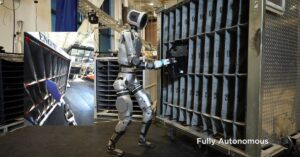
Boston Dynamics is testing Atlas in a real factory setting
Boston Dynamics’ new Robotics Metaplant Application Center, known as RMAC, is the more concrete side of the story. The company announced on Sept. 21, 2026, that the first phase of the center is operational inside Hyundai Motor Group Metaplant America outside Savannah, Georgia.
RMAC is meant to train Atlas for automotive manufacturing work before broader deployment across Hyundai Motor Group’s operations. Boston Dynamics said the robots are being trained in real-world environments, including logistics and sequencing work that prepares automotive parts and places them in the correct order for assembly.
The task choice is significant. Parts sequencing is not as dramatic as dancing, running or flipping, but it is closer to the kind of repetitive factory work that could justify a humanoid robot. It also gives developers a controlled environment for data collection, task refinement and reliability testing.
Boston Dynamics said Atlas applications are expected to extend to component assembly by 2030, with later work involving repetitive motions and strenuous jobs such as heavy lifting. Hyundai’s earlier CES 2026 roadmap said Atlas robots trained at RMAC would start sequencing tasks at HMGMA by 2028, with assembly applications beginning by 2030.
The September announcement also says Hyundai Motor Group plans to expand Atlas deployment across its global network, starting with 25,000 units at Hyundai Motor and Kia plants over the next few years. The Group also plans a U.S. production facility capable of producing 30,000 robots annually. Those are plans, not evidence that tens of thousands of Atlas units are already working in production.
Training centers are not the same as full deployment
The RMAC announcement is still an important step because it moves Atlas from controlled lab development toward factory-side validation. But it should not be read as proof that humanoid robots are ready to replace large numbers of factory workers.
Boston Dynamics did not disclose how many Atlas robots are currently operating at RMAC, how many task cycles they have completed, or what level of human supervision remains involved. The company did say the center will move into a new building in 2027, expanding to about 10 times its current size.
That makes RMAC a bridge between product announcement and commercial rollout.
The IFR number provides the other side of the picture. It separates general enthusiasm from actual commercial scale. A market can attract investment, produce viral demos and still be in the early data-gathering stage.
The next test is repeatable work
For humanoid robots, 2026 is becoming a year of measurement. The industry now has an initial sales benchmark from IFR data, and Boston Dynamics has a permanent training environment tied to a major automaker.
The next signals will be more practical than theatrical. Analysts, manufacturers and buyers will be looking for evidence that humanoids can perform specific tasks repeatedly, reduce workload or risk, fit into existing operations, and justify their cost compared with conventional automation.
Boston Dynamics is also looking beyond Hyundai. The company said it is in discussions with existing Spot and Stretch customers in manufacturing, aerospace, semiconductors, logistics, food and beverage, and life sciences to expand data collection and continue Atlas training in 2027.
That points to the central challenge for humanoid robots. The form factor is attractive because factories, warehouses and service spaces are built around people. But the business case will come from measurable work, not human-like movement alone.
The latest numbers suggest the category has crossed out of pure speculation. They also show it is still at the beginning.

I can suggest related Tech Help Canada articles based on the topic you’re reading now.

Tech Help Canada Staff researches, writes, and reviews practical content for business owners and professionals. Our coverage spans business, marketing, SEO, technology, and the tools and systems people use to grow and operate online. We focus on clear, useful information backed by research, hands-on experience, and editorial review. Learn more about our team and editorial standards. Need help with something? Contact Us