A bigger team can feel like the safest answer to a difficult problem. So why does the project with eight people sometimes move slower than the one with three?
It shows up when you’re hiring, delegating, building a leadership team, or trying to get a stalled project across the line. Payroll can rise while ownership falls. Meetings can multiply while decisions get weaker. Everyone can agree the work matters, but no one feels fully responsible for pulling it forward.
The Ringelmann effect gives a name to that pattern. It explains why adding people can increase capacity while also creating hidden effort loss, coordination drag, and weaker individual accountability.
If you lead a team, it’s worth understanding before you try to fix every missed deadline with another hire, another meeting, or another approval layer.
What is the Ringelmann effect?
The Ringelmann effect is the tendency for individual effort to decrease as group size increases. People often try less when their effort is pooled with everyone else’s and their personal contribution becomes less visible.
The group’s total output may still rise as more people join. The problem is that total output usually doesn’t rise in proportion to the number of people added.
If one person can pull with 100 units of force, a three-person group might seem like it should pull with 300. In practice, it usually pulls with less. The missing output is known as process loss. It’s the difference between the group’s theoretical potential and what the group actually produces.
In business, process loss rarely looks like someone visibly slacking off. It usually looks more ordinary.
Five people attend a meeting, but only one leaves with a clear next action.
A project has many contributors, but no one owns the final outcome.
Everyone agrees a task matters, but each person assumes someone else will move it forward.
More reviewers are added to improve quality, but feedback becomes slower and less decisive.
A founder hires more people, then spends more time coordinating the team than moving the business.
The Ringelmann effect is why a team can look well staffed and still feel strangely slow.
Max Ringelmann’s rope-pulling experiments
Max Ringelmann’s work is often described as a rope-pulling experiment, but the history is a little more specific than the simplified version.
Kravitz and Martin’s 1986 paper, “Ringelmann Rediscovered,” clarified that Ringelmann wasn’t a German psychologist, as many later writers assumed. He was a French agricultural engineer. He gathered much of his data between 1882 and 1887 and published the relevant work in 1913. He was studying the practical efficiency of human workers, animals, and machines.
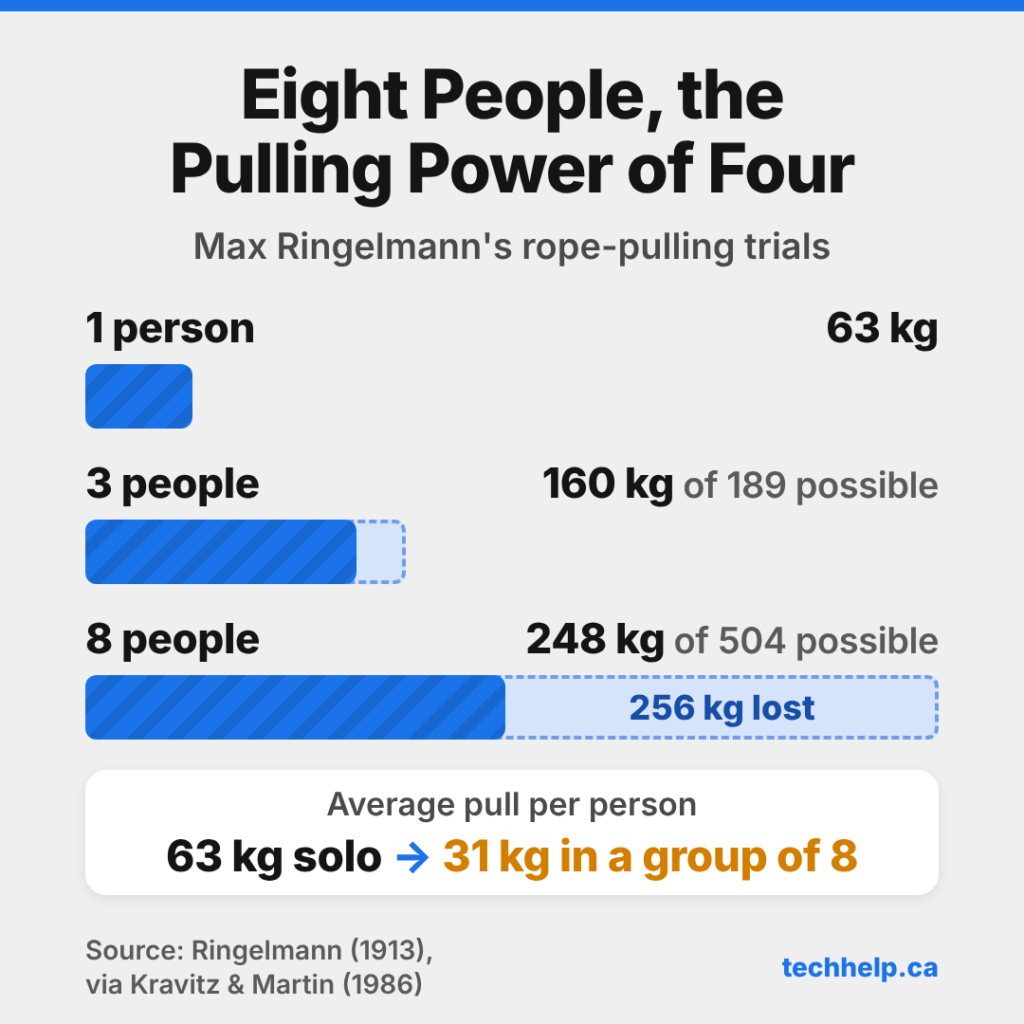
The finding that made his name famous came from comparing individual and group performance. In the commonly cited summary, individual workers pulled with an average force of about 63 kilograms. If group output scaled perfectly, three people would produce about 189 kilograms, and eight people would produce about 504 kilograms.
That’s not what happened. Groups of three produced about 160 kilograms. Groups of eight produced about 248 kilograms. The group output increased, but not nearly in proportion to group size.
Later researchers revisited the effect. In 1974, Alan Ingham, George Levinger, James Graves, and Vaughn Peckham reexamined the Ringelmann effect with rope-pulling studies of their own. Their work found that performance dropped significantly as group size increased from one person to two or three, then leveled off rather than falling in a straight line.
So the losses don’t stack up evenly with every new person. The first few additions to a group can cause a meaningful drop in individual effort, and larger teams create more chances for effort to become hidden, duplicated, delayed, or poorly coordinated.
Why group effort drops
The Ringelmann effect is usually explained through two broad forces: motivation loss and coordination loss.
Motivation loss happens when a person doesn’t work as hard because the group setting makes their individual effort feel less visible, less necessary, or less likely to change the outcome.
Coordination loss happens when people are willing to work, but the group fails to combine their efforts efficiently. People pull at different times. They work from different assumptions. They duplicate work, wait on each other, interrupt each other, or spend too much time aligning.
Those forces often appear together. A poorly coordinated team can make motivated people feel that extra effort is pointless. A low-accountability team can make coordination harder because nobody wants to be the person who forces clarity.
In day-to-day work, those two forces show up as five common mechanisms.
Mechanism
What happens
Business version
Best fix
Social loafing
People reduce effort because their contribution is hidden inside group output.
“Someone else will handle it.”
Make ownership and output visible.
Diffusion of responsibility
People feel less personally responsible because responsibility is spread across the group.
“We all agreed this was important, but nobody moved it forward.”
Assign one accountable owner.
Coordination loss
People work, but their efforts don’t combine smoothly.
People believe nobody can tell whether they did strong work.
A group project where mediocre input disappears into the final file.
Review individual contributions before merging work.
Meaning loss
People don’t see why their effort matters.
Work becomes a task queue, not a meaningful outcome.
Connect the task to a clear customer, revenue, risk, or quality result.
Social loafing is one of the best-known motivational explanations. Latané, Williams, and Harkins helped popularize the term in 1979 after experiments involving clapping and shouting. They found that people reduced individual effort when performing collectively compared with performing alone, even when the task didn’t require complicated coordination.
Karau and Williams later reviewed 78 studies and found social loafing to be a robust effect across tasks and populations. Their meta-analysis also found that loafing gets stronger or weaker depending on factors such as evaluation potential, expectations of co-worker performance, task meaningfulness, and cultural background. Several of those, especially evaluation and meaningfulness, are within a leader’s reach.
That’s good news. It turns the Ringelmann effect into a design problem, and design problems can be fixed.
Social loafing vs. diffusion of responsibility
Social loafing and diffusion of responsibility are related, but they aren’t the same thing.
Social loafing is mostly about effort. People may contribute less because their work is hard to identify, their contribution feels small, or the group output feels disconnected from personal performance.
Diffusion of responsibility is mostly about ownership. People may fail to act because responsibility is spread across several people. Each person assumes someone else has the task, the authority, or the obligation.
The classic diffusion-of-responsibility research comes from Darley and Latané’s work on bystander intervention. Their research wasn’t about business teams, but the workplace parallel is easy to see. When many people are present and responsibility is unclear, the pressure to act can become weaker for each individual.
You see this in small businesses all the time.
A customer complaint is copied to four people. Nobody replies quickly because everyone assumes someone else is closer to the issue.
A sales process is “owned by the team.” Leads get discussed, but follow-up slips because no one person is accountable for the next contact.
A website problem is seen by marketing, operations, and support. Each team knows it matters, but nobody has the authority to prioritize the fix.
Each of these comes down to unclear ownership.
Why the Ringelmann effect hurts businesses
Entrepreneurs often add people because they’re trying to relieve pressure. That can be the right move. A growing business needs more capacity, more specialized knowledge, and less dependence on the founder.
But headcount doesn’t fix unclear work. It usually makes unclear work louder.
If a two-person process is vague, a six-person process can become a swamp of updates, side conversations, partial ownership, and waiting. The founder feels confused because the business is bigger, the payroll is higher, and yet everything seems to take longer.
The Ringelmann effect shows up in business through several patterns.
More people can reduce personal urgency
When a task belongs to one person, the accountability is obvious. When a task belongs to “the marketing team,” “the leadership team,” or “everyone involved,” urgency can blur.
Shared work can still have shared input. It also needs one owner who is responsible for moving it forward.
This is where effective delegation comes in. Good delegation defines the outcome, authority, deadline, standards, and check-in rhythm clearly enough that the person can act.
More people can create more coordination work
Every added person creates more communication paths. That isn’t automatically bad. More people can bring knowledge the original team lacks.
The cost appears when everyone must stay aligned with everyone else. A project with five contributors can quickly turn into a project with too many meetings, too many opinions, and no decision rhythm.
This is why busyness can feel like progress while the actual work stalls. Tech Help Canada’s guide on busyness vs. business makes a related point: teams lose time when communication is constant but decisions remain unclear.
More people can hide weak work
When output is merged, individual quality can disappear. This happens in group reports, marketing campaigns, software releases, sales handoffs, and operations projects.
If nobody can see who contributed what, strong contributors may feel taken for granted and weaker contributors may feel protected by the group. Over time, the standard settles lower than leaders expect.
More people can make entrepreneurship slower
Early-stage businesses often need speed, judgment, and direct learning from customers. A founder may assume the answer is to involve more people in every decision so the business becomes more professional.
Sometimes that works. Often, it creates more approval steps before the business has enough evidence to justify them.
Good entrepreneurship leadership means knowing which decisions need broad input, which ones need one accountable owner, and which ones need a fast test before the team debates them for another week.
The team-size trap
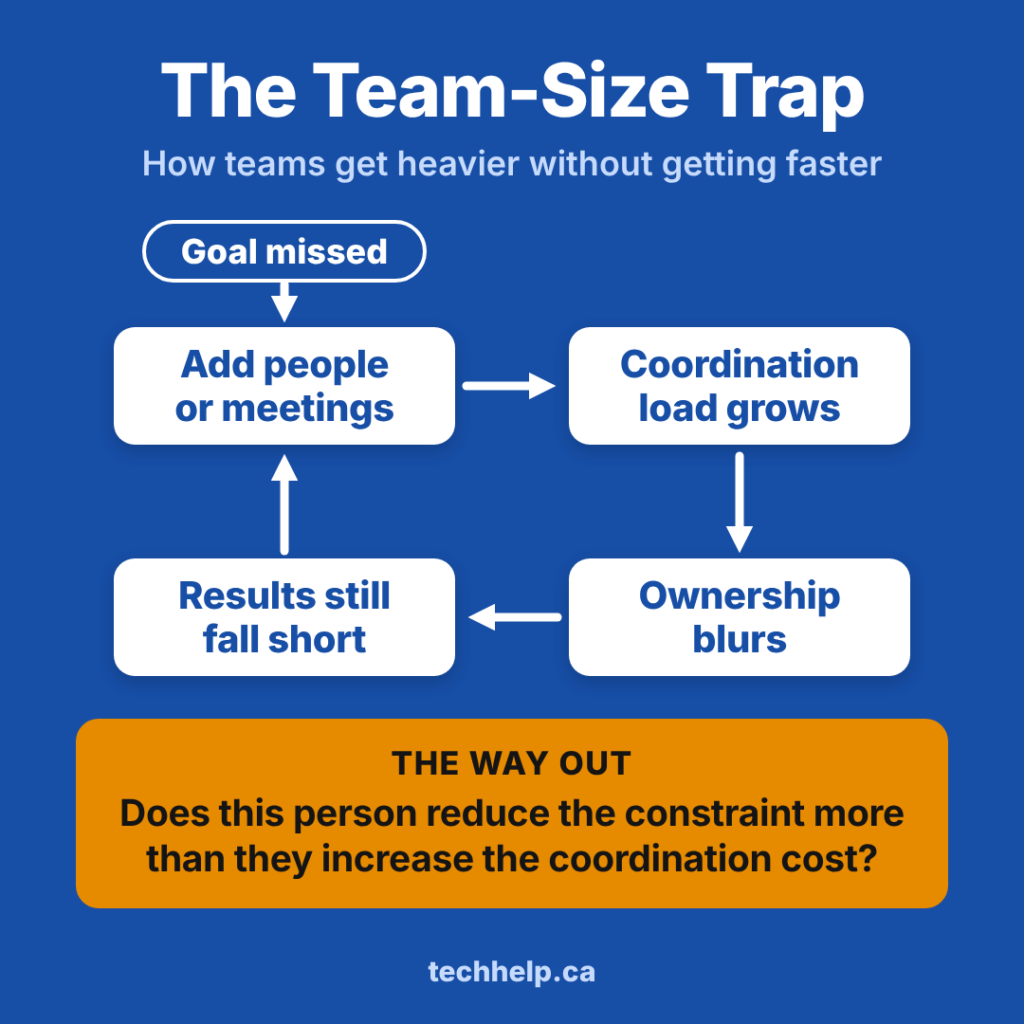
The most dangerous version of the Ringelmann effect is the team-size trap, and it works like this: a team misses a goal, so leadership adds more people. The added people increase coordination demands. The team spends more time in alignment. Individual ownership becomes less visible. Performance doesn’t improve as much as expected. Leadership responds by adding more oversight, more meetings, or more people.
The business gets heavier without getting faster.
Newer team-size research adds useful nuance. Larger teams can help on complex work when the extra knowledge, perspectives, and capacity are truly needed. But coordination requirements change the equation. The more people must synchronize their work, the more likely process losses are to eat into the benefit of adding people.
So instead of asking, “How many people can we put on this?” ask, “Does this person reduce the constraint more than they increase the coordination cost?”
That question protects you from treating team size as a proxy for seriousness. A six-person team with clear ownership can outperform a 15-person committee with no decision rights.
The Ringelmann effect team audit
Use this audit when a project feels slower than its staffing level suggests.
Warning sign
What it usually means
What to change
Nobody can name the single owner
Responsibility is diffused
Assign one directly responsible person
People keep asking for “alignment”
Decision rights are unclear
Define who decides, who advises, and who is informed
Meetings end with agreement but no movement
Agreement is being mistaken for ownership
End with owner, action, deadline, and next check
Work waits for too many reviewers
Quality control has become a bottleneck
Separate required approval from optional feedback
Strong people stop pushing
Extra effort isn’t visible or rewarded
Make individual contributions easier to see
Tasks bounce between functions
Handoffs are poorly designed
Map the sequence and remove unnecessary dependencies
Everyone is busy but output is thin
Coordination is consuming capacity
Reduce active priorities and meeting load
Deadlines move without consequence
The group absorbs accountability
Tie commitments to named owners and trade-offs
More people are added before work is clarified
Headcount is being used as a substitute for design
Fix the work system before expanding the team
This audit is simple on purpose. The Ringelmann effect thrives in ambiguity. The cure starts with making the work visible enough to manage.
How leaders can reduce the Ringelmann effect
Leaders can’t remove every coordination cost from group work. They can design the work so effort is easier to see, responsibility is harder to dodge, and team size fits the task.
Keep teams as small as the work allows
Small teams aren’t automatically better, but they force trade-offs earlier. They make ownership easier to see and reduce the number of handoffs it takes to move work forward.
Before adding people, ask whether the current team lacks capacity, lacks skill, lacks authority, or lacks clarity. Those are different problems. Adding people only solves one of them.
Assign one accountable owner
Shared input is fine. Shared accountability is often where work goes to disappear.
For each meaningful project, name one owner. That person doesn’t have to do all the work. They’re responsible for moving the work, surfacing blockers, asking for decisions, and making sure the next step is clear.
Make individual contributions visible
Visibility changes effort. If people know their work will be reviewed, used, discussed, or credited, they’re less likely to disappear into the group.
This requires clear work design, not surveillance. Ask people to contribute named sections, recommendations, decisions, drafts, analysis, or deliverables before everything gets merged.
Make the task meaningful
Karau and Williams found task meaningfulness to be one of the variables that influences social loafing. That fits everyday leadership experience. People work harder when they understand what the work protects, improves, earns, or prevents.
Don’t rely on generic motivation. Connect the work to a specific outcome: a customer problem, a launch date, a sales target, a risk reduction, a quality standard, or a promise the business made.
Separate input from decision-making
Many teams invite everyone into every conversation because they want buy-in. That can help early, but it can also create a slow-motion veto system.
Use clearer roles instead.
Owner: drives the work and recommends the path.
Approver: makes the decision or accepts the final version.
Contributor: provides a defined piece of work or expertise.
Reviewer: gives feedback within a clear scope.
Informed: needs the update but doesn’t weigh in on the decision.
Without role clarity, group work quietly turns into group fog.
Reduce dependencies
The Ringelmann effect gets stronger when everyone depends on everyone else for everything.
Break work into modules where possible. Give individuals or pairs clear pieces. Bring the work together at planned review points instead of forcing constant synchronization.
Use fewer, better meetings
Ambiguous meetings do the damage. Every meeting should have a purpose, owner, decision path, and next action. If the meeting exists only because the project feels uncertain, fix the uncertainty directly. Decide what needs to be decided, who can decide it, and what information is missing.
Reward the behavior you want repeated
If the team only celebrates final group output, people may learn that individual effort is invisible. Recognize the specific behaviors that reduce process loss: clear ownership, useful handoffs, fast escalation, thoughtful preparation, high-quality review, and decisive follow-through.
People repeat what the system notices.
How individuals can avoid loafing in groups
You don’t need to be a manager to counter the Ringelmann effect. If you’re part of a group project, you can make your own contribution clearer and help the team avoid drift.
Start by naming your piece of the work. If the project feels vague, ask, “What am I responsible for delivering, and by when?” That question may feel basic, but it prevents a lot of quiet failure.
Make your output visible before the deadline. Send the draft, decision note, research summary, customer feedback, or status update early enough that the team can use it.
Don’t hide behind consensus. If you see a missing owner, say so. If you think a decision is stuck, ask who has the authority to make it. If the team keeps revisiting the same issue, suggest the next concrete step.
And if you’re the person who tends to over-function in groups, be careful. Covering every unclear task can train the group to stay unclear. Help the team define ownership instead of silently absorbing the work.
When larger teams do work
The Ringelmann effect isn’t an argument against teams.
Many problems are too complex for one person. Larger teams can bring specialized knowledge, diverse perspectives, backup capacity, and better coverage across functions. The key is to use a larger team when the work genuinely needs it, then design the team to reduce process loss.
Larger teams tend to make more sense when the work can be divided into clear modules, the required expertise is genuinely different, the coordination rhythm is explicit, and one person or a small leadership group owns the final integration.
They tend to struggle when everyone is asked to contribute to the same vague output at the same time. A large team can work. A large blur usually can’t.
A practical rule for team design
Before you add people to a project, answer four questions.
Question
If the answer is unclear
What constraint are we trying to remove?
You may be adding people to a problem you haven’t diagnosed.
Who owns the outcome?
Responsibility will spread and effort may drop.
How will individual contributions be visible?
Social loafing becomes easier.
What coordination cost are we accepting?
More people may slow the work instead of accelerating it.
If those answers are clear, more people may help. If they’re vague, adding people may only give the problem more room to hide.
What leaders should take from the Ringelmann effect
The Ringelmann effect is a warning about how groups are set up more than a verdict on people. People often behave differently when their effort is pooled, their ownership is unclear, and their contribution is hard to evaluate. That’s true in rope-pulling experiments, student projects, business teams, committees, and startups trying to grow.
The useful response is better team design, with fewer places for effort to disappear.
Keep the group only as large as the work requires. Make ownership visible. Define decision rights. Reduce unnecessary coordination. Give people meaningful work where their contribution can be seen.
More people can help a business grow. But only when the work is designed so each person still has a reason to pull.
Frequently asked questions
What is the Ringelmann effect?
The Ringelmann effect is the tendency for individual effort to decrease as group size increases. A larger group may produce more total output, but each person often contributes less than they would if they were working alone.
What did Max Ringelmann’s rope-pulling experiment show?
Ringelmann’s rope-pulling work showed that group output did not rise in proportion to the number of people pulling. In the commonly cited summary, individual workers averaged about 63 kilograms of force, while groups of three produced about 160 kilograms and groups of eight produced about 248 kilograms.
Is the Ringelmann effect the same as social loafing?
They are closely related, but not identical. Social loafing is one cause of the Ringelmann effect. It refers to people reducing effort when their individual contribution is hidden inside group output. The Ringelmann effect can also involve coordination loss, where people work but fail to combine their effort efficiently.
Why does the Ringelmann effect happen in business teams?
It happens when work is shared too vaguely. If nobody owns the outcome, individual contributions are hard to see, decision rights are unclear, or the team spends too much time coordinating, people can contribute less than they would in a clearer work system.
How can leaders reduce the Ringelmann effect?
Leaders can reduce it by keeping teams as small as the work allows, assigning one accountable owner, making individual contributions visible, clarifying decision rights, reducing unnecessary dependencies, and connecting the work to a meaningful business outcome.
Get new small business insights by email
Practical ideas and useful articles to help you make better business decisions.
Tech Help Canada Staff researches, writes, and reviews practical content for business owners and professionals. Our coverage spans business, marketing, SEO, technology, and the tools and systems people use to grow and operate online. We focus on clear, useful information backed by research, hands-on experience, and editorial review. Learn more about our team and editorial standards. Need help with something? Contact Us