Most problem solving quotes look great on a poster and do very little when a client is upset, the numbers look wrong, and you’ve got an hour to decide what to do. A surprising number of the popular ones also have the wrong name underneath them.
The 20 below hold up on both counts. Each one comes with where it was said or written, the business or leadership lesson inside it, and one thing to try on a real problem this week. They’re grouped by the stage of a problem they help with: facing it, defining it, finding a fix, testing that fix, leading people through it, and deciding which problems deserve your time in the first place.
Six famous lines that didn’t survive a source check are at the end. Three of them are usually credited to Einstein.
Quotes about facing a problem
1. James Baldwin on looking at what you’ve been avoiding
“Not everything that is faced can be changed; but nothing can be changed until it is faced.”
James Baldwin, writer, “As Much Truth As One Can Bear,” The New York Times Book Review (1962)
Baldwin wrote this in an essay about the writer’s job of telling the truth about the world as it is. The line travels well because avoidance is such a common first response to a problem, in business as much as anywhere.
You know the version in your own work. The sales report you haven’t opened since spring. The client who’s stopped replying. The conversation with a business partner you keep pushing to next month. Ignoring them doesn’t freeze them in place, and an unpaid invoice is easier to chase at 30 days than at 90.
Try this: Pick one thing you’ve been avoiding and give it 30 minutes this week. You don’t have to fix it in that time. Just look at it closely enough to say what’s going on.
2. Maya Angelou on complaining versus changing
“What you’re supposed to do when you don’t like a thing is change it. If you can’t change it, change the way you think about it. Don’t complain.”
Maya Angelou, Wouldn’t Take Nothing for My Journey Now (1993)
The popular version, “If you don’t like something, change it. If you can’t change it, change your attitude,” is a shortened take on this passage. The original ends with the two words that do most of the work.
Complaining feels productive because it gives a problem your attention. It doesn’t move the problem, though, and it can swallow a whole team meeting. Angelou’s advice sorts every complaint into two piles. If you can change it, change it. If you can’t, like a fee hike from a platform you sell on, adjust how you work around it and stop spending energy on it.
Try this: Name the complaint you’ve made most often this month. Next to it, write one change you’ll make or one way you’ll adapt. Then retire the complaint.
3. Alan Mulally on making bad news visible
“You can’t manage a secret.”
Alan Mulally, then CEO of Ford, in BusinessWeek (2007)
Mulally said this after ordering every operating group at Ford to share all its financial data with every other group. Three executives called him to check they’d heard right.
Getting people to admit problems took more than a new rule. In a 2006 meeting, Mark Fields, then president of Ford’s Americas business, showed a status chart marked red because a faulty tailgate latch had halted production of the new Edge crossover. “We had a culture where, if you reported bad news, you were done,” Fields later told Fortune. The room went silent. Then Mulally started clapping. Mulally told Bloomberg he remembers saying, “Great visibility, Mark,” before asking whether there was anything the team could do to help.
The way you react to the first piece of bad news decides whether you’ll hear the second. If people get punished for reporting red, they’ll keep everything green until it’s too late to fix.
Try this: In your next team check-in, ask each person for one thing that’s off track. Answer the first one with thanks and a question about what they need.
Quotes about defining the problem
4. John Dewey on stating the problem clearly
“It is a familiar and significant saying that a problem well put is half-solved.”
John Dewey, philosopher, Logic: The Theory of Inquiry (1938)
You’ll usually see this as “A problem well stated is a problem half solved,” credited to inventor Charles Kettering. We couldn’t find a source tying that version to him, and Dewey called it a familiar saying back in 1938, so whoever said it first is a mystery. Dewey then warns that “to mistake the problem involved is to cause subsequent inquiry to be irrelevant or to go astray.”
“Sales are down” isn’t a problem statement. It’s a mood. “Repeat orders from our restaurant clients have dropped by a third since March” points you somewhere. It tells you who to call, which numbers to pull, and when things changed.
Try this: Turn the problem into one sentence with a number, a who, and a when before your next meeting about it. If nobody can write that sentence, use the meeting to define the problem instead of solving it.
5. Sherlock Holmes on guessing before you have the facts
“It is a capital mistake to theorise before one has data. Insensibly one begins to twist facts to suit theories, instead of theories to suit facts.”
Sherlock Holmes, in Arthur Conan Doyle’s “A Scandal in Bohemia” (1891)
Holmes says this when Watson asks him to explain an unsigned note that has just arrived. He refuses to guess.
In business, the guessing starts fast. Revenue dips, and within an hour someone has decided it’s pricing, or the algorithm, or the economy. From then on, every number gets read as proof. A slow Tuesday confirms it. A good Friday is a fluke. Pay attention to Doyle’s word “insensibly.” You don’t notice yourself twisting the facts while you’re doing it.
Try this: List the three numbers you’d need to see before you’d bet on a cause, like where in your sales process people drop off or which customers stopped buying. Pull them before anyone guesses out loud.
6. Taiichi Ohno on digging past the first answer
“By repeating why five times, the nature of the problem as well as its solution becomes clear.”
Taiichi Ohno, a pioneer of the Toyota Production System, Toyota Production System (English edition, 1988)
This line sums up the “five whys,” the method Toyota made famous. Ohno’s own example in the book starts with a machine that stopped. Why? An overload blew the fuse. Why? The bearing wasn’t lubricated well enough. Why? The lubrication pump wasn’t pumping properly. Why? Its shaft was worn. Why? There was no strainer, so metal scraps got in. Replace the fuse and you’ve handled the first answer while the machine waits to fail again.
The same pattern shows up in a small business. A client complains about a late delivery, so you apologize and rush the next order. Ask why a few more times and you might find that quotes go out without anyone checking the production schedule.
The method has critics. A 2017 paper in BMJ Quality & Safety argued that in complex settings like healthcare, it oversimplifies problems by pushing people toward a single root cause. Plenty of problems have several. Use the whys to keep digging, and expect to find more than one cause behind the bigger ones.
Try this: The next time a problem shows up twice, write out the whys with the person closest to the work. Stop when you reach a cause you can act on, not just the first thing that broke.
7. Abraham Maslow on the tool picking the diagnosis
“I suppose it is tempting, if the only tool you have is a hammer, to treat everything as if it were a nail.”
Abraham Maslow, psychologist, The Psychology of Science (1966)
Philosopher Abraham Kaplan made the same point earlier, in 1962, with a boy who gets a hammer and decides everything he meets needs pounding. Maslow’s version is the one that stuck, although the popular “If all you have is a hammer, everything looks like a nail” isn’t his exact wording.
Whoever diagnoses your problem tends to find one their skills can fix. A web designer sees a redesign. An ad buyer sees a budget problem. A consultant who sells training sees a training need. You do it too, with whatever you’re best at or whatever software you’re already paying for.
Try this: Get a second diagnosis from someone with a different skill set before you pay for any recommended fix. If their answer is completely different, slow down.
Quotes about finding a solution
8. Linus Pauling on having more ideas
“The best way to have a good idea is to have a lot of ideas.”
Linus Pauling, chemist and two-time Nobel Prize winner, quoted in Fortune (1960)
Pauling later gave a fuller version in public, adding that you throw away the bad ones. Both halves matter.
In a lot of meetings, the first idea someone says out loud ends up as the plan, or at least as the yardstick every other idea gets measured against. Coming up with options before judging any of them gives better ideas a chance to show up.
Try this: Come up with 10 possible fixes before you choose one. Include a couple that seem too cheap, too simple, or a little ridiculous. Then cut the list down.
9. Charlie Munger on working the problem backward
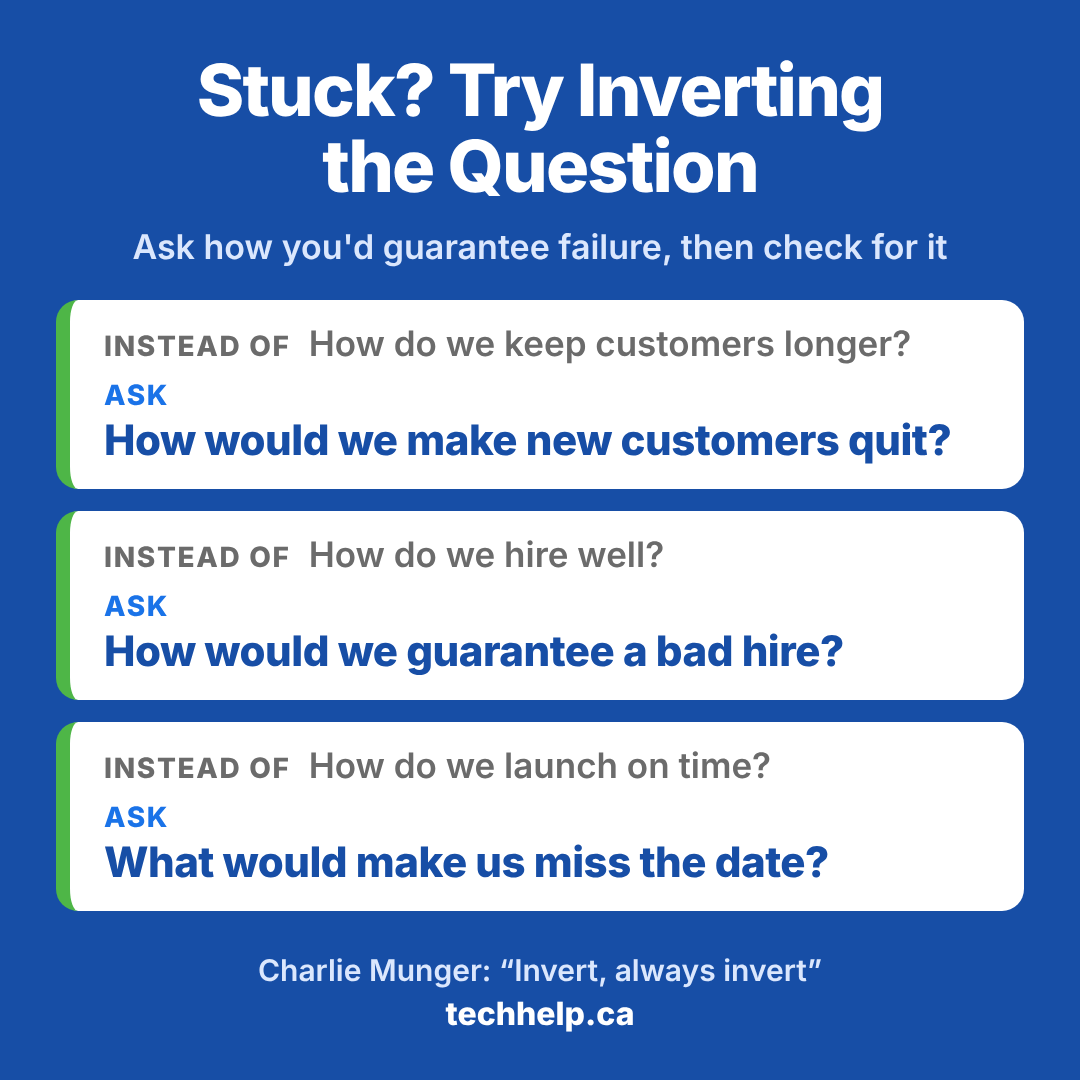
“Invert, always invert.”
Charlie Munger, Berkshire Hathaway vice chairman, quoting mathematician Carl Jacobi in a 1986 commencement speech at the Harvard School in Los Angeles
Munger’s speech put the idea to work. Instead of telling graduates how to have a happy life, he gave them a list of reliable ways to have a miserable one, because “many hard problems are best solved only when they are addressed backward.” In the same speech, he told the story of a rustic who wished he knew where he was going to die, so he’d never go there.
In a business, inversion turns “How do we keep customers longer?” into “How would we make sure every new customer cancels in the second month?” That second question is oddly easy to answer. Slow onboarding. No check-in after the first purchase. A confusing invoice. Then you check which of those you’re already doing.
Try this: Spend 20 minutes with your team listing every way to guarantee your biggest goal fails. Circle the ones already happening.
10. George Pólya on solving a smaller problem first
“If you cannot solve the proposed problem try to solve first some related problem.”
George Pólya, mathematician, How to Solve It (1945)
The snappier version, “If you can’t solve a problem, then there is an easier problem you can solve: find it,” isn’t in Pólya’s own text as far as we could find. It traces to mathematician John H. Conway’s foreword to a 2004 edition of the book, where he presents it as Pólya’s advice.
Either way, the move works outside math. When “make all three locations profitable” feels impossible, solve a smaller, related problem first, like one location, one product line, or one type of customer. What you learn there often shows you how to approach the bigger version.
Try this: Take a problem that’s been stuck for weeks and cut it down to a version you could solve by Friday. Solve that one first.
11. Antoine de Saint-Exupéry on fixing by taking away
“In anything at all, perfection is finally attained not when there is no longer anything to add, but when there is no longer anything to take away.”
Antoine de Saint-Exupéry, pilot and author, Wind, Sand and Stars (1939), translated by Lewis Galantière
Saint-Exupéry was writing about aircraft design. The version you’ll see online, “Perfection is achieved, not when there is nothing more to add, but when there is nothing left to take away,” is a looser translation of his French.
A 2021 study in Nature found that people default to adding when they try to improve things and overlook changes that take something away, and they were even less likely to spot a useful subtraction when their minds were busy with something else. That describes most business owners on a weekday. The answer to a confusing checkout might be removing a form field, not adding a chat widget. A slow approval process might need one fewer sign-off, not a new tool to track sign-offs.
Try this: Look at the problem on your desk right now and list what you could remove, whether that’s a step, a rule, a product option, or a meeting. Try the removal before you add anything.
Quotes about testing your fix
12. Ed Catmull on expecting a rough first version
“Candor could not be more crucial to our creative process. Why? Because early on, all of our movies suck.”
Ed Catmull, Pixar co-founder, Creativity, Inc. (2014)
Pixar gets that candor from the Braintrust, a group of directors, writers, and heads of story that meets every few months to look at each film in production and talk candidly about what isn’t working. Catmull describes the job as getting a film “from suck to not-suck.”
Your first attempt at a fix will usually be rough too, whether it’s a new onboarding process, a pricing page, or a refund policy. Trouble starts when you expect it to work the first time and hear criticism as an attack on the idea.
Try this: Show your next fix to two people whose job is to find problems before you roll it out, and ask, “What’s the weakest part of this?” That question gets you specifics. “What do you think?” gets you politeness.
13. Richard Feynman on fooling yourself
“The first principle is that you must not fool yourself—and you are the easiest person to fool.”
Richard Feynman, physicist, “Cargo Cult Science,” Caltech commencement address (1974)
Feynman was talking to Caltech graduates about scientific integrity. In the same speech, he said that if you’re doing an experiment, “you should report everything that you think might make it invalid.”
Once you’ve put money and pride into a fix, you want it to work, and you’ll find reasons to believe it does. Maybe you count the new leads and skip the cancellations, or compare against your worst month instead of a normal one. That’s why you’re the easiest person to fool. Nobody wants the fix to succeed more than you do.
Try this: Before you launch a fix, write down what result, by what date, will count as working and what will count as not working. Judge it against that note, not against how the week felt.
14. Henry Ford on starting over with what you learned
“Failure is only the opportunity more intelligently to begin again.”
Henry Ford, My Life and Work (1922), written with Samuel Crowther
The version that circulates today smooths out Ford’s odd word order. In the next sentence, he wrote, “There is no disgrace in honest failure; there is disgrace in fearing to fail.”
Some fixes deserve a restart, not another patch. Think of the spreadsheet carrying six years of workarounds, the website plugin that breaks with every update, or the client process that only works because one employee remembers all its exceptions. Each patch made sense on its own. Together they’ve built something nobody wants to touch. “More intelligently” is the condition, though. A restart only beats the patching if it uses what the failures taught you.
Try this: For anything you’ve patched three or more times, ask, “If we were building this today, would we build it this way?” If the answer’s no, put a rebuild on the calendar instead of the next patch.
Quotes about leading people through problems
15. W. Edwards Deming on fixing the system, not the person
“A bad system will beat a good person every time.”
W. Edwards Deming, statistician and management consultant, at a 1993 seminar in Phoenix, according to the W. Edwards Deming Institute
Deming spent decades arguing that most failures come from the way work is set up rather than the effort of the people doing it. According to the Deming Institute, the point is that trying harder inside a broken system often does more damage, and that the fix is to change the system so success is built into it.
If two different people make the same mistake on the same task, coaching a third person won’t solve it. Look at the form that’s easy to misread, the step with no clear owner, or the deadline that makes shortcuts the only way to finish.
Try this: When something goes wrong, ask, “Would someone else in the same seat have made the same mistake?” before you ask who did it. If the answer is yes, fix the process.
16. Ben Horowitz on refusing the shortcut
“There are no silver bullets for this, only lead bullets.”
Ben Horowitz, co-founder of Andreessen Horowitz, “Lead Bullets” (2011), later in The Hard Thing About Hard Things (2014)
Horowitz was CEO of Opsware when its toughest competitor, BladeLogic, started beating it in large deals. His team pitched workarounds, and he answered each one with this line. Customers were still buying. They just weren’t buying Opsware’s product, so the only fix was to build a better one. After nine months of hard work, Opsware regained its product lead.
Shortcuts are most tempting when the problem is your core offer. A rebrand, a new ad channel, or a partnership can look like a quick win while the thing you sell stays second-best. Someone has to say that out loud, and it usually has to be the person in charge, because a team will keep hunting for silver bullets until its leader tells them to stop.
Try this: Collect the quick fixes your team has floated for your biggest problem. For each one, ask whether it fixes the core issue or routes around it.
17. Mary Barra on refusing to move on too fast
“But I never want to put this behind us. I want to keep this painful experience permanently in our collective memories.”
Mary Barra, CEO of General Motors, speaking to employees in Warren, Michigan (June 5, 2014)
Barra said this after an internal investigation into GM’s handling of a faulty ignition switch, which could shut off a car’s engine while it was moving and keep the airbags from inflating. She told employees the investigation had uncovered “a pattern of incompetence and neglect” in a problem that persisted for more than 11 years. GM’s compensation fund later found 124 death claims eligible for compensation.
The usual instinct after a crisis is to get it over with. Barra wanted the opposite, because forgetting is how a mistake happens again. Smaller businesses run the same risk. The people who remember losing a client over a missed deadline eventually leave, and the next hire repeats the mistake.
Try this: Write a one-page account of your most expensive mistake this year, covering what happened, what it cost, and what you changed. Make it part of how you onboard new people.
Quotes about choosing which problems to solve
18. Paul Graham on finding problems worth building on
“The way to get startup ideas is not to try to think of startup ideas. It’s to look for problems, preferably problems you have yourself.”
Paul Graham, co-founder of Y Combinator, “How to Get Startup Ideas” (2012)
Graham argues that the very best ideas tend to be things the founders want themselves, can build themselves, and that few others realize are worth doing. Ideas invented from scratch often fail that test, because nobody involved actually has the problem they’re meant to solve.
The point reaches well beyond startups. A problem you deal with every week comes with insider knowledge. You know how often it happens, what people already try, and what a fix would be worth. That’s a head start on any new product, service, or internal tool.
Try this: For two weeks, log every annoyance in your own work, from a task you redo by hand to a tool that never quite fits. Then look for anything that repeats.
19. Uri Levine on staying loyal to the problem
“Fall in love with the problem, not the solution.”
Uri Levine, Waze co-founder, title of his 2023 book
Levine gave an example in a 2023 interview with Thought Economics. Pitch “an AI crowd-sourced navigation system” back in 2007, he said, and you’d get “polite interest, but ultimately, indifference.” Tell people you’re going to help them bypass traffic jams, and they’re engaged.
It’s easy to fall for your solution because you built it. Customers care about their problem. Stay loyal to the problem and you can swap solutions when one stops working without losing your direction. Stay loyal to the solution and you’ll keep polishing features nobody asked for.
Try this: Check your last three product or service decisions. For each one, ask whether it made your customer’s problem smaller or just made your solution more impressive.
20. Peter Drucker on problems versus opportunities
“Results are obtained by exploiting opportunities, not by solving problems. All one can hope to get by solving a problem is to restore normality.”
Peter Drucker, management writer, Managing for Results (1964)
It’s an odd quote to close a list of problem solving quotes, and that’s why it belongs here. Fixing a problem gets you back to where you were. Drucker wrote that the results themselves have to come from opportunities.
Problems still need fixing. His warning is about how much of your time they take. You can spend a whole month putting out fires, every one of them real, and end it exactly where you started.
Try this: Go through last week’s calendar and mark each block as fixing or growing. If fixing won, book two hours this week for an opportunity, like a referral partner you’ve meant to call or a request your best customer keeps making.
Famous problem solving quotes with shaky sources
These lines turn up on plenty of quote lists, but the record doesn’t back the names attached to them. Some of the advice still holds. Just give it the right credit, or none.
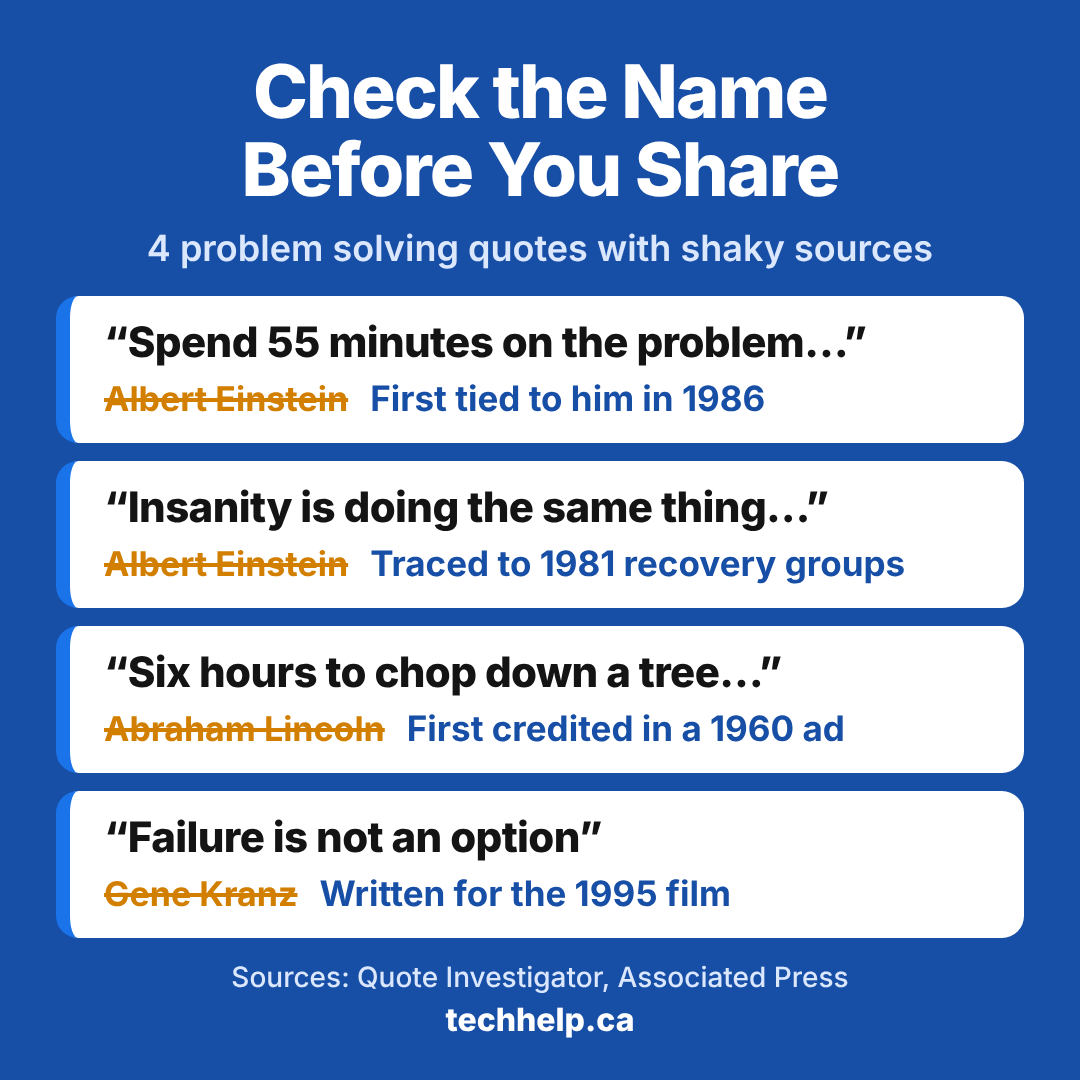
“If I had an hour to solve a problem, I’d spend 55 minutes thinking about the problem and 5 minutes thinking about solutions.” Quote Investigator found no substantive evidence that Einstein said anything like it. A 1966 version credited an unnamed Yale professor with spending up to two-thirds of the hour defining the problem, and the 55/5 version with Einstein’s name on it didn’t show up until 1986. If you want real Einstein on the subject, he and physicist Leopold Infeld wrote in The Evolution of Physics (1938) that “The formulation of a problem is often more essential than its solution.”
“We cannot solve our problems with the same thinking we used when we created them.” Today in Science, which catalogs science quotations, lists this line and its variations among the Einstein-like quotes with no known source in the given wording. It resembles something he did write in 1946, in a telegram asking several hundred prominent Americans to fund a public education campaign for the atomic age. In it, he wrote that “a new type of thinking is essential if mankind is to survive and move toward higher levels.”
“Insanity is doing the same thing over and over again and expecting different results.” The earliest versions Quote Investigator found came from twelve-step recovery groups in 1981. The first Einstein credit it found came in 1990, 35 years after his death.
“Give me six hours to chop down a tree and I will spend the first four sharpening the axe.” Abraham Lincoln died in 1865. The earliest version Quote Investigator found is from a 1944 speech that credited an unnamed lumberjack, and the first Lincoln credit appeared in a 1960 trade magazine ad for drilling equipment.
“Failure is not an option.” Gene Kranz, the flight director the line is pinned on, never said it during Apollo 13. He told the Associated Press in 2020 that the filmmakers came up with it for the 1995 movie, and he later borrowed it for the title of his 2000 memoir. What he says he told his team was, “This crew is coming home.”
“Your assumptions are your windows on the world. Scrub them off every once in a while, or the light won’t come in.” It’s usually credited to Isaac Asimov. Actor Alan Alda said it in a 1980 commencement speech at Connecticut College, and Quote Investigator found the first Asimov credit in a 2002 online post. Of the six lines here, this is the one worth keeping, with Alda’s name on it.
Find the stage where you usually get stuck
Most people have one weak spot in how they handle problems. Some avoid them until they’re expensive. Some grab the first fix that comes to mind. Some never check whether the fix worked. You probably recognized yourself in one of the sections above. Go back to it, pick one quote, and use its “Try this” on the next problem that comes up.
Get new small business insights by email
Practical ideas and useful articles to help you make better business decisions.
Tech Help Canada Staff researches, writes, and reviews practical content for business owners and professionals. Our coverage spans business, marketing, SEO, technology, and the tools and systems people use to grow and operate online. We focus on clear, useful information backed by research, hands-on experience, and editorial review. Learn more about our team and editorial standards. Need help with something? Contact Us