Most people treat failure like a verdict. It feels uncomfortable, public, and final. But failure is often less like a stop sign and more like feedback: something about the plan, skill, timing, system, or assumption needs attention.
That doesn’t mean every failure is useful. Repeating the same mistake, ignoring warnings, or risking damage you can’t recover from isn’t growth. But the right kind of failure, handled with reflection and discipline, can make you sharper, steadier, and more capable.
The research-backed idea behind this is simple: growth happens near the edge of your ability. If everything works all the time, the challenge is probably too easy. If everything fails, the challenge is probably too hard. The learning zone sits in between.
The 85% Rule: Why Some Failure Helps Learning
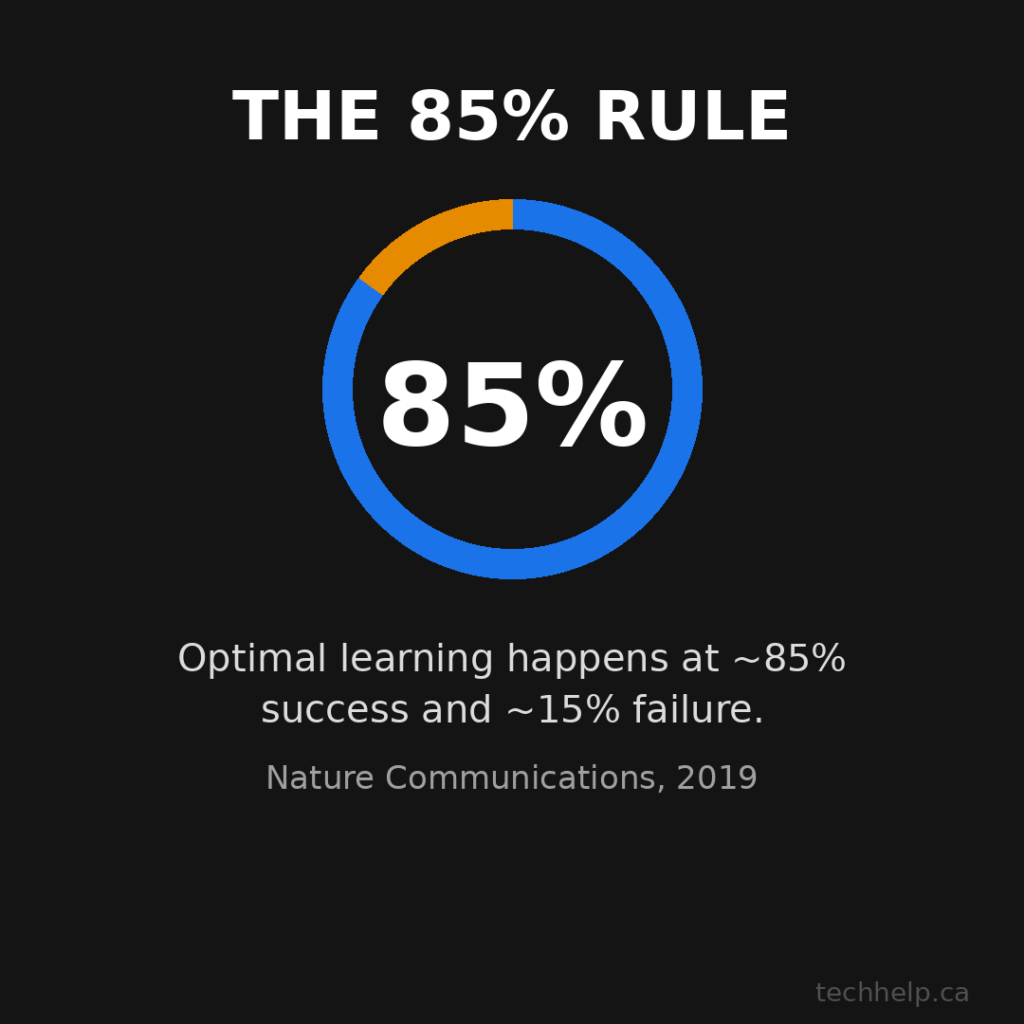
A 2019 Nature Communications paper called “The Eighty Five Percent Rule for optimal learning” found that, across several learning models, performance improved fastest when the learner succeeded about 85% of the time and made errors about 15.87% of the time.
That doesn’t mean you should try to fail at exactly 16% of everything you do. The study focused on learning systems and task difficulty, not life advice or a universal success formula.
Still, the principle is useful: learning often improves when the challenge is hard enough to create mistakes but not so hard that mistakes become constant. For business, leadership, creative work, and personal growth, that means productive failure usually has three traits:
Productive Failure Has…
What It Means
A real learning edge
The task stretches your current ability
Recoverable downside
The cost of being wrong is survivable
Fast feedback
You can see what happened and adjust
This also fits the growth mindset idea associated with Stanford psychologist Carol Dweck: abilities can develop through effort, feedback, and learning. Failure helps only when it becomes part of that learning loop.
That’s the difference between smart experimentation and reckless risk. The point isn’t to chase failure. The point is to use failure as information.
Why Failure Matters: 10 Benefits
1. Failure Builds Self-Awareness
Failure forces contact with reality. It shows where your assumptions were wrong, where your preparation was thin, where your timing was off, or where your skills still need work.
That can sting, but it’s also clarifying. Success can hide weak spots because the result feels good enough to stop inspecting the process. Failure makes the process visible.
How to use it: After a setback, separate the event from your identity. Ask what the failure revealed about your plan, habits, knowledge, or environment.
2. Failure Develops Resilience Under Pressure
Resilience isn’t built by avoiding difficulty. It grows when you face a setback, recover, and learn that discomfort is survivable.
This matters because bigger goals usually bring uncertainty, criticism, delay, and surprise. If every obstacle feels like proof that you should stop, progress becomes fragile. If setbacks become something you can work through, you become harder to shake.
How to use it: Review what helped you recover last time. Was it time, support, better data, a smaller next step, or a calmer interpretation? Turn that into a recovery routine.
3. Failure Sharpens Critical Thinking
When something works, you may not question why. When something fails, you have to inspect cause and effect.
That inspection strengthens critical thinking. You start noticing weak evidence, missing variables, unrealistic timelines, bad incentives, unclear goals, and assumptions that never got tested.
How to use it: Treat each failure like a decision review. Ask: What did I expect? What happened? What did I miss? What would I test before trying again?
4. Failure Strengthens Emotional Regulation
Failure can bring frustration, embarrassment, disappointment, anger, or shame. Learning to feel those emotions without letting them take over is a serious skill.
Emotional regulation helps you respond instead of react. It keeps one bad result from turning into a spiral of overcorrection, avoidance, blame, or quitting too soon.
How to use it: Pause before making the next big decision. Name the emotion, let the intensity drop, then decide what the evidence actually says.
5. Failure Creates Humility Without Weakness
Failure reminds you that you can be talented and still wrong. You can be experienced and still miss something. You can be confident and still need feedback.
That kind of humility isn’t weakness. It’s what keeps people teachable. In teams, it also makes it easier for others to admit problems early instead of hiding them until the damage grows.
How to use it: Ask for one specific piece of feedback after a setback. Skip “Was that bad?” and ask, “What is one thing I should change before the next attempt?”
6. Failure Sparks Experimentation and Creativity
When the first path fails, you’re forced to look for another one. That’s often where creativity begins.
The failed attempt narrows the problem. It shows what doesn’t work, which constraints are real, and where the next idea should be different. This is why experimental cultures often treat small, early failures as useful signals.
How to use it: Before trying again, change one variable. If you change everything, you won’t know what made the next result better.
7. Failure Reveals Weak Assumptions
Many failures start before the visible mistake. The real issue may be an assumption about what customers want, what a team can handle, how long a task takes, or what the market will reward.
Failure exposes those assumptions. That’s especially valuable in business, where confidence can easily outrun evidence.
How to use it: Write down the assumption that failed. Then decide whether you need more research, a smaller test, a different audience, or a clearer success metric.
8. Failure Accelerates Practical Learning
Some lessons only stick once you have felt the consequence. A book can explain a principle. A failed attempt shows you where that principle applies in real life.
This is the strength of learning by doing. You gain context, pattern recognition, and judgment that theory alone can’t provide. That’s also why lean learning focuses on fast feedback loops instead of waiting until everything is perfect.
How to use it: Capture the lesson while the details are fresh. A short debrief within 24 hours is usually more useful than a long reflection weeks later.
9. Failure Improves Risk Management
Failure teaches you to respect downside. Once you have seen what can go wrong, you become better at spotting warning signs, estimating consequences, and building safeguards.
This is where failure connects to calculated risk. Smart risk isn’t risk avoidance. It’s taking action with a clear view of the stakes, the reward, the recovery plan, and the signals that would tell you to stop.
How to use it: Before the next attempt, define the maximum acceptable loss: money, time, reputation, trust, or energy. If the loss isn’t survivable, reduce the scope first.
Leaders who never admit failure teach people to hide mistakes. Leaders who name failure clearly, take responsibility, and extract lessons teach people to speak up earlier.
That doesn’t mean celebrating carelessness. It means separating blame from learning. In a workplace, this depends heavily on psychological safety: people need to believe they can report problems, challenge assumptions, and admit mistakes without being punished for honesty.
How to use it: When something fails, model the review you want from others. Say what happened, what you missed, what you learned, and what will change.
The Types of Failure That Actually Teach You
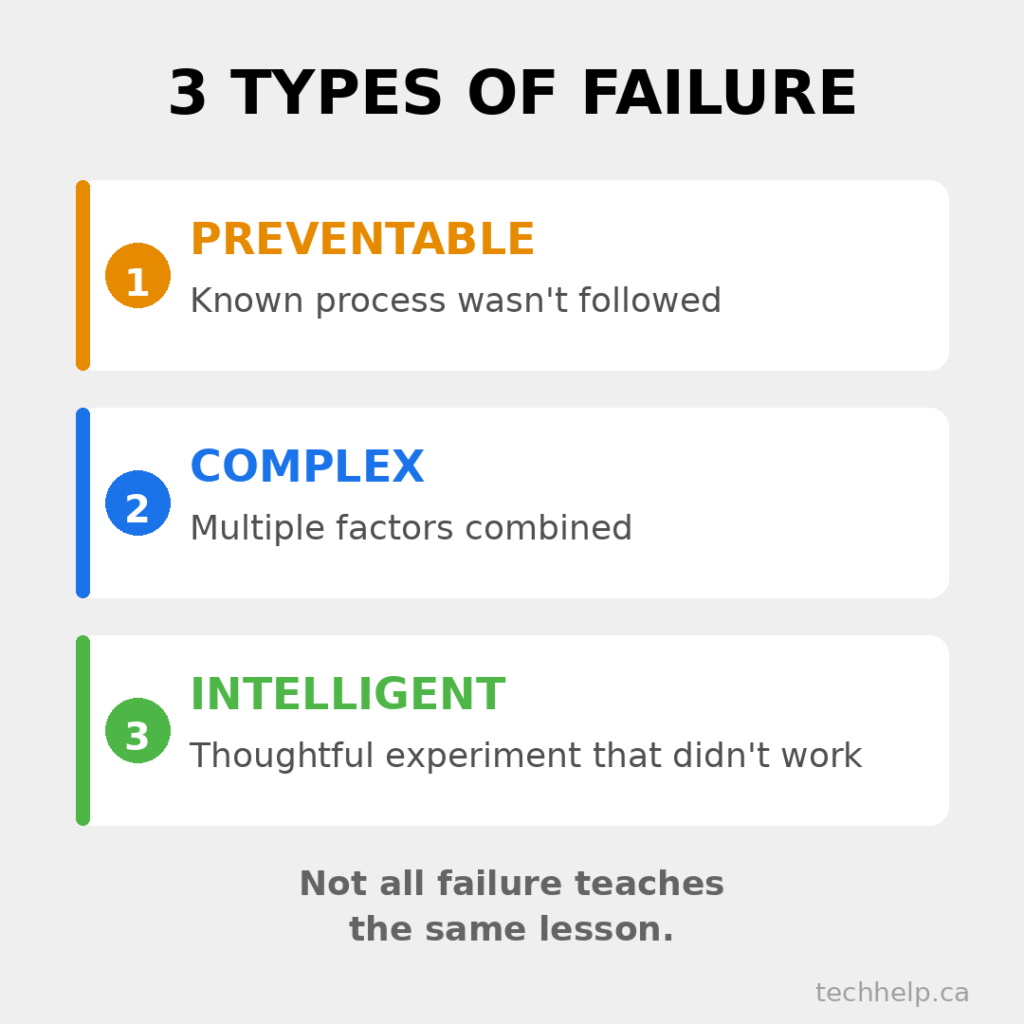
Harvard Business School professor Amy Edmondson has argued that leaders often treat all failure as the same, when the response should depend on the kind of failure involved. Her Harvard Business Review work identifies three categories that are especially useful.
Preventable Failure
Preventable failure happens in predictable work when people don’t follow known processes, standards, or safeguards. Examples include skipping a quality check, ignoring a documented procedure, or failing to communicate a known risk.
This kind of failure isn’t something to romanticize. The lesson is discipline. Improve the checklist, training, accountability, supervision, or process design so the same mistake is less likely to happen again.
Complex Failure
Complex failure happens when many factors interact in a way that’s hard to predict. No single decision may explain the whole outcome. Market shifts, unclear roles, technology issues, timing, resource limits, and communication gaps can combine into a result no one intended.
The lesson is systems thinking. Instead of looking for one culprit, study the conditions that allowed the failure to form. Complex failure needs debriefing, pattern analysis, and stronger early-warning signals.
Intelligent Failure
Intelligent failure happens when you’re exploring new territory, running a thoughtful experiment, and learning something valuable from a result that didn’t work.
This is the kind of failure worth designing for. It should be small, fast, informed by a clear hypothesis, and limited enough that the downside is manageable. Intelligent failure is how teams learn when the answer can’t be known in advance.
How to Fail Smarter
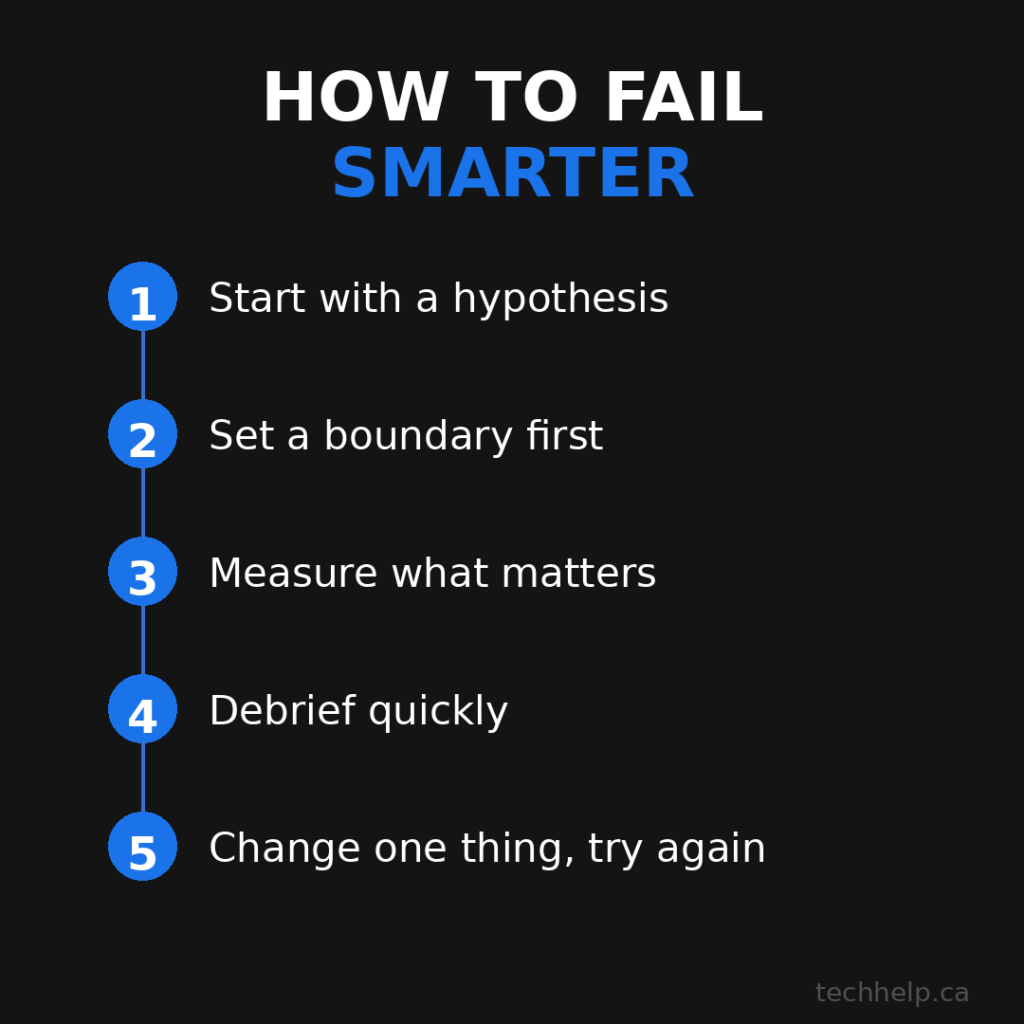
Failing smarter means designing your attempts so failure produces information instead of chaos.
Start with a hypothesis. Define what you believe will happen and why. “This landing page will convert better” is too vague. “This landing page will convert more trial users because the headline names the exact pain point” gives you something to test.
Set a boundary before you begin. Decide how much time, money, energy, or reputation you can afford to risk. A failure with no boundary can become expensive denial.
Measure what matters. Choose the signal that tells you whether the attempt worked. That could be conversion rate, customer response, completion time, error rate, retention, revenue, or learning quality.
Debrief quickly. Ask what happened, why it happened, what surprised you, and what should change. Keep the review specific enough that it leads to action.
Try again with one clear change. The goal isn’t to keep pushing blindly. The goal is to run the next attempt with better information.
When Failure Is Not Useful
Failure isn’t useful when you repeat the same mistake without changing anything. That’s not learning. It’s a loop.
It isn’t useful when the downside is too large to absorb. Betting the whole business, reputation, or relationship on one untested move isn’t courage. It’s poor risk design.
It isn’t useful when the lesson is ignored. A failure that creates no change becomes a cost without a return.
It isn’t useful when people are harmed and the response is self-protection instead of accountability. Learning from failure should never become an excuse to dismiss real damage.
The healthiest view is balanced: avoid preventable failures, investigate complex failures, and design intelligent failures when you need to learn something new.
Final Thoughts
Failure matters because it gives you information success often hides. It shows where your thinking, systems, habits, skills, or assumptions need work.
But failure only helps when you respond well. Reflect, recover, adjust, and try again with better information. That’s how failure turns into self-awareness, resilience, creativity, judgment, and stronger leadership.
The goal isn’t to fail more for the sake of it. The goal is to fail better: smaller, sooner, safer, and with enough honesty to learn from it.
Frequently Asked Questions
Why is failing important for success?
Failing is important because it exposes weak assumptions, skill gaps, process issues, and decision errors that success can hide. When you reflect and adjust, failure becomes feedback that improves judgment, resilience, and future performance.
How do I overcome the fear of failure?
Start by making failure smaller and more recoverable. Test ideas in low-risk ways, define what you’re trying to learn, and review the result without turning it into a judgment about your identity. Fear usually shrinks when the next step feels specific and survivable.
What kind of failure is actually useful?
Useful failure is usually intelligent failure: a thoughtful experiment in uncertain territory where the downside is limited and the lesson is captured quickly. Preventable failures should be reduced through better systems, while complex failures should be analyzed for patterns and root causes.
Does the 16% failure rule apply to everything?
No. The 16% figure comes from research on optimal learning difficulty, where models learned fastest at about 85% success and 15.87% error. It’s best understood as a learning principle, not a universal rule for life, business, or risk-taking.
How can leaders handle failure without encouraging carelessness?
Leaders should separate learning from negligence. Encourage honest reporting, fast debriefs, and small experiments, but keep standards high for repeatable work where safeguards already exist. The message should be: learn from mistakes, but don’t excuse avoidable harm.
What should I do immediately after failing?
Pause long enough to regain perspective, then write down what you expected, what happened, what surprised you, and what you’ll change next. Keep the review specific. A useful failure should lead to a clearer next action, not just regret.
Tech Help Canada Staff researches, writes, and reviews practical content for business owners and professionals. Our coverage spans business, marketing, SEO, technology, and the tools and systems people use to grow and operate online. We focus on clear, useful information backed by research, hands-on experience, and editorial review. Learn more about our team and editorial standards. Need help with something? Contact Us