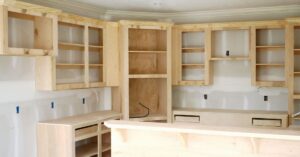
Canadian kitchen cabinet and bathroom vanity manufacturers have less than two months before a scheduled U.S. tariff hike would raise the duty on their products from 25% to 50%, unless Washington reaches an agreement that changes the timetable.
The U.S. Section 232 wood-products tariff took effect on Oct. 14, 2025. The original proclamation placed a 25% duty on kitchen cabinets and vanities, including completed goods and parts imported for use in them. A later White House proclamation delayed the planned jump to 50% by one year, moving it to Jan. 1, 2027.
Global Affairs Canada’s current guidance lists no CUSMA-compliant exemption for Section 232 tariffs on kitchen cabinets and vanities. Origin compliance alone does not remove the 25% duty, and the scheduled increase would double that duty unless a country-specific agreement intervenes.
Separate U.S. Section 338 measures have also added uncertainty across wood and manufactured goods. Trade Commissioner Service guidance says those duties, where applicable, can stack on Section 232 measures and do not include a CUSMA exemption.
Why cabinet makers are exposed
The Canadian Kitchen Cabinet Association says the sector generated $4.7 billion in annual sales in 2024, employs more than 25,000 Canadians and includes roughly 3,700 small and medium-sized businesses. The association says 97% of companies in the industry employ fewer than 50 workers.
That structure makes a major tariff shock harder to absorb in a sector with many export-oriented, labour-intensive firms. A large manufacturer may spread tariff costs across multiple divisions, customers or markets. A smaller cabinet shop with U.S. customers often has fewer ways to protect margins without losing orders.
In June testimony before the Senate Standing Committee on Foreign Affairs and International Trade, CKCA executive director Sandra Wood said the existing U.S. tariff was already affecting manufacturers. She also told senators that cabinet imports into Canada had grown by about 20% annually since 2019, with import values rising from $176 million to $231 million over the previous 18 months.
Company reports show pressure moving from pricing to production
Reuters reported on Nov. 5 that Cabico, a Quebec-based cabinet maker, had shipped 90% of its products to the U.S. before the latest tariff pressure. According to the report, the company’s U.S. shipment volume has fallen 25% from 2024 levels after it invested about C$30 million in its Quebec and Ontario plants, and it has laid off more than a quarter of its 700 employees.
Reuters also reported that Ontario-based Muskoka Cabinet Company had cut 40% of its 70 staff, moved to a three-day workweek and stopped investment to preserve cash. Manitoba-based Decor Cabinet Company was reported to be absorbing part of the tariff cost to keep U.S. customers while using a federal work-sharing program to retain skilled labour.
The tariff pressure is also influencing whether some firms consider U.S. production partners.
Canada’s stopgap relief is aimed at import pressure
Canada has responded on a separate front. The Department of Finance announced a provisional safeguard measure on July 31, 2026, placing a 25% surtax on certain imported wood cabinets and vanities for a maximum of 200 days while a Canadian International Trade Tribunal inquiry continues.
The Canada Gazette says the surtax applies to specified wood cabinets, vanities and subassemblies, including frames, boxes, doors, drawers, drawer components, back panels and end panels. It also says the measure excludes imports from certain free trade partners and developing countries, including the United States and Mexico, consistent with Canada’s trade obligations.
The safeguard measure addresses import pressure in Canada. It does not remove the U.S. tariff on Canadian exports. That leaves cabinet makers exposed on two fronts: reduced competitiveness in the U.S. market and low-priced import competition at home.
The Canadian International Trade Tribunal inquiry covers solid and engineered wood cabinets and vanities, solid and engineered hardwood flooring, and engineered-wood storage furniture. The Tribunal must report to the finance minister by Jan. 15, 2027. If it makes an affirmative finding, it has been directed to recommend remedies over a three-year period.
Closures affect suppliers and rural communities
Cabinet manufacturing is value-added wood production tied to forestry inputs, hardware, finishing, housing, renovation and local employment. The Canada Gazette impact statement said firms in the subsector were undergoing closures or curtailments, affecting rural communities and suppliers such as wood panel manufacturers and softwood lumber producers.
What changes next
Broader Canada-U.S. trade talks remain a possible escape valve. The Associated Press reported on Nov. 1 that Prime Minister Mark Carney and President Donald Trump had discussed a potential deal, with negotiators expected to work toward an agreement in the following weeks. No published agreement reviewed on Nov. 6 had removed the scheduled cabinet tariff increase.
A Canada-U.S. trade agreement before Jan. 1: A deal that addresses wood-products tariffs could change the scheduled increase before it takes effect.
The Jan. 1, 2027 U.S. tariff schedule: Without an agreement or another delay, the cabinet and vanity rate is scheduled to rise from 25% to 50%.
The Jan. 15, 2027 CITT report: The Tribunal’s findings will determine whether longer-term Canadian safeguard measures are recommended.
Get new small business insights by email
Practical ideas and useful articles to help you make better business decisions.
Tech Help Canada Staff researches, writes, and reviews practical content for business owners and professionals. Our coverage spans business, marketing, SEO, technology, and the tools and systems people use to grow and operate online. We focus on clear, useful information backed by research, hands-on experience, and editorial review. Learn more about our team and editorial standards. Need help with something? Contact Us