Two of the world’s most influential creative economies just put serious money behind a statement: AI should not replace the people who make art, film, and content.
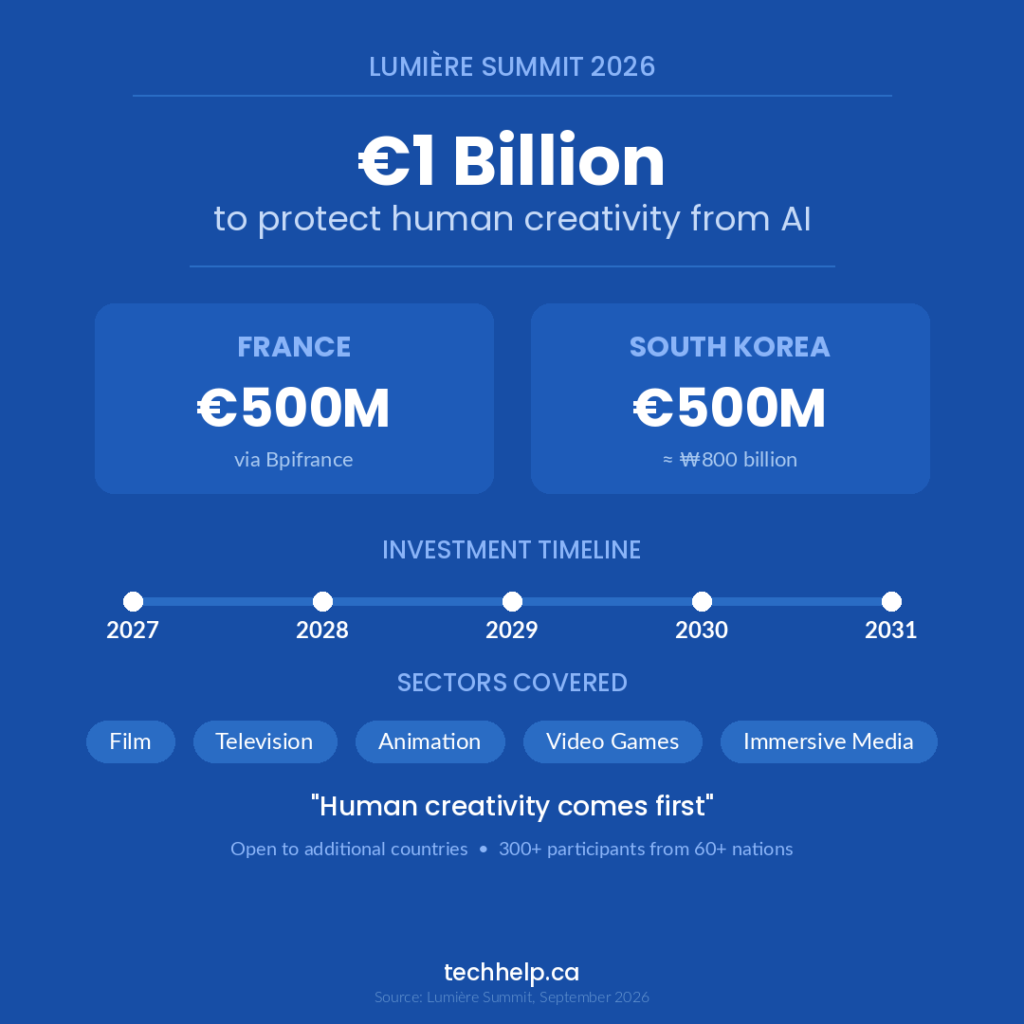
On September 7, 2026, French President Emmanuel Macron and South Korean President Lee Jae-myung announced the Lumière Partnership, a €1 billion investment split evenly between the two countries over five years, built on one clear premise: human creativity comes first.
The principles emerging from the Lumière Summit in Saint-Paul-de-Vence, France, could influence how governments worldwide approach AI regulation, copyright enforcement, and the protection of creative work. If you create content, sell creative services, or use AI tools in your business, these developments are worth tracking closely.
What the Lumière Partnership puts on the table
The structure is straightforward. France and South Korea will each contribute €500 million from 2027 through 2031. France’s portion flows through Bpifrance, its national public investment bank. South Korea’s commitment represents roughly 800 billion won, channeled through its cultural investment infrastructure.
The money targets the audiovisual sector broadly: film, television, animation, video games, and immersive media. Every investment made under the partnership must align with the principles adopted at the summit, including copyright protection, cultural diversity, and the primacy of human creativity.
The partnership is designed to expand. It’s open to additional countries, and the summit attracted more than 300 participants from over 60 nations, including executives from Netflix, Universal, Disney, and Sony Pictures. George Clooney was in the room. So were the heads of the Berlinale, the BFI, and the Toronto Film Festival.
Alongside the partnership, Macron announced IRIS (International Resilience Initiative for Independent Screens), a separate effort to support independent cinemas, distributors, and networks around the world. IRIS is led by an international council of more than 40 filmmakers and artists, including Denis Villeneuve, Sofia Coppola, Tilda Swinton, and Wim Wenders, and it’s targeting €30 million in funding from international partners.
Why France and South Korea are writing this check
France and South Korea both have large screen industries and have invested heavily to expand them.
France launched “La Grande Fabrique de l’Image” in 2022, a €350 million program to expand studio capacity, VFX facilities, and workforce training. It funded 68 projects, including 11 film studios, 12 animation studios, and 34 training organizations. France’s broader production push is also showing up in inbound spending: since January 2026, international productions have committed €628.5 million in France, with total international production expenditure on track to hit €1 billion by year’s end. That’s roughly double the 2025 level.
South Korea also has a large screen economy. The country’s screen industry generated $16.4 billion and supported 291,100 jobs in 2025, according to an MPA-Oxford Economics report. K-content exports doubled between 2019 and 2024, with North America and Europe each growing to about 14% of the export mix. The government tripled its national AI budget in 2026 and launched the K-Culture Value-Up Fund, a ₩150 billion ($102 million) investment vehicle split between ₩100 billion for AI and intellectual property and ₩50 billion for content innovation. It also committed ₩43 billion ($29.3 million) to train 3,400 professionals across AI, creative, and export-oriented roles.
Both countries are actively seeking wider international participation in these frameworks, and the summit’s open-signature model is designed to bring more governments to the table.
The converging pressures on creative industries
The investment didn’t happen in a vacuum. Creative industries are under pressure from multiple directions, and AI is among the most disruptive forces in the mix.
A UNESCO report released in February 2026 projected that generative AI will drive global revenue losses of up to 24% for music creators and 21% for audiovisual creators by 2028. The employment picture adds context. Los Angeles County has shed 41,000 film and television jobs over the past three years, roughly a quarter of its entertainment workforce, with the motion picture and sound recording sector there losing 6,700 jobs in the year ending May 2026 alone. AI is one factor in that decline, alongside the end of the streaming-era production boom, studio consolidation, and the lingering effects of recent industry strikes.
Among the roles considered most vulnerable to AI disruption are VFX artists, animators, concept artists, and sound editors earning between $60,000 and $108,000 annually. In a recent industry survey, a third of entertainment executives predicted that AI would displace 3D modelers by the end of 2026. Some filmmakers and AI-focused production teams have reported that AI tools reduced their animation production costs by as much as 90% on certain workflows, though that figure reflects specific use cases rather than a broad industry benchmark.
Macron was direct about what’s at stake. “We would be making a tremendous mistake if this technology became a tool that replaces, or claims to replace, creators,” he said at the summit. He also flagged a subtler threat: the attention economy reshaping creativity itself. “Our attention is an economic resource,” Macron said, arguing that the flood of AI-generated images and content is disrupting “creativity, the ability to find an audience, and the ability to think.”
Lee Jae-myung pushed a similar point from a different direction. “The film and audiovisual industry must be rooted in human creativity and must resonate with human emotions,” he said, calling for AI to develop in “a more responsible and human-centred way.”
An emerging framework for AI and creative work
The Lumière Summit didn’t just announce funding. It produced a set of policy declarations that could shape how creative industries and governments approach AI in the years ahead.
The Lumière Declaration on the Future of Cinema and the Moving Image, co-presented by France and South Korea and remaining open for further signatures, sets out 15 principles for global film governance. Its central framing treats audience attention as “a trust to be honored, not a resource to be captured,” a direct counter to the algorithmic content systems that optimize for engagement metrics over creative substance. Among the 15 are principles on discoverability in an age of agentic AI, combating piracy, and embracing new technology while protecting intellectual property and human creativity.
Separately, the summit adopted the Saint-Paul-de-Vence Declaration on Artificial Intelligence, which lays out six AI-specific principles. Among them: AI systems that produce, distribute, or transform cultural works fall within the scope of the 2005 UNESCO Convention on cultural diversity; any use of protected creative works for AI training must comply with intellectual property law and result in fair payment to rights holders; and the preservation of human creative employment is recognized as a public policy objective. The AI declaration also calls for transparency in training datasets, clear labeling of AI-generated or AI-altered content, and mechanisms that let rights holders identify uses of their work.
Four additional thematic declarations were adopted at the summit, covering piracy, gender equality, image education, and environmental sustainability. All declarations remain open for signature.
These policy declarations echo regulatory moves already underway in other jurisdictions. Under the EU AI Act’s Article 50, which took effect on August 2, 2026, providers of covered generative AI systems generally must embed machine-readable markings in AI-generated or manipulated content, with exceptions for standard assistive editing and changes that don’t substantially alter the underlying content. Deployers face separate obligations: they must disclose deepfakes to people exposed to them and label certain AI-generated text published on matters of public interest that lacks human editorial control. For deepfakes that are part of evidently artistic, creative, satirical, or fictional works, disclosure requirements are lighter so they don’t hamper the work’s display or enjoyment.
In the United States, SAG-AFTRA’s 2026 TV/Theatrical Agreement, ratified in June with 91.42% member approval, strengthens protections within covered productions. Producers must bargain with the union before using synthetic performers, and they’ve agreed to a principle strongly favoring human performance. If a synthetic is used in a role that would otherwise go to a human actor, producers must demonstrate that it brings “significant additional value.” Digital replicas of performers covered by the agreement require explicit written consent.
These frameworks operate differently and carry different scopes, but common themes are emerging across all of them: greater transparency around AI-generated content, stronger consent and rights protections for creators, and increased scrutiny of AI being used to replace human creative work.
What this signals for content creators and entrepreneurs
You don’t have to be a filmmaker to feel the effects of these shifts. If you produce marketing content, sell creative services, or rely on AI tools in your workflow, the policy and regulatory frameworks taking shape around AI and creative work have implications for how you protect and position your output.
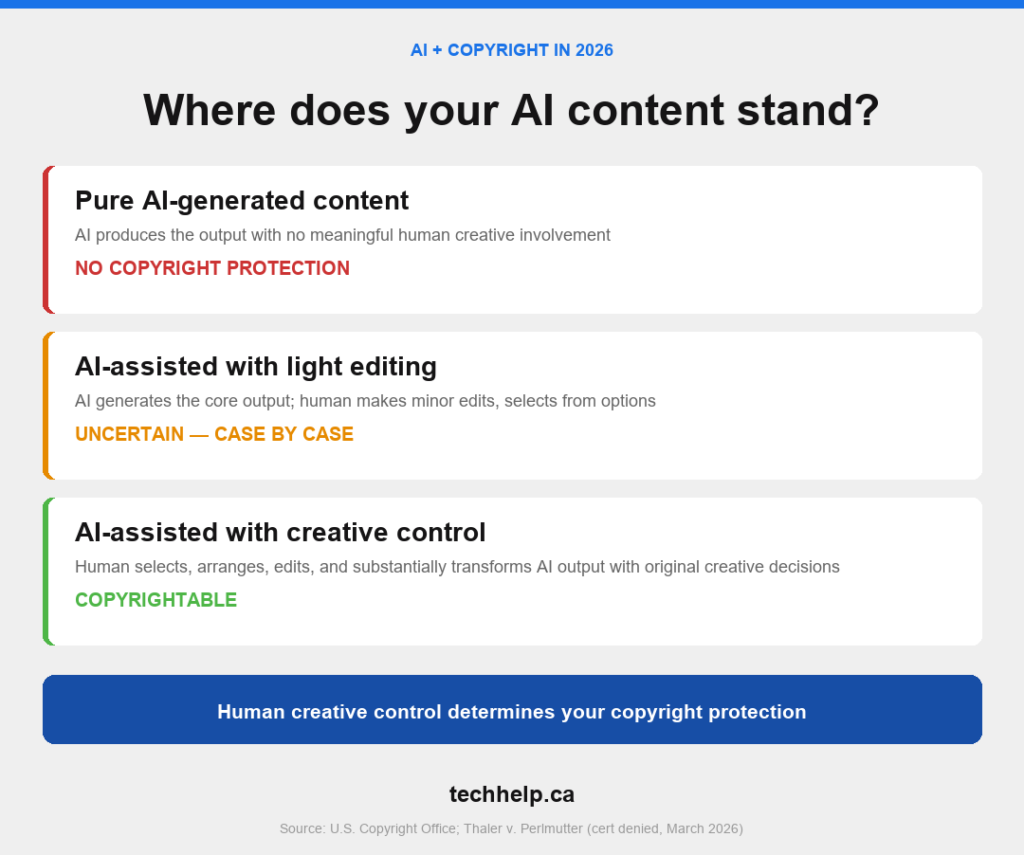
Start with copyright. In March 2026, the U.S. Supreme Court declined to hear a challenge to the human-authorship requirement for copyright, leaving intact a D.C. Circuit ruling that wholly AI-generated expressive material is not eligible for copyright protection under current law. AI-assisted work, where a person exercises creative control over selection, arrangement, and editing, can qualify for protection on a case-by-case basis.
The U.S. Copyright Office has said that creative arrangement or modification of AI-generated material may qualify, as can human-authored expression that’s perceptible in the final output. But prompting alone isn’t enough. The legal position of your work depends on the actual human-authored expression it contains, not just on how much effort you put into the process.
Transparency requirements are another shift to track. Under the EU AI Act, providers of covered generative AI tools generally must make outputs machine-detectable, and deployers face specific disclosure rules for deepfakes and certain AI-generated text on public-interest topics. While these obligations are EU-specific, other jurisdictions are exploring similar approaches. If you’re producing AI-generated content at scale, it’s worth monitoring how labeling and disclosure requirements develop in your market.
For entrepreneurs who use AI as a tool in their creative process, the emerging direction is worth watching. The Lumière declarations emphasize human creativity, creator rights, and fair remuneration. The EU AI Act focuses on transparency and disclosure. U.S. labor agreements like SAG-AFTRA’s place contractual restrictions on synthetic performers within covered productions. Taken together, they point to more transparency around synthetic content and, in some contexts, stronger protections for human creators and performers.
One possibility worth considering: as transparency rules expand and audiences become more aware of AI-generated content, demand for demonstrably human-created work could grow. That’s not a certainty, but it’s a scenario businesses should factor into how they position their content marketing and creative services.
The practical step you can take right now is documentation. If you’re using AI in your creative process, keep records of your prompts, drafts, edits, and final decisions. That documentation won’t determine whether your work qualifies for copyright protection on its own, but it can serve as evidence of the human creative choices you made along the way. It’s also worth reviewing the terms of service for any AI tools you use, since they vary significantly in how they handle output rights.
The €1 billion question
The Lumière Partnership represents a serious financial commitment to an idea: that human creativity is worth protecting with public capital, not just public statements. France and South Korea are two globally influential screen markets, both with substantial employment and export revenue tied to creative industries. The investment reflects that economic reality.
Whether you’re producing feature films or writing content for your small business, the direction is becoming clearer. Governments with significant creative economies are building financial and policy frameworks around the principle that human creativity isn’t interchangeable with machine-generated output. How far those frameworks spread, and how fast, is the open question.
Get new small business insights by email
Practical ideas and useful articles to help you make better business decisions.
Tech Help Canada Staff researches, writes, and reviews practical content for business owners and professionals. Our coverage spans business, marketing, SEO, technology, and the tools and systems people use to grow and operate online. We focus on clear, useful information backed by research, hands-on experience, and editorial review. Learn more about our team and editorial standards. Need help with something? Contact Us