Brent crude touched $99.46 a barrel on September 8. A widening Middle East conflict is the main driver, and the Strait of Hormuz sits at the center of it. On a normal day, roughly 138 vessels transit this 33-kilometer chokepoint between Iran and Oman. Separately, about one-fifth of the world’s oil supply passes through it. Both of those numbers have collapsed since February.
Six months into the Hormuz crisis, the waterway that carries more oil than any other maritime corridor is barely functioning. The costs are cascading into three areas you’ll feel directly: freight rates, fuel prices, and insurance premiums.
If you run a business that ships products, buys diesel, or depends on goods that travel by sea, these increases are already hitting your margins. Here’s how much, and what you can do about it.
What’s happening at Hormuz right now
The Strait of Hormuz has been effectively closed to commercial shipping since February 28, 2026, when the United States and Israel launched joint airstrikes against Iran. In retaliation, Iran’s Revolutionary Guard Corps warned merchant ships away, boarded vessels, and laid sea mines across the strait.
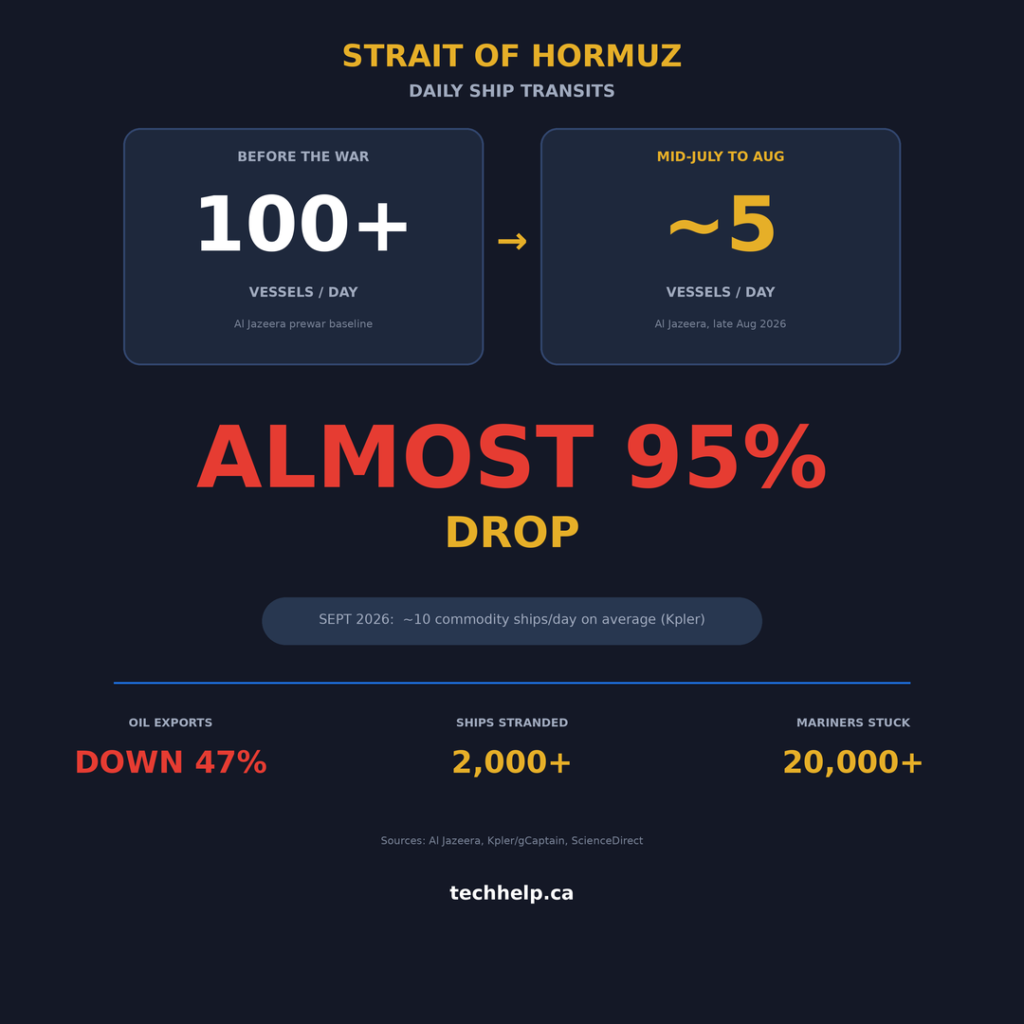
At its worst, daily traffic fell almost 95% from prewar levels, dropping from more than 100 vessels a day to roughly five between mid-July and late August, according to Al Jazeera. A ScienceDirect study using satellite radar and AIS tracking data documented a similarly steep collapse during the early weeks of the crisis. The situation has barely recovered since. In early September, Kpler data showed an average of roughly 10 commodity ships per day passing through the strait over a 10-day period, though daily counts have swung as low as four.
Crude exports from the Gulf region have dropped by 47%, from roughly 17 million barrels per day in 2025 to about nine million barrels per day as of August 2026, according to industry data. By April, the International Maritime Organization reported that around 20,000 mariners and 2,000 ships were stranded in the Persian Gulf.
The U.S. Navy launched Operation Project Freedom on May 4 to escort merchant ships through the strait. But the Navy itself acknowledged it doesn’t have enough destroyers and frigates to sustain full-scale escort operations. Meanwhile, Iran’s Supreme Leader has called Hormuz a “lever” that “must continue to be used,” and Houthi forces in Yemen have attacked Saudi energy facilities, widening the disruption beyond the strait itself.
Freight rates: elevated and volatile
If you import goods or rely on international shipping, your invoices have probably already jumped. The picture six months into the crisis is elevated but uneven.
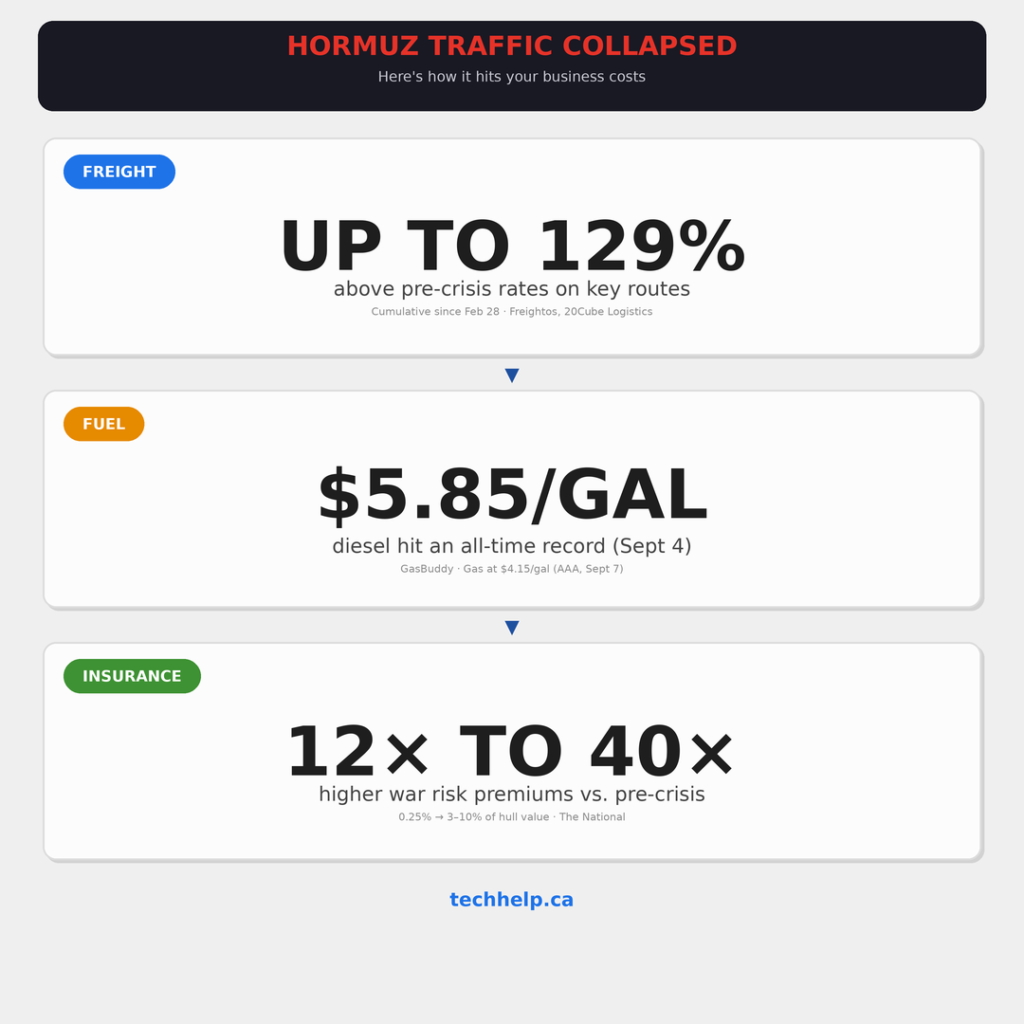
Since late February, cumulative spot rate increases have been dramatic on some routes. By late May, Lloyd’s List reported that Drewry’s Shanghai-to-Los Angeles benchmark had climbed 59% above pre-crisis levels, while the Shanghai Containerized Freight Index’s U.S. West Coast rate was up 129%. For routes that touch the Middle East, total shipping costs rose 125% to 180% compared to pre-crisis baselines, according to 20Cube Logistics.
But the latest weekly data shows more divergence than a straight climb. Freightos’ September 8 update shows Asia-to-U.S. West Coast rates slipping 1%, Asia-to-U.S. East Coast down 3%, Asia-to-North Europe down 3%, and Asia-to-Mediterranean down 1%. Drewry’s World Container Index, however, showed transpacific lanes rising that same week, an indication that different benchmarks are diverging as the crisis stretches on.
A second, overlapping disruption is compounding the problem. Renewed Houthi attacks in the Red Sea have pushed most major carriers off the Suez route and onto the Cape of Good Hope. That detour adds 3,500 to 4,000 nautical miles and 10 to 14 extra days per voyage, pushing costs up 30% to 50% on Asia-Europe lanes specifically. This is primarily a Red Sea avoidance issue, not a Hormuz workaround — ships rounding Africa still can’t enter the Persian Gulf through the strait.
The combined effect of both disruptions has squeezed global shipping capacity. Lloyd’s List estimated earlier in the crisis that rerouting, slow steaming from higher bunker costs, and port congestion together reduced effective container capacity by roughly 19%. Carriers have also stacked on emergency surcharges, with some corridors seeing charges up to $3,000 per FEU. Maersk formalized a global Emergency Bunker Surcharge in March, embedding higher fuel costs directly into shipping economics.
Fuel prices at record highs
While freight rate increases get embedded into your next shipping invoice, fuel costs hit your business directly, every day.
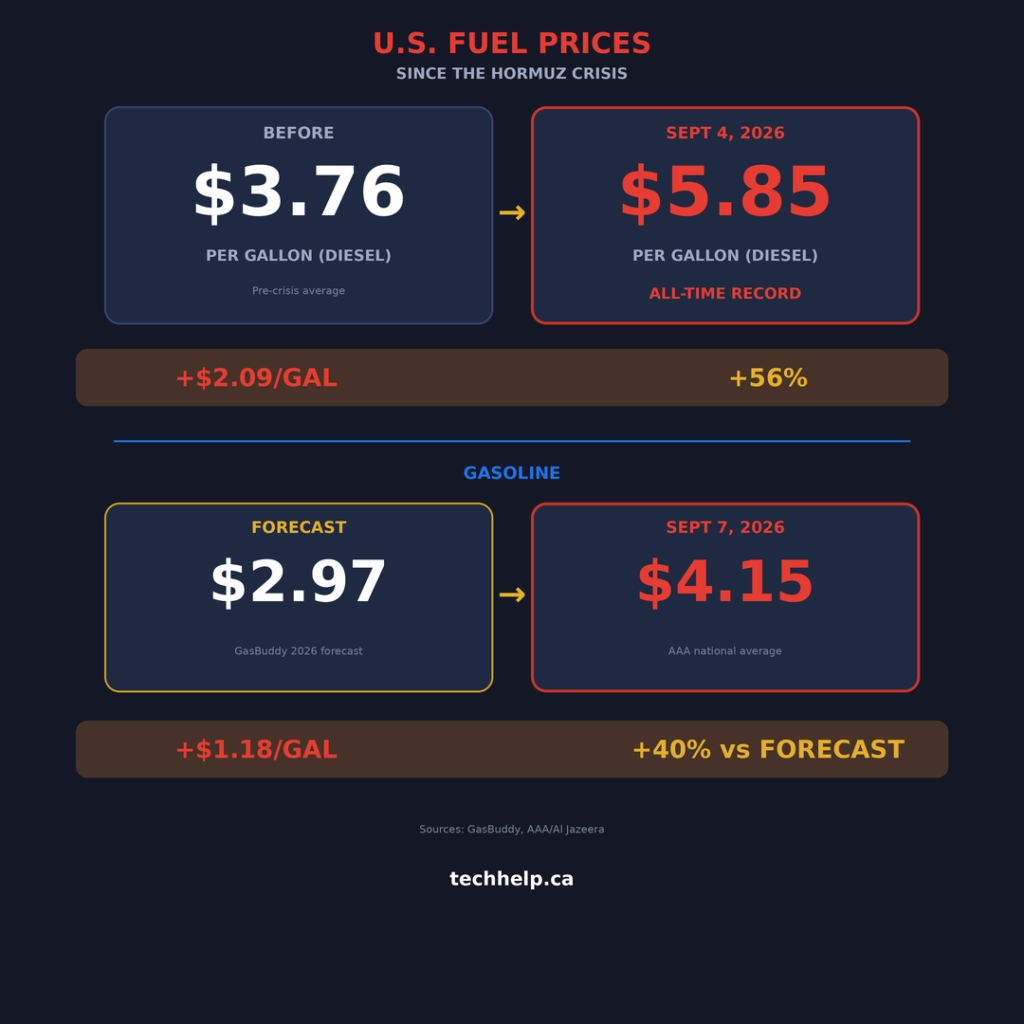
Diesel reached an all-time record high of $5.85 per gallon on September 4, according to GasBuddy, and has continued climbing since. Gasoline reached a national average of $4.15 per gallon on September 7, up 39% since the war began, according to AAA data cited by Al Jazeera. Before the conflict, diesel sat at approximately $3.76 per gallon. It’s now up over $2 from a year ago.
These prices were supposed to go the other direction. GasBuddy had forecast the 2026 national average for gasoline at $2.97 per gallon. Diesel was expected to average $3.55. The Hormuz crisis blew through those projections within weeks of the February strikes.
In March 2026, small business gasoline spending surged 23% year-over-year, according to Bank of America Institute payments data. Agriculture and transportation firms saw increases exceeding 25% in the same period. Those figures reflect March conditions, early in the crisis. Fuel prices have risen significantly since.
Carriers are passing these costs through. FedEx and UPS use fuel surcharges that move with diesel benchmarks, and both have raised their rates in 2026. USPS took a different approach, implementing a temporary 8% transportation-related price increase on certain competitive package services rather than adding a surcharge. Industry forecasts suggest businesses should budget for Bunker Adjustment Factor increases of 20% to 40% over the next 30 to 90 days, according to 20Cube Logistics.
Insurance: the cost most businesses never see
This one’s quieter, but it might be the most dramatic. War risk insurance for ships transiting the Persian Gulf has gone from a routine cost to a crisis-level expense that gets baked into shipping quotes.
Before February 28, war risk premiums sat at around 0.25% of a vessel’s hull value. Within 48 hours of the strikes, premiums surged fivefold. As the crisis deepened, several leading marine insurers terminated existing coverage and repriced policies dramatically. By mid-2026, war risk premiums had climbed to between 3% and 10% of hull value for tankers transiting the Gulf, according to The National.
In dollar terms, a $100 million tanker that used to pay around $250,000 for war risk coverage now faces premiums of $3 million to $10 million. In April, JPMorgan analysts estimated that 329 vessels were operating in the Persian Gulf carrying a combined $352 billion in insured value, according to the World Economic Forum. That much insured value concentrated in an active war zone has left the marine insurance market deeply exposed.
Several private insurers have pulled back from the market entirely. To fill the gap, the U.S. Development Finance Corporation partnered with leading insurers to create a $40 billion reinsurance facility. The World Economic Forum noted this marks a shift toward governments becoming “insurers of last resort.”
You won’t see “war risk premium” on your FedEx label or Amazon shipping estimate. But these costs flow downstream through carriers, freight forwarders, and logistics providers that touch Gulf-connected routes. When insuring a single ship costs an order of magnitude more than it did seven months ago, that math eventually lands in your shipping quote.
The buffers are under strain
If you’re hoping the price pressure eases soon, the outlook is mixed.
Some cushioning mechanisms are working. Saudi Arabia has rerouted crude exports through its East-West pipeline to the Red Sea port of Yanbu. Non-OPEC producers, including the United States, Canada, Guyana, and Brazil, have increased output. These alternatives have helped keep crude from rising even further.
But the largest buffers are strained. The U.S. government authorized a release of 172 million barrels from the Strategic Petroleum Reserve in March — the largest single-country emergency release in history. That release helped dampen the initial price spike, but it’s drawn the SPR down to roughly 287 million barrels as of late August, the lowest level since 1982.
OPEC+ hasn’t been able to deliver on its quota increases either. On paper, member nations have hiked output quotas by roughly 800,000 barrels per day between April and July. In the early months of the crisis, the gap between targets and reality was enormous: total OPEC+ production fell from 42.77 million barrels per day in February to 33.13 million in May, according to OPEC data. Output has partially recovered since then, but core OPEC members are still falling short. In August, OPEC crude production (the 13-member group, excluding non-OPEC allies) dropped 900,000 barrels per day to average 19.91 million barrels per day, with Saudi output alone declining by over one million barrels, according to Bloomberg. Pipeline capacity and alternative export routes outside the Gulf can cushion a partial shutdown, but they can’t replace normal Hormuz volumes without significant price shocks.
In March, Goldman Sachs raised U.S. recession probability to 30%, citing the oil shock. Vanguard’s analysis found that oil would need to exceed $150 per barrel for four quarters or longer to trigger a global recession. With Brent hovering just under $100, the immediate recession threshold hasn’t been crossed, but sustained high energy costs are already putting upward pressure on inflation and squeezing purchasing power for consumers and businesses.
How to protect your margins
You can’t control what happens in the Strait of Hormuz. But if your business depends on shipping, fuel, or imported goods, you can control how exposed you are to it.
Consolidate shipments. If you’re making multiple smaller shipments, combining them into fewer, larger ones reduces per-unit freight costs and minimizes the number of times you’re absorbing surcharges.
Diversify your carriers. Multi-carrier shipping lets you shift volume to whoever offers the best rate on a given lane. In an environment where surcharges vary widely across providers, that flexibility directly protects your margins.
Renegotiate fuel surcharge terms. Many shipping contracts peg surcharges to diesel benchmarks with lag times that can work for or against you. Review your terms now. A surcharge indexed to actual diesel costs with a reasonable cap can limit your exposure during spikes.
Hold inventory closer to your customers. Positioning stock in regional warehouses or fulfillment centers near your largest markets reduces your dependence on long-haul freight. Shorter shipping distances won’t eliminate fuel-price exposure entirely, but they do reduce the number of cost variables between your warehouse and your customer.
Shift from just-in-time to just-in-case. The JIT model depends on reliable, predictable shipping. That assumption broke in 2020, broke again in 2024 when Houthi attacks forced Red Sea rerouting, and has broken again now. Building modest buffer inventory costs money upfront, but it costs far less than emergency air freight when your container is stuck on a 14-day detour around Africa.
Shorten your supply chain. This is the most durable protection. Sourcing closer to your end market, whether that means nearshoring or working with regional suppliers, structurally reduces your exposure to energy price shocks and maritime disruption. It’s not always possible overnight, but it’s worth mapping where your longest, most Gulf-dependent supply lines sit.
What this means for your cost structure
For businesses that rely on shipping, fuel, or physical supply chains, the Hormuz crisis has driven up three of the costs they’re most exposed to: freight rates, fuel prices, and insurance premiums. Freight and fuel are variable costs that scale directly with volume and market conditions. War risk insurance, while not a variable cost, has become another significant cost pressure in this crisis. Those costs don’t stay inside shipping invoices. They flow into the price of groceries, e-commerce deliveries, manufacturing inputs, and every product that moves through a global supply chain.
The usual buffers are strained. Strategic reserves are at four-decade lows. OPEC members are producing well below their quotas. Alternative shipping routes are adding weeks and costs of their own. Non-OPEC production and pipeline workarounds are helping, but they aren’t enough to fully offset the disruption.
If your business depends on freight, fuel, or imported goods, the question isn’t whether this affects your costs. It’s how quickly you adjust. The companies that renegotiate shipping terms, reposition inventory, and diversify their logistics networks now will absorb less damage than those who wait for the next invoice to explain it for them.
Get new small business insights by email
Practical ideas and useful articles to help you make better business decisions.
Tech Help Canada Staff researches, writes, and reviews practical content for business owners and professionals. Our coverage spans business, marketing, SEO, technology, and the tools and systems people use to grow and operate online. We focus on clear, useful information backed by research, hands-on experience, and editorial review. Learn more about our team and editorial standards. Need help with something? Contact Us