Dockworker unions are preparing a coordinated day of industrial action on Friday, October 30, 2026, in a campaign that began among European and Mediterranean ports and has since drawn support beyond the region.
The World Federation of Trade Unions said the October 30 action followed the Third International Meeting of Mediterranean and European Dockworkers’ and Port Workers’ Unions, held in Istanbul in May 2026. The participating unions included CGT Ports and Docks in France, ENEDEP in Greece, LAB in the Basque Country, Liman-İş in Turkey, ODT in Morocco, and USB in Italy. ORSA Porti in Gioia Tauro later endorsed the Istanbul Declaration.
USB said on October 21 that participation had grown to more than 100 ports in 17 countries and four continents. The union named large hubs including Tangier, Marseille, Piraeus, Gioia Tauro, Genoa, and Mersin, and said support had also arrived from northern Europe, India, Mexico, and the United States.
Kuehne+Nagel, in a customer advisory, put the planned action at over 50 ports across Europe, the Mediterranean, and other regions. That lower count does not necessarily conflict with USB’s larger figure. The freight forwarder also cautioned that the operational effect would differ by location, with some ports facing walkouts and others holding demonstrations instead of full stoppages.
Italy and Greece carry the clearest disruption risk
Kuehne+Nagel identified Hamburg, Genoa, Livorno, Gioia Tauro, Marseille, Piraeus, Tangier, Mersin, and Veracruz as potentially affected.
In Italy, the port component appears more concrete. Kuehne+Nagel said the Italian transport ministry had formally registered a nationwide 24-hour port workers’ strike for October 30. USB listed Genoa, Livorno, Trieste, Civitavecchia, Ancona, Ravenna, and Gioia Tauro among Italian port cities involved.
That Italian picture became more complicated on October 27. ANSA reported that Transport Minister Matteo Salvini had signed an order seeking to defer transport-sector strike action connected to the October 30 general strike, citing a holiday-related restriction period around the commemoration of the dead. ANSA also reported that USB replied it would confirm the strike in the sectors named in the ministerial act. That makes Italy both one of the most exposed locations and one of the most legally uncertain parts of the mobilization.
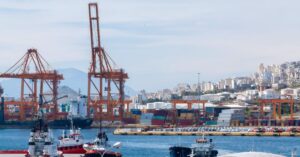
In Greece, To Vima reported that seafarers’ unions had called a 24-hour strike on October 30 at Piraeus, Rafina, Lavrio, Patra, Igoumenitsa, Elefsina, and Rio-Antirrio. The same report said the Federation of Permanent Port Employees of Greece had called a three-hour stoppage from 10:00 to 13:00, while the Piraeus Labour Centre planned a 24-hour strike and rally.
Operators have already published some schedule changes. Blue Star Ferries has cancelled several October 30 departures, while Minoan Lines lists a 23:00 sailing from Piraeus in its revised schedule. The strike call does not mean every sailing at the named ports will be cancelled.
The port count may overstate the number of full stoppages
PortNews reported, citing USB, that the European Dockworkers Council was among the participants. It also noted that the precise form of action had not been confirmed at every port.
A registered 24-hour walkout at a port can affect gates, vessel work, terminal labour, rail links, trucking flows, and feeder connections. A solidarity rally may create little direct cargo disruption unless workers stop operations or access routes are blocked. The October 30 risk is therefore concentrated around ports with formal strike calls, dense labour participation, or connected transport stoppages.
USB has estimated that unions involved from the early stages handle about 40% of Mediterranean container traffic and that roughly 40,000 containers could be delayed for a day. PortNews noted that those estimates have not been independently verified. They should be treated as union estimates, not confirmed throughput forecasts.
A one-day stoppage can last longer than one day
The practical risk for cargo owners is not only the strike day itself. Missed cut-offs, delayed vessel work, yard congestion, and missed feeder connections can carry into the following week, especially at transshipment hubs such as Gioia Tauro and Piraeus.
The February 6, 2026 port action gives a partial guide to how disruptions can spread. The Maritime Executive reported at the time that a 24-hour Italian port strike caused disruptions at multiple ports, with union reports describing blocked container and RoRo terminals in Genoa, road and rail traffic backing up, and effects on intermodal operations from Trieste into Austria and Germany. Some vessel-movement details in that report were based on union claims, but the pattern shows why even a short stoppage can create downstream delays.
The October 30 action also lands close to weekend operating patterns and public-holiday pressures in parts of Europe. If terminal work, gate hours, ferry sailings, or inland movements are missed on Friday, the recovery period may depend on each port’s weekend labour availability and backlog.
The dispute reflects a larger fight over port strategy
The Council of the European Union said in June that ports handle around 74% of goods entering or leaving the EU and about 395 million passengers every year. The Council also described ports as increasingly central to energy transition, industrial development, military mobility, and economic security.
The October 30 mobilisation is unfolding inside that policy context. Governments are treating ports as strategic infrastructure. The participating unions are opposing arms shipments and the militarization of port infrastructure, while also raising older workplace issues such as pay, safety, subcontracting, and automation.
The action is a test of whether dockworker coordination across ports can influence cargo flows tied to politically sensitive goods, while also using supply-chain leverage in debates over automation and labour conditions.
What remains unclear before October 30
Several facts may change before Friday. The final number of ports participating, the type of action at each site, the operational response from carriers and terminals, and the effect of Italy’s ministerial order were not settled as of October 28.
For companies with goods moving through European and Mediterranean routes, the most exposed shipments are likely containers with Friday terminal cut-offs, cargo routed through transshipment hubs, and ferry or RoRo freight connected to Greek and Italian gateways.

I can suggest related Tech Help Canada articles based on the topic you’re reading now.

Tech Help Canada Staff researches, writes, and reviews practical content for business owners and professionals. Our coverage spans business, marketing, SEO, technology, and the tools and systems people use to grow and operate online. We focus on clear, useful information backed by research, hands-on experience, and editorial review. Learn more about our team and editorial standards. Need help with something? Contact Us