

Online business growth: The ultimate guide for building a stronger digital business
Online business growth isn't just more traffic, more posts, more ads, or more tools. Those things can help, but only when the business underneath them is ready to convert attention into revenue.
That doesn't mean every online business grows automatically. It means more of your customers are online, more of their buying journey happens before they talk to you, and more competitors are fighting for the same attention.
The businesses that win don't chase every trend. They build a system:
Demand x Trust x Conversion x Retention x Margin = online growth.
If one part is weak, the whole system slows down. You can have plenty of traffic and still struggle if your offer is unclear. You can have a strong product and still lose money if acquisition costs are too high. You can convert first-time buyers and still plateau if nobody comes back.
Use this as a working guide, not a motivational speech. The goal is to help you find the next constraint in your online business and fix it with focus.
Explore the online business growth guide
Jump to the framework, growth stages, constraint diagnostic, 90-day plan, checklist, FAQ, related resources, and sources.
- What online business growth means
- The online growth equation
- Match the growth strategy to the business model
- Start with the growth stage you're actually in
- Choose one 90-day growth goal
- Find the constraint before you add more tactics
- Define the customer more sharply than your competitors do
- Build an offer people can understand fast
- Make your website easier to trust
- Fix the pages closest to revenue first
- Fix the technical basics that quietly limit growth
- Build traffic you can sustain
- Use SEO as a long-term growth asset
- Prepare for AI search and answer engines
- Turn content into a growth system
- Use paid ads without letting them hide weakness
- Build an email list before you need it
- Convert visitors without pressuring them
- Improve average order value without becoming pushy
- Make retention part of the growth plan
- Protect margins as you grow
- Add automation where it removes friction
- Use AI tools without diluting trust
- Measure the numbers that actually guide decisions
- Build a simple attribution habit
- Create a 90-day online growth plan
- Common online business growth mistakes
- Online business growth checklist
- The real path to online growth
- Frequently asked questions
- Related
- Sources
Contents
What online business growth means
Online business growth means increasing revenue, profit, market reach, or customer value through digital channels. That can include ecommerce sales, booked calls, subscriptions, leads, appointments, digital products, paid communities, service inquiries, repeat purchases, or any other measurable outcome that moves the business forward.
Growth isn’t the same as activity. Posting daily is activity. Getting more qualified buyers to trust you and take action is growth. Running ads is activity. Turning paid traffic into profitable customers is growth. Publishing content is activity. Building pages that keep earning traffic, links, leads, and trust over time is growth.
A stronger definition is this:
Online business growth is the process of improving the full digital customer journey so more of the right people find you, trust you, buy from you, return to you, and recommend you.
That definition keeps you from over-focusing on one number. Traffic alone can hide weak conversion. Revenue alone can hide poor margins. New customers alone can hide retention problems. Growth has to be measured as a system.
The online growth equation
Most growth problems fit into one of five areas. Demand is the number of qualified people who know about the problem, want a solution, and can find you. Trust is the confidence they have in your offer, proof, brand, experience, and ability to deliver. Conversion is the percentage of people who take the next step, whether that’s buying, booking, subscribing, requesting a quote, or joining a list.
Retention is what happens after the first sale or first conversion. Do customers come back? Do they use what they bought? Do they refer others? Do they buy the next thing? Margin is the money left after acquisition, delivery, software, labor, refunds, payment fees, and other costs.
If you want a simple diagnostic, start with the questions a healthy growth system has to answer. Do enough of the right people know you exist? Do they quickly understand why they should choose you? Does the website make the next step obvious and easy? Do you follow up when someone is interested but not ready? Do customers return, expand, or refer? And after all of that, are you making enough profit to keep growing without stress?
Those questions are better than “What tactic should we try next?” They point you toward the part of the system that needs work.
Match the growth strategy to the business model
Online growth doesn’t look the same for every business. A service company, ecommerce store, SaaS product, marketplace, and digital product business can all use SEO, email, paid ads, partnerships, and social media, but the economics behind those channels are different.
For service businesses, growth usually depends on trust, qualification, and response speed. The buyer wants to know whether you understand their problem, whether you’re credible, what the process looks like, and whether the conversation will be worth their time. A service business can often grow faster by clarifying packages, improving case studies, shortening the inquiry path, and following up with leads quickly than by publishing more generic content.
For ecommerce businesses, the growth system has to connect product discovery, product page clarity, checkout ease, delivery expectations, repeat purchase, and margin. A store can generate plenty of traffic and still struggle if product pages don’t answer buying questions, shipping feels unclear, reviews are thin, or discounts train customers to wait. Growth often comes from improving product education, bundles, merchandising, abandoned-cart recovery, post-purchase emails, and reorder prompts.
For SaaS and subscription businesses, the first sale is only the start. Acquisition matters, but activation and retention usually decide whether growth compounds. A company can sign up new users every week and still leak revenue if onboarding is confusing, the first useful action takes too long, or the product doesn’t become part of the customer’s routine. In this model, growth work should connect marketing promises with product adoption, support, renewals, upgrades, and churn prevention.
For digital products, courses, memberships, and communities, the challenge is often belief. The buyer has to believe the outcome is real, the method makes sense, and they’ll actually use what they buy. Strong previews, lesson samples, student examples, creator credibility, clear outcomes, and post-purchase engagement matter more than polished hype. If customers don’t finish or participate, future growth gets harder because proof dries up.
For local businesses, visibility and convenience carry extra weight. Customers often need your location, hours, service area, contact options, and proof that other local customers trust you. Local SEO, Google Business Profile quality, reviews, service-area pages, photos, fast call or booking options, and consistent business listings can do more than broad content aimed at everyone.
This is why copying another company’s growth playbook can backfire. The tactic may be visible, but the business model underneath it may be completely different. Start with how your business earns, delivers, retains, and expands value, then choose the channels that support that model.
Start with the growth stage you're actually in
Online businesses often copy strategies from companies at a different stage. That creates waste. A brand with strong demand can profitably run ads that would destroy a newer business. A company with hundreds of content assets can run optimization plays that make no sense for a site with ten pages.
Name your current stage before you borrow someone else’s tactics.
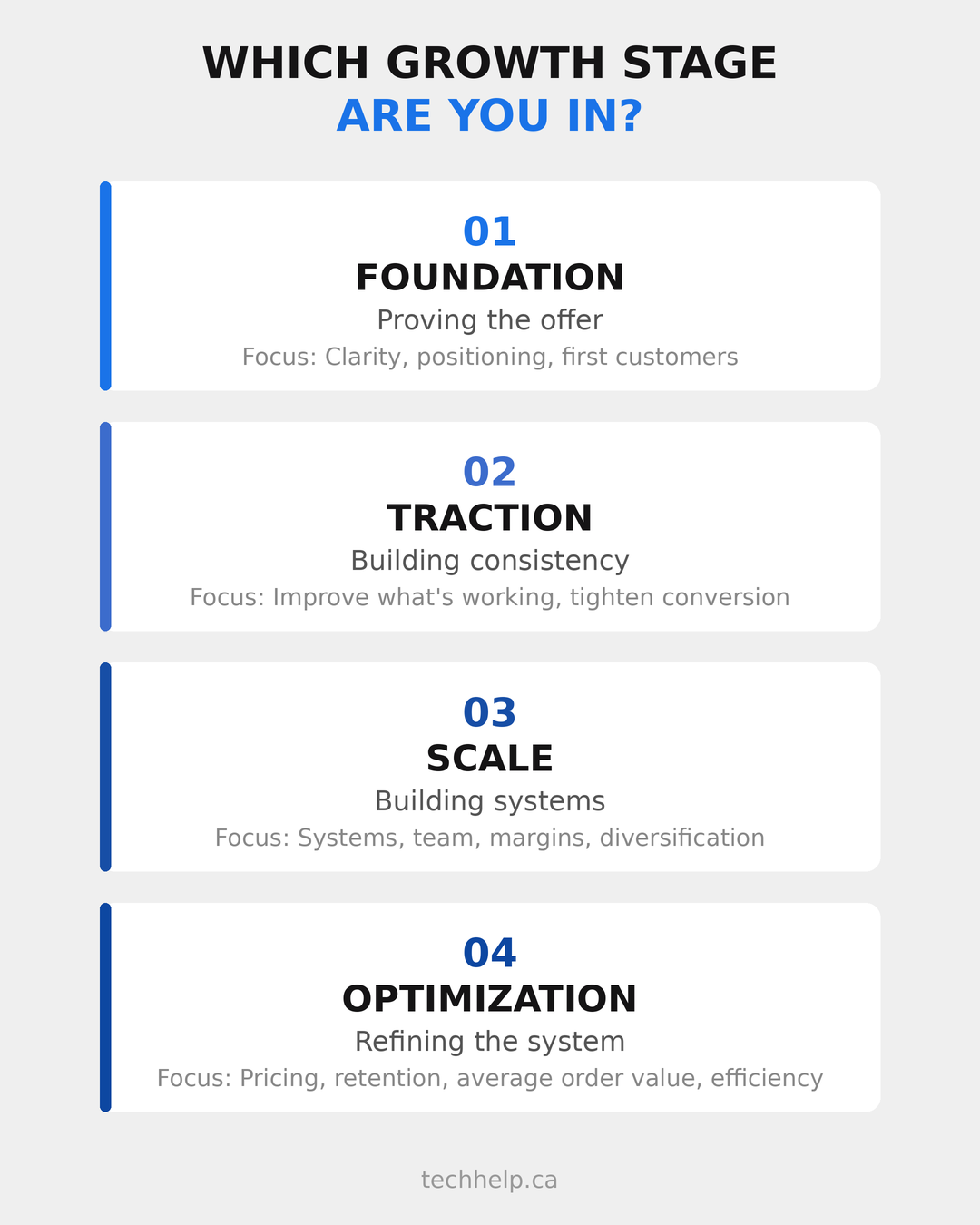
Stage 1: foundation
You’re still proving the offer. You may have a website, a few customers, and some early interest, but the messaging, pricing, delivery, and lead flow aren’t steady yet.
At this stage, growth comes from clarity. You need customer conversations, sharper positioning, simple pages, clear proof, and a small number of acquisition experiments. Don’t build a complex funnel before you know what people want and why they buy.
Stage 2: traction
You have signs that the offer works. Some customers buy, some leads come in, and one or two channels show promise. The problem is consistency.
At this stage, growth comes from improving what already shows life. Tighten the website. Improve follow-up. Publish around proven buyer questions. Test offers. Make the conversion path easier. You aren’t trying to be everywhere; you’re trying to make the first working channel more reliable.
Stage 3: scale
You have a repeatable way to attract and convert customers. Growth is now limited by budget, fulfillment, team capacity, margins, or systems.
At this stage, growth comes from process. You need better attribution, stronger sales operations, retention programs, automation, hiring, margin control, and channel diversification. The goal isn’t just to sell more. The goal is to sell more without breaking delivery.
Stage 4: optimization
You already have traffic, customers, and systems. The biggest opportunities are hidden inside the business: pricing, conversion rate, retention, average order value, upsells, referrals, customer support, and operational efficiency.
At this stage, small improvements can have large effects. A better checkout, a stronger onboarding sequence, a clearer upgrade path, or a higher-margin package can create more growth than chasing a brand-new channel.
Choose one 90-day growth goal
“Grow the business” is too vague to guide decisions. Pick one primary goal for the next 90 days.
That goal might be increasing qualified leads by 25 percent, improving website conversion from 1 percent to 2 percent, growing repeat purchases by 15 percent, reducing customer acquisition cost by 20 percent, increasing average order value by $20, booking 30 more sales calls from organic search, or launching one new offer for existing customers.
Each goal leads to a different plan. If you need sales now, your priority may be improving the offer, fixing checkout, following up with warm leads, or running a narrow paid campaign. If you need more demand, your priority may be search content, partnerships, referrals, social proof, or paid reach.
BDC recommends that a growth plan include a clear picture of the business’s current position, a future vision, and an action plan that names who will do what and when. That fits online growth: the work gets messy fast, and you need a short plan with a clear bottleneck, not a giant document nobody uses.
Your 90-day goal should pass three tests:
It should be measurable. It should be tied to revenue, profit, or customer value. It should be narrow enough that you can make real progress without trying to rebuild the whole business at once.
Find the constraint before you add more tactics
Most online businesses don’t need more tactics at first. They need a better diagnosis.
If your traffic is low, you likely have an acquisition problem. If traffic is healthy but leads are weak, you may have a positioning, offer, page, or trust problem. If leads are strong but sales are weak, you may have a follow-up, pricing, qualification, or sales process problem. If customers buy once and vanish, you have a retention problem. If revenue grows but cash feels tight, you likely have a margin, fulfillment, or payment timing problem.
You can think of these as business growth levers. Pulling the wrong one creates motion without progress.
Use this constraint map to avoid guessing:
Swipe horizontally to see the full table.
| If the problem is… | Look first at… |
|---|---|
| Low traffic | Distribution, search visibility, partnerships, or paid reach |
| Low conversion | Offer clarity, proof, page flow, pricing, CTAs, or checkout |
| Low lead quality | Audience focus, promise, lead magnet, or qualification |
| Low close rate | Sales follow-up, objection handling, pricing, or sales materials |
| Low repeat purchase | Onboarding, delivery, lifecycle emails, support, or next-step offers |
| Low profit | Pricing, packaging, costs, fulfillment, refunds, or channel mix |
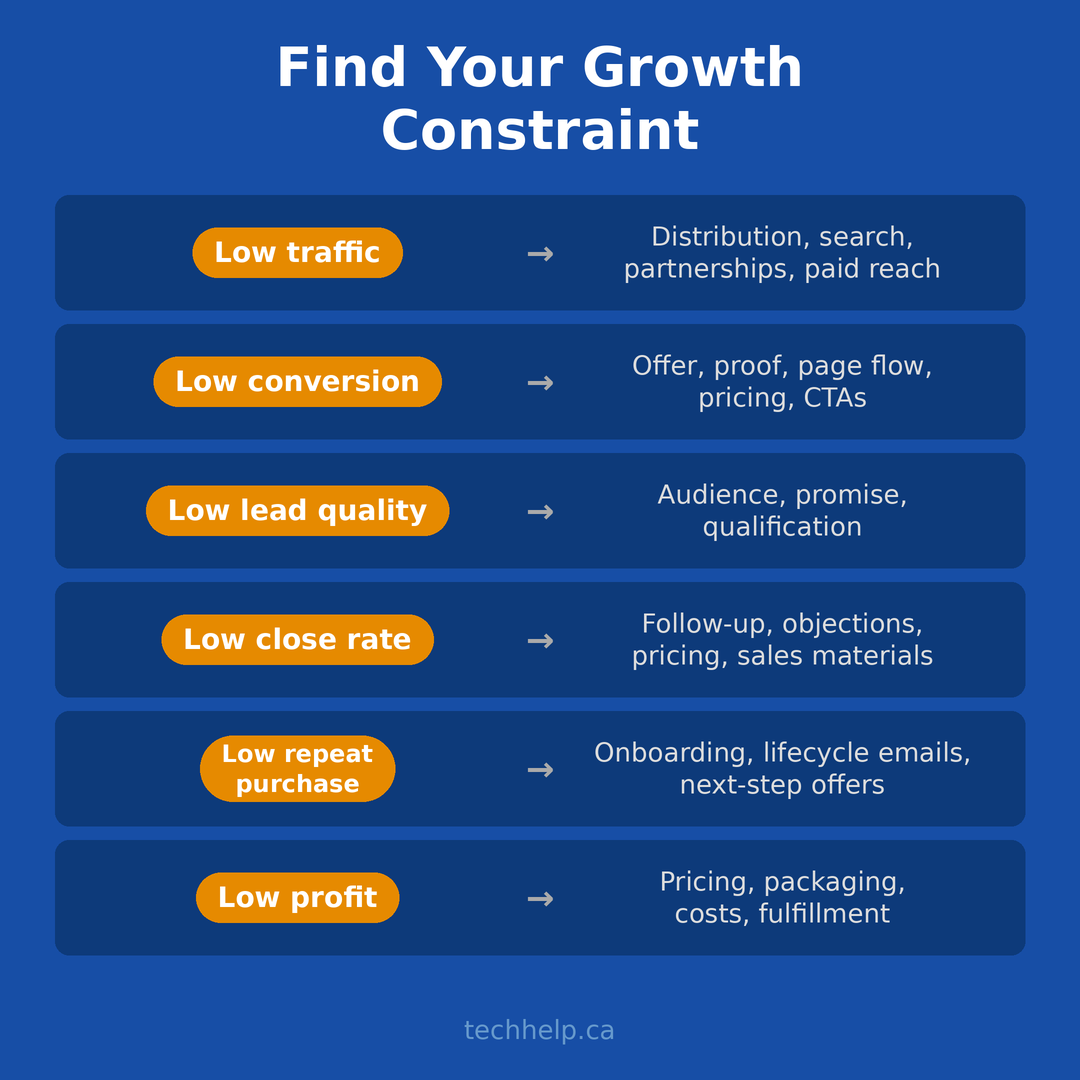
Pick the constraint that’s closest to revenue. Fixing a conversion leak on a page that already gets traffic usually beats launching a brand-new channel from scratch.
Growth support
Not sure which constraint is holding growth back?
Tech Help Canada helps small businesses improve the pages, content, SEO, and systems that turn attention into revenue.
Define the customer more sharply than your competitors do
Weak marketing usually starts with a vague customer. “Small businesses” isn’t enough. “Busy home service companies that need more booked jobs from local search” is better. “Independent ecommerce brands selling replenishable products with low repeat purchase rates” is better. The more specific the customer, the easier it becomes to write copy, choose channels, build offers, and earn trust.
Start with the buying situation, not just demographics. What changed in the customer’s world that makes them look for a solution now? What have they already tried? What do they think will be hard? What do they fear wasting money on? What would make them feel safe enough to move forward?
Then write in their language. Don’t make people translate your offer. Say who it’s for, what problem it solves, what result it supports, and what makes it different from doing nothing or choosing a competitor.
This simple value proposition formula will expose weak positioning fast:
We help [specific customer] get [specific result] without [specific frustration].
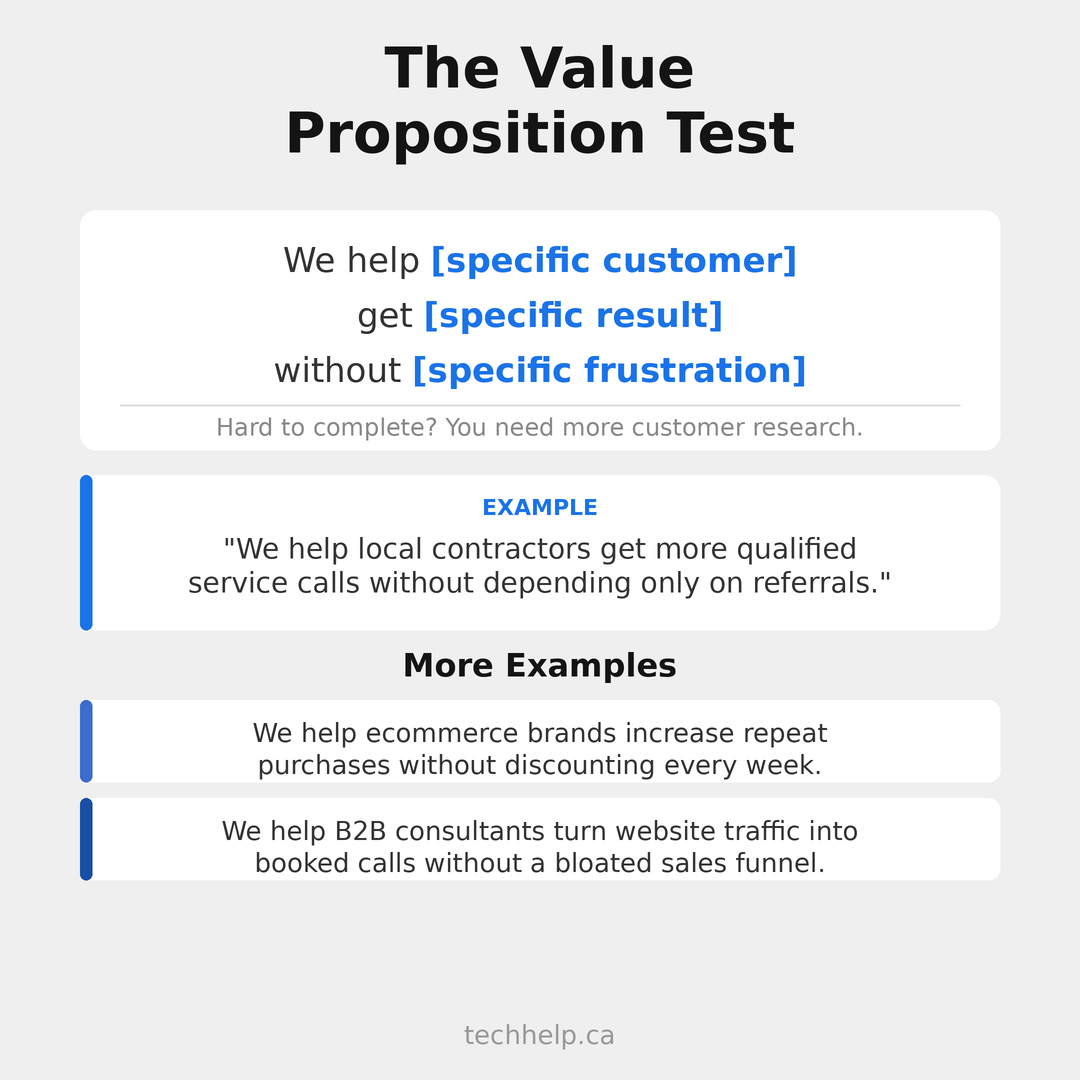
For example, a local contractor version might be: “We help local contractors get more qualified service calls without depending only on referrals.” An ecommerce version could be: “We help ecommerce brands increase repeat purchases without discounting every week.” A B2B consulting version might be: “We help B2B consultants turn website traffic into booked calls without a bloated sales funnel.”
If that sentence is hard to complete, the next step isn’t more ads. It’s more customer research.
Build an offer people can understand fast
An offer isn’t just the product or service. It’s the promise, price, risk reversal, proof, terms, delivery method, urgency, and next step packaged together.
A weak offer asks the customer to do too much work. They have to figure out what’s included, whether it fits them, why the price makes sense, what happens after buying, and whether they can trust you. A strong offer answers those questions before doubt takes over.
Your offer should make five things clear without forcing the buyer to ask: who it’s for, what problem it solves, what outcome the customer can reasonably expect, what’s included and excluded, and what the customer should do next.
For service businesses, packaging often improves growth because it removes ambiguity. Instead of “contact us for marketing help,” you might offer a local SEO audit, a website conversion review, a monthly content package, or a fixed-scope launch plan. For ecommerce, packaging can mean bundles, starter kits, subscriptions, replenishment reminders, trial sizes, or gift sets.
Pricing is part of the offer too. Cheap can create doubt. Expensive can create hesitation. Clear pricing helps people decide whether they’re in the right place.
If you can’t show exact pricing, explain how pricing works. Give ranges, examples, starting points, or the factors that affect cost. Silence around price rarely makes a buyer more confident.
Make your website easier to trust
Your website doesn’t need to be fancy. It needs to answer the buyer’s real questions quickly.
Most visitors are trying to answer a few basic questions:
Do you solve my problem? Do you work with people like me? Can I trust you? What will this cost? What happens next? What if I have questions? Why should I choose you instead of another option?
If those answers are buried, people leave. They may not complain. They compare you with someone easier to understand.
For most online businesses, the homepage and key landing pages need a headline that names the offer or outcome, a short explanation of who it’s for, and a clear path to buy, book, inquire, subscribe, or compare. Proof should appear near the decision point, not hidden at the bottom of the page. The page should also handle common objections around price, trust, timing, support, and risk while giving buyers contact options that match their urgency. And because so much research happens on phones, the mobile version has to feel like the real page, not an afterthought.
Trust signals matter more when the customer can’t meet you in person. Reviews, case studies, customer logos, before-and-after examples, certifications, founder stories, security badges, return policies, guarantees, media mentions, and transparent contact details can all reduce doubt.
Don’t hide the basics. If you serve only certain locations, say so. If shipping takes five business days, say so. If a service starts at a certain price, say so. Clarity can filter out poor-fit leads, but that’s a strength. You don’t need every visitor. You need the right visitors to feel confident enough to act.
Fix the pages closest to revenue first
Not every page deserves the same attention. Start with the pages that have the highest commercial impact.
For ecommerce, that usually means product pages, collection pages, cart, checkout, shipping policy, return policy, and post-purchase emails. For service businesses, it usually means the homepage, service pages, pricing or packages page, case studies, contact page, booking page, and thank-you page.
Read each page as if you were the buyer. The promise should be clear within the first few seconds, and the copy should feel written for a specific person with a specific problem. The page should answer the objections that stop action, place proof near the CTA, and match the next step to the buyer’s stage of awareness. If the mobile experience is awkward or the only option is “buy now,” the page is probably leaking good prospects.
Baymard’s checkout research is a reminder that friction has a real cost. It reports that 18 percent of U.S. online shoppers have abandoned an order because checkout was too long or complicated. Baymard also found that the average U.S. checkout flow contains 23.48 form elements by default, while an ideal checkout can be much shorter.
That isn’t just an ecommerce issue. Service businesses create friction too: long forms, unclear booking steps, hidden pricing, slow replies, weak confirmation emails, and vague next steps. Every extra moment of confusion gives the buyer a chance to leave.
Fix the technical basics that quietly limit growth
Technical problems rarely look like marketing problems at first. They show up as abandoned carts, form drop-offs, lower search visibility, weak tracking, missed calls, duplicate leads, broken automations, and customers who say they never received the confirmation email.
Start with crawlability and indexability for the pages that matter. Search engines need to access your important service pages, product pages, category pages, guides, and location pages. If key pages are blocked, duplicated, thin, missing internal links, or buried several clicks deep, demand can exist without ever reaching the right page.
Then check speed and mobile usability. A page doesn’t need to win design awards, but it should load quickly, display correctly, and make the next step easy on a phone. Buttons should be easy to tap, forms should be short enough to finish, and checkout or booking steps shouldn’t feel like a patience test.
Analytics deserve the same attention. If purchases, form submissions, booked calls, email sign-ups, quote requests, and important button clicks aren’t tracked, you can’t tell which channels or pages create real growth. Clean tracking doesn’t have to be complex, but it does need to be reliable enough to guide decisions.
Finally, review the systems that connect the website to the rest of the business. Test contact forms, payment flows, calendar links, email confirmations, abandoned-cart automations, CRM routing, support inboxes, and thank-you pages. A buyer can do everything right and still disappear if the handoff fails after the click.
These fixes aren’t glamorous, but they protect every channel. SEO, ads, email, referrals, and social traffic all perform better when the site underneath them works.
Build traffic you can sustain
Traffic isn’t one strategy. It’s a portfolio of channels, and each channel has a different job.
Search works well when people already know what they want and are looking for answers, comparisons, local services, product details, or problem-solving content. Social media works well for repeated exposure, proof, personality, and community. Email works well after someone has already shown interest. Paid ads can test offers quickly, but they get expensive when the offer, landing page, or follow-up system is weak. Partnerships and referrals work well when trust is hard to build from scratch.
The mistake is trying to run every channel at the same level. Most small teams should choose one primary acquisition channel and one support channel.
Your primary channel is where the next wave of qualified demand should come from. Your support channel is what helps warm, educate, retarget, or retain those people.
For example, SEO can be the primary channel while email supports the relationship after someone subscribes. Paid search can be the primary channel while landing page testing improves the economics. LinkedIn content can create repeated exposure while a newsletter keeps warm prospects close. Referral growth may depend less on posting and more on case studies that give happy customers something credible to share. Marketplace listings often need review collection behind them, and short-form video usually works better when paired with retargeting or email capture instead of being treated as a standalone engine.
The right mix depends on your buyer, price point, sales cycle, and urgency. A $29 impulse product and a $10,000 consulting engagement don’t need the same channel strategy.
Use SEO as a long-term growth asset
SEO isn’t just ranking blog posts. It’s helping search engines understand your business and helping buyers find the right page at the right moment.
Google’s SEO Starter Guide says SEO helps search engines understand your content and helps users decide whether to visit your site. Google’s helpful content guidance also says its systems prioritize helpful, reliable information created for people, not content made primarily to manipulate rankings.
Treat that as a guardrail for content decisions. Don’t publish articles just to hit a word count. Don’t create dozens of thin posts around topics you don’t know well. Don’t summarize what every competitor already said and expect to stand out.
Build search assets around real buyer intent. Problem pages answer questions like “why is my checkout conversion low?” Comparison pages help someone choose between options, such as Shopify vs. WooCommerce for a small store. Buying guides show people how to choose a provider, product, or platform. Local pages connect urgent needs with a specific geography. Use-case pages explain how your solution fits a specific scenario, while proof pages turn claims into evidence through case studies, examples, results, and reviews. Educational assets such as tutorials, calculators, templates, and glossary pages can support all of that when they help the reader finish a task.
For a linkable asset, depth matters only when it helps the reader finish the job. A complete guide should answer follow-up questions, define terms, show decision frameworks, give examples, cite useful sources, and make the next action easier. Google even encourages creators to ask whether someone leaves a page feeling they have learned enough to achieve their goal.
That’s the standard. If your content leaves the reader needing to search again for the same question, it probably isn’t strong enough.
Prepare for AI search and answer engines
Search is changing. Traditional rankings still matter, but buyers are also using AI tools, AI Overviews, answer engines, social search, and marketplace search to compare options and get recommendations.
That doesn’t mean you should abandon SEO. Google’s generative AI optimization guide says foundational SEO still applies because AI search features are rooted in Google’s core ranking and quality systems. The shift is that your content has to be easier for both humans and machines to understand.
AI systems tend to work better with clear entities, specific answers, structured pages, original information, and visible proof. If your website is vague, thin, outdated, or hard to parse, it becomes harder to cite, summarize, or recommend.
Strong AI-search readiness starts with clarity. Your site should clearly explain who you serve and what you offer, with specific service, product, and category pages that are easy to understand. Original examples, data, case studies, and expert commentary give AI systems something distinct to reference. Consistent business information across the web reduces confusion, while author or company credibility signals help support trust. FAQ sections and schema can help when they serve the reader, but they aren’t substitutes for current pages that are easy to crawl, index, and understand.
Google’s guidance on AI-generated content is also useful here: AI can help with research and structure, but scaled content that adds little value can violate spam policies. If you use AI tools, use them to support original expertise, not replace it.
The durable play is to become the clearest, most useful, most trustworthy source in your niche. That supports traditional search, AI search, referral traffic, and direct brand trust.
Turn content into a growth system
Content works when it’s tied to a buyer journey. Random posting creates clutter. A content system creates trust and momentum.
Start with the main questions customers ask before they buy. Then group those questions by stage.
Early-stage content helps people understand the problem. Middle-stage content helps them compare solutions. Late-stage content helps them choose you. Post-purchase content helps them succeed, return, and refer.
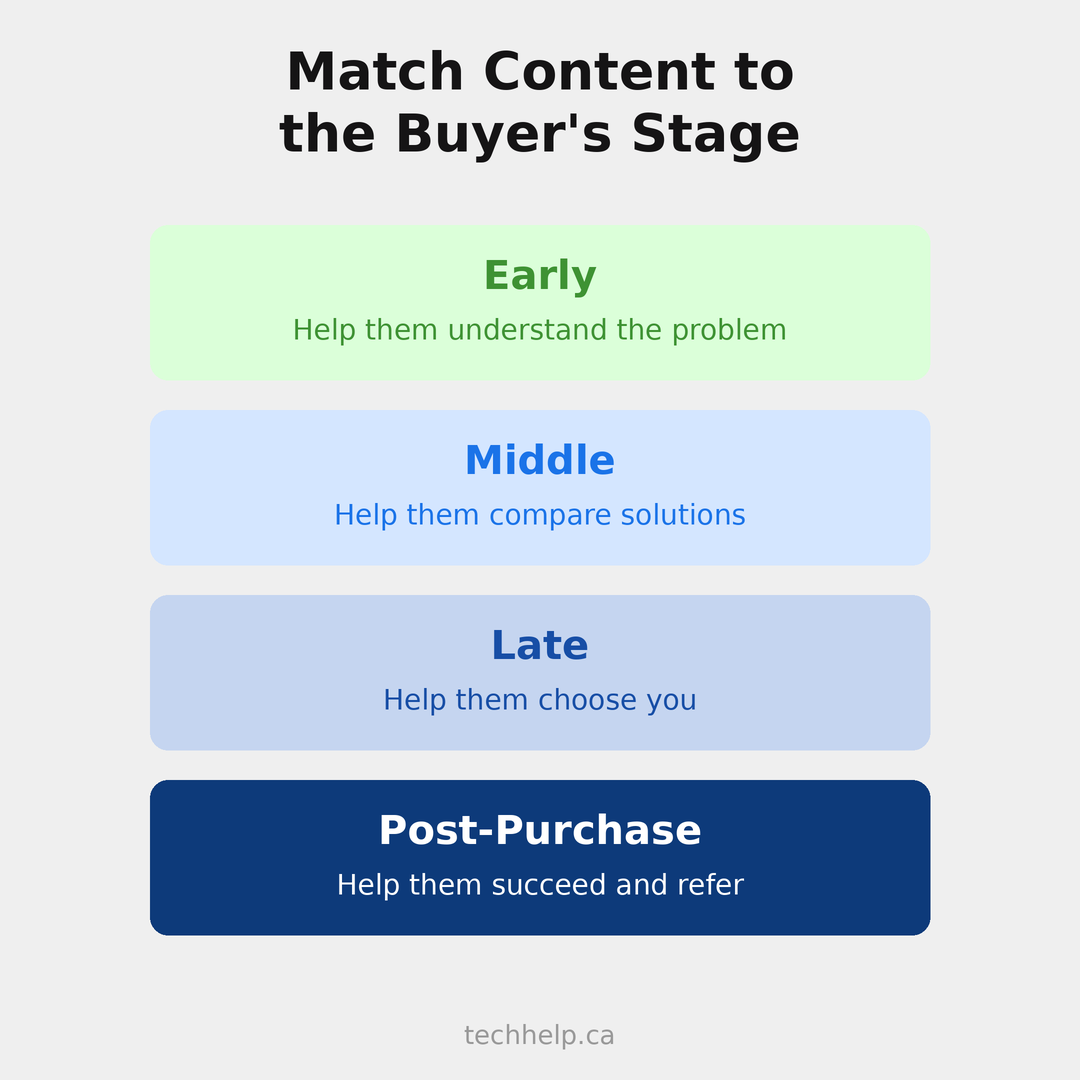
A strong content system usually has a few deep pillar pages that cover major topics, then supporting articles that answer specific questions around them. Product or service pages handle conversion, while case studies and examples prove outcomes. Email sequences continue the conversation after someone shows interest, and social posts distribute the strongest ideas in formats people can consume quickly.
You can also use a content waterfall strategy to turn one strong asset into smaller pieces for email, social media, sales enablement, and follow-up. The point isn’t to copy and paste the same thing everywhere. It’s to adapt one good idea to the format and intent of each channel.
For online growth, every content asset should have a job. It should attract, educate, compare, convert, retain, or support. If you can’t name the job, the content may not need to exist.
Use paid ads without letting them hide weakness
Paid ads can be useful, especially when you need speed. They can test demand, validate messaging, promote a new offer, retarget warm visitors, and bring traffic to a page faster than SEO.
But ads amplify the system you already have. They don’t repair a weak offer, confusing website, poor follow-up, or bad unit economics.
Before increasing ad spend, check the system behind the campaign. A cold visitor should understand the offer quickly, and the landing page should match the promise made in the ad. The CTA has to fit the buyer’s stage; a high-friction demo request may work for a serious B2B buyer, but it can fail for someone still comparing options. You also need tracking for leads, purchases, revenue, and cost, plus a clear view of break-even customer acquisition cost. If follow-up is slow or customer lifetime value can’t support the spend, more budget will usually expose the weakness faster.
Paid traffic is less risky when it points to a proven page. If a page can’t convert warm traffic, sending cold traffic to it usually makes the problem more expensive.
For service businesses, paid search can work well when buyers have urgent intent. For ecommerce, paid social can work when the product is easy to understand visually and the economics support repeat purchase or higher order value. For B2B, paid campaigns often work best when paired with strong educational assets, retargeting, and sales follow-up.
Build an email list before you need it
Email is one of the few growth assets you can carry across platforms. Social reach can change. Search results can change. Ad costs can rise. An email list gives you a direct follow-up channel with people who already showed interest.
Litmus reports that email drives an average ROI of $36 for every dollar spent. That doesn’t mean every newsletter performs well. It means email can be a strong revenue channel when the list is permission-based, segmented, useful, and tied to real offers.
A simple email system can support the whole customer journey. A welcome sequence sets expectations and starts the relationship. Educational emails help buyers understand the problem before they purchase. Abandoned cart or unfinished inquiry emails recover people who were close but got distracted. Post-purchase emails help customers succeed with what they bought, while review and referral requests turn good experiences into proof. Later, recommendation and re-engagement emails can bring people back when the next useful product, service, or reminder fits their needs.
Strong emails usually do one thing. They teach one idea, answer one objection, share one proof point, make one offer, or ask for one action. If every email tries to do everything, readers learn to ignore it.
Segmentation matters too. A first-time visitor, a repeat buyer, an abandoned-cart shopper, and a high-value customer shouldn’t always receive the same message. Even simple segmentation by interest, stage, purchase history, or location can improve relevance.
Convert visitors without pressuring them
Conversion isn’t about tricking people. It’s about making the right next step clear and low-friction.
The CTA should match the reader’s awareness level. Someone comparing vendors may be ready to book a call, request a quote, or start checkout. Someone early in the process may prefer a checklist, guide, sample, calculator, webinar, or email series.
Your conversion path should include at least one option for buyers who are interested but not ready. Otherwise, you force every visitor into “buy now” or “leave.”
Good conversion points vary by stage. A ready buyer may need “buy now,” “book a call,” “request a quote,” or “start a trial.” A buyer who is still researching may need to download a guide, join the email list, compare plans, get a sample, save something for later, or ask a question. The point is to give interested people a path that matches their readiness instead of forcing every visitor into the same step.
The page should also explain what happens after the click. “Book a call” is stronger when the page says the call takes 20 minutes, covers goals and fit, and has no obligation. “Request a quote” is stronger when the form says when the customer will hear back. “Download the guide” is stronger when the reader knows what’s inside and why it’s worth their email.
Trust grows when the next step feels predictable.
Improve average order value without becoming pushy
Average order value is one of the most overlooked growth levers. If you can increase the value of each order while still helping the customer, you can grow revenue without needing the same increase in traffic.
The key is relevance. Upsells and cross-sells work when they make the original purchase better, easier, faster, safer, or more complete.
For ecommerce, that might mean bundles, volume discounts, replenishment offers, warranties, accessories, gift wrapping, subscriptions, or free-shipping thresholds. For services, it might mean implementation support, reporting, training, faster turnaround, maintenance, add-on strategy sessions, or a higher-touch package.
Avoid random add-ons. A checkout page filled with unrelated offers can create doubt. A strong add-on feels like a natural next step.
Before adding an upsell, ask what the customer likely needs next. What would help them get better results from the first purchase? What would reduce risk or effort? What would they otherwise have to buy somewhere else?
Answering those questions turns average order value into customer value, not just revenue extraction.
Make retention part of the growth plan
New customers cost effort to win. Existing customers already know you. If the experience is good, they’re often easier to serve again.
Retention starts with delivery. Make the purchase, onboarding, or first-use experience smooth. Set expectations early. Follow up before customers have to chase you. Ask for feedback while you can still act on it.
Then build natural reasons for the customer to return. That might be a reorder reminder, service plan, subscription, loyalty offer, educational sequence, customer community, account review, maintenance schedule, or upgrade path.
For service businesses, retention often comes from consistent communication. A client who understands what’s happening, what was done, what changed, and what comes next is less likely to feel ignored. For ecommerce, retention often comes from timing, replenishment, personalization, and post-purchase education.
Good lifecycle marketing turns the customer journey into a relationship instead of a single transaction. It helps you think beyond acquisition and build touchpoints that support awareness, purchase, onboarding, support, repeat purchase, and advocacy.
The most durable retention strategy is still a product or service that delivers. No email sequence can fix a disappointing customer experience for long.
Protect margins as you grow
Revenue growth can hide financial weakness. A business can sell more and still feel poorer if margins shrink, refunds rise, ad costs climb, or fulfillment gets messy.
Watch contribution margin by channel and offer. A channel that brings cheap leads may still be weak if those leads rarely close. A product with high revenue may be weak if shipping, returns, discounts, and support eat the profit. A service package may look strong until you count the hours required to deliver it.
You need to know the economics behind each offer and channel. That means gross margin by product or service, customer acquisition cost by channel, average order value or deal size, repeat purchase or retention rate, refund or churn rate, fulfillment cost, time to payment, and lifetime value by customer segment. Without those numbers, it’s easy to scale the offer that feels busy instead of the one that actually creates profit.
The goal isn’t to obsess over spreadsheets. It’s to avoid scaling a money leak.
If profit is thin, the answer may be pricing, packaging, offer mix, supplier costs, delivery process, refund prevention, or better qualification. Sometimes a strong growth move is saying no to low-margin work that consumes capacity.
Add automation where it removes friction
Automation should make the business feel more responsive, not colder.
Automate repetitive, time-sensitive tasks such as appointment reminders, order confirmations, lead routing, invoice follow-ups, abandoned cart emails, review requests, customer onboarding, renewal reminders, and simple support triage. These are easy to miss when the business gets busy.
Be careful with automation that needs judgment, empathy, or context. A badly timed automated message can damage trust faster than a slow human reply. This is especially true for complaints, refunds, sensitive service issues, and high-value sales conversations.
Before automating a workflow, document it manually. What triggers it? What should happen next? Who owns it? What does success look like? What exceptions require a human?
Marketing automation works best after the process is clear. Otherwise, you’re just making confusion faster.
Use AI tools without diluting trust
AI tools can speed up research, drafting, content planning, summarization, customer support triage, data analysis, and internal documentation. They can help small teams do more with less.
But AI isn’t a growth strategy by itself. It’s leverage. If your positioning is weak, AI can help you produce weak content faster. If your customer data is messy, AI can summarize the mess. If your process is unclear, AI can make the confusion sound polished.
Use AI tools where they improve speed without lowering quality. They can help draft first-pass outlines, summarize customer feedback, turn sales calls into objection lists, create content briefs, repurpose long content into shorter formats, build internal SOPs, group support tickets by theme, and generate test variations for headlines or CTAs. Those are useful accelerators because the work still benefits from human review and judgment.
Keep human judgment on strategy, claims, proof, examples, customer empathy, legal risk, and final review. Google’s guidance is clear that using AI isn’t the issue by itself. The issue is whether the content is accurate, useful, original, and created to help people.
Measure the numbers that actually guide decisions
You don’t need a giant dashboard. You need a few numbers that show whether growth is healthy.
The right metrics depend on the model, but most online businesses should watch:
Swipe horizontally to see the full table.
| Growth area | Metrics to watch | What the metric tells you |
|---|---|---|
| Demand | Sessions, impressions, reach, branded search, referral traffic | Whether enough people are finding you |
| Quality | Lead source, qualified lead rate, engagement, return visits | Whether the right people are arriving |
| Conversion | Conversion rate, form starts, checkout completion, booked calls | Whether visitors take the next step |
| Sales | Close rate, average deal size, revenue by channel | Whether interest becomes money |
| Profit | Gross margin, CAC, contribution margin, refund rate | Whether growth is financially healthy |
| Retention | Repeat purchase rate, churn, renewal rate, LTV | Whether customers keep creating value |
| Experience | Support tickets, review rating, NPS, time to first response | Whether customers are satisfied enough to return |
The point isn’t to admire the numbers. It’s to make better decisions.
If traffic is low, work on acquisition. If traffic is solid but conversions are weak, work on the offer and page. If conversions are strong but profit is thin, review pricing, costs, and fulfillment. If new customers buy once and disappear, focus on retention.
Build a simple attribution habit
Attribution gets complicated fast, especially when buyers discover you through one channel, compare you through another, and convert days or weeks later. Don’t wait for perfect attribution before making decisions.
Start with practical tracking. Use GA4 or another analytics platform to track key events, set up Search Console for organic search visibility, and tag campaign links with UTMs. Ask leads how they found you, then track source and close rate in your CRM. When available, review assisted conversions and compare first-touch, last-touch, and self-reported source data. None of these views is perfect on its own, but together they give you a better read on what is actually creating customers.
Self-reported attribution is imperfect, but useful. If many buyers say they found you through a podcast, referral, YouTube video, or AI answer that analytics undercounts, that signal matters.
Use attribution to reduce obvious waste, not to create false certainty. The better question is often: “Which channels consistently bring customers we want more of?”
Create a 90-day online growth plan
A good growth plan is short enough to use and specific enough to guide action.
Use this structure for the first sprint.
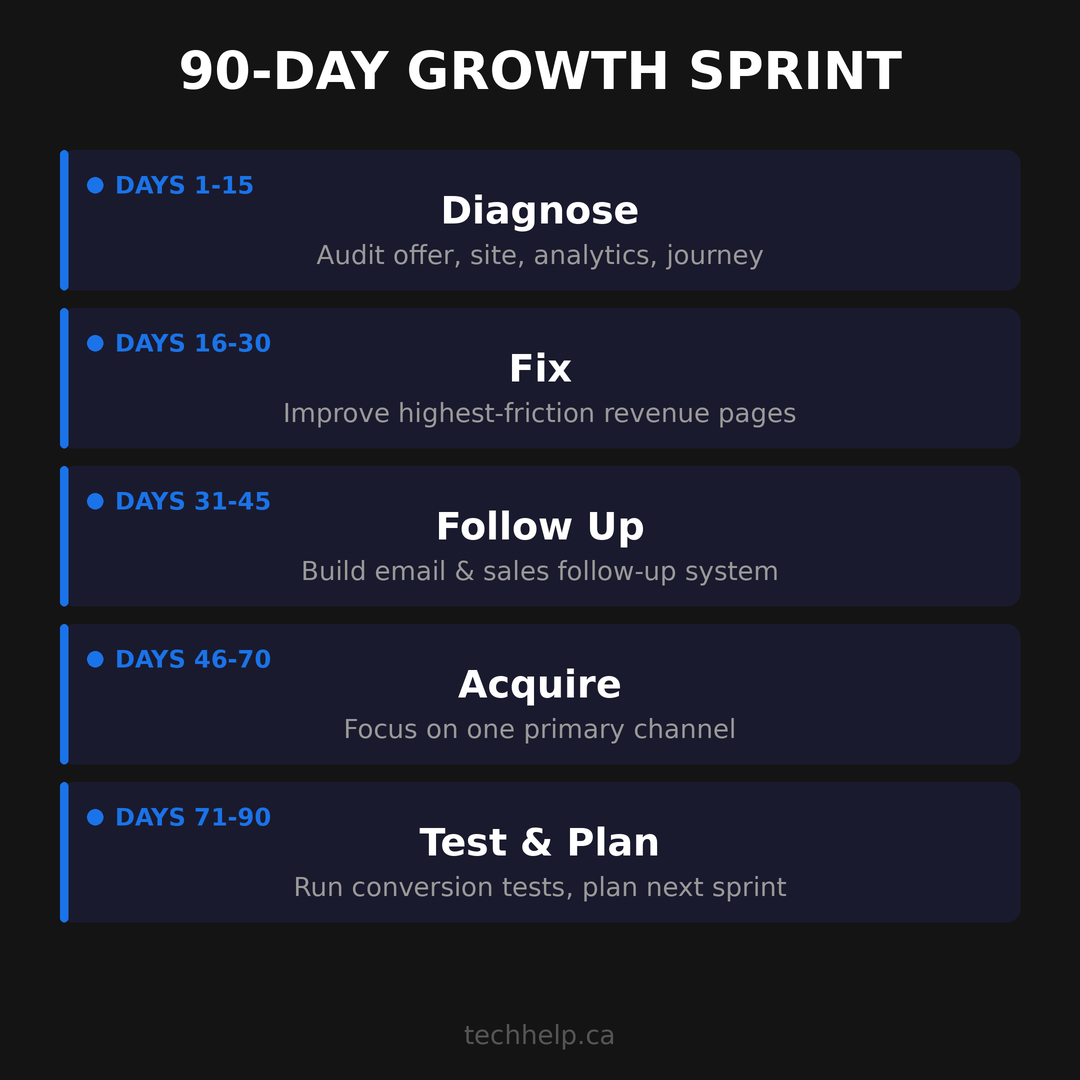
Days 1-15: diagnose the business
Audit the offer, website, analytics, customer journey, traffic sources, conversion points, follow-up, pricing, delivery, and retention. Identify the biggest constraint closest to revenue.
Talk to customers if you can. Ask why they bought, what almost stopped them, what they compared you with, and what they wish had been clearer. Customer language is often better than anything you can invent in a meeting.
Days 16-30: fix the highest-friction revenue pages
Improve the pages that already influence sales. Rewrite the headline. Clarify the offer. Add proof. Improve the CTA. Reduce form friction. Explain pricing. Improve mobile layout. Add FAQs where they help. Make the next step obvious.
For ecommerce, focus on product pages, cart, checkout, shipping, and returns. For services, focus on the homepage, service pages, proof pages, and contact or booking flow.
Days 31-45: strengthen follow-up
Build or improve the email and sales follow-up system. Add a welcome sequence, quote follow-up, abandoned cart reminder, post-purchase education, review request, and re-engagement email where relevant.
Make sure every lead or customer gets a clear next step. Many businesses lose revenue not because people are uninterested, but because follow-up is slow, generic, or missing.
Days 46-70: increase effort on one acquisition channel
Choose one primary channel based on your customer and offer. Publish search content, run a paid test, build referral partnerships, improve marketplace listings, increase LinkedIn activity, launch a newsletter, or pitch relevant podcasts and newsletters.
Don’t spread the effort across six channels. Give one channel enough focus to learn what works.
Days 71-85: test conversion improvements
Run focused tests on messaging, CTA placement, pricing display, offer packaging, proof placement, email subject lines, checkout steps, or lead magnet positioning.
Only test things that can change behavior. Button color is rarely the real issue. Promise, proof, friction, audience, and offer usually matter more.
Days 86-90: review, cut, and plan the next sprint
Compare results against the 90-day goal. What improved? What didn’t move? What created the strongest signal? What wasted time?
Keep what worked, cut what didn’t, and choose the next constraint.
Growth gets easier when every quarter teaches you something useful.
Build the next sprint
Turn this 90-day plan into focused growth work.
Bring the offer, website, content, and follow-up into one practical plan so the next move is obvious.
Common online business growth mistakes
Many growth problems are self-inflicted. Once you see them, you can fix them.
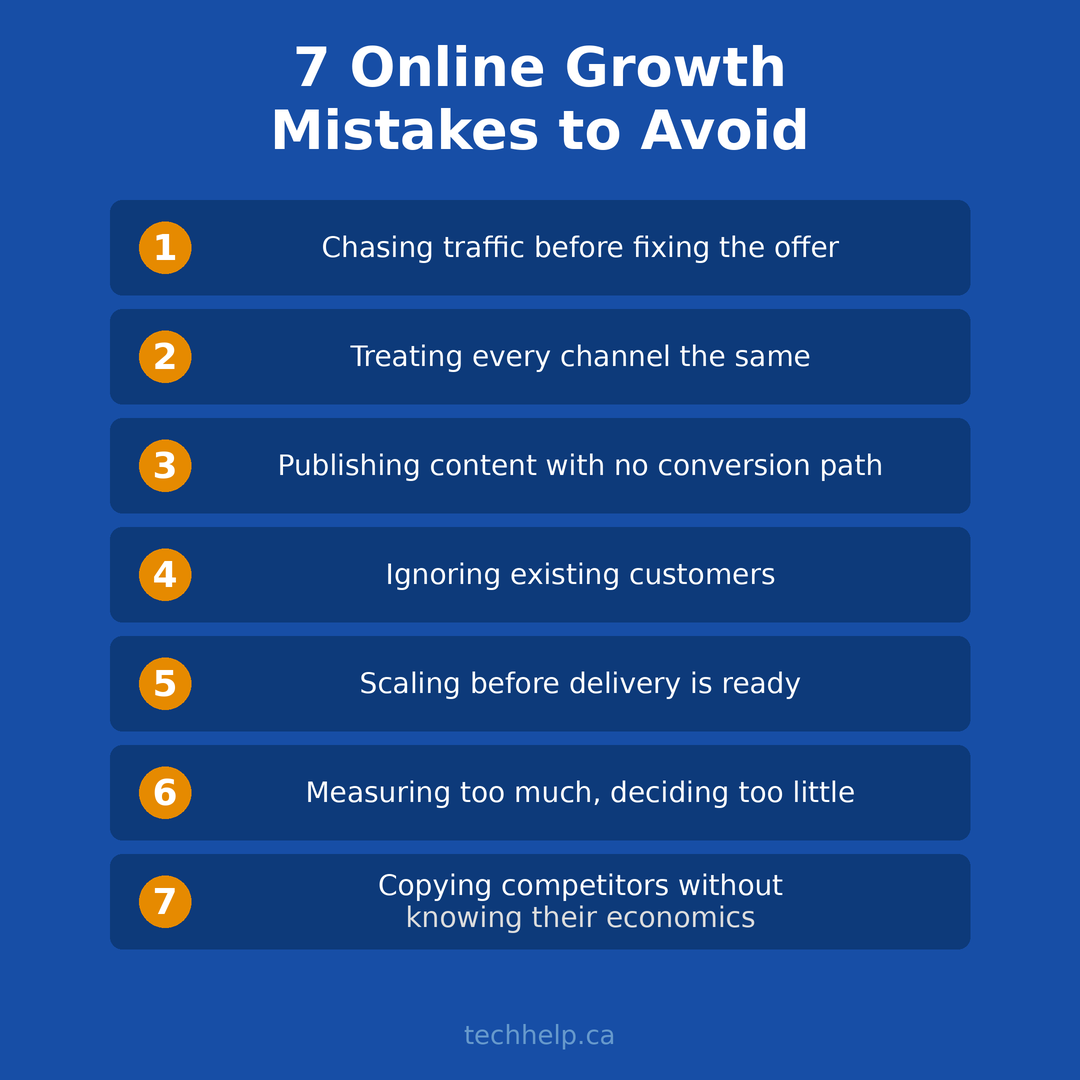
Mistake 1: chasing traffic before fixing the offer
More traffic won’t save an unclear offer. It will just send more people into confusion. If visitors don’t understand who you help, what you sell, and why they should care, start there.
Mistake 2: treating every channel the same
Search, social, email, paid ads, referrals, and partnerships do different jobs. Use each channel for the part of the journey it supports best. Don’t expect a TikTok post, a Google ad, and a sales email to behave the same way.
Mistake 3: publishing content with no conversion path
Content that attracts readers but gives them no next step is incomplete. Every useful page should offer a logical path: read next, subscribe, compare, book, buy, download, ask, or save.
Mistake 4: ignoring existing customers
If you only focus on acquisition, you keep paying to replace customers you could have retained. Retention, repeat purchase, referrals, and expansion should be part of the plan from the start.
Mistake 5: scaling before delivery is ready
Growth can break a business that isn’t operationally ready. If more sales create late orders, weak support, stressed staff, or lower quality, fix delivery before pushing harder.
Mistake 6: measuring too much and deciding too little
Dashboards are useless if they don’t change decisions. Pick a few metrics tied to the current goal. Review them on a set schedule. Decide what to do next.
Mistake 7: copying competitors without knowing their economics
You can see a competitor’s ads, pages, and content. You can’t see their margins, retention, customer acquisition cost, or cash flow. Copying the visible tactic without knowing the economics is risky.
Online business growth checklist
Use this checklist when you need a quick audit.
You don’t need to fix everything this week. You need to find the highest-impact gap and start there.
Next move
Found a gap in the checklist?
Start with the highest-impact bottleneck, or get a second set of eyes before you spend more time on tactics.
The real path to online growth
Online growth isn’t about doing everything. It’s about finding the next constraint and improving it with discipline.
Clarify the offer. Make the website easier to trust. Choose channels you can sustain. Build content that helps buyers finish their research. Follow up with people who show interest. Retain the customers you have already earned. Watch the numbers closely enough to know what needs work next.
The businesses that grow online aren’t always the loudest. They’re the ones that make it easiest for the right customer to understand, trust, buy, return, and recommend.
Start with one bottleneck this week. Fixing that will do more for growth than adding five new tactics to a system that’s already overloaded.
Frequently asked questions
What’s the fastest way to grow an online business?
The fastest path is usually fixing the constraint closest to revenue. If you already have traffic, improve the offer, page, checkout, or follow-up before chasing more visitors. If you have strong conversion but low demand, focus on one acquisition channel you can sustain.
Should I focus on SEO, paid ads, or social media first?
Choose based on buyer intent and your current stage. SEO works well when people already search for your problem or offer. Paid ads help test demand quickly when the economics make sense. Social media is useful for trust, repeated exposure, proof, and community. Most small teams should pick one primary channel and one support channel.
How do I know if my website is holding back growth?
Your website may be the bottleneck if traffic is steady but few people buy, book, subscribe, or inquire. Look for unclear messaging, weak proof, hidden pricing, long forms, poor mobile experience, slow pages, vague CTAs, or missing follow-up options for visitors who are interested but not ready.
What metrics matter most for online business growth?
The most useful metrics are traffic, conversion rate, lead quality, average order value or deal size, customer acquisition cost, gross margin, repeat purchase rate, churn or refund rate, and lifetime value. The right metric depends on the bottleneck you’re trying to fix.
How long does online business growth usually take?
Some fixes can improve results quickly, especially checkout, pricing clarity, follow-up, and offer messaging. SEO, content, brand trust, partnerships, and retention systems usually take longer because they compound over time. A 90-day sprint is a good window for focused improvement and useful signals.
Do I need automation to grow online?
You don’t need complex automation to grow, but simple automation can remove friction. Appointment reminders, lead routing, order confirmations, abandoned cart emails, review requests, and post-purchase follow-ups can make the business more responsive without adding much manual work.
Sources
View sources used in this guide
- https://www.census.gov/retail/eCommerce.html
- https://datareportal.com/reports/digital-2026-global-overview-report
- https://developers.google.com/search/docs/fundamentals/seo-starter-guide
- https://developers.google.com/search/docs/fundamentals/creating-helpful-content
- https://developers.google.com/search/docs/fundamentals/using-gen-ai-content
- https://developers.google.com/search/docs/fundamentals/ai-optimization-guide
- https://baymard.com/lists/cart-abandonment-rate
- https://www.bdc.ca/en/articles-tools/business-strategy-planning/manage-growth/growing-small-business-your-growth-plan
- https://www.litmus.com/resources/email-marketing-roi