The European Commission fined AliExpress €550 million on July 20, 2026, the largest penalty issued under the Digital Services Act so far. The Commission found that AliExpress failed to assess and reduce risks tied to illegal, unsafe and counterfeit products, and it gave the platform until October 20 to submit an action plan.
The fine targets AliExpress. The operational pressure is likely to travel down the chain through tighter identity checks, new document requests, automated listing controls and faster suspensions when information is missing.
Marketplace sellers should prepare for that pressure before it reaches their accounts. Build a portable compliance file for every EU-facing product, make sure the listing matches the physical product and keep copies of everything outside the platform.
What the Commission found
The Commission opened formal proceedings against AliExpress in March 2024. The investigation covered systemic risk management, content moderation, advertising and recommender-system transparency, trader traceability and researcher access.
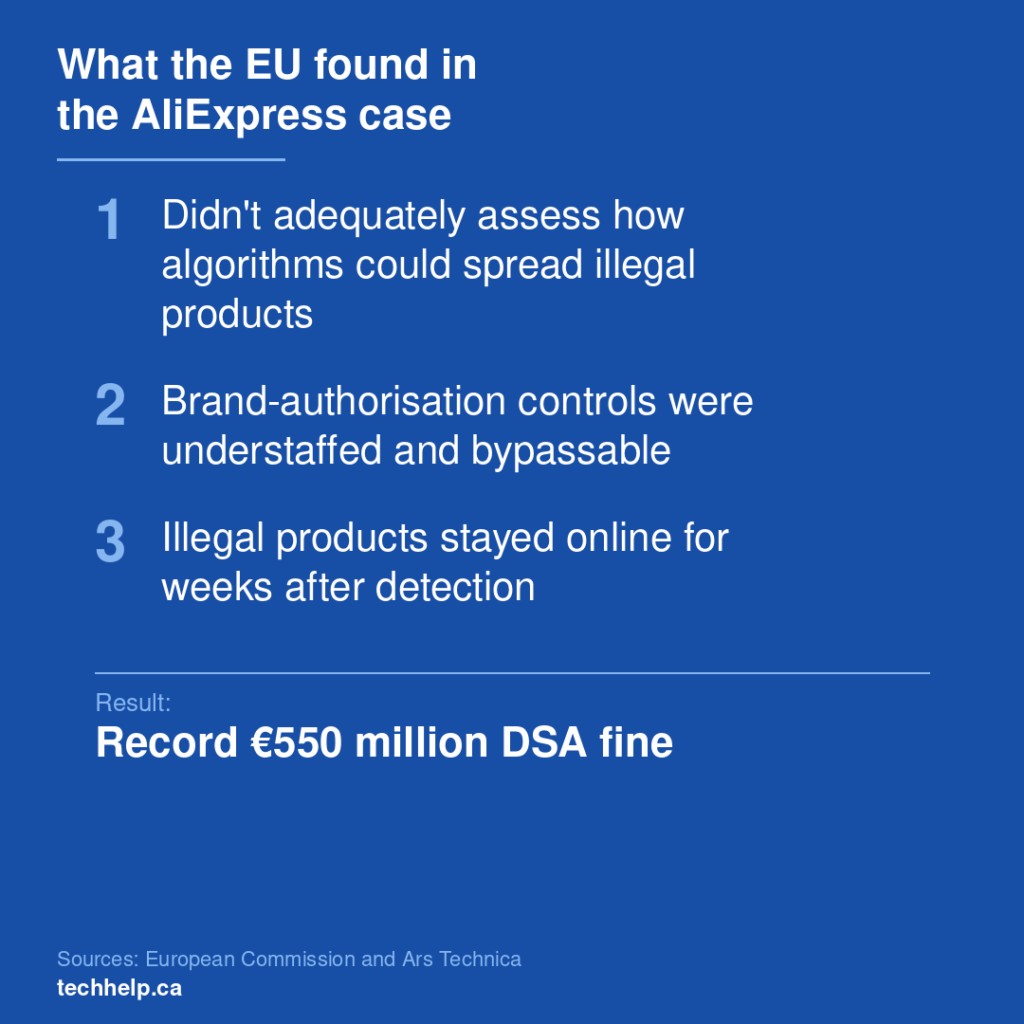
In June 2025, the Commission accepted a separate set of commitments from AliExpress and made them binding. Those commitments addressed several concerns, including trader checks, reporting tools and transparency. At the same time, the Commission issued preliminary findings that AliExpress hadn’t adequately assessed or mitigated the risk of illegal products spreading through its marketplace.
The July 2026 decision turned that part of the case into a formal finding and a fine. The Commission’s public announcement says AliExpress fell short in multiple parts of its risk assessment and failed to take effective measures to reduce the spread of illegal products.
Ars Technica reported that sellers could reduce scrutiny by miscategorizing products, that AliExpress’s brand-authorisation controls were understaffed and that illegal products sometimes remained online for weeks after detection. The Commission also found that AliExpress hadn’t adequately assessed how its advertising and recommendation systems could increase the exposure of illegal products.
Those are platform-level failures, not proof that every AliExpress seller or listing is unlawful. They show why the Commission considered the problem systemic rather than a collection of isolated bad listings.
EU technology chief Henna Virkkunen’s position was blunt: a marketplace’s size doesn’t excuse weak controls, and product risks must be identified and addressed systematically.
AliExpress told the Associated Press that it had invested heavily in product safety, consumer protection and DSA compliance. The company disputed what it called a disproportionate fine and said it was reviewing the decision and considering its options. It hadn’t announced an appeal when this article was prepared.
AliExpress must submit an action plan by October 20, 2026. The Commission says failure to comply with the decision may lead to periodic penalty payments.
Three DSA fines show where enforcement is heading
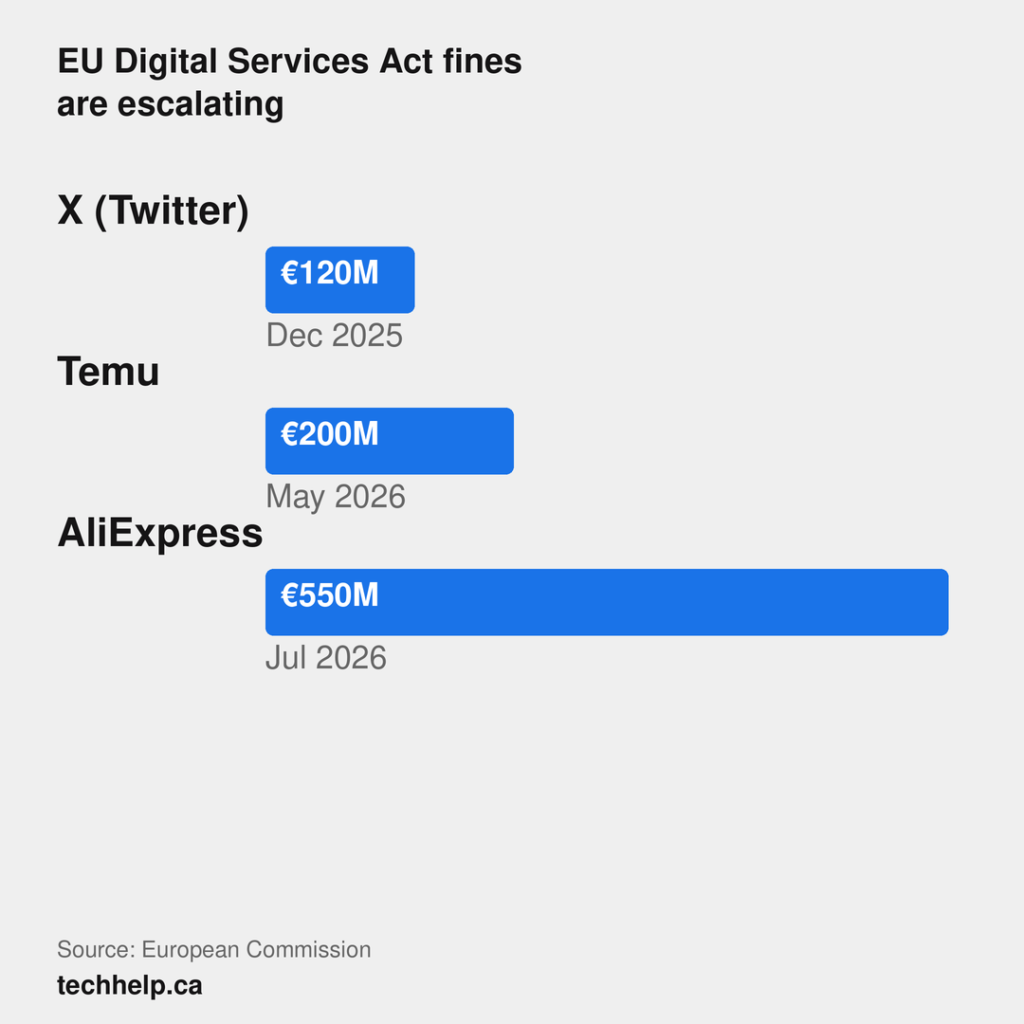
AliExpress is the third company fined under the DSA in less than eight months, and each fine has been larger than the one before it.
In December 2025, the Commission fined X €120 million for violations involving its blue checkmark design, advertising repository and researcher access to public data.
In May 2026, the Commission fined Temu €200 million for failing to identify and assess the risk of illegal products on its marketplace. The Commission said its investigation found that EU shoppers faced a high risk of encountering illegal items and that Temu’s 2024 assessment relied on general ecommerce information instead of evidence specific to its own service.
Then came the €550 million AliExpress fine.
Together, these cases show that the DSA isn’t only a social-media content law. It also makes online marketplaces responsible for assessing systemic risks from illegal goods, designing interfaces that support lawful listings and knowing who their traders are.
The product-safety backdrop is also getting louder. The European Commission’s Safety Gate system recorded 4,671 alerts for dangerous non-food products in 2025, a record and a 13% increase from 2024. Cosmetics and toys accounted for more than half of the alerts. China was listed as the country of origin for 2,006 cases, or about 43% of the total.
The fine is aimed at AliExpress, but sellers should expect tighter controls
The Commission’s decision doesn’t order marketplaces to punish compliant sellers. It gives AliExpress and its competitors a stronger incentive to demand better information before a listing goes live and to act faster when a product is flagged.
That can produce blunt enforcement. A platform may ask for a test report, brand authorisation, manufacturer address or EU economic-operator details on a short deadline. Automated systems may block a new listing or deactivate an existing one while the seller proves compliance. A mismatched company name, expired document or incomplete safety warning can become an account problem even when the product itself is safe.
Amazon’s GPSR policy offers a practical example. Amazon told sellers of non-food products in its EU stores to submit manufacturer information, EU Responsible Person details and required warnings or safety documents. Its published guidance says it will deactivate offers when it becomes aware of invalid, expired or otherwise non-compliant information.
The volume of marketplace enforcement is already enormous. The Federation of German Consumer Organisations analysed DSA transparency records from Amazon, eBay, Temu, Otto and AliExpress for November 2025. It counted 68.24 million automated moderation decisions involving removed offers across the EU. The platforms categorised about 29.6 million of those offers as unsafe, non-compliant or prohibited; the rest were recorded as other violations of platform terms.
This count measures moderation records rather than proven unique dangerous products that reached shoppers. It shows that marketplaces already remove listings at a scale where an individual seller’s case can become one record among millions.
We’ve seen the same dependency from a different direction. Shopify’s vape ban showed how a platform can change what an entire category of merchants is allowed to sell. Regulation, payment risk, public pressure or a policy change can all reach the seller through the infrastructure.
Treat a marketplace as a sales channel, not the foundation of the business.
The documents EU-facing sellers should have ready
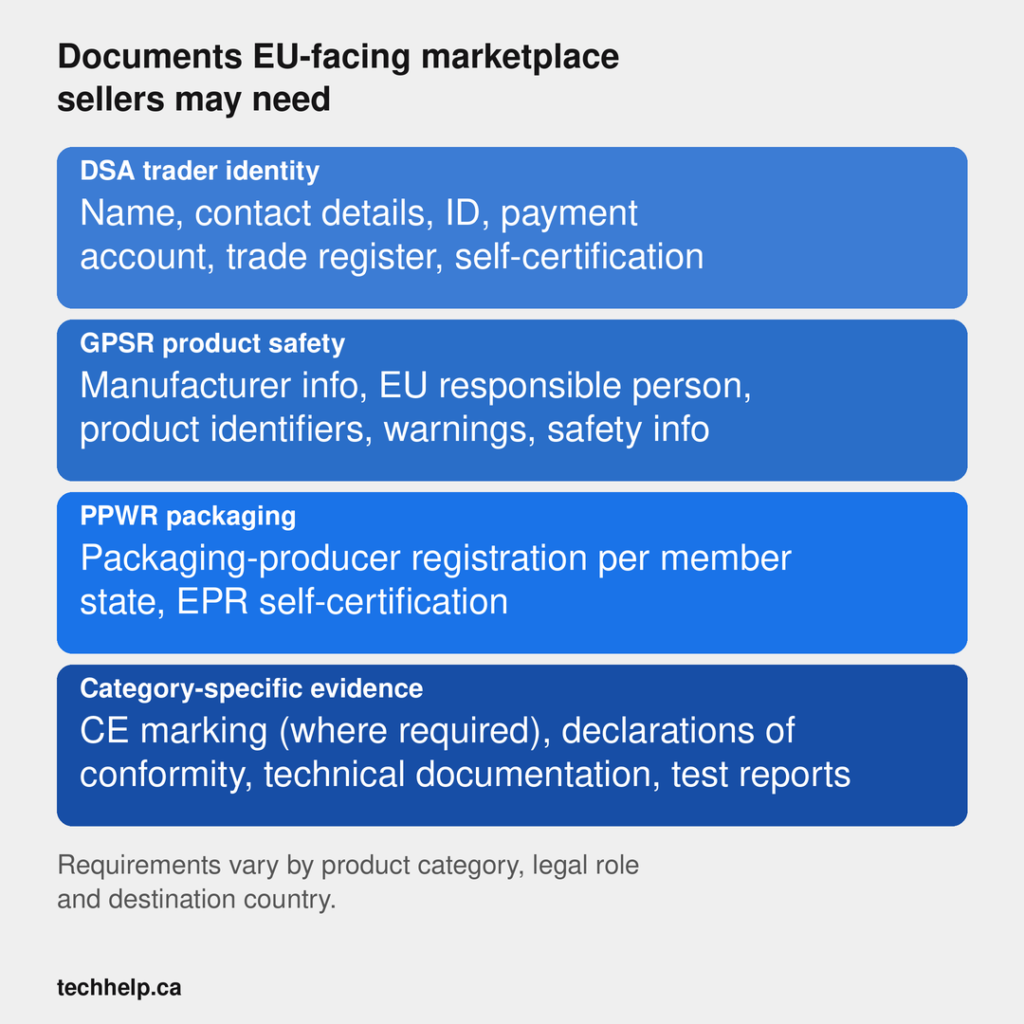
The exact requirements depend on the product, the seller’s role in the supply chain and the EU countries being served. Several obligations can apply to the same listing at once.
Trader identity and traceability
Article 30 of the DSA requires online marketplaces to obtain key information before a trader can offer products or services to EU consumers. That information includes the trader’s name and contact details, identification, payment account details, relevant trade-register information and a self-certification that the trader will offer only products or services that comply with EU law.
Platforms must make best efforts to assess whether the information is complete and reliable. When information can’t be verified, the platform can ask the trader to correct it. A trader who doesn’t comply can have the service suspended for EU offers.
The DSA has generally applied since February 17, 2024. Platforms had a 12-month transition period to collect the required information from traders already using their services on that date, so established accounts shouldn’t assume their older onboarding records are enough.
Product and EU economic-operator information
The General Product Safety Regulation has applied since December 13, 2024. For covered non-food consumer products offered online, the listing must clearly show the manufacturer’s name and contact information. When the manufacturer isn’t established in the EU, the offer must also identify the responsible economic operator in the EU, including a postal and electronic address.
That responsible party isn’t always a paid authorised representative. Depending on the supply chain and applicable law, it may be an EU manufacturer, importer, authorised representative or fulfilment service provider.
The online offer must also include information that identifies the product, such as an image, product type and other identifier, plus required warnings or safety information in a language consumers in the destination country can understand.
Packaging and producer-responsibility records
The EU’s Packaging and Packaging Waste Regulation begins applying on August 12, 2026. It requires covered online platforms to obtain packaging-producer registration information for the member state where the consumer is located, along with a producer self-certification about extended producer responsibility obligations. Platforms must make best efforts to assess whether that information is complete and reliable.
This isn’t one universal switch that automatically bans every product without a number on August 12. Registration systems, national requirements and platform processes affect how the obligation is implemented. Sellers should identify where they qualify as a producer, which national registers apply and whether separate obligations cover packaging, batteries or electrical equipment.
Product-specific safety evidence
CE marking applies only to product categories covered by legislation that requires it. Toys, some electronics, machinery and certain personal protective equipment are examples; cosmetics don’t use CE marking. Depending on the product, a seller may need a declaration of conformity, technical documentation, lab reports, chemical information, warnings, instructions, supplier records or proof of brand authorisation.
A logo on a product or a generic supplier certificate is weak evidence unless it covers the specific product, model, materials and claims in the listing.
Build one portable file for every EU-facing product
Create one controlled folder for each product or model rather than searching email and platform dashboards after a listing is suspended. At minimum, keep:
trader identity, registration and payment-account information that matches the marketplace account;
manufacturer, importer and EU responsible-person details, including current mandates where applicable;
product names, model or batch identifiers, images and copies of the live listing;
risk assessments, test reports, declarations, certificates and technical files required for the category;
labels, warnings and instructions for every country where the product is offered;
supplier invoices, brand authorisation and traceability records;
packaging, battery, electronics and other producer-responsibility registrations where applicable;
expiry dates, renewal dates and the person responsible for each record; and
copies of platform notices, submissions, approvals, removals and appeals.
Then compare the file with the physical product and the listing. The model number on a report must match the item being sold. The manufacturer in the account must match the label. Safety warnings can’t disappear when copy is shortened for a mobile listing.
Start with the products that produce the most EU revenue or carry the highest safety risk. Fixing those first reduces the largest exposure without turning the project into an endless paperwork exercise.
Keep the compliance file and customer relationship outside the platform
A complete product file helps you answer a marketplace review. An independent copy helps you keep operating when the dashboard is locked.
Export the records the platform allows you to retain, including product data, images, compliance submissions and order records. Keep renewal dates in a calendar your team controls. Make sure more than one authorised person knows how to reach the files and respond to a notice.
Store identity and payment records in an access-controlled location. Portability shouldn’t turn sensitive documents into copies scattered across unmanaged shared drives.
Reduce channel concentration too. An owned website, permission-based email list, portable product catalogue and second sales channel won’t eliminate regulatory duties, but they give the business options when one platform pauses a listing or changes its policy.
The AliExpress decision is a platform fine with a seller lesson: access can disappear faster than a business can rebuild its documentation. Prepare the proof before a marketplace asks for it, and keep enough of the business portable to survive a platform decision.
EU requirements vary by product, legal role and destination country. Confirm the rules that apply to each product before selling or relying on this general checklist.
Get new small business insights by email
Practical ideas and useful articles to help you make better business decisions.
Tech Help Canada Staff researches, writes, and reviews practical content for business owners and professionals. Our coverage spans business, marketing, SEO, technology, and the tools and systems people use to grow and operate online. We focus on clear, useful information backed by research, hands-on experience, and editorial review. Learn more about our team and editorial standards. Need help with something? Contact Us