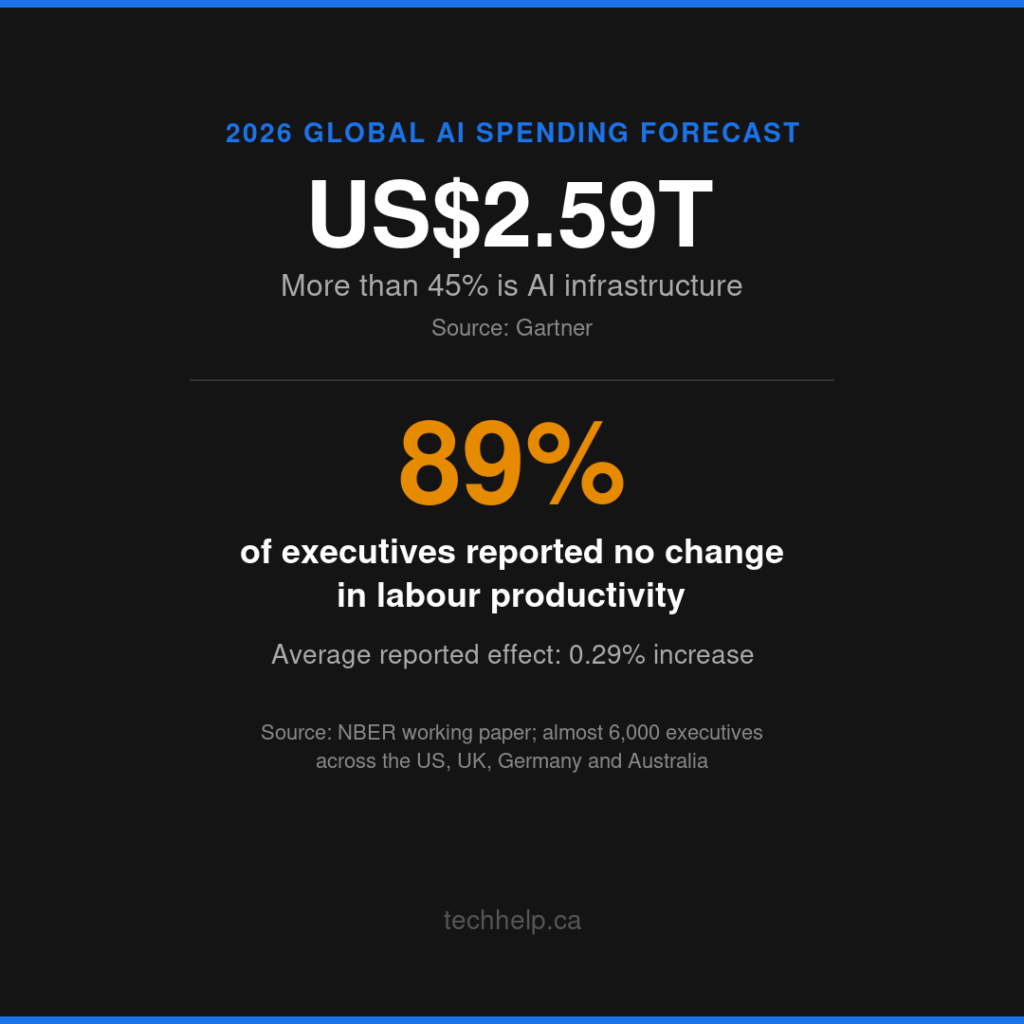
Gartner forecasts worldwide AI spending will reach US$2.59 trillion in 2026. It’s an arresting number, but it doesn’t mean ordinary businesses are collectively spending that amount on chatbots and software subscriptions. More than 45% of the forecast is AI infrastructure, and Gartner says technology vendors and hyperscalers have driven most spending so far.
The return question is still real. An international NBER working paper surveyed almost 6,000 CEOs, CFOs and other executives in the United States, United Kingdom, Germany and Australia. Eighty-nine percent said AI had produced no change in labour productivity, measured as sales per employee, during the previous three years.
The average reported effect wasn’t zero. It was a small 0.29% productivity increase, and executives expected a larger 1.4% gain over the next three years. A separate NBER paper based on nearly 750 executives also found positive gains that varied widely by sector.
AI is producing value in some businesses. It simply isn’t producing the same value everywhere.
The dividing line is rarely access to another model. AI creates capacity. That capacity becomes money only when it improves a constraint tied to revenue, cost, risk or customer value.
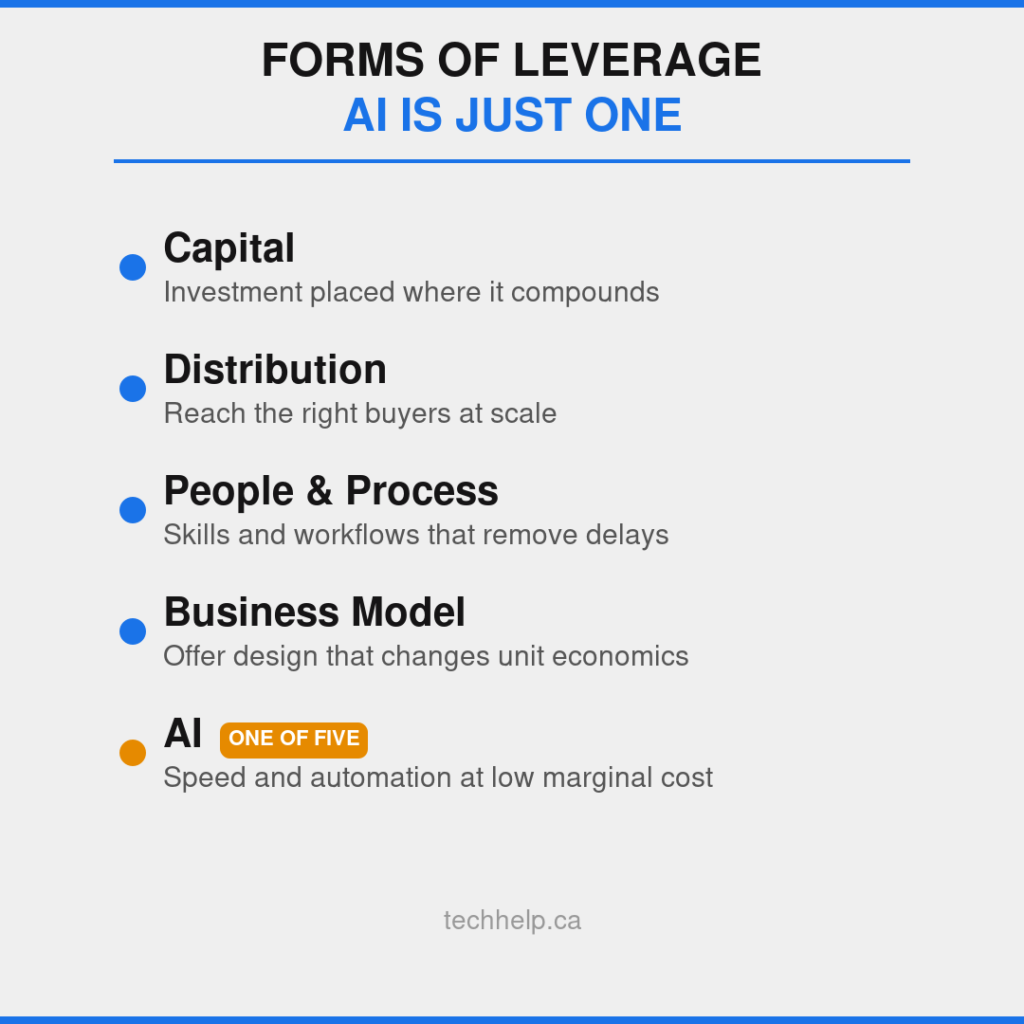
AI is one form of leverage, not the only one
Leverage lets a business produce a larger result without increasing every input at the same rate. AI is one source of leverage, but it sits beside several others that still matter.
Capital
Money can increase inventory, buy equipment, secure better terms, hire specialized talent or fund distribution. The return depends on where it’s placed. More capital sent into a weak offer or wasteful process can enlarge the loss.
Distribution
An audience, trusted brand, search presence, sales network or partner channel can carry one message to many buyers. Faster content production won’t compensate for weak distribution. One useful article that reaches the right customer can create more value than dozens of generated pieces nobody sees.
People and process
A skilled employee, clear handoff or better operating rule can remove delays across an entire workflow. Better training may outperform another software license when the problem is judgment, ownership or inconsistent execution.
Business model
Changing how the business sells or delivers can alter its economics. Productized services, group delivery, subscriptions, licensing and self-service options can reduce the amount of custom work required for each sale. The leverage comes from the design of the offer, not the speed of producing documents around it.
AI
AI can draft, classify, summarize, search, compare, generate and automate at a low marginal cost. It can reduce the time required for a task and make previously impractical tests affordable.
It can also produce more low-priority work, more material requiring review and more activity that never reaches a customer. Speed multiplies the quality of the decision behind it.
Faster work isn’t automatically a better business
Workday’s 2026 research shows the difference between gross time saved and net value. Hanover Research surveyed 3,200 active AI users working full time at organizations with more than US$100 million in annual revenue. Eighty-five percent said AI saved them between one and seven hours a week, but 37% of that time was offset by correcting, rewriting or verifying AI output. Only 14% said they consistently achieved clear, positive net outcomes.
That survey reflects active AI users at large organizations, not every worker or small business. Its practical warning travels well: measure the review burden with the time saved.
The widely repeated claim that 95% of enterprise generative AI pilots produce no return needs similar care. The figure came from a preliminary 2025 Project NANDA report associated with MIT. The researchers reviewed more than 300 public initiatives, interviewed representatives from 52 organizations and surveyed 153 senior leaders.
The report said 95% of organizations in its research had no measurable profit-and-loss impact and only 5% of task-specific tools reached successful implementation. It also acknowledged that its deployment figures were directionally accurate, based largely on interviews and affected by differing definitions of success. The 95% figure is a warning from a limited research design, not a precise failure rate for every AI project.
Both studies point to the same management problem. Producing an output faster isn’t enough. The business has to use the saved capacity, control rework and connect the change to an outcome.
More capacity can turn into faster busy work
AI makes previously expensive work feel cheap. A team can launch another channel, produce more reports, create more offer variations or build a feature that never would have survived the old time constraint.
The low production cost can hide the opportunity cost. Every new output still needs some combination of review, approval, distribution, maintenance, measurement and attention. If the work wasn’t important before AI made it faster, automating it won’t make it important.
This is why output metrics can mislead. More articles, tickets handled, lines of code, summaries or campaign variants show activity. They don’t establish that customers bought more, costs fell, risk declined or the team increased throughput.
Time saved can also disappear. If a five-hour task becomes a one-hour task and the employee fills the remaining four hours with unplanned work, the company hasn’t automatically gained four hours of financial value. The return appears when that capacity is redeployed to valuable work or allows the business to avoid a real cost.
Find the constraint before choosing the tool
The Theory of Constraints treats performance as a system problem. Its focusing steps begin by defining the goal and metrics, identifying the constraint, getting more from that constraint, aligning the rest of the system around it and then elevating it when necessary.
A business can have many problems while only a small number directly limit its current result. The constraint might be insufficient demand, weak conversion, slow approvals, limited delivery capacity, inconsistent quality, cash, owner availability or customer trust.
AI aimed at the wrong part of the system creates a local improvement. The task gets faster while the business result stays put.
If demand is the constraint, faster fulfilment won’t create orders. If the offer is weak, generating more ad variations may only test the same weak proposition faster. If work waits for management approval, faster first drafts can increase the queue. If customers leave because policies are confusing, a support bot can answer the same broken policy more quickly.
Before buying or building anything, ask:
Which business result needs to change? Name the revenue, contribution margin, cost, cycle-time, quality, risk or customer measure.
What currently limits that result? Find where work, decisions, customers or cash wait.
Would improving this task change the constraint? A task can be slow without limiting the system.
Which lever fits the problem? The answer may be AI, capital, distribution, training, delegation, a process change or a different offer.
What could move downstream? Faster output can create more review, support, inventory, compliance or approval work elsewhere.
Where AI can earn a return
AI earns its keep when it improves a defined constraint and the business measures the complete effect.
When demand is limited
AI can analyze customer interviews, group sales objections, produce test variations and shorten the time required to learn from a campaign. It can’t manufacture demand for an unwanted offer or provide distribution on its own.
Measure qualified pipeline, customer acquisition cost, conversion and contribution margin. Content volume and impressions are supporting measures, not the return.
When sales capacity is limited
AI can prepare account research, summarize calls, draft follow-ups and identify unanswered questions. The value should appear in response time, sales-cycle length, qualified opportunities, close rate or revenue per representative.
Automating outreach without protecting relevance and reputation may increase activity while weakening the channel.
When delivery is limited
AI can retrieve approved knowledge, draft routine documents, classify requests and support quality checks. Measure throughput, turnaround time, error rates, rework, customer satisfaction and gross margin.
Keep human review where errors could create material financial, legal, safety or reputational harm. The review time belongs in the cost calculation.
When decisions are slow
AI can collect information, compare scenarios and prepare a structured first analysis. It can reduce research time, but a faster recommendation isn’t useful when the underlying data is poor or nobody owns the decision.
Measure the full decision cycle, the quality of the result and whether the action happened. A summary that sits unread hasn’t removed the constraint.
What you stop matters as much as what you automate
Stopping low-value work can release money and attention immediately. Before automating a task, ask what would happen if the business stopped doing it.
If customers, revenue, cost, risk and delivery wouldn’t notice, the task may need removal rather than automation. If the task matters but contains avoidable steps, simplify it before adding AI. Automating a broken process makes the defects travel faster.
This discipline is central to a lean business model: define customer value, remove waste, test assumptions and standardize what works. AI can support each step, but it shouldn’t decide which work deserves to exist.
A six-step test for AI return
1. Choose one outcome
Write one measurable result before selecting the tool. For example: reduce the median time required to resolve a routine support request from 18 minutes to 10 without increasing reopen rates or lowering customer satisfaction.
2. Establish the baseline
Measure the current workflow for a representative period. Record volume, labour time, waiting time, error or rework rate, outside spending, conversion and quality. Without a baseline, improvement becomes an opinion.
3. Count the complete cost
Include software subscriptions, model or token charges, integration, data preparation, training, security review, human review, rework, maintenance and change management. Include the time people spend learning and supervising the system.
Use one workflow, customer segment or team. Set a review date and a minimum amount of activity so the comparison means something. A low-volume sales process may need a longer test than a high-volume document workflow.
5. Measure net value
Use verified financial effects where possible:
Net value = added contribution margin + verified cost avoided + quantified expected-loss reduction - total AI cost
AI ROI = net value ÷ total AI cost × 100
Treat time saved as capacity until you can show how the business used it. Treat risk reduction as financial value only when the probability and cost assumptions are documented.
6. Scale, change or stop
Scale when the outcome improves after accounting for quality, rework and downstream effects. Change the workflow when the value is promising but implementation creates friction. Stop when the result doesn’t justify the complete cost.
Stopping a weak pilot is a return decision too. It prevents more money and attention from following sunk costs.
Ask a harder question than “Are we using AI?”
Ask whether AI increased contribution margin, avoided a real cost, reduced a quantified risk or released capacity at the business’s current constraint.
If it did, you’ve found a useful lever. Keep measuring and improve the workflow.
If it didn’t, another model or larger prompt library may not solve the problem. Recheck the constraint, consider the other forms of leverage and remove work that never deserved automation.
The businesses that benefit most from AI won’t necessarily use the most tools. They’ll know which result must change, where the system is stuck and how each tool earns its place.
If you want help finding that point and building a workflow around it, our AI consulting for small businesses starts with the bottleneck rather than the software.
Frequently Asked Questions
Why isn’t AI improving my business’s profit?
AI can make a task faster without changing the constraint that limits revenue or profit. It may also create review, correction, integration and maintenance work that offsets the saving. Start with the business result that needs to change, identify what currently limits it, and test AI only where it can affect that constraint.
How should a small business calculate AI ROI?
Add the contribution margin created, verified costs avoided and any quantified reduction in expected losses. Then subtract subscriptions, usage charges, integration, training, security, review, rework and maintenance. Divide the resulting net value by the total AI cost and multiply by 100. Count time saved as financial value only when you can show how that capacity was used or which cost it avoided.
Which business tasks are best suited to AI?
Good candidates are repeatable, information-heavy tasks with enough volume to matter, clear inputs, a measurable result and a practical review process. Examples include document classification, approved-knowledge retrieval, call summaries, routine first drafts and data comparison. Avoid automating work that has no business value or carries unacceptable risk when it fails.
How long should an AI pilot run?
Run it long enough to process a representative amount of work and compare the result with a reliable baseline. A high-volume document process may produce a useful signal in a few weeks, while a low-volume sales workflow may require a full sales cycle. Set the review date, success measure, minimum activity and stop condition before the test begins.
Does time saved by AI count as ROI?
Time saved creates capacity, but it isn’t automatically financial return. It becomes measurable value when the business uses that capacity for profitable work, increases throughput at a constraint, avoids hiring or outside spending, or reduces a documented risk. Subtract the time required for checking, correcting and maintaining AI output.
Should I stop an AI pilot that hasn’t produced a return?
Stop when the measured outcome doesn’t justify the complete cost and there isn’t a specific, testable change likely to fix it. Continue or revise the pilot when the result is promising but adoption, data, workflow integration or review creates a solvable problem. Decide using the success and stop conditions set before the pilot, not the amount already spent.
Get new small business insights by email
Practical ideas and useful articles to help you make better business decisions.
Tech Help Canada Staff researches, writes, and reviews practical content for business owners and professionals. Our coverage spans business, marketing, SEO, technology, and the tools and systems people use to grow and operate online. We focus on clear, useful information backed by research, hands-on experience, and editorial review. Learn more about our team and editorial standards. Need help with something? Contact Us