Some customers don’t want an AI answer between them and the source.
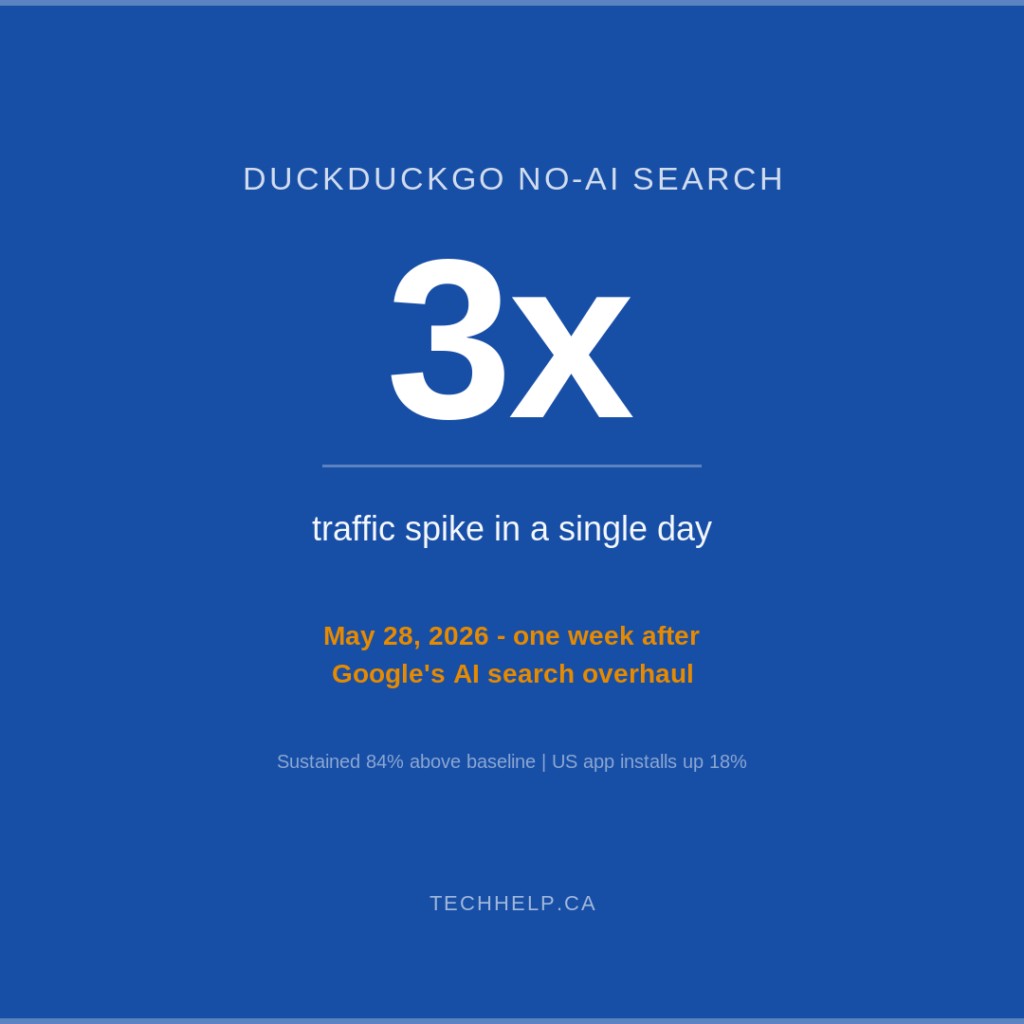
That became visible after Google’s May 2026 search announcements. According to TechCrunch, traffic to DuckDuckGo’s no-AI search page tripled on May 28, 2026, and visits have averaged roughly 84% above baseline since Google’s latest search update.
DuckDuckGo also saw a lift in app installs. The company told TechCrunch that U.S. app installs rose 18.1% week over week on average from May 20 to May 25, with U.S. iOS installs peaking at 69.9% growth.
This doesn’t mean Google is losing the search market. It doesn’t even mean most people reject AI in search. It means a visible group of users wants more control over how search works, especially when AI summaries, chat prompts, and generated images sit between them and traditional results.
For business owners, that’s the signal. Your customers won’t all search the same way anymore. Some will ask AI tools for a recommendation. Some will use Google and accept AI Overviews. Some will look for traditional links on DuckDuckGo or other search engines. Your marketing has to work across that split.
What Google Changed
At Google I/O 2026, Google described the next version of Search as a more AI-centered, task-oriented experience. In its Search announcement, Google said AI Mode had passed one billion monthly users one year after launch, with queries more than doubling every quarter.
Google also said it was upgrading AI Mode to Gemini 3.5 Flash as the default model globally and rolling out what it called the biggest upgrade to the Search box in more than 25 years. The new search box can accept text, images, files, videos, and Chrome tabs as inputs. It also suggests more refined questions beyond traditional autocomplete.
The change isn’t just visual. Google is moving more of search from “show me links” toward “answer this, then help me continue.” Users can ask follow-up questions from an AI Overview and move into AI Mode, where the experience becomes more conversational.
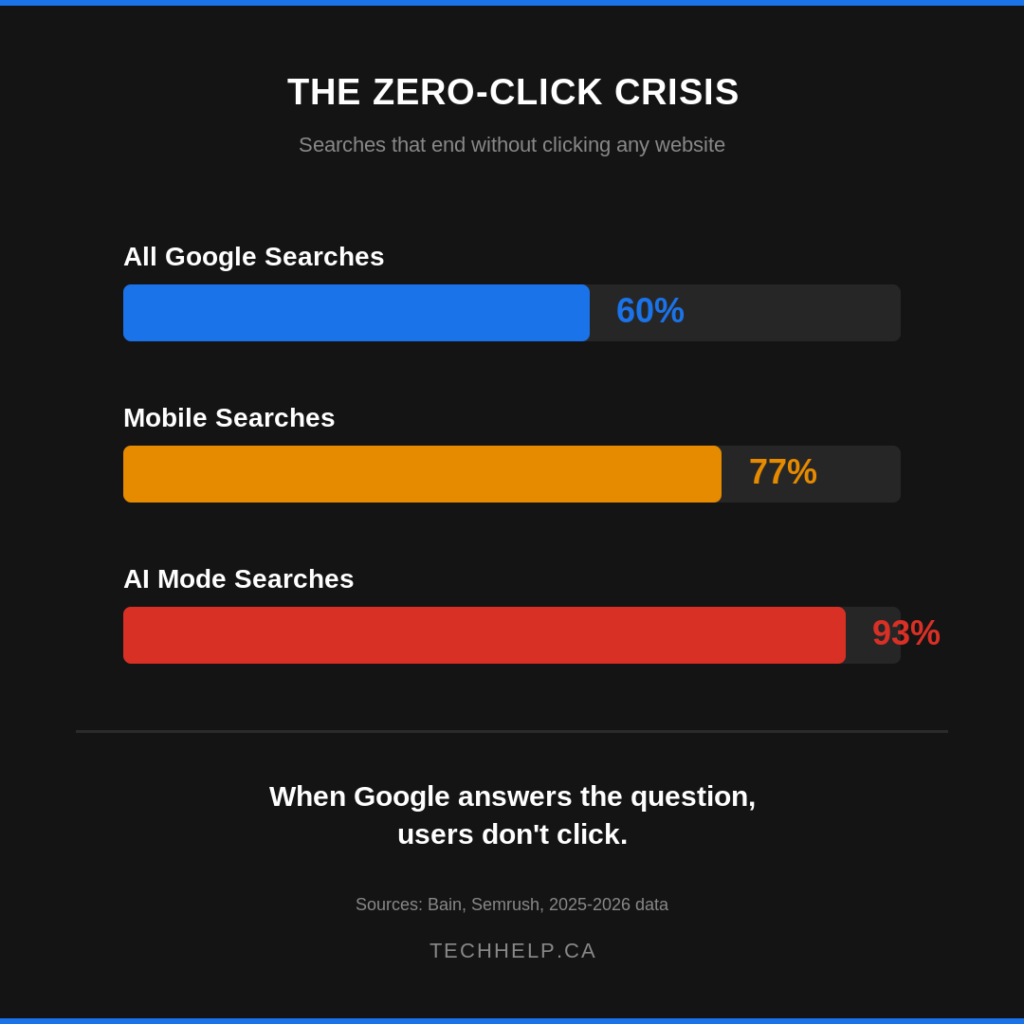
Google says Search will still provide a range of results. But the balance is changing. The more useful the answer is on the results page, the less pressure there is for the user to click through to a website.
That shift is why this matters to small businesses. If your marketing still assumes people search, click, land on your site, and then decide, you’re working from an older version of the customer journey.
Why DuckDuckGo Benefited
DuckDuckGo’s pitch isn’t that AI should disappear from the internet. The company offers optional AI tools of its own. Its pitch is that AI should be optional in search.
The no-AI version of DuckDuckGo strips out AI-assisted answers, chat prompts, and many AI-generated images by default. Users still get a traditional search results page with links and snippets, then decide which source to trust.
That sounds old-fashioned until you look at the behavior. DuckDuckGo’s no-AI page was already seeing growth after Google’s I/O announcements, then hit a new high on May 28. The company responded by launching Chrome and Firefox extensions that let users set the no-AI search page as their default search engine.
DuckDuckGo CEO Gabriel Weinberg put the contrast directly in his statement to TechCrunch: “Google is force-feeding AI with no way to opt out.” That’s a strong line, but the business lesson is broader than the quote. People don’t only care about better answers. They care about control, trust, verification, and the ability to inspect the source themselves.
That’s especially true when the search affects a real decision: which software to buy, which contractor to hire, which doctor to call, which product to trust, or which local business deserves the next click.
The Trust Problem Behind the Backlash
AI summaries can be useful. They can also be wrong, weakly sourced, or too confident for the evidence behind them.
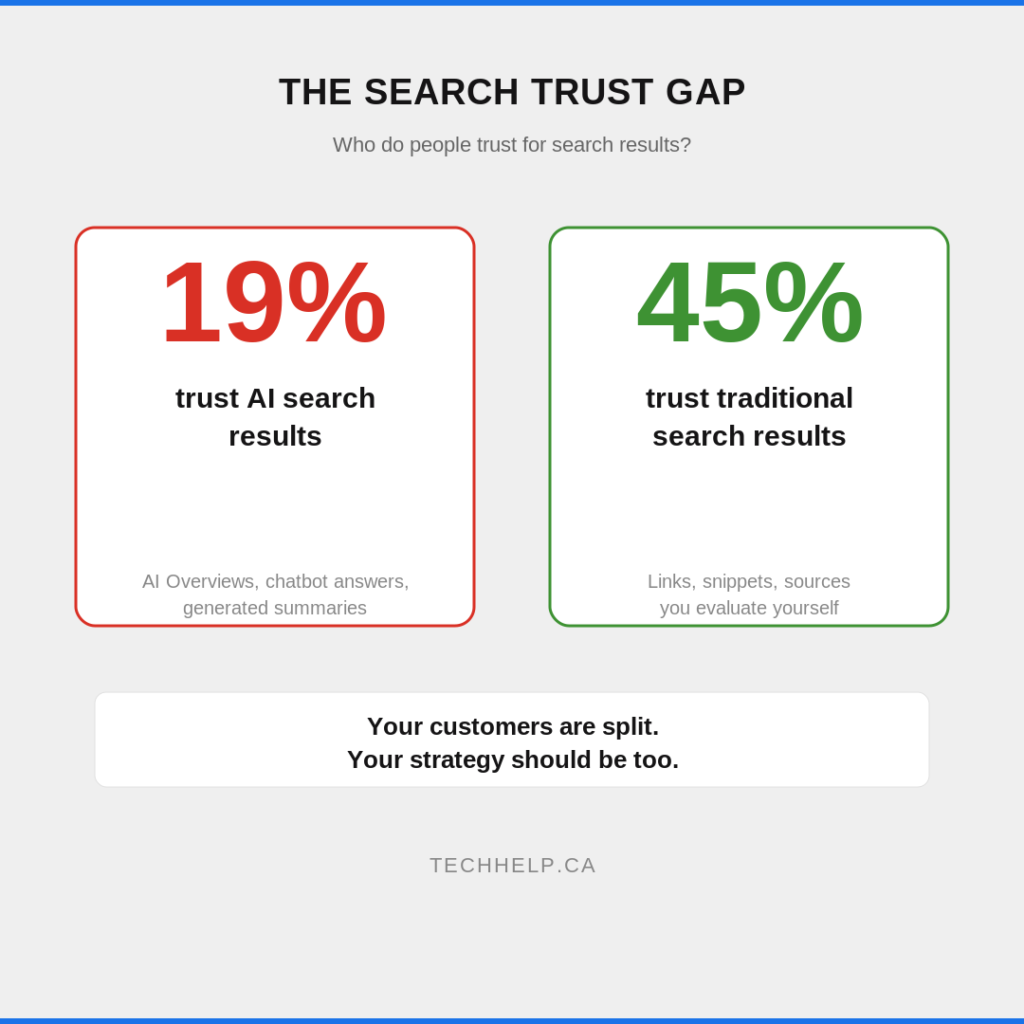
A Pew Research Center survey found that 65% of U.S. adults at least sometimes encounter AI summaries in search results. Among those who have seen them, 53% say they have at least some trust in the information, but only 6% say they trust it a lot.
That mix explains the current tension. People may use AI summaries because they’re fast, but that doesn’t mean they fully trust them.
Accuracy research adds another wrinkle. Search Engine Land reported on a New York Times analysis with AI startup Oumi that found Google’s AI Overviews answered a factual benchmark correctly 91% of the time in February 2026. That sounds strong, but at Google’s scale, even a small error rate can affect a huge number of searches.
Oumi’s own write-up found that only 39% of assessed AI Overviews were both correct and fully supported by their cited sources. Google disputed the Times analysis, saying the benchmark didn’t reflect real user searches. Even with that caveat, the trust issue remains easy to understand: if the user can’t quickly tell whether the answer is grounded in the linked sources, some will prefer the older search experience.
For your business, this isn’t an abstract debate about AI accuracy. It’s a customer confidence issue. If someone is researching you, your competitors, your category, or a buying decision, they may want proof they can inspect, not just a summary they can skim.
Who Are These No-AI Searchers?
There isn’t enough public data to say exactly who visited DuckDuckGo’s no-AI page after Google’s update, so keep the conclusion narrow. One traffic spike doesn’t create a full customer persona.
A safer read is more modest: these users care enough about search experience to change behavior. They may be privacy-conscious, source-conscious, frustrated with AI summaries, or simply tired of search pages that feel crowded.
Those users can matter a lot to small businesses. The person who refuses to accept a summary and clicks through to compare sources may be the same person who reads your reviews, checks your pricing page, studies your case studies, and notices whether your website feels trustworthy.
They may not be the largest audience. They may be one of the more deliberate ones.
That’s why it would be a mistake to treat traditional search as dead. AI search is growing quickly, but not every customer wants the answer prepackaged. Some still want the page, the source, the details, and the chance to decide for themselves.
What This Means for SEO
You now have to serve two search behaviors at once.
For AI search, your content needs to be easy for systems to understand, summarize, and cite. That means clear headings, direct answers, current facts, original examples, visible expertise, third-party trust signals, and pages that answer real questions better than generic summaries do.
Tech Help Canada’s guide to AI in search explains how AI Overviews, AI Mode, and tools like Perplexity are changing visibility.
For traditional search, the fundamentals still matter. Your pages need to load quickly, answer the query, earn trust, support claims, and give readers a reason to stay. A no-AI searcher isn’t looking for a machine summary. They’re looking for a result worth clicking.
That makes content quality more important, not less. A thin page built only to catch a keyword is weak in both worlds. AI systems have little reason to cite it, and traditional searchers have little reason to trust it.
The practical move is to build pages that work for both:
Answer the main question near the top.
Show clear evidence for meaningful claims.
Add real examples, screenshots, comparisons, or process details.
Make author, business, and contact information easy to find.
Keep important pages current as platforms change.
That’s not a trick. It’s just harder to fake usefulness when search is split across AI answers, traditional links, and source-checking behavior.
Your Traffic Mix Needs a Backup Plan
DuckDuckGo’s traffic surge is also a reminder not to build your whole customer pipeline on one platform.
Google still matters. It will keep mattering. But a customer journey that depends too heavily on organic Google clicks is more exposed than it used to be. AI Overviews can absorb informational clicks. AI Mode can keep users inside Google longer. Traditional results can move lower on the page. And users who don’t like that experience may shift to a different search engine entirely.
That doesn’t mean you should abandon SEO. It means SEO can’t be the only pillar.
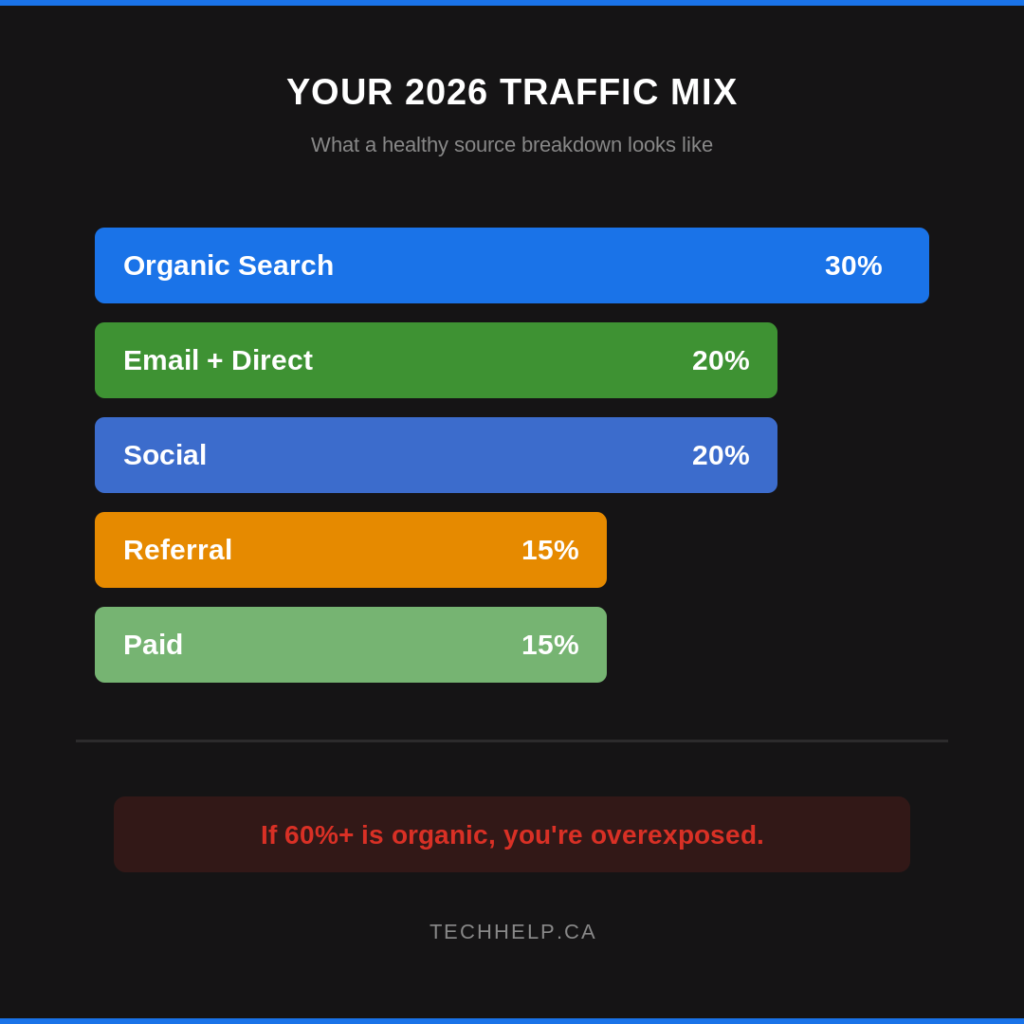
Email, direct traffic, referral relationships, YouTube, community participation, local visibility, partnerships, and brand search all matter more when search fragments. If a customer already knows your name, subscribes to your list, watches your videos, or sees you recommended in a trusted community, you’re less dependent on whichever interface Google decides to put in front of them.
Video deserves special attention here. Product explainers, service walkthroughs, founder answers, and short educational videos can show up in search, live on YouTube, support sales pages, and give people a human signal that AI summaries can’t fully replace.
The goal isn’t to chase every channel. It’s to make sure one search interface change doesn’t quietly remove your most important source of demand.
What to Do Now
Start by checking how exposed you are. Look at the last six to twelve months of traffic by source. If organic Google traffic carries most of your leads, sales, or inquiries, you’re not just doing SEO well. You’re carrying platform risk.
Then test how your business appears across the split. Search your category in Google with AI Overviews, Google AI Mode, DuckDuckGo, ChatGPT, Perplexity, Gemini, YouTube, and Reddit.
Don’t only search your brand name. Search the problems your customers actually type before they know who to hire or buy from.
Look for three things: whether you’re visible, whether the information about you is accurate, and whether the path to your website still makes sense.
If you’re invisible in AI answers, improve the clarity, structure, and credibility of your strongest pages. If you’re weak in traditional results, tighten the page itself: better title, stronger opening, clearer proof, better internal links, fresher examples. If your traffic is too dependent on Google, build an owned audience you can reach without waiting for an algorithm to cooperate.
None of this requires panic. It does require attention.
Not a Revolution by Itself
DuckDuckGo’s no-AI search spike isn’t a revolution by itself. It’s a signal.
Some people want AI answers. Some people want traditional links. Plenty will use both, depending on the question. That means the old idea of “ranking on Google” is too narrow for the way discovery now works.
Your business needs to be understandable to AI systems, credible to skeptical humans, and findable outside one platform. The companies that handle this shift well won’t be the ones arguing over whether AI search is good or bad. They’ll be the ones making sure customers can find them either way.
Tech Help Canada Staff researches, writes, and reviews practical content for business owners and professionals. Our coverage spans business, marketing, SEO, technology, and the tools and systems people use to grow and operate online. We focus on clear, useful information backed by research, hands-on experience, and editorial review. Learn more about our team and editorial standards. Need help with something? Contact Us