Canada’s new foreign-influence registry opens on August 4, 2026. Most businesses won’t need to register, but some companies, consultants, agencies, associations, nonprofits, universities, and advisors should review their work now.
The new regime isn’t a ban on foreign engagement. It doesn’t treat ordinary foreign customers, foreign suppliers, foreign investment, or international partnerships as suspicious on their own.
The risk sits in a narrower place: arrangements where someone acts for or with a foreign principal to influence a Canadian political or governmental process.
For a small business, this can become a compliance question fast. A communications firm, event organizer, research contractor, public affairs consultant, or trade group may not think of itself as part of a foreign-influence regime. But if the work touches Canadian government decisions, public policy, contracts, legislation, elections, referendums, or public messaging around those processes, the business may need to assess whether registration applies.
What starts on August 4
The Office of the Foreign Influence Commissioner of Canada says it will open on August 4, 2026. Its job is to administer a public registry of foreign influence activities in Canada and oversee compliance with registration requirements.
The launch brings much of the Foreign Influence Transparency and Accountability Act into force. The law was enacted as part of the Countering Foreign Interference Act, and the Canada Gazette order fixed August 4, 2026, as the start date for Part 4, with some exceptions.
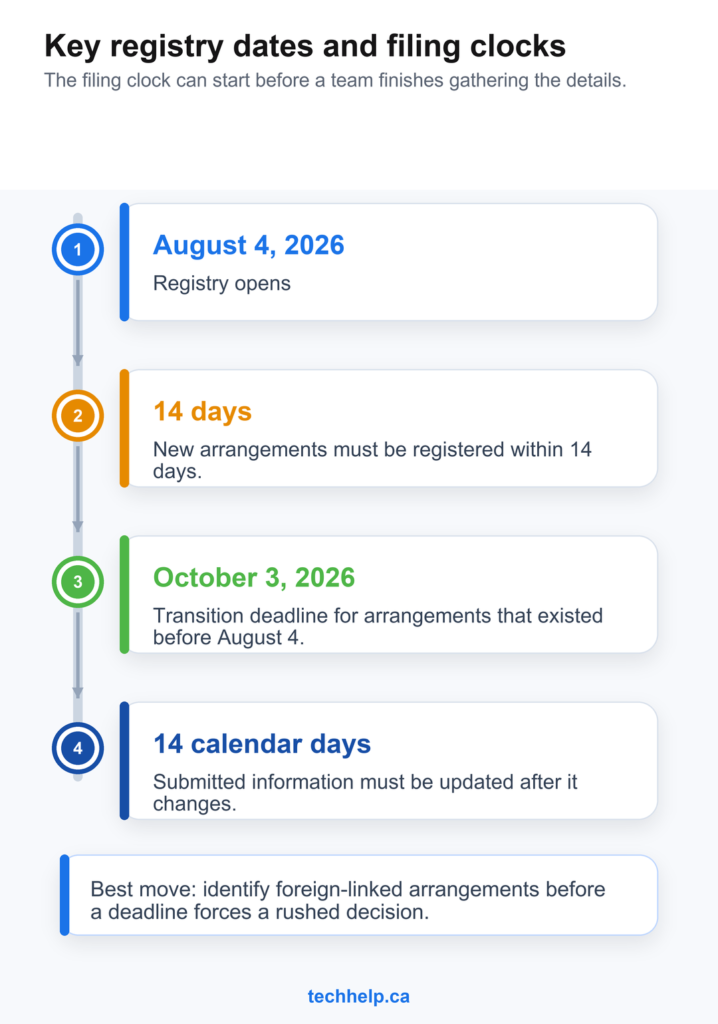
Once the regime opens, covered individuals and organizations must register arrangements with foreign principals. New arrangements must be registered within 14 days. Arrangements that already existed before August 4, 2026, have a transition deadline of October 3, 2026.
The Office describes the online registration form as a 20-to-40-minute form. The broader compliance work may take longer. The final regulations estimate five hours for initial registration activities because registrants may need to review guidance, understand the requirements, contact registry support, create an account, and gather details for each arrangement.
The registration test businesses should use
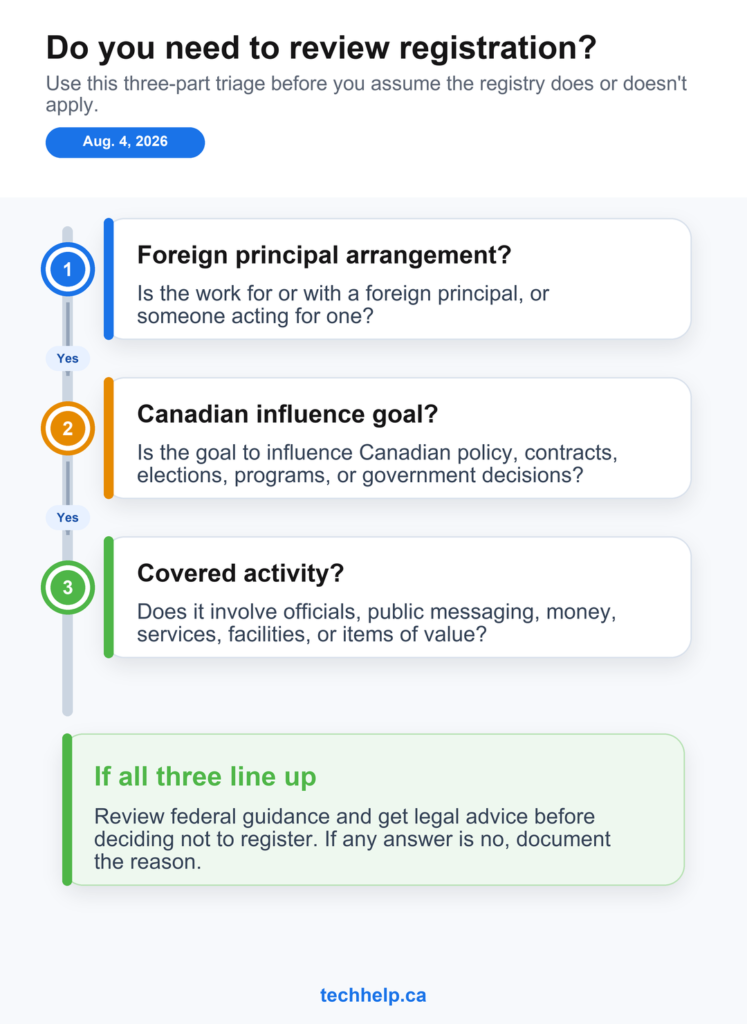
The government’s guidance frames registration around three conditions. All three have to be present.
First, there has to be an arrangement with a foreign principal.
Second, the goal of that arrangement has to be influencing a political or governmental process in Canada.
Third, the arrangement has to involve a covered influence activity, such as communicating with a public office holder, sharing or publishing information for the public, or providing money, services, facilities, or items of value.
If one of those pieces is missing, registration may not be required. If all three are present, the business should treat the arrangement as a serious compliance question.
What counts as a foreign principal
The Act and federal guidance define “foreign principal” broadly. It can include a foreign power or state, a foreign entity, a foreign economic entity, or an individual acting on behalf of one.
For businesses, the category can extend beyond a foreign government department. It can include foreign state-owned or state-controlled economic entities, foreign organizations, and people acting for those parties.
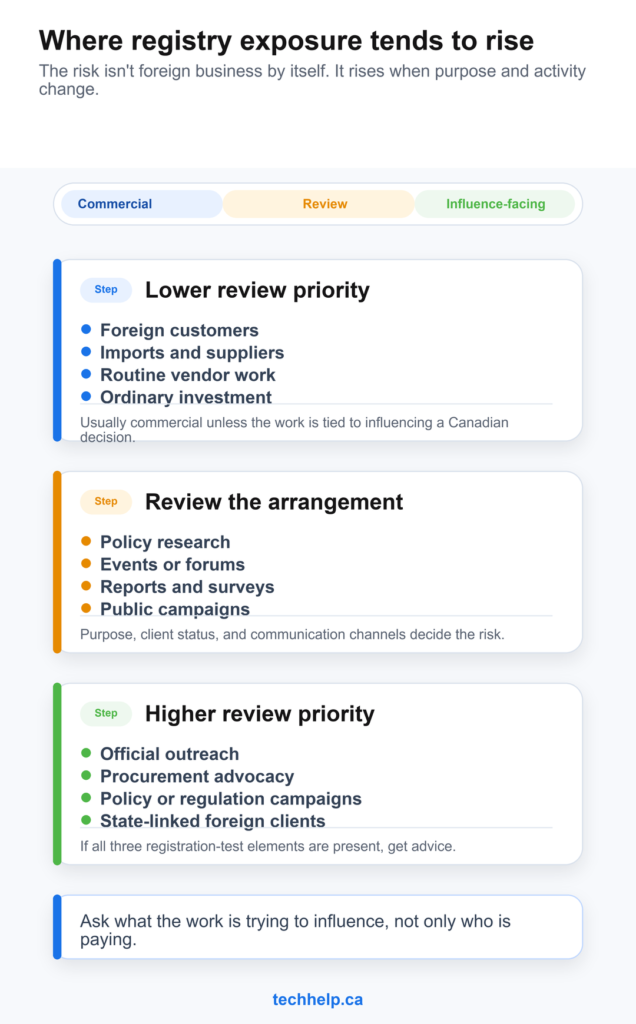
A Canadian company working for a private foreign client on ordinary commercial work may be outside the registry. A Canadian company working for a foreign state-linked entity on a campaign aimed at Canadian public policy may be in a different position.
Focus on the arrangement. Businesses shouldn’t look only at who is paying them. They should look at the client’s status, the goal of the work, and the activities being carried out in Canada.
Ordinary international business isn’t the target
The Office’s FAQ says many foreign influence activities are lawful and legitimate, and most Canadians won’t be required to register.
A Canadian business can sell to foreign customers, import goods, receive foreign investment, attend international trade events, or work with a foreign partner without automatically creating a registry obligation.
The issue is whether the arrangement is tied to influencing a Canadian political or governmental process. That can include legislation, regulations, policies, programs, government decisions, government contracts, elections, referendums, nomination contests, or party platforms.
So the practical question isn’t “Do we work with anyone outside Canada?” It’s “Are we carrying out influence activities in Canada for or with a foreign principal?”
Why small businesses are in the frame
The final regulatory analysis published in the Canada Gazette estimates that 2,422 businesses and individuals will be affected, including 1,550 businesses and 872 individuals. It also estimates that 1,009 small businesses will be affected, with a net cost of $657,046 over 10 years, or about $651.19 per impacted small business.
Those figures are regulatory estimates, not a count of actual registrations. Still, they show the federal government expects businesses, including small businesses, to be part of the regime.
The cost estimate may not be the main concern for small firms. The bigger issue is classification. A business can miss the registry question if it treats the work as normal communications, research, events, or consulting without looking at the foreign principal and the Canadian government process involved.
Where businesses can get caught
The registry may matter most for businesses that sit around communications, government relations, research, policy, events, or public campaigns.
A public relations agency hired by a foreign state-owned company to influence debate around a Canadian regulation should review the rules. So should a consultant engaged by a foreign organization to arrange meetings with provincial officials about a government program or contract.
A trade association working with a foreign principal on a public campaign tied to procurement, tariffs, sanctions, trade policy, or sector regulation may also need to assess the arrangement. The same goes for a firm that distributes reports, social media content, public statements, videos, events, or surveys as part of a foreign-backed effort to influence a Canadian decision.
This creates a narrow form of regulatory uncertainty for businesses that sell communications, research, advocacy, public affairs, and event support. The work may feel routine. The registry question depends on the arrangement behind it.
What registrants may need to disclose
Registrants will need to provide identifying and contact information, details about the foreign principal, and details about the arrangement.
For a business or other entity, the required information can include its legal name, operating names, civic address, business or incorporation number, website, parent entity information where applicable, and a description of its regular activities.
The arrangement details can include start and end dates, compensation or benefits, the political or governmental process involved, the type of influence activities being carried out, the people or classes of public office holders targeted, and the foreign principal’s stated objective.
Public communications can require extra detail. The regulations refer to channels such as social media, television, radio, audio or visual recordings, emails, text messages, phone calls, electronic or print publications, and virtual or in-person events. If social media is used, registrants may need to identify platforms, account names or identifiers, and relevant forums, groups, threads, communities, or channels.
For businesses, this is where compliance becomes more than filling out a form. The company may need to know who approved the work, what channels were used, which officials or audiences were targeted, what benefits were provided, and how the foreign principal described the objective.
What becomes public
The registry is public, but not every submitted detail is published.
The Office says submitted information will be reviewed and validated before publication. Personal identifiers such as dates and places of birth, addresses, phone numbers, and email addresses are kept private.
Public information may include the registrant’s name, certain location information, organization details, foreign principal information, the purpose of the arrangement, the political or governmental process involved, and the types of influence activities carried out.
The regulations also say registry information is retained for 20 years after the arrangement ends.
Public visibility is deliberate. The regime is designed to make certain foreign-backed influence activities easier for Canadians to see, not simply to create a private filing system.
Penalties are serious
Failure to register on time, failure to update required information, or providing false or misleading information can lead to enforcement action.
Administrative monetary penalties can range from $250 to $1 million. The Commissioner can consider factors such as compliance history, the seriousness of the violation, whether the conduct was intentional or inadvertent, any benefit gained, ability to pay, and cooperation with the Office.
The Commissioner can also report violations publicly. For serious cases, the government’s FAQ says criminal prosecution may be possible, with fines of up to $5 million or imprisonment of up to five years on conviction by indictment.
For businesses near the line, waiting for the transition deadline is risky. The registry opens August 4, but the work of reviewing arrangements, documenting decisions, and gathering information can start before a filing is due.
How businesses should review their exposure now
Start with the arrangements, not the invoice list. A foreign client alone doesn’t answer the question.
Pull together current and recent work involving foreign governments, state-owned or state-linked entities, foreign organizations, foreign-funded associations, foreign parent companies, and people acting on behalf of those parties. Then look for work connected to Canadian political or governmental processes.
From there, review the activities. Did the business contact public office holders? Did it arrange meetings? Did it publish or distribute messages to the public? Did it run social media content, events, reports, media outreach, campaigns, surveys, videos, or public statements? Did it provide money, services, facilities, or items of value as part of the arrangement?
If those pieces line up, document the assessment and get advice before deciding not to register.
Businesses should also assign one owner for registry decisions. This shouldn’t be scattered across sales, marketing, legal, and operations with nobody clearly responsible. Even if the final answer is that no registration is required, keeping a short record of the reasoning can help if questions come later.
Work aimed at federal, provincial, territorial, and municipal decision-making deserves attention. If an arrangement touches Indigenous-government-related processes, check the current guidance carefully because not every provision starts on August 4.
The practical takeaway
Canada’s foreign-influence registry isn’t aimed at ordinary international business. It’s aimed at transparency when foreign principals are connected to influence activities involving Canadian political or governmental processes.
That still leaves a meaningful group of businesses that should pay attention: PR agencies, communications firms, consultants, event organizers, associations, policy researchers, nonprofits, universities, advisors, and companies working with foreign state-linked clients.
The safest move isn’t panic. It’s a quick, disciplined review of foreign-linked arrangements, especially any work involving officials, public messaging, government decisions, public policy, contracts, elections, or funding.
If the arrangement looks close to the registration test, get proper legal advice before assuming it is outside the regime.
Frequently asked questions
Do most Canadian businesses need to register under the foreign-influence registry?
No. Most businesses won’t need to register just because they have foreign customers, suppliers, investors, or partners. Registration is tied to specific arrangements with foreign principals where the goal is to influence a Canadian political or governmental process through covered influence activities.
What is a foreign principal?
A foreign principal can include a foreign power or state, a foreign entity, a foreign economic entity, or an individual acting on behalf of one. For businesses, the category can include more than foreign governments, especially where a foreign state-owned or state-linked entity is involved.
What activities can trigger registration?
Registration can be triggered when an arrangement with a foreign principal involves communicating with public office holders, publishing or distributing information to the public, or providing money, services, facilities, or items of value, and the goal is to influence a Canadian political or governmental process.
What are the registration deadlines?
New arrangements must be registered within 14 days. Arrangements that existed before August 4, 2026, have until October 3, 2026, to be registered. If submitted information changes, the registry entry must be updated no later than 14 calendar days after the change occurs.
What happens if a business doesn’t register when required?
Non-compliance can lead to administrative monetary penalties ranging from $250 to $1 million, and violations can be reported publicly. Serious cases may also lead to criminal prosecution, with possible fines of up to $5 million or imprisonment of up to five years on conviction by indictment.
Get new small business insights by email
Practical ideas and useful articles to help you make better business decisions.
Tech Help Canada Staff researches, writes, and reviews practical content for business owners and professionals. Our coverage spans business, marketing, SEO, technology, and the tools and systems people use to grow and operate online. We focus on clear, useful information backed by research, hands-on experience, and editorial review. Learn more about our team and editorial standards. Need help with something? Contact Us