

Guest blogging for backlinks still works, but only when the article is worth publishing beyond the link.
That distinction matters. A useful guest article on a relevant site can help search visibility, referral traffic, brand recognition, and relationships with publishers in your space. A thin article placed only to force a keyword-rich backlink is a weak signal at best and a liability at worst.
Backlinks may be the reason you are considering guest blogging. There is nothing wrong with that. The mistake is treating the host site like a metric in a spreadsheet instead of a publication with readers, standards, costs, and reputation.
This guide focuses on the backlink side of guest blogging: what makes guest post backlinks valuable, how to choose sites, how to handle anchor text, when link attributes matter, where links should point, and how to measure whether the work is paying off.
If you need the full prospecting, pitching, writing, and follow-up workflow, start with our guest posting guide. If you want the wider picture beyond guest articles, our link building strategies guide covers the full system.
Guest blogging for backlinks works when the article earns the link
A guest post backlink is valuable because it can look like an editorial recommendation. A publication reviews your idea, accepts the article, publishes it for its audience, and allows a relevant link because the link helps the reader understand the topic.
That is very different from buying access to a site that publishes anything as long as the invoice is paid.
The practical test is simple: would this article still make sense if search engines did not exist? If the answer is yes, the link is more likely to sit inside a useful publishing relationship. If the answer is no, the article is probably just a container for a backlink.
Google’s spam policies describe link spam as links created primarily to manipulate rankings. The policies call out buying or selling links for ranking purposes, advertorial or native advertising links that pass ranking credit, keyword-rich links in articles distributed across other sites, and low-value content created mainly to manipulate linking signals.
Legitimate guest contributions are still legitimate. Google also says third-party editorial work, columns, opinion pieces, advertorials meant for real readers, and properly treated affiliate or sponsored links are not automatically site reputation abuse. The issue is behavior: weak content, poor fit, manipulative anchors, scale without standards, and links that exist only to influence rankings.
For a serious SEO campaign, the goal is not to hide the fact that you care about backlinks. The goal is to build links in places where the article, audience, and destination page all make sense together.
What makes a guest post backlink valuable
The best guest post backlinks usually share a few traits: topical relevance, editorial review, real readership, natural anchor text, credible surrounding links, and a destination page worth visiting.
Relevance comes first. A cybersecurity company earning a link from a security publication is easy to understand. A cybersecurity company publishing on a generic lifestyle blog with no clear connection to security is harder to defend, even if the site has a high authority score.
Editorial review matters because it creates the signal guest blogging is supposed to provide. A publisher that edits submissions, checks fit, protects its audience, and turns away weak articles is making a real judgment. A site that accepts every submission is not giving much of an endorsement.
Real audience matters more than audience size. A niche site with 50 engaged readers in the exact market you serve can be more useful than a larger-looking site full of bot traffic, scraped content, or visitors who leave immediately. Audience size matters when direct referral volume is the goal. For link quality, brand credibility, and long-term relationship value, the better question is whether the audience is real, relevant, and engaged.
The linking environment also matters. If the host article links to credible resources, recognized brands, original research, and useful supporting pages, your backlink sits in good company. If the same site links out to casinos, payday loans, unrelated product pages, and obvious paid placements in every post, your link shares that neighborhood.
The destination page has to hold up too. A link to a strong guide, report, tool, template, glossary, case study, or useful service page is easier for an editor to approve and easier for readers to trust. A link to a thin lead-capture page is weaker because it gives the reader less reason to click.
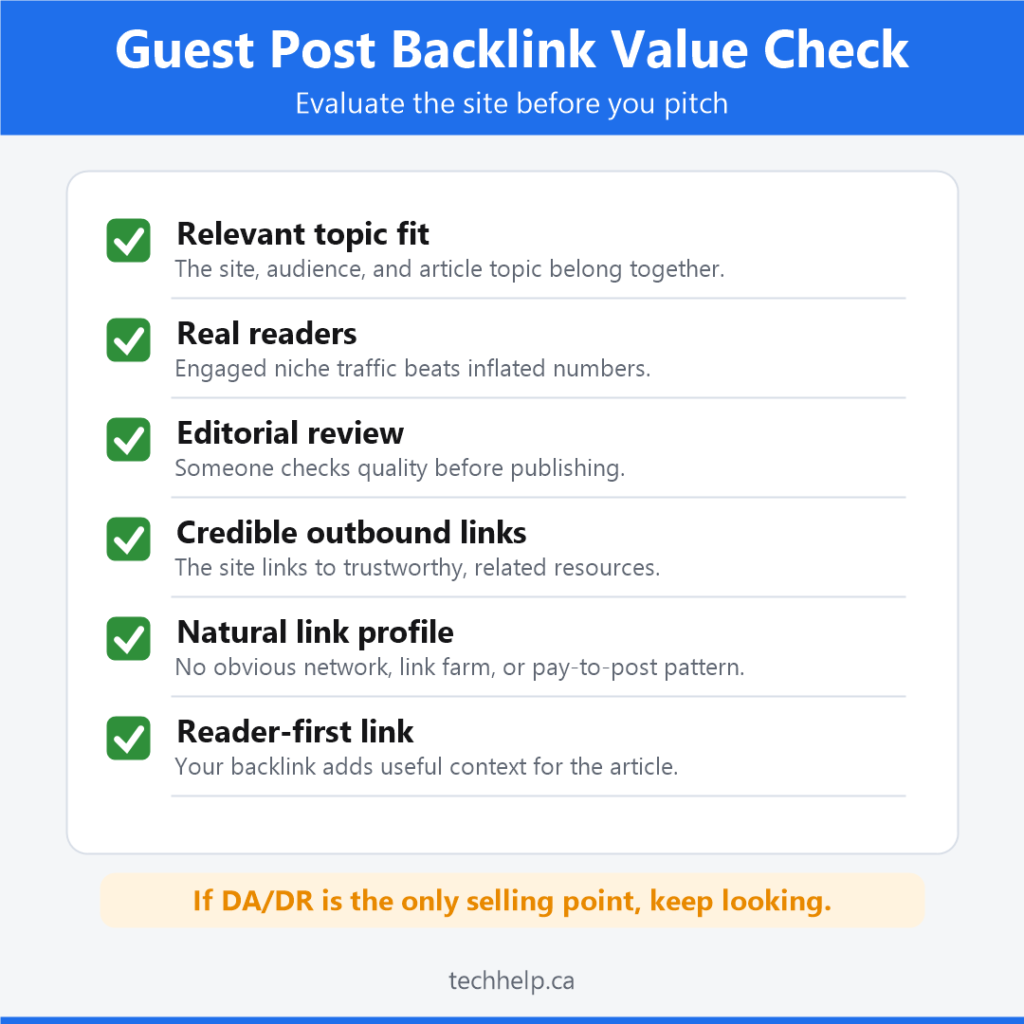
How to evaluate sites before pitching
Do not start with DA or DR. Start with fit.
Ask whether the publication serves your topic, your audience, or a closely related problem. A site can be worth pitching even if it is small, provided it has readers who care about the topic and a reason to publish your perspective.
Then read recent articles. Look for signs of editing, sourcing, useful examples, author expertise, topical consistency, and a clear reason each article exists. You do not need perfection. You do need evidence that someone is taking care of the publication.
Check whether the site is active. Recent publishing, updated pages, visible authors, newsletter activity, social engagement, comments, community mentions, and return contributors can all suggest that the site has an actual audience. Lack of comments alone is not a dealbreaker. Some strong B2B and niche sites have quiet comment sections but engaged email readers.
Review outbound links. The links a site gives are often more revealing than the links it receives. If every article contains unrelated commercial anchors, exact-match phrases, or links to low-quality sites, skip it.
Use SEO metrics after the human review. Moz Domain Authority, Ahrefs Domain Rating, organic traffic estimates, referring domain counts, and keyword visibility can help you prioritize. They should not decide the placement by themselves. Ahrefs describes DR as a relative measure of backlink profile strength, and even Ahrefs warns that DR can lead you astray if you do not understand it. Google also notes that third-party authority scores do not correspond to Google’s own signals.
A lower-DR site with relevance, editorial care, and loyal readers can be a better guest blogging target than a high-DR site with no topical fit and no visible audience.
Anchor text should sound like part of the sentence
Anchor text is the clickable text in a link. It helps readers and search engines understand what the destination page is about.
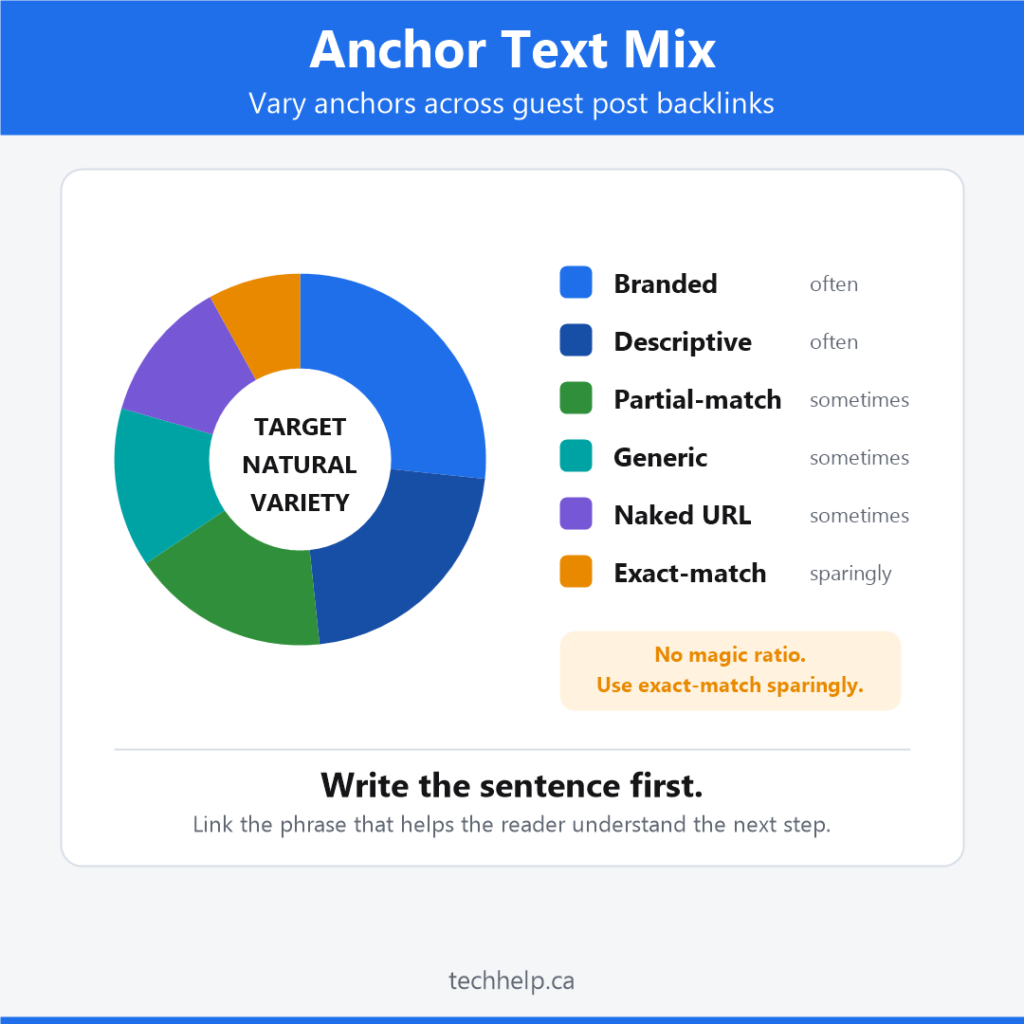
The safest anchor text strategy is also the most natural one: write the sentence first, then link the phrase that genuinely describes the useful next step.
If you are linking to a guide about abandoned cart recovery, the anchor might be “abandoned cart recovery guide” or “research on cart recovery timing.” If the sentence naturally names your company, a branded anchor may be better. If the link appears in an author bio, a brand or homepage anchor often feels normal.
What you want to avoid is repetition. If every guest post points to the same page with the same exact commercial keyword, the pattern becomes obvious. One exact-match anchor in a relevant article is not the problem. Exact-match anchors repeated across many placements are.
A healthy guest blogging campaign usually mixes branded anchors, partial-match anchors, descriptive anchors, generic anchors, naked URLs, and occasional exact-match anchors when the wording genuinely fits. The anchor should help the reader, not announce the keyword target.
If you find yourself rewriting a sentence just to force a keyword into the link, choose a different anchor.
Follow, nofollow, sponsored, and UGC links
SEOs often use “dofollow” to mean a normal followed link. The shorthand is common, but there is no official rel="dofollow" attribute. A link is followed by default unless another attribute changes how search engines treat it.
Google recognizes several link attributes that matter for guest blogging and link building.
Use rel="sponsored" when a link is part of an advertisement, sponsorship, or paid placement. Google says nofollow is still acceptable for those links, but sponsored is the preferred label when the relationship is paid.
Use rel="ugc" for user-generated content links, such as comments or forum posts. That usually does not apply to a reviewed guest article, but it matters if you are building visibility through communities.
Use rel="nofollow" when the publisher does not want to associate its site with the linked page or does not want the link treated as a normal editorial signal.
In 2019, Google changed how it treats nofollow and related attributes, describing them as hints rather than strict directives for Search. Nofollow links should not be treated as identical to followed links, but they can still have business value through referral traffic, brand exposure, discovery, and a more natural link profile.
A campaign made entirely of followed guest post backlinks can look manufactured. Real link profiles usually include a mix of followed links, nofollow links, sponsored links, brand mentions, citations, social links, directory profiles, partner links, and links from content you did not directly control.
Editorial fees are normal, but they do not guarantee SEO value
Some publishers charge editorial, review, or processing fees for contributed content. That can be legitimate.
Reviewing a submission takes time. So does editing the article, checking sources, formatting the page, handling images, managing author details, publishing the post, updating old content, and maintaining the site. A publisher charging to cover that work is not automatically selling links.
The fee should cover the editorial process. It should not automatically guarantee acceptance, a specific anchor text, a followed backlink, permanent placement, or publication without review.
This is the line to watch: a legitimate editorial fee pays for the publisher’s time and workflow. A risky pay-to-post arrangement sells ranking credit with no standards.
If money, sponsorship, product compensation, or advertising is the reason a link is placed, the link should be treated transparently. That may mean rel="sponsored" or rel="nofollow" depending on the publisher’s policy and the nature of the arrangement.
An editorial fee by itself is not the issue. Be skeptical of sites that promise guaranteed followed links, publish weak content, accept unrelated topics, hide their standards, or seem to exist only to sell placements.
Where guest post backlinks should point
The page you link to affects both SEO value and editorial acceptance.
Homepage links are natural when the article mentions your brand or author bio. They can support general discovery and brand trust, but they are less specific.
Inner-page links are better when the guest article and the destination page share a clear topic. If you write a guest article about cloud backup planning, a link to a detailed backup strategy guide on your site is more useful than a generic homepage link.
The strongest target pages are linkable assets. These are pages that deserve citations because they help the reader do something, understand something, or compare options. Examples include original research, detailed guides, checklists, calculators, templates, benchmarks, glossaries, case studies, and resource hubs.
Commercial pages can receive guest post backlinks, but they need to make sense in context. A link to a service page may be natural if the article is about choosing that service and the page contains useful information. A forced link to a sales page in the middle of an unrelated article will feel like a placement.
Before outreach begins, choose the pages you want to support. Strengthen those pages first. A good guest post link can bring a qualified reader to your site, but the destination page has to earn the next click.
If you are still building your SEO foundation, our guide on what SEO is and how it works explains how backlinks fit with content, technical quality, search intent, and site structure.
How many guest post backlinks do you need?
There is no universal number.
A new local business in a low-competition market may see progress from a small number of relevant links. A national SaaS company competing against established brands may need sustained link acquisition from multiple channels over many months.
Instead of starting with a fixed count, compare the pages and domains currently ranking for your target topics. Look at their referring domains, topical authority, content quality, internal links, brand strength, and page-level relevance. The gap tells you how much work may be needed.
Pacing matters too. A site that normally earns one or two links a month should not suddenly add dozens of guest post links from similar sites with similar anchors. Growth can increase as your campaign matures, but it should look like the result of broader marketing activity rather than one mechanical placement push.
Quality also changes the math. One guest post on a respected niche publication with real readers can be more useful than ten posts on sites nobody trusts. It can send referral traffic, create a brand mention, build a relationship with an editor, and support rankings at the same time.
Guest blogging is easier to sustain when it is part of content marketing, PR, partnerships, and expert visibility. The stronger your assets and reputation become, the easier it is to earn better placements.
Mistakes that weaken guest post backlinks
The biggest mistake is treating guest blogging like a bulk order.
Mass-producing similar articles for unrelated sites leads to thin content, repetitive anchors, weak placements, and publisher relationships that do not compound. It may create a short-term spike in links, but it rarely creates a strong brand or a durable backlink profile.
Another mistake is choosing sites by authority score alone. DA and DR can help you sort opportunities, but they cannot tell you whether the audience trusts the site, whether the article will be read, whether the outbound links are credible, or whether the topic fit is strong.
Repetitive anchor text is another common problem. If every placement uses the same keyword-rich anchor, the campaign starts to look engineered. Natural campaigns have variety because different writers, editors, pages, and contexts produce different link language.
Thin destination pages also reduce value. If your guest post links to a weak page, the reader has no reason to stay and the editor has less reason to approve the link in the first place.
Finally, avoid relying on guest posting as your entire link strategy. Guest post backlinks are useful, but a healthy link profile also includes digital PR, original research, resource mentions, partner links, citations, unlinked brand mentions that later become links, community visibility, and links earned because people found your content worth referencing.
How to measure guest blogging backlink performance
Do not measure guest blogging only by the number of links published.
Track the quality of the referring domains, the relevance of the linking pages, the anchor text used, whether the links are followed, nofollow, sponsored, or UGC, and which pages on your site receive those links.
Then track outcomes. Watch ranking movement on the linked pages, organic traffic for the topic cluster, referral visits from the guest post, assisted conversions, email signups, demo requests, branded search, and new mentions that happen after the article goes live.
Link survival is worth checking. Some guest post links disappear during redesigns, content refreshes, editorial policy changes, or site ownership changes. Check important placements after 3, 6, and 12 months.
Also measure relationship value. Did the editor invite another pitch? Did the article lead to a podcast, quote request, newsletter feature, partner conversation, or unlinked brand mention? Those outcomes may not show up as a clean backlink metric, but they matter.
In AI search and broader discovery, mentions can matter even when they do not include a link. The ideal outcome is often both: a relevant brand mention and a useful backlink. But do not dismiss a credible mention just because it is unlinked.
How guest blogging fits into a stronger link building strategy
Guest blogging is one of the more controllable ways to earn backlinks. You can choose the topic, pitch the angle, shape the content, and suggest a relevant link.
That control is useful, but it also means you need restraint. A backlink profile built mostly from guest posts can look narrow. A brand that earns links from research, media coverage, tools, partnerships, local involvement, expert quotes, directories, and community references looks more natural because the links come from different reasons.
Use guest blogging to support pages that deserve attention. Pair it with linkable assets, expert commentary, digital PR, content promotion, and relationship-led outreach. If you need help choosing the mix, start with our link building strategies guide.
The strongest guest post backlinks come from articles that help the host site’s readers, make the publisher look good, and give your target page a reason to be cited.
That is the standard worth aiming for: a link that still makes sense even if search engines ignored it.
Frequently Asked Questions
Is guest blogging for backlinks still worth it?
Yes, guest blogging can still be worth it when the article is useful, the publication is relevant, the audience is real, and the link fits naturally. It becomes weak or risky when the post exists only to carry a backlink, especially across unrelated sites with repeated keyword-rich anchors.
How many guest post backlinks do I need?
There is no universal number. The right amount depends on your competition, current authority, target pages, content quality, and how many other link building channels you are using. A few strong links from relevant sites can be more valuable than many weak links from sites with no real audience.
Are editorial fees for guest posts normal?
Yes, some publishers charge editorial, review, or processing fees to cover staff time. That can be legitimate when the fee covers review, editing, formatting, publishing workflow, and maintenance. It should not automatically guarantee acceptance, a specific anchor, a followed backlink, or publication without review.
Should guest post backlinks be followed?
A followed link can have direct SEO value, but nofollow and sponsored links can still be useful for referral traffic, brand exposure, discovery, and a natural link profile. If a link is part of a paid or sponsored arrangement, the publisher should treat it transparently with an attribute such as rel="sponsored" or rel="nofollow".
What anchor text should I use for guest post backlinks?
Use anchor text that sounds natural inside the sentence and helps the reader understand what they will find after clicking. Branded, descriptive, partial-match, generic, and naked URL anchors can all make sense. Avoid repeating the same exact-match commercial keyword across many guest posts.
Is DA or DR enough to choose a guest blogging site?
No. Domain Authority and Domain Rating can help you compare opportunities, but they should not decide the placement by themselves. Check relevance, editorial standards, audience quality, outbound links, site maintenance, and whether a real reader would care about the article.

I can suggest related Tech Help Canada articles based on the topic you’re reading now.

Tech Help Canada Staff researches, writes, and reviews practical content for business owners and professionals. Our coverage spans business, marketing, SEO, technology, and the tools and systems people use to grow and operate online. We focus on clear, useful information backed by research, hands-on experience, and editorial review. Learn more about our team and editorial standards. Need help with something? Contact Us