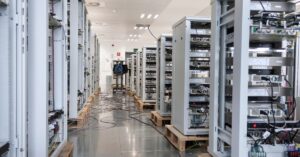
Google, Nvidia and Emerald AI have launched a new industry group focused on a problem that is quickly becoming central to AI infrastructure: how to add more data centers without overloading local power grids.
The AI Energy Management Alliance, or AEMA, is built around the idea that AI data centers should be able to adjust electricity use when the grid is under stress. Instead of treating large AI facilities as fixed, always-on power users, the group wants flexible data centers to reduce, shift or manage demand in response to grid conditions.
Nvidia announced the alliance on September 16, 2026, describing it as a coalition meant to advance data centers that can dynamically manage electricity use. AEMA frames the approach as a way to speed AI infrastructure connections, protect reliability and reduce pressure on electricity affordability.
What AEMA wants to change
AEMA’s core argument is that flexibility should be recognized as a grid asset. In practice, that means a data center operator that can reliably cut power draw during peak stress, move some workloads to another location, use batteries, or coordinate with onsite generation could receive different treatment than a facility that requires full power at all times.
Nvidia’s announcement said AEMA is technology-neutral and performance-based. The group is focusing on measurable requirements such as response speed, duration, predictability and emergency behaviour rather than prescribing one hardware or software stack.
The alliance’s principles include defining curtailment and contingency-response obligations before a facility connects, standardizing technical requirements and operational data sharing, and creating faster risk-adjusted pathways for customers that make credible flexibility commitments.
That policy detail matters. A data center promising flexibility is only useful to the grid if utilities and grid operators can verify the response, trust the timing, and understand which workloads or backup resources are available during an emergency.
Why the grid issue is getting harder
AI infrastructure is being built on timelines that often move faster than power systems. Data centers can be planned, financed and ordered on technology cycles measured in months. Transmission upgrades, substations and new generation can take years.
That mismatch has pushed regulators into the debate. On June 18, 2026, the Federal Energy Regulatory Commission directed all six regional grid operators under its jurisdiction to justify or reform tariffs for data centers and other large energy users. One of the reform categories named by FERC was providing new transmission services for flexible large loads.
AEMA’s launch fits directly into that regulatory opening. The alliance is not just promoting a technical idea. It is also advocating for rules that reward data centers when they can prove they will behave differently from traditional large loads.
Public pressure is also growing. AP-NORC and the Energy Policy Institute at the University of Chicago reported on September 16 that 53% of Americans are extremely or very concerned about the environmental impacts of AI, up from 41% in 2025. EPIC’s 2026 polling summary also said 84% are at least somewhat concerned about data centers’ impact on electricity prices, and 73% support requiring data centers to pay for grid upgrades.
How a flexible AI data center would work
A flexible AI data center does not shut down every time power gets tight. The point is to separate workloads and resources by urgency.
Some AI workloads, such as live inference for customer-facing applications, may need priority treatment. Other tasks, including certain training, batch processing or lower-priority jobs, can sometimes be delayed, moved or power-capped. Batteries and paired generation can also reduce demand from the grid during short stress periods.
A June 2026 arXiv preprint, Power-Flexible AI Data Centers: A New Paradigm for Grid-Responsive Compute, reported experiments on a 130 kW GPU cluster showing rapid load reduction, sustained curtailment, carbon-aware operation and workload shifting across locations while preserving service levels for priority jobs. The paper is a preprint, not a guarantee that every hyperscale facility can deliver the same results, but it shows why AI workloads are being treated differently from older industrial loads.
The technical challenge is coordination. Data center operators need power telemetry, workload scheduling, grid signals and controls that can respond fast enough without damaging service quality. The commercial challenge is proving that capability to utilities, regulators and customers.
Google already has a demand-response record
Google is not starting from zero. In March 2026, the company said it had integrated 1 gigawatt of data center demand-response capacity into long-term energy contracts with multiple U.S. utilities.
Google said its demand-response capability can limit or shift a portion of machine learning workloads running in its data centers, reducing overall power demand during certain hours or times of year. The company listed agreements involving Entergy Arkansas, Minnesota Power and DTE Energy, following earlier agreements with Indiana Michigan Power and the Tennessee Valley Authority.
That existing work gives AEMA a practical reference point. The larger question is whether demand response can move from individual utility agreements into broader interconnection and tariff frameworks that apply across more regions.
The hard part is not only technical
AEMA can define principles, but utilities and regulators will decide whether flexible data centers get faster interconnection, different cost treatment or new service options.
That creates several unresolved questions. Grid operators will need to know how much flexibility is firm, how often it can be called, how long it can last, what happens if a facility fails to respond, and whether local communities still bear upgrade costs if AI demand grows faster than expected.
The affordability claim also needs careful handling. Flexible demand can reduce the need for infrastructure built only for rare peaks, but it does not erase the cost of serving large new loads. The benefit depends on location, grid conditions, facility design, contract structure and how regulators allocate costs.
As of September 22, 2026, AEMA is best understood as a standards and policy push, not proof that flexible AI data centers will automatically lower bills or shorten every interconnection queue.
What this means for AI infrastructure buyers
For businesses and IT teams buying cloud and AI services, the short-term effect is likely indirect. Power availability may influence where AI capacity gets built, how quickly new GPU clusters come online, and how cloud providers discuss reliability, sustainability and cost.
If flexible power agreements work at scale, more AI capacity may be able to connect without waiting for every grid upgrade to finish first. If they do not, more projects may lean on onsite power, batteries and location-specific deals, which could make AI infrastructure more uneven across regions.
The practical takeaway is that AI capacity is becoming an energy planning issue as much as a computing issue. Chips, models and cloud platforms still matter, but electricity access is now part of the competitive equation.
What to watch next
The next phase will depend on whether AEMA can turn its principles into technical standards, verified performance metrics and utility tariff proposals that regulators accept.
The most important signals will be real projects. A flexible data center that receives a faster grid connection, responds to dispatch events reliably, protects priority workloads and reduces upgrade costs would give the alliance a stronger case. Without those examples, the idea remains promising but unproven at the scale AI companies are trying to build.
Google, Nvidia and Emerald AI are betting that AI data centers can become more than power-hungry infrastructure. They are arguing that data centers can become controllable grid resources. The next test is whether power systems, regulators and host communities agree.
Get new small business insights by email
Practical ideas and useful articles to help you make better business decisions.
Tech Help Canada Staff researches, writes, and reviews practical content for business owners and professionals. Our coverage spans business, marketing, SEO, technology, and the tools and systems people use to grow and operate online. We focus on clear, useful information backed by research, hands-on experience, and editorial review. Learn more about our team and editorial standards. Need help with something? Contact Us