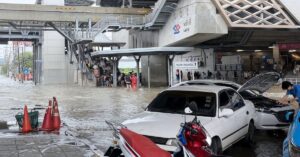
As of Friday, October 2, 2026, flooding in Thailand had disrupted vehicle production and air cargo.
The Nation Thailand reported that Toyota Motor Thailand and Honda Automobile (Thailand) halted vehicle assembly after transport routes were flooded and suppliers could not deliver automotive parts to production lines.
Honda Automobile (Thailand) President and CEO Koji Iwanami said the company would suspend production at its Prachin Buri and Ayutthaya plants from October 2 to October 6. The reported cause was not a lack of final assembly capacity, but the inability of parts suppliers to deliver components after flooding affected areas including Chonburi and Rayong. Honda expected the effect to be short term and planned to resume normal operations on October 7, with overtime shifts to recover lost output.
Toyota’s schedule was still developing. Reuters, cited by multiple outlets, reported on September 30 that Toyota’s Thai unit had suspended three plants and a Toyota Auto Works facility after floodwater disrupted parts deliveries. On October 2, Thairath reported that Toyota had announced a temporary halt at Samrong, Ban Pho and Gateway from October 5 to October 10 because flooding affected parts delivery in Samut Prakan, Chachoengsao and Chonburi. The suspension period may change depending on conditions and parts-delivery readiness.
Thairath’s earlier coverage described the Toyota stoppage as temporary rather than a permanent closure or structural capacity reduction. The available reports point to delivery access as the constraint, not a destroyed factory base.
The cargo problem followed the same pattern
The Nation Thailand reported that Thai Airways initially announced a seven-day suspension of inbound and outbound cargo acceptance at its Suvarnabhumi warehouse from September 30 to October 6 after flooding disrupted employee travel, created a manpower shortage and left a backlog of goods.
That picture changed as agencies intervened. Thailand’s Civil Aviation Authority said on September 30 that it met with Airports of Thailand, Thai Airways, the Thai Airfreight Forwarders Association, Suvarnabhumi customs officials and Bangkok Flight Services to allocate space, staff, equipment and sorting support for backlogged cargo. CAAT said Thai Airways would cancel its cargo embargo, although cargo acceptance could still be managed or slowed to match available capacity and prevent another buildup.
Freight forwarder Expeditors posted on October 1 that Thai Airways had lifted the temporary cargo suspension at its Bangkok Suvarnabhumi terminal, but significant backlogs, terminal congestion and processing constraints remained at Thai Airways and Bangkok Flight Services facilities.
Emergency support and early damage estimates
AP reported that Thailand’s government approved 4.1 billion baht in emergency funds after floods affected more than 2.6 million people. AP also reported that Suvarnabhumi’s baggage backlog was tied largely to airport workers being unable to get to work, with the Thai Air Force sending personnel to help clear luggage. Thai Airways separately said it reduced 15 flights on October 1 and 9 flights on October 2 to match operational capacity, and planned to resume full flight operations on October 3.
Thairath reported that the Federation of Thai Industries estimated preliminary industrial damage at 1,018.36 million baht, based on partial data and an assumption that about 40% of members in affected areas were impacted. The same report said final damage assessments were still being collected, especially from industrial estates in Chonburi.
The risk for technology and hardware supply chains
Many technology, ecommerce and hardware businesses rely on narrow delivery windows, regional hubs and just-in-time replenishment. In that model, a part does not have to be destroyed to become unavailable. It only has to be stuck behind a flooded road, an understaffed cargo terminal or a paused acceptance window.
CAAT’s response also shows where recovery work often begins. The agency focused on space, people, sorting systems, customs clearance and additional equipment. Those less visible parts of logistics can decide whether goods move again or wait in a pile.
For business operators watching the story, the key risk is not only single-supplier exposure. It is route exposure: how many roads, warehouses, customs points and ground-handling teams sit between inventory and use.
What to watch next
Whether Honda resumes normal production on October 7 as planned.
Whether Toyota’s October 5 to October 10 suspension changes as road and supplier conditions improve.
Whether Thai Airways and airport partners clear cargo backlogs without reinstating broad acceptance limits.
Whether the Federation of Thai Industries’ damage estimate rises as more companies report losses.
Get new small business insights by email
Practical ideas and useful articles to help you make better business decisions.
Tech Help Canada Staff researches, writes, and reviews practical content for business owners and professionals. Our coverage spans business, marketing, SEO, technology, and the tools and systems people use to grow and operate online. We focus on clear, useful information backed by research, hands-on experience, and editorial review. Learn more about our team and editorial standards. Need help with something? Contact Us