ASOS has confirmed that customer information was accessed after an unauthorized party used stolen employee credentials to reach third-party platforms used by the retailer.
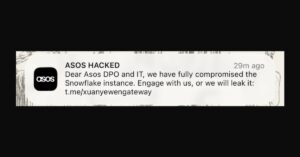
The incident became public in an unusual way: customers received a rogue ASOS app push notification on 6 October claiming the company’s Snowflake instance had been compromised. The notification appeared to be addressed to ASOS’s data protection officer and IT team, not to customers.
In a 6 October regulatory announcement, ASOS said an unauthorized customer notification was sent at around 10 a.m. and that it was investigating activity involving third-party platforms used to communicate with customers. It said access to the notification platforms was restricted, its website and app were operating normally, and it was too early to quantify any trading impact.
ASOS later told customers that an unauthorized party gained access to an employee account by impersonating a trusted contact to obtain login credentials. The company said those credentials were used to access information on certain third-party platforms, which were then locked down.
The retailer said its investigation found access to some personal information, including names and contact details, and certain non-personal account-related information. It said payment card information and account passwords were not accessed. ASOS also said the website and app remained safe to use.
The data issue may go beyond a contact list
The Guardian reported on 8 October that the accessed information included delivery and email addresses, names, phone numbers and recent search history from the app. The outlet said search terms such as glamorous wide fit and Asos petite appeared in the accessed data, citing earlier BBC reporting and ASOS customer communications.
ASOS’s public wording is narrower than some media accounts. The company has confirmed names, contact details and non-personal account-related information, while BBC and Guardian reporting describe more detailed records. That distinction matters because the official investigation is still continuing.
Still, shopping-related data changes the risk profile. A list of names and contact details can support broad phishing attempts. Contact details paired with recent searches can make a fake message look more personal, more timely and more likely to be mistaken for a legitimate brand communication.
The Snowflake claim remains separate from confirmed facts
The rogue notification claimed the ASOS Snowflake instance had been fully compromised. Snowflake told Sky News that the issue did not result from a vulnerability, weakness, flaw or misconfiguration in Snowflake’s service, platform or internal environments, and said no remediation was required for Snowflake customers.
That does not settle every technical question around ASOS’s connected services, but it narrows the public record. The confirmed path is social engineering against an ASOS employee account and access to third-party platforms. A platform-level Snowflake compromise has not been established publicly.
The risk is the connection between data and delivery
A customer messaging system can do more than send discount codes. In a large retail stack, it may sit near customer profiles, segmentation rules, app notifications, email campaigns and behavioral signals used for personalization.
The ASOS incident shows why those systems need to be treated as part of the security perimeter. If an attacker gains access, the risk is not only data exposure. The attacker may also be able to speak through a channel customers associate with the brand.
That combination changes the pressure on incident response. Instead of discovering a breach and preparing a customer notice, the company may have to respond after customers have already seen a message from the attacker inside the official app.
Controls that deserve attention
The practical lesson for operators is not to isolate this as a retail story. Any business using email platforms, SMS tools, push notification consoles, customer data platforms or marketing automation systems should know which accounts can export data, launch campaigns or send messages through official channels.
Useful questions after the ASOS incident include:
Which third-party platforms can send messages in the company’s name?
Which accounts and roles can access customer attributes or behavioral data?
Are high-risk actions such as data exports, API token creation, segment syncs and mass notifications protected by phishing-resistant multi-factor authentication and approval checks?
Are logs retained long enough to trace admin activity across vendors and internal identity systems?
Does the incident plan cover attacker use of official customer channels?
Those questions matter because customer-facing SaaS tools often sit between marketing, support, data and security teams. Ownership can become blurry even when the permissions are powerful.
Customer guidance remains cautious
The UK National Cyber Security Centre advised ASOS customers to assume they are affected even if they did not receive the unauthorized notification. It also advised watching for suspicious messages that may arrive after a breach and avoiding suspicious links, including links in push notifications, emails or messages.
ASOS says it is not currently asking customers to change their ASOS passwords or take any account action. That should not be read as a reason to ignore basic account hygiene elsewhere. A strong, separate password and two-step verification remain useful protection if a phishing attempt follows the breach.
Open questions remain
As of Oct. 11, ASOS had not publicly named every affected third-party platform, confirmed the number of customers affected or fully described how the rogue notification path related to the accessed customer information. The company has said the investigation will continue over the coming weeks and that relevant customers will be emailed if updates affect them directly.
Get new small business insights by email
Practical ideas and useful articles to help you make better business decisions.
Tech Help Canada Staff researches, writes, and reviews practical content for business owners and professionals. Our coverage spans business, marketing, SEO, technology, and the tools and systems people use to grow and operate online. We focus on clear, useful information backed by research, hands-on experience, and editorial review. Learn more about our team and editorial standards. Need help with something? Contact Us