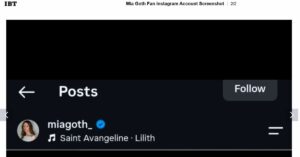
An image of Mia Goth that spread on Instagram this month was AI-generated, according to her representatives.
Goth filed a petition for divorce from Shia LaBeouf in Los Angeles County Superior Court on October 6, according to the Associated Press. Soon after, an Instagram post from the account @miagoth_ appeared to show Goth wearing a white T-shirt with the text “MY EX IS MY BIGGEST FAN.” The post also included Beyoncé’s “Single Ladies (Put a Ring on It),” according to The Verge.
The account was labeled as fan-run, but it also carried a blue Meta Verified checkmark and had more than one million followers, The Verge reported. The Verge said the image drew hundreds of thousands of likes, including from people in the entertainment industry, and that some entertainment coverage treated the post as authentic before the correction caught up.
Goth’s representative Christine Tripicchio told The Verge that Goth does not own or engage in social media accounts on any platform. Tripicchio said Goth’s team had filed multiple complaints asking Instagram to remove the verified fan account, which she said continued posting “counterfeit, AI images” of Goth. She also questioned how the account qualified for a blue check and called the situation “incomprehensible.”
Meta spokesperson Alex Dziedzan later told The Verge the @miagoth_ account was removed for impersonating a public figure. The available reporting does not identify who generated the image, and it does not explain how the account obtained its verified badge.
The blue check was part of the confusion
Meta launched Meta Verified in 2023 as a paid subscription that included a verified badge, account support and impersonation protections. Meta’s own launch materials said subscribers would receive a badge confirming the account holder is the “real you,” with applicants required to submit a government ID matching the profile name and photo.
The problem is that account-level verification is not the same as content-level authenticity. A badge can make an account look more trustworthy, but it does not prove that every image on that account is real, current or approved by the person shown in the post. In this case, the account’s fan-page label and its blue check sent mixed signals to casual viewers, outlets and social users encountering the post quickly.
The failure was a chain
Account layer: A fan account with a large audience and a blue check looked more credible than an ordinary repost account.
Content layer: The image appeared to show a timely personal reaction from Goth, but her representative said it was AI-generated and not posted by Goth.
Amplification layer: Likes, screenshots and entertainment coverage helped the image move beyond the original Instagram post.
Search layer: In a follow-up report on October 15, The Verge said the false premise also appeared downstream in Google Search, including an AI-generated overview that described Goth as taking a swipe at LaBeouf.
That sequence shows how a fake social post can move from platform content to perceived public statement. Once enough pages repeat the premise, search and AI summary systems may surface the repeated claim even if the original evidence is weak.
Why AI labels may not catch this kind of post
Meta has said it labels AI-generated images on Facebook, Instagram and Threads when it can detect industry-standard indicators such as C2PA or IPTC metadata. The company also says it requires people to use its disclosure tool for organic content with photorealistic AI video or realistic-sounding AI audio, and that penalties may apply when users fail to disclose that kind of content.
Meta has also acknowledged limits. Its February 2024 AI-labeling announcement said it is not possible to identify all AI-generated content, and that people can strip out invisible markers. That matters for still images because detection may depend on technical signals surviving the upload process, the uploader disclosing AI use or later enforcement after a report.
Publishers need a narrower standard for viral screenshots
For publishers, marketers and social teams, the supported facts are narrow: Goth did not post the image; her representative said she does not use social media; The Verge reported that the image was AI-generated; Meta removed the fan account for impersonation. Claims about Goth’s feelings, motive or intended message are not supported by the available record.
The same verification standard applies to any viral screenshot that appears to show a public figure. Checks should include whether the account is official, whether the subject controls it, whether the account labels itself as fan-run, whether other reports are only repeating the same screenshot, and whether the image has independent provenance.
Tech Help Canada has previously covered a similar publishing risk in its guidance on AI-generated content and search quality: AI material still needs human review, source checks and context before publication.
For public figures, likeness protection is increasingly reactive. For publishers and social teams, a blue check can no longer carry the whole verification burden. The account may be real; the post can still be false.
Get new small business insights by email
Practical ideas and useful articles to help you make better business decisions.
Tech Help Canada Staff researches, writes, and reviews practical content for business owners and professionals. Our coverage spans business, marketing, SEO, technology, and the tools and systems people use to grow and operate online. We focus on clear, useful information backed by research, hands-on experience, and editorial review. Learn more about our team and editorial standards. Need help with something? Contact Us