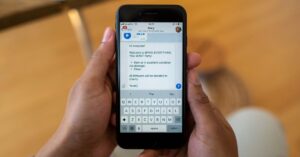
Apple’s iPhone keyboard uses undisclosed phrase-level restrictions that can stop some terms from appearing in predictive text or being produced through swipe typing, according to research published by independent researcher Derik Kauffman and reported by Reuters.
In its November 6, 2026, report, Reuters emphasized that the multilingual “gray list” is not a ban, because iPhone users can still type the words and phrases letter by letter.
That distinction matters. Predictive text and swipe typing are convenience features, but they are also part of how many people write on a phone. Apple’s own iPhone User Guide describes predictive text as a feature that can complete words or phrases and QuickPath as a way to type by sliding from one letter to the next. If a phrase is held back by the keyboard, the practical effect is not censorship in the strict sense. It is friction.
What Kauffman found in iOS language data
Kauffman’s Swipeblocked project says Apple’s iPhone keyboard carries hidden lists of phrases it will never suggest and will often not allow through swipe typing. The project says Apple does not publish the lists or explain how phrases are chosen.
The public English list on Swipeblocked shows 4,513 recovered phrases. Kauffman’s technical notes also describe 4,525 English prediction-table entries and 2,794 QuickPath entries in iOS 27.0. The difference reflects a key limitation of the research: the recovered human-readable phrases are not always a perfect one-to-one match for Apple’s internal table entries.
The technical notes say the restrictions are stored as a minimal perfect hash table of fingerprints rather than a plain-text list. Kauffman says the phrases were recovered by enumerating possible candidates and checking them against Apple’s table. His own site adds two important limits: some entries could not be decoded, and a phrase’s presence on the list does not reveal why Apple added it.
Swipeblocked says similar lists exist for 27 other languages and scripts, with many comparable in size to the English list. Reuters quoted Kauffman as saying there are different ways to count the restricted words, phrases and permutations, with a conservative estimate of about 100,000, not including Chinese characters.
Reuters also reported that Matt Suiche, an engineer at the agentic AI cybersecurity company Tolmo, said he independently recovered the same gray list and cross-referenced Kauffman’s findings against Apple’s internal data, finding a near-perfect match.
The examples include politics, drugs, sex and offensive language
Most of the flagged words and phrases are vulgar, offensive, or related to drugs, sex or violence, according to Kauffman. But Reuters and Swipeblocked also identified politically or socially charged examples, including “sleepy Joe,” “Tibetan independence,” “United Ireland,” “right wing conspiracy” and “dictator Trump.”
Reuters said it tested a small subset of the phrases identified by Kauffman and found they were either hard to enter through swipe typing or not suggested through autocomplete. In one example reported by Reuters, attempts to swipe-type “United Ireland” often produced “United Iceland.” Attempts to swipe-type “Tibetan independence” often produced “Tibetan independences.”
The list is not limited to English. Reuters reported examples in Hindi, French and Hebrew, while Swipeblocked lists examples across Chinese, Arabic, Spanish, German, Italian, Dutch, Turkish, Punjabi and other languages. Kauffman’s site cautions that translations are approximate and that Apple’s source data often drops capitals and accents.
Apple says the keyboard avoids inappropriate suggestions
Apple did not directly comment to Reuters on Kauffman’s findings, including the size or makeup of the list or the reasons specific political terms were included. Reuters reported that Apple said iPhone users can type specific words or phrases and override predictive text suggestions. Apple also said the keyboard was set up to avoid offering suggestions that might be inappropriate or offensive.
That explanation fits one obvious reason for a restriction list. No platform wants a keyboard to accidentally suggest slurs, explicit terms or inflammatory slogans and then appear to endorse them.
The bigger issue is user control
The strongest concern is not any single restricted phrase. It is that Apple’s keyboard can make certain words or phrases less convenient to write without exposing a clear setting, explanation or editable list.
Electronic Frontier Foundation senior counsel David Greene told Reuters there may be a case for curbing unwanted or inflammatory suggestions, but said users should be aware of the system and have some ability to customize it. He also said the feature “should not be secret.”
Apple’s public support documentation explains how to turn predictive text and inline predictions on or off. It does not describe an inspectable phrase-level restriction list or a way to edit the kind of phrase rules Kauffman documented.
What this means for iPhone users
For journalists, support teams, multilingual users and anyone who writes about politics, history, public safety or sensitive social topics, the finding is more than a keyboard quirk. A failed swipe result may reflect a built-in restriction rather than poor gesture recognition, a personal dictionary issue or weak language support.
The unanswered question is whether Apple will disclose more about how these lists are built, how often they change and whether users should have a setting that separates “avoid offensive suggestions” from “let the keyboard suggest what the user appears to be typing.” Until then, the iPhone keyboard is not just predicting text. In some cases, it is deciding what not to predict.
Get new small business insights by email
Practical ideas and useful articles to help you make better business decisions.
Tech Help Canada Staff researches, writes, and reviews practical content for business owners and professionals. Our coverage spans business, marketing, SEO, technology, and the tools and systems people use to grow and operate online. We focus on clear, useful information backed by research, hands-on experience, and editorial review. Learn more about our team and editorial standards. Need help with something? Contact Us