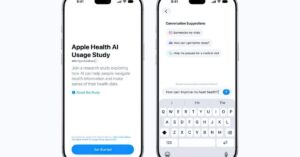
Apple launched the Apple Health AI Usage Study on November 15, 2026, to examine how people understand, trust and use conversational AI for health. The U.S. research project combines an Apple-designed iPhone experience with technology from clinical AI company OpenEvidence.
Health answers with optional personal context
According to Apple’s announcement, participants can ask everyday health questions and see clinical citations supporting responses. They can choose to share HealthKit information, including resting heart rate, activity, sleep and lab results, so researchers can examine whether personal context affects relevance and understanding.
The App Store listing also describes features for preparing for medical visits and building exercise or meal plans. It states that neither the app nor the study provides medical advice, diagnosis or treatment.
Why comprehension needs its own test
A separate randomized study published in Nature Medicine on February 9, 2026, illustrates the challenge. It involved 1,298 UK adults assessing doctor-written medical scenarios, rather than seeking treatment for their own symptoms. Participants using three chatbots did no better at identifying relevant conditions or choosing a course of action than a control group allowed to use its preferred resources.
That study collected data in 2024 and didn’t test Apple’s app or OpenEvidence. It provides context for studying human interaction with health AI, not evidence that Apple’s approach will succeed or fail.
Study data won’t train AI models
Apple says study data won’t be used to train AI models, and participants control whether to share HealthKit measurements or survey responses. The App Store privacy label separately says a user ID may be collected and linked to identity for analytics and app functionality. The no-training commitment therefore shouldn’t be read as a promise that the app collects no data.
Apple also told ABC News that OpenEvidence would delete question-and-response data within 24 hours and wouldn’t train its model on those queries. That retention commitment concerns OpenEvidence’s handling of conversations; Apple’s launch announcement doesn’t specify a retention period for the study records Apple maintains.
Enrollment is U.S.-only
The announced enrollment limit is 200,000 participants. Participants must be at least 21 and have an Apple Intelligence-capable iPhone running iOS 26 or later, according to Apple.
The App Store’s 18+ rating doesn’t change the study’s minimum age. Apple’s November 15 announcement covers U.S. enrollment only and provides no Canadian launch date or timetable for publishing findings.
Image credit — Apple.
Get new small business insights by email
Practical ideas and useful articles to help you make better business decisions.
Tech Help Canada Staff researches, writes, and reviews practical content for business owners and professionals. Our coverage spans business, marketing, SEO, technology, and the tools and systems people use to grow and operate online. We focus on clear, useful information backed by research, hands-on experience, and editorial review. Learn more about our team and editorial standards. Need help with something? Contact Us