Google launched AI Overviews and AI Mode in France on July 22, 2026, bringing its AI search products to a market it had left out of earlier European expansions.
The delay matters more than the launch date. France has spent years forcing Google to negotiate over how it uses publishers’ work. AI Overviews arrived only after that fight produced compensation agreements for French news outlets and while Google was rolling out new controls that let some site owners leave its generative AI search features.
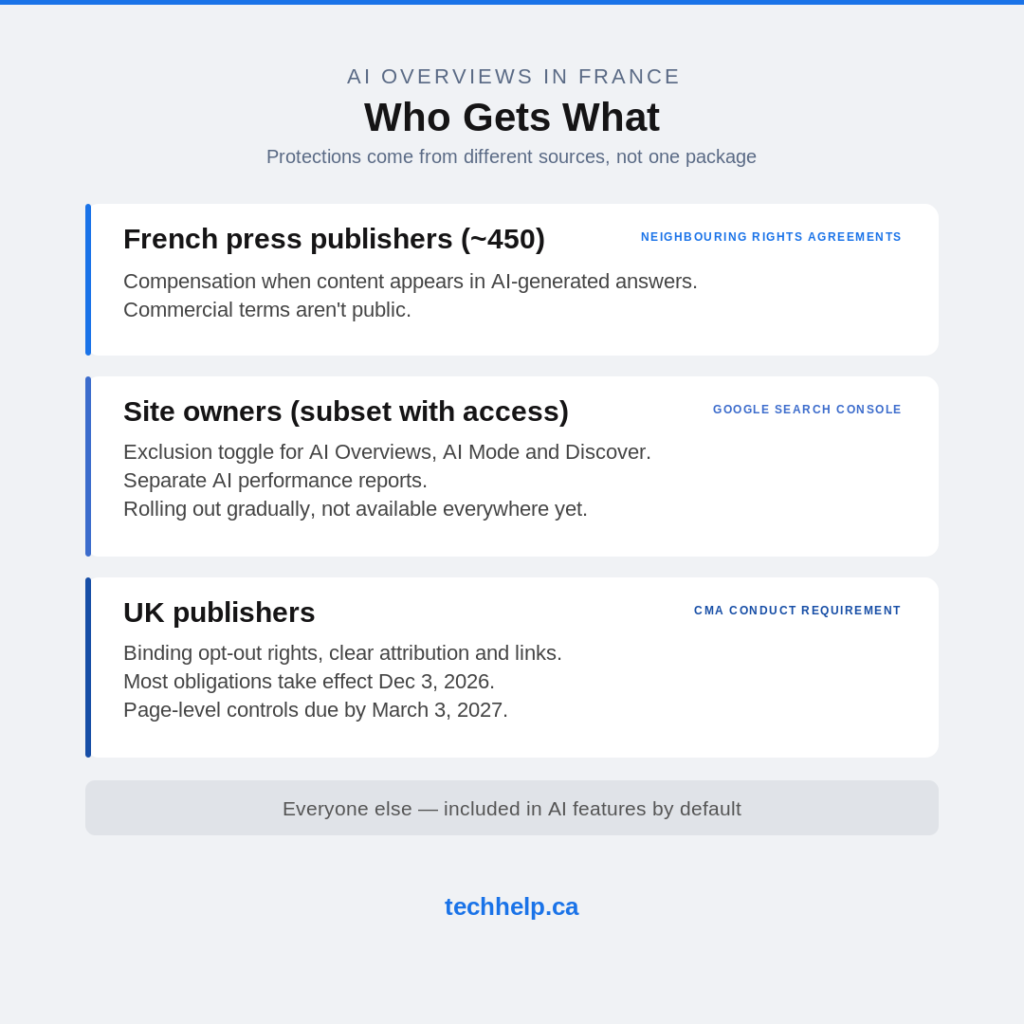
But those protections need to be understood correctly. France didn’t receive one universal package that guarantees payment, detailed reporting and a risk-free opt-out for every website. Compensation applies to participating French press publishers. Google’s Search Console controls and reports are still reaching a subset of sites. Some of the strongest requirements, including future page-level controls, come from the UK’s competition regulator.
For businesses that depend on search traffic, the practical lesson is simpler: AI search is becoming more measurable and controllable, but it can still reduce clicks. Measure your exposure before deciding whether visibility or exclusion is worth more.
What Google launched in France
AI Overviews are summaries that Google generates above or among its regular search results when it decides a synthesized response will be useful. The answers draw on Google’s search systems and include links to supporting web pages.
AI Mode is a conversational search experience. It lets people ask longer questions, use text, images or voice, and continue with follow-up questions. Google says it uses a query fan-out technique that runs several related searches to assemble a response.
Google also introduced Search Live in France, allowing people to discuss what their phone camera can see while receiving spoken AI answers and links.
These products don’t merely change how search results look. They change how much of the user’s task Google can complete before the person visits another website.
Why France took longer
France was the first EU member state to put the European Copyright Directive’s press-publisher right into national law in 2019. That neighbouring right requires online services to negotiate over certain uses of press content.
Google initially responded by changing how French news snippets appeared unless publishers allowed their content to be shown without payment. France’s competition authority intervened. In July 2021, the Autorité de la concurrence fined Google €500 million for failing to comply with orders to negotiate in good faith. The authority accepted a set of Google commitments in 2022 intended to create a fairer negotiating process.
In March 2024, the authority imposed another €250 million fine after finding that Google hadn’t complied with several of those commitments. Among the issues, it found that Google had used content from press agencies and publishers in connection with Bard, later renamed Gemini, without properly informing them or giving them an effective way to object.
That history helps explain why an AI search launch in France couldn’t be treated as an ordinary product update. An AI-generated answer can reuse the substance of reporting while satisfying enough of the query that the searcher never visits the publisher.
French enforcement didn’t stop with Google. On July 8, 2026, the competition authority ordered Meta to resume good-faith negotiations with two French publisher groups and provide information needed to calculate remuneration within 15 days. That action wasn’t about AI Overviews, but it reinforced the same message: neighbouring rights are enforceable obligations, not voluntary partnership language.
What publishers actually get
The protections surrounding the French launch come from different agreements, products and regulators. Combining them into a single promise makes the arrangement sound stronger and simpler than it is.
Compensation for participating French news publishers
Le Monde reported that about 450 French media outlets with neighbouring-rights agreements will be compensated when excerpts from their work appear in Google’s AI-generated answers. Those arrangements matter, but they aren’t a general payment system for every French website or every business whose content contributes to an answer.
The commercial terms aren’t public. That makes it difficult to judge whether the payments offset any lost subscriptions, advertising revenue or reader relationships.
An exclusion control in Search Console
Google is rolling out a Search Console setting called “Search generative AI” to a subset of site owners. The setting covers AI Overviews, AI Mode and generative AI features in Discover.
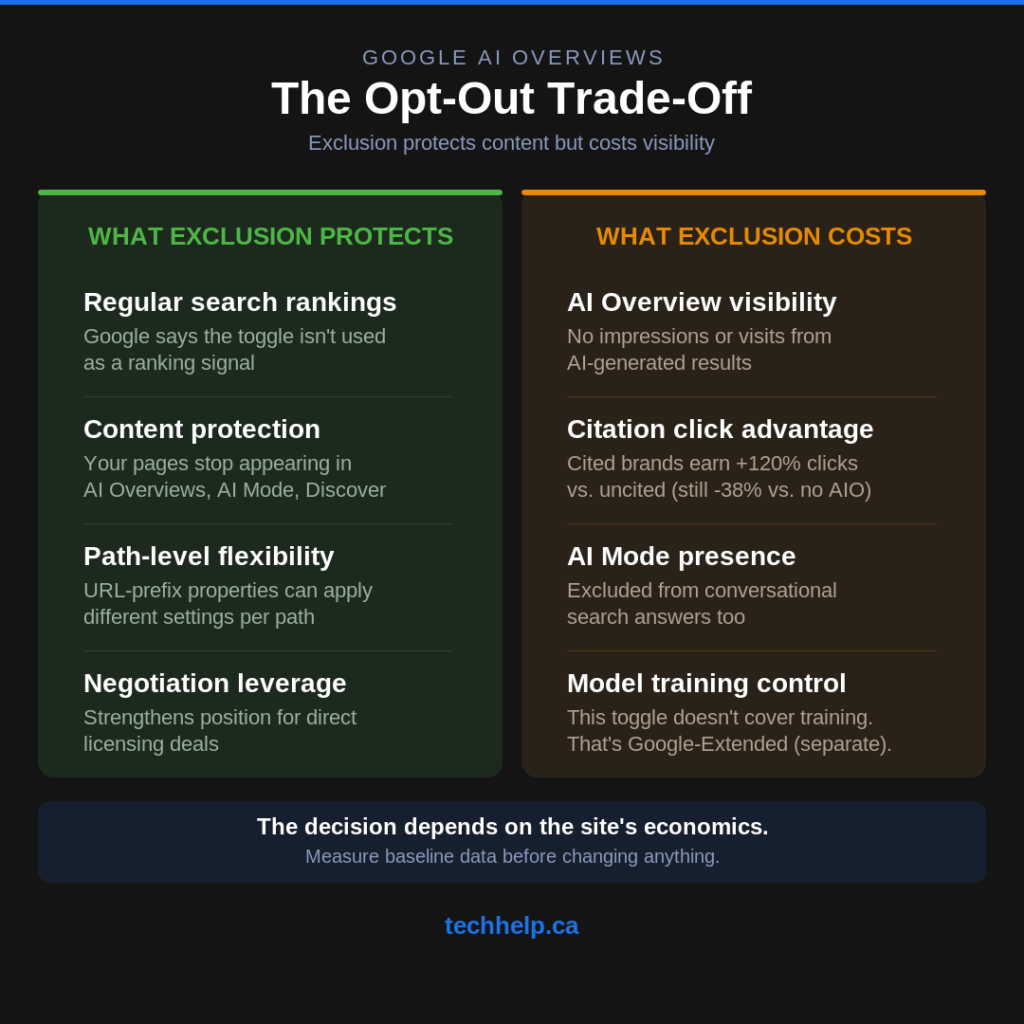
Sites are included by default. An eligible owner can exclude a Search Console property, and child properties can inherit the setting from a parent. URL-prefix properties also allow an owner to apply a different setting to a particular path, so the control isn’t limited to an all-or-nothing domain switch.
Google says exclusion generally takes effect within a few days. Once the control is active, the affected content should stop appearing in covered AI features within one or two days, although cached information can take longer to disappear.
Exclusion has consequences. Google says the setting isn’t used as a ranking or inclusion signal elsewhere in Search, but an excluded page can’t earn impressions or visits from the AI features it has left.
The setting also doesn’t control whether Google uses a site to train its AI models. Google directs publishers to Google-Extended for that separate decision.
Separate generative AI performance reports
Google is also rolling out dedicated Search Console reports for its generative AI features. The reports can show clicks, impressions, pages, countries, devices and dates separately from conventional web-search reporting.
That’s useful because site owners previously had limited visibility into whether AI Overviews displayed their work or sent visits. It isn’t universal yet, though. Google says the reports are being introduced to a subset of sites while it refines the experience.
Stronger requirements in the UK
Some controls described as part of the French launch actually come from the UK’s Competition and Markets Authority.
The CMA imposed a publisher conduct requirement on Google in June 2026. It requires effective ways for publishers to opt out of having their content used in AI search features while remaining in the rest of Search. It also requires clear attribution and links.
Most of that requirement is scheduled to take effect on December 3, 2026. Page-level controls are due by March 3, 2027. Those are UK implementation deadlines, not dates when Google has promised the same control to every site worldwide.
The distinction matters. Current Search Console properties already provide some path-level flexibility, but the CMA’s future page-level requirement is more precise.
The click data shows real risk, not one universal outcome
France entered the AI Overviews rollout after researchers had already measured the feature in other markets. Their findings point in the same general direction: when Google places a generated answer on the results page, fewer people click conventional organic links.
The size of the effect varies because the studies use different countries, dates, queries and methods. Their percentages shouldn’t be stacked as if they measured the same population.
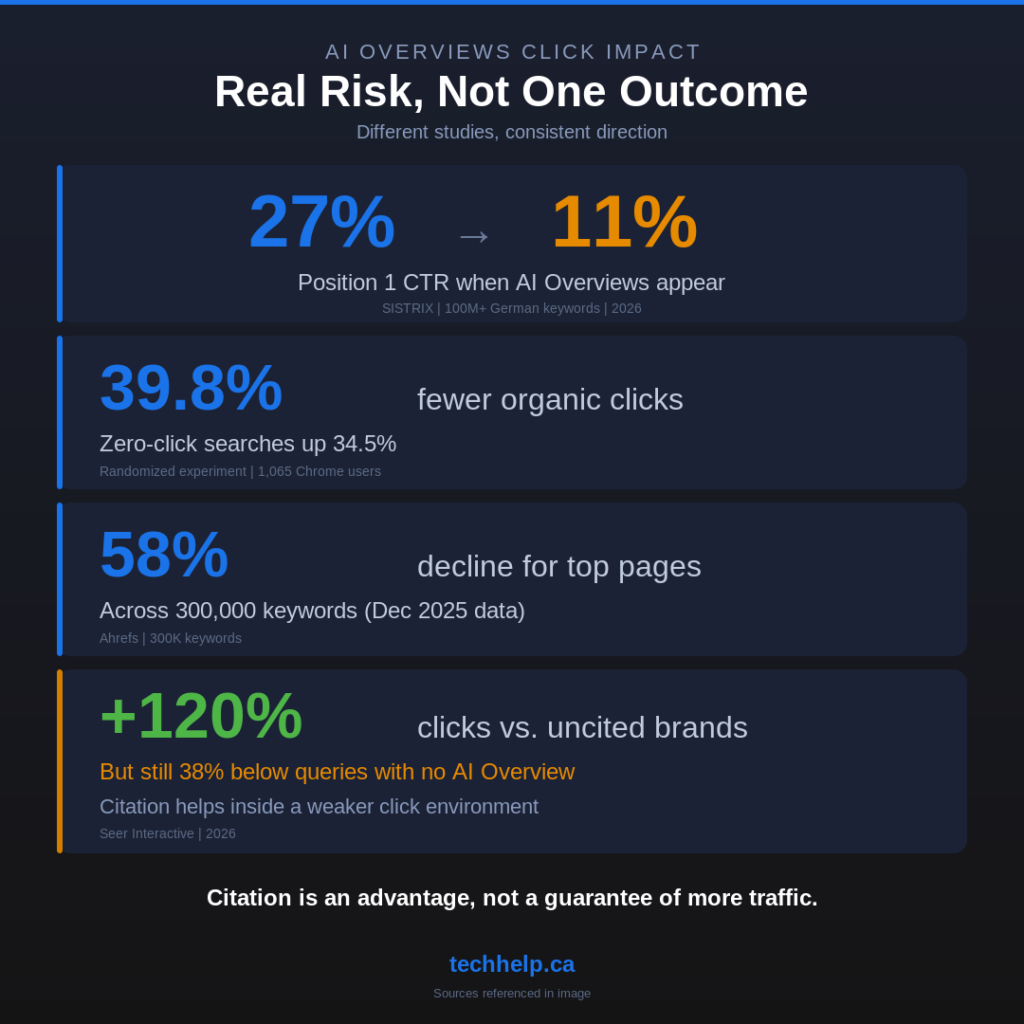
SISTRIX studied more than 100 million German keywords and found AI Overviews on about 20% of them. For queries with an overview, the click-through rate at the first organic position fell from 27% to 11%. Its model estimated an average 6.6% loss across all keywords and about 265 million fewer organic clicks per month in Germany.
A randomized field experiment reached a similar conclusion through a different method. When an AI Overview appeared, outbound organic clicks fell by 39.8% and zero-click searches rose by 34.5%. Sponsored clicks didn’t show a meaningful change, and participants didn’t report a measurable improvement in search quality or ease.
Ahrefs compared 300,000 keywords using December 2025 data and estimated that the presence of an AI Overview correlated with a 58% lower click-through rate for the top-ranking page. Pew Research Center found that users clicked a conventional result on 8% of visits with an AI summary, compared with 15% when no summary appeared.
There is an important counterpoint. Seer Interactive found that a brand cited in an AI Overview earned about 120% more organic clicks per impression than a brand appearing on the same AI Overview query without a citation. Yet cited brands were still 38% below the click rate measured on queries without an AI Overview.
That makes citation an advantage inside a weaker click environment, not proof that AI Overviews create more traffic overall. It also supports Google’s broader move away from click-dependent search: the results page can now complete more of the task itself.
Regulators are pushing for more control
France is one part of a broader dispute over whether AI search can use publisher content while reducing the traffic and revenue that fund it.
The European Commission opened an antitrust investigation in December 2025 into Google’s use of web-publisher and YouTube content for AI Overviews and AI Mode. The investigation is examining compensation and whether publishers have a viable way to refuse AI use without losing access to conventional search.
In February 2026, the European Publishers Council filed a separate antitrust complaint. It argued that publishers face an unfair choice between allowing Google to use their journalism in AI answers and withdrawing from a search engine that remains essential to discovery.
The UK’s binding requirement, France’s neighbouring-rights enforcement and the EU investigation don’t create one global rule. They do show that AI search controls, attribution and payment are becoming competition issues rather than optional product features.
What businesses should do now
The right response isn’t a blanket opt-out or a blind attempt to appear in every generated answer. It starts with understanding which parts of the business depend on clicks that an AI summary can replace.
Measure before opting out
If the generative AI reports or control appear in your Search Console account, record a baseline before changing anything. Track impressions, clicks and high-value landing pages separately from total traffic.
The AI search opt-out decision depends on the site’s economics. A publisher that earns money from page views faces a different trade-off from a service business that needs a small number of qualified leads. Exclusion can protect content from covered AI features, but it also gives up the chance to be cited there.
Map content by the job it performs
Identify pages where the answer itself is the product. Definitions, simple comparisons and routine instructions are easier for a search summary to satisfy without a visit.
Then separate pages where the reader still needs a tool, transaction, local provider, original evidence, detailed evaluation or trusted human judgment. These pages aren’t immune to AI summaries, but they give people a stronger reason to click.
Avoid assuming that every informational query is doomed or every transactional query is safe. Measure behaviour at the page and query level where your data permits it.
Give Google a reason to cite and people a reason to click
Clear explanations, first-hand testing, original data, named expertise and evidence that other pages merely repeat can improve the usefulness of a source. Strong LLM SEO practices can also make important facts easier for AI systems to identify.
None of that guarantees a citation. And a citation alone isn’t the finish line. The title, brand and destination page still need to promise value beyond the generated answer.
The same fundamentals behind durable SEO ranking factors still matter: credible authorship, a site people trust, technically accessible pages and content that demonstrates real experience.
Reduce traffic concentration
AI Overviews are another reminder that a ranking isn’t an owned audience. Search can remain valuable without being the only route to the business.
Build permission-based email, direct brand demand, partnerships, referrals and communities where they fit. A deliberate balance between search and social traffic won’t remove platform risk, but it reduces the damage one interface change can cause.
France changed the negotiation, not the traffic math
France’s importance isn’t that it found a way to make AI search harmless. It showed that publishers with legal rights and credible enforcement can force negotiation before a product reaches their market.
The result includes compensation for participating French news publishers and arrives alongside better exclusion and reporting tools. Those gains create leverage and information. They don’t guarantee that website traffic will hold.
For businesses, the immediate decision is to measure where AI search replaces visits, strengthen the pages worth citing and reduce dependence on any one platform. Regulation may change what Google has to disclose or offer, but it won’t rebuild an audience for you.
Get new small business insights by email
Practical ideas and useful articles to help you make better business decisions.
Tech Help Canada Staff researches, writes, and reviews practical content for business owners and professionals. Our coverage spans business, marketing, SEO, technology, and the tools and systems people use to grow and operate online. We focus on clear, useful information backed by research, hands-on experience, and editorial review. Learn more about our team and editorial standards. Need help with something? Contact Us