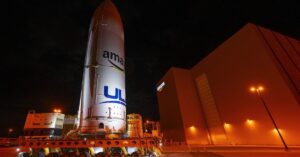
Amazon lost 40 Leo internet satellites on November 15, 2026, when a United Launch Alliance Vulcan rocket failed to reach orbit. The rocket lifted off from Cape Canaveral Space Force Station in Florida at 12:40 p.m. EST, according to Amazon’s mission tracker.
Early findings point to booster underperformance
In a November 17 update, ULA said early indications point to underperformance in the rocket’s main booster shortly after liftoff. According to that preliminary assessment, stage separation occurred too low and too slow for the vehicle to reach orbit.
ULA said telemetry and the mission appear to have been lost about 10 minutes into flight. The Centaur second stage appeared to start normally, and its RL10 engines were operating as planned, but the stage could not recover the performance shortfall.
The company separately said the side-mounted solid rocket boosters appeared to have performed normally. ULA stressed that the investigation is at an early stage and has not published a final root-cause finding.
Vulcan was supposed to accelerate deployment
The loss came on Amazon’s first Vulcan mission, LV-01, which was intended to carry its largest satellite batch so far. Amazon’s November 9 mission preview said its 38 contracted Vulcan launches would deploy more than 1,500 first-generation satellites, close to half the planned constellation.
Amazon had also been preparing its second Vulcan mission in parallel. Before the failure, the company said it expected that flight within weeks of a successful LV-01 mission.
The setback comes despite a growing inventory of completed spacecraft. Amazon’s October 8 manufacturing report said more than 1,000 satellites had been built, compared with 396 deployed across 14 launches. In its November mission preview, Amazon said hundreds of flight-ready satellites were waiting for launch.
Taken together, those figures suggest that replacing the lost spacecraft is only part of Amazon’s challenge. Deploying its existing inventory also depends on reliable launch access.
FAA requires an investigation
The U.S. Federal Aviation Administration required a ULA-led mishap investigation on November 16. The regulator said it will oversee the work and approve the final report, including any corrective actions.
The FAA also activated two Debris Response Areas during the failed launch, briefly slowing some aircraft or holding them at their departure airports. Those areas are activated when unplanned debris falls outside the aircraft hazard areas already closed for a launch.
The FAA’s statement did not set a return-to-flight date. A restart depends on the agency’s public-safety determination, although its procedures allow clearance before an investigation is complete if the required safety and licensing conditions are met.
Ariane 6 remains the next planned launch
As of November 17, Amazon’s mission tracker and Arianespace’s announcement still list LE-04 for no earlier than November 23, 2026. The Ariane 64 mission is planned to carry 36 Leo satellites from the Guiana Space Centre in Kourou, French Guiana. Arianespace says the final launch window will be set closer to the mission.
Amazon says the satellites will need health checks, orbit raising and commissioning before they can provide service. Successful deployment would bring the number delivered by Arianespace for Amazon to 136, according to the launch provider.
Image credit — Amazon.
Get new small business insights by email
Practical ideas and useful articles to help you make better business decisions.
Tech Help Canada Staff researches, writes, and reviews practical content for business owners and professionals. Our coverage spans business, marketing, SEO, technology, and the tools and systems people use to grow and operate online. We focus on clear, useful information backed by research, hands-on experience, and editorial review. Learn more about our team and editorial standards. Need help with something? Contact Us