
You can still gain more followers on X without following people just to get a follow back, but the way you do it has changed. The For You feed, recommendations, replies, reposts, search, trends, and profile visits all shape whether new people find you and decide you’re worth following.
That last part is the piece most people skip. A follower is not just a number. A follower is someone choosing to see more from you later.
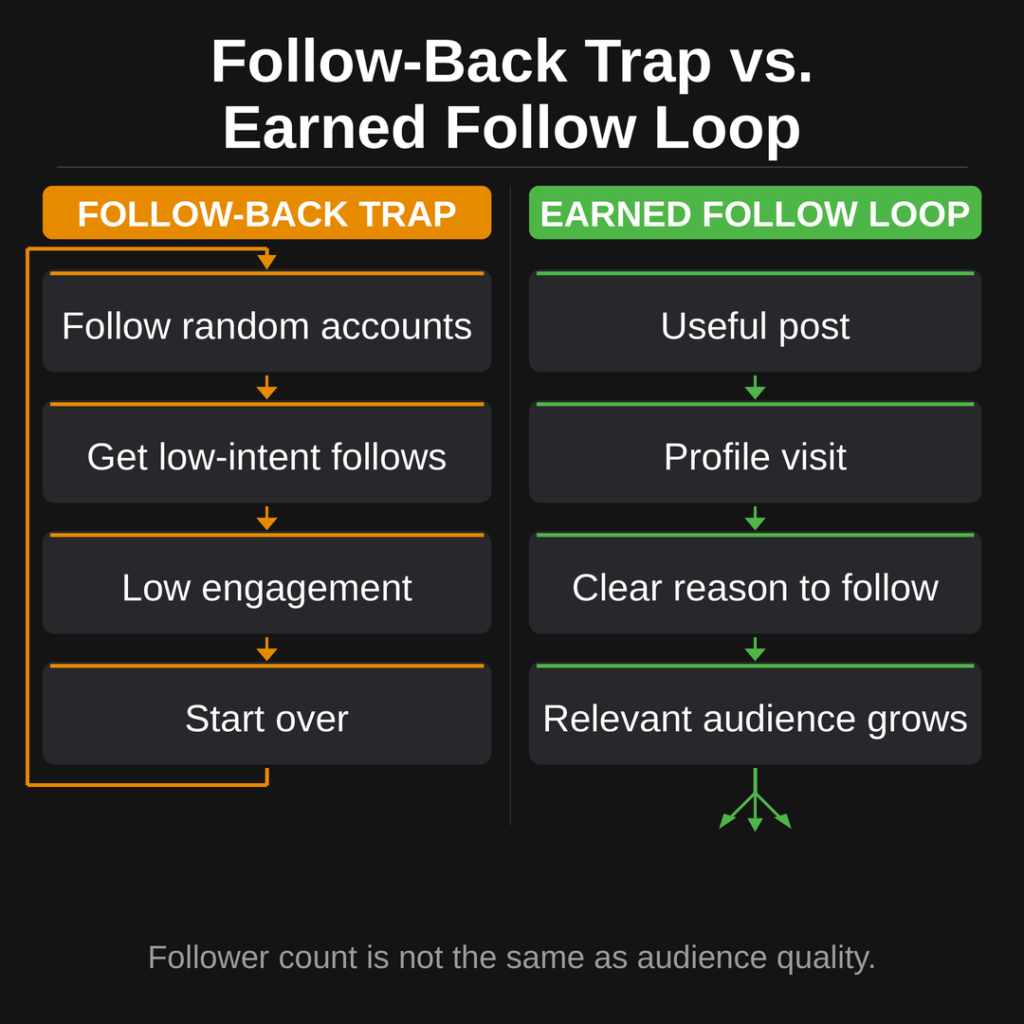
If your strategy is based on following random accounts and hoping they follow back, you’re not building demand. You’re creating a shaky audience full of people who may not care about your work, your business, or your ideas. It can inflate the follower count, but it doesn’t automatically create attention, trust, clicks, leads, or customers. The better goal is simple: become easy to understand, useful to the right people, and visible in the conversations where those people already spend time.
Why follow-for-follow is the wrong game
Follow-for-follow sounds easy because it turns audience growth into a mechanical task. Follow 100 accounts, get some follows back, repeat. The problem is that it attracts people who are also trying to grow mechanically, which gives you an audience with weak intent.
X also has rules that make aggressive follow tactics a bad bet. X says every account can follow up to 400 accounts per day, but follow ratios start to apply after an account follows 5,000 accounts. X also prohibits follow churn, indiscriminate following, copying another account’s followers through automation, and services or apps that claim to add followers.
So the issue is not only that follow-for-follow is a weak growth strategy. It can also create platform risk. Even if you never hit a limit, the bigger problem remains: people who follow you only because you followed them first are less likely to engage, repost, click, buy, or remember you. You want followers who made a choice.
What follower growth on X actually means
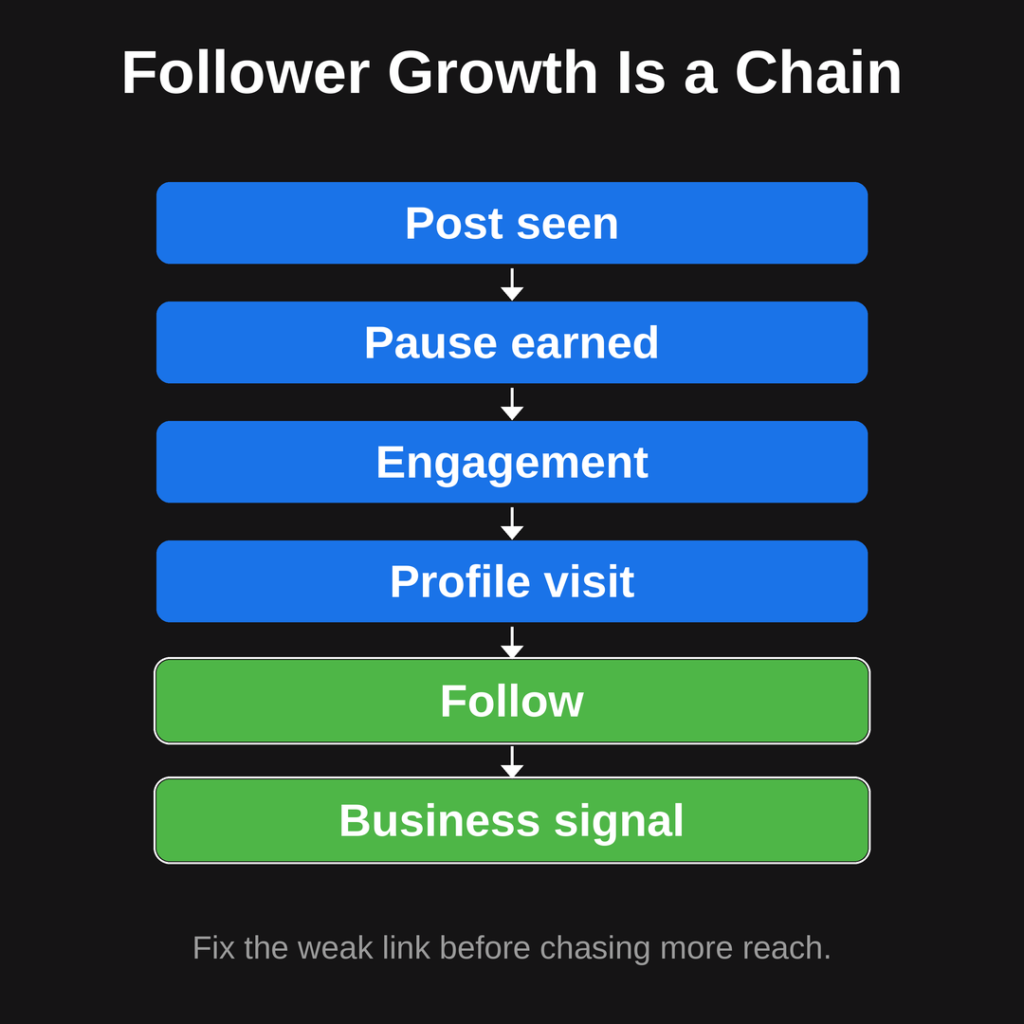
Follower growth on X comes from a chain of smaller decisions. Someone sees a post. The first line earns a pause. The post earns a reaction, reply, repost, click, bookmark, or profile visit. The profile confirms what you’re about. Then the person follows because they want more. Follower growth is a system, not one tactic.
| Growth signal | What it tells you |
|---|---|
| Impressions | Your posts are getting seen |
| Engagement | People care enough to act |
| Profile visits | A post made someone curious about you |
| Follow rate | Your profile convinced some of those people to subscribe |
| Replies from relevant people | You’re reaching the right audience |
| Reposts from credible accounts | Other people are helping distribute your ideas |
| Link clicks, messages, leads, or sales | Attention is moving toward business value |
If impressions are growing but followers are flat, your posts may be visible but your profile may not be convincing. If profile visits are strong but follows are weak, your positioning may be unclear. If followers grow but nobody engages, you may be attracting the wrong audience.
That is why follower count alone is a poor scorecard. You need to know what created the follow and whether those followers are the kind of people you wanted in the first place.
The current X picture
X still has a large audience, but it is a harder channel than it used to be. DataReportal’s 2026 mid-year update reported that X’s potential global ad reach fell from 611 million in April 2024 to 450 million in April 2026, based on figures from X’s own planning tools. DataReportal also reported that X had 99.0 million users in the United States and 9.74 million users in Canada in late 2025, based on advertising resources. Those ad-reach numbers are not the same as monthly active users, but they help show the size of the reachable audience.
Socialinsider’s 2026 social media benchmarks, based on analysis of 70 million posts across major platforms, put X at the lowest average engagement rate among the analyzed platforms, around 0.10% by followers through recent quarters. Pew Research Center also found that X remains heavily tied to news and current events. In its 2024 research, half of X users said they regularly get news on the site, and 65% said news is at least one reason they use it.
That gives you the practical picture:
| Data point | Current signal | How to read the follower-growth signal |
|---|---|---|
| Global X ad reach | 450 million in April 2026 | The audience is still large, but reported reach has fallen |
| U.S. X ad reach | 99.0 million in late 2025 | The U.S. remains a major market for X |
| Canada X ad reach | 9.74 million in late 2025 | Canada still has a sizable reachable audience |
| Average X engagement rate | Around 0.10% by followers | Average brand engagement is low, so relevance matters |
| News as a usage reason | 65% of X users | Timely, useful commentary can still travel |
For small businesses, founders, creators, and professionals, the lesson is not “ignore X.” The lesson is that generic posting has less room to win. You need a reason to be followed.
Build a profile that makes the follow obvious
Before you worry about posting more, fix the moment when someone visits your profile. Your profile should answer three questions fast:
| Question | Your profile needs to answer |
|---|---|
| Who is this for? | The type of person you help, teach, entertain, or inform |
| Why should I follow? | The repeat value people can expect from your posts |
| Can I trust this person or business? | Proof, credibility, useful posts, and a clear identity |
Your bio does not need to be clever. It needs to be clear. If you help restaurant owners improve local marketing, say that. If you write about AI tools for small businesses, say that. If you’re a founder sharing lessons from building a product, say that.
The banner should support the same promise. The pinned post should give visitors a quick sample of your best thinking. Your recent posts should prove the account is active and focused. If your profile looks random, people will treat the follow button like a gamble.
Choose one audience before you chase followers
Most weak X growth advice starts with tactics: post more, use hashtags, reply to large accounts, join trends. Those tactics can help, but only after you know who you’re trying to attract. If you want to gain more followers without following back, your content has to pull the right people toward you, which means you need a clear target audience before you write the next post.
Ask yourself:
- Who should follow this account?
- What decisions are they trying to make?
- What do they already care about?
- What do they complain about?
- What do they want explained, challenged, simplified, or proven?
- What should they associate with you after seeing 10 posts?
The tighter the audience, the easier it is to write posts that feel relevant. A broad account has to be interesting to everyone. A focused account only has to be useful to the right people.
Create content lanes people can recognize
A person is more likely to follow when they can predict the kind of value they’ll get next. Every post does not need to sound the same, but your account does need recognizable lanes. For a business or professional account, three to five lanes is usually enough.
| Content lane | Example |
|---|---|
| Teaching | “Here is how to diagnose weak landing-page conversions” |
| Point of view | “Most businesses don’t have a traffic problem. They have a trust problem.” |
| Proof | Screenshots, results, examples, before-and-after lessons |
| Commentary | Useful takes on platform changes, industry news, or customer behavior |
| Behind the work | What you’re testing, learning, building, fixing, or noticing |
Content lanes help followers understand what they’re signing up for. They also make your account easier to remember. If every post is a new personality, people may enjoy one post and still have no reason to follow.
Write posts that create a follow moment
People follow when a post does more than fill the feed. It gives them a reason to think, “I want more of this.” That usually happens when a post does at least one of these things:
| Post type | Why it earns follows |
|---|---|
| A useful explanation | The reader learns something they can use |
| A sharp point of view | The reader recognizes a belief they share or want to explore |
| A practical framework | The reader gets a mental model they can reuse |
| A specific example | The reader sees proof, not theory |
| A timely interpretation | The reader understands something happening right now |
| A strong reply | The reader finds you inside a conversation they already care about |
This is where the first line carries a lot of weight. If the first line is vague, the post has to work too hard. If the first line creates recognition, tension, or curiosity, the rest of the post gets a chance.
Weak:
“Here are some social media tips.”
Stronger:
“If your posts get impressions but no followers, your content may be interesting but your profile is not convincing.”
The stronger version names a specific problem and creates a reason to keep reading. If you want sharper openings, this copywriting hooks guide can help you write first lines that earn attention without relying on cheap bait.
Use replies as distribution, not spam
Replies are one of the best ways to get discovered on X, but only if you use them with judgment. Replying to large accounts with “great post” will not build much. Replying with a useful example, a respectful counterpoint, a clarifying question, or a short practical addition can get the right people to check your profile.
X’s own rules warn against duplicated, unsolicited replies posted across many accounts, so do not turn replies into spam. Use replies where you can add something:
- A missing example
- A useful data point
- A simple explanation
- A personal lesson
- A customer-facing angle
- A question that moves the conversation forward
The goal is to make people curious, not to hijack the thread.
Use current conversations without chasing every trend
X is still a strong platform for news, commentary, and public conversations. That creates follower-growth opportunities when you have something useful to add, but relevance has to come first. If you’re a cybersecurity consultant, a major software vulnerability is relevant. If you’re a restaurant owner, a food delivery platform fee change may be relevant. If you’re a designer, a major UX change from a large platform may be relevant.
You do not need to post about every trending topic. You need to notice the conversations your audience already cares about and add a useful angle before the moment passes.
That can mean:
- Explaining what changed
- Showing who is affected
- Correcting a bad assumption
- Sharing what a business owner should check
- Turning the news into a practical decision
This works because people do not only follow accounts that entertain them. They follow accounts that help them understand what is going on.
Treat hashtags as labels, not a growth engine
Hashtags can help with context, discovery, events, campaigns, and live conversations. They will not save weak content. Use hashtags when they help the reader or connect the post to a relevant discussion, and skip them when they make the post look desperate.
For most business accounts, one to three relevant hashtags is enough when hashtags make sense at all. A post stuffed with broad tags like #business, #marketing, #success, #growth, and #entrepreneurship does not look more strategic. It looks less specific, and specificity wins on X because people follow accounts that feel tuned to their interests.
Repost and quote post with a reason
Reposting can help you stay present, but an account that only reposts other people can feel empty. Quote posts are usually stronger because they let you add judgment, so do not quote post just to say “this.”
Add something useful:
- “This is true, but only if…”
- “The part small businesses should notice is…”
- “Here is the operational version of this…”
- “This is a good example of…”
- “The risk is not the headline. It is…”
When you add context, people are not only seeing what you shared. They’re seeing how you think, and that is what earns follows.
Turn your best ideas into repeatable assets
If you want this to become a stronger growth channel, stop thinking only in single posts. Create ideas people can reference, such as:
- A checklist
- A short benchmark table
- A diagnostic matrix
- A before-and-after example
- A mini case study
- A recurring weekly thread
- A teardown
- A simple decision tree
These assets can earn reposts because they give people something useful to pass along. They can also send people back to your profile because the asset makes your expertise easier to see. This is also how X can support your broader social media strategy. One useful asset can become a post, a thread, a LinkedIn update, a newsletter section, a blog visual, a short video, and a sales conversation starter.
Share your X account outside X
You do not have to grow only inside the platform. If you already have attention somewhere else, use it. Add your X profile where it naturally fits: your website, email signature, newsletter footer, podcast notes, webinar slides, YouTube descriptions, LinkedIn profile, and author bio.
You can also promote specific posts when they deserve more attention. If you write a strong post that summarizes a useful lesson, send people to that post, not just your profile.
Many of your best future followers may already know you somewhere else. They just have not been given a reason to follow you on X. If you are promoting articles, guides, or resources across multiple channels, this guide on how to promote an article can help you build a smarter distribution habit around your best work.
Paid promotion can help, but do not buy followers
There is a difference between promoting useful content and buying follower count. X’s rules call out services and apps that claim to add followers. Avoid them. Paid followers, fake followers, and low-quality follower packages can make an account look bigger while weakening the signals that actually help your business.
If you use paid promotion, promote posts that already show promise. A post with strong replies, reposts, profile visits, or link clicks may deserve a small paid push. A post that nobody cared about organically probably needs a better idea, not a larger budget. Use paid reach to amplify useful proof, not to cover weak positioning.
A simple X follower quality scorecard
Use this scorecard before you celebrate follower growth.
| Signal | Weak version | Stronger version |
|---|---|---|
| New followers | Random accounts with no fit | People in your target audience |
| Engagement | Likes from low-relevance accounts | Replies, reposts, and bookmarks from relevant people |
| Profile visits | People visit and leave | Profile visits turn into follows |
| Reposts | Generic reposts | Reposts from accounts your audience trusts |
| Link clicks | Curiosity clicks with no next step | Clicks that lead to signups, messages, calls, or sales |
| Replies | “Nice post” comments | Questions, objections, examples, and buyer signals |
If your follower count grows but the stronger signals do not move, your audience may be getting bigger without becoming more useful.
A 30-day plan to gain more followers without following back
Give yourself 30 days to test the system.
| Week | Focus | What to do |
|---|---|---|
| Week 1 | Fix the profile | Rewrite your bio, update the banner, pin a strong post, and define three content lanes |
| Week 2 | Publish with intent | Post one useful idea per day and test different formats: short post, thread, image, quote post, and reply |
| Week 3 | Join relevant conversations | Leave thoughtful replies on accounts your audience already follows |
| Week 4 | Measure and repeat | Review impressions, engagement, profile visits, follows, replies, reposts, link clicks, and messages |
At the end of the month, do not only ask, “How many followers did I gain?” Ask:
- Which posts drove profile visits?
- Which posts earned follows from relevant people?
- Which replies brought the right audience back to your profile?
- Which topics earned reposts?
- Which posts produced clicks, messages, leads, or useful conversations?
Then repeat what worked and cut what only made you feel busy.
What to stop doing
Some X follower-growth advice should be retired:
- Stop following hundreds of accounts just to get attention.
- Stop using apps that promise followers.
- Stop stuffing posts with broad hashtags.
- Stop posting only links to your own content.
- Stop replying with empty compliments.
- Stop copying viral formats that do not fit your audience.
- Stop measuring success only by follower count.
Growth gets easier when the account becomes clearer.
Followers are a consequence
You do not gain meaningful followers on X by chasing the follow button. You gain them by giving the right people repeated evidence that you’re worth hearing from again.
Your profile has to make sense. Your posts have to give people a reason to pause. Your replies have to add something. Your point of view has to become recognizable. Your strongest ideas have to travel beyond the people who already follow you. You can still grow without following back, but you have to earn the follow before you ask the follower count to move.
Frequently Asked Questions
Can you still gain followers on X without following back?
Yes. You can still gain followers without following people back, but the account has to give people a clear reason to subscribe. That means a focused profile, useful posts, relevant replies, recognizable topics, and content that makes the right people want more from you.
Is follow-for-follow allowed on X?
X prohibits abusive follow behavior, including follow churn, indiscriminate following, automated bulk following or unfollowing, and services that claim to add followers. Beyond the rules, follow-for-follow usually builds a weak audience because many of those people are not following because they care about your content.
How often should you post on X to gain followers?
There is no perfect posting frequency for every account. A useful starting point is one strong post per day, supported by thoughtful replies in relevant conversations. Quality and fit matter more than volume. Posting more only helps when the posts give the right people a reason to respond or follow.
Do hashtags help you gain followers on X?
Hashtags can help when they connect your post to a relevant event, topic, campaign, or live conversation. They are not a growth strategy by themselves. For most business accounts, one to three relevant hashtags is enough when hashtags make sense at all.
What should you measure besides follower count?
Measure impressions, engagement, profile visits, follow rate, replies from relevant people, reposts, bookmarks, link clicks, messages, leads, and sales. Follower count can show growth, but it does not tell you whether the audience is useful to your business.
Should you pay to get more X followers?
You should not buy followers or use services that promise follower growth. If you use paid promotion, promote posts that already show strong organic response from the right audience. Paid reach works best when it amplifies useful content, not when it tries to make a weak account look bigger.
References
- https://help.x.com/en/using-x/x-follow-limit
- https://help.x.com/en/rules-and-policies/x-rules-and-best-practices
- https://help.x.com/en/rules-and-policies/recommendations
- https://datareportal.com/reports/digital-2026-mid-year-global-update-report
- https://datareportal.com/reports/digital-2026-united-states-of-america
- https://datareportal.com/reports/digital-2026-canada
- https://www.socialinsider.io/social-media-benchmarks
- https://www.pewresearch.org/journalism/2024/06/12/x-users-experiences-with-news/

I can suggest related Tech Help Canada articles based on the topic you’re reading now.

Tech Help Canada Staff researches, writes, and reviews practical content for business owners and professionals. Our coverage spans business, marketing, SEO, technology, and the tools and systems people use to grow and operate online. We focus on clear, useful information backed by research, hands-on experience, and editorial review. Learn more about our team and editorial standards. Need help with something? Contact Us