You don’t get long to prove the next line is worth reading. Chartbeat data cited by Time found that 55% of visitors spent fewer than 15 seconds actively on a page, while Gloria Mark’s research puts average attention on any screen at 47 seconds.
Those numbers already tell the story.
That’s the world your copy lives in. In content marketing, the headline gets the click, but your hook decides whether they stay. And it’s why the hook — the first line or idea that earns the next sentence — isn’t something you can improvise. It’s the single highest-leverage line in anything you write.
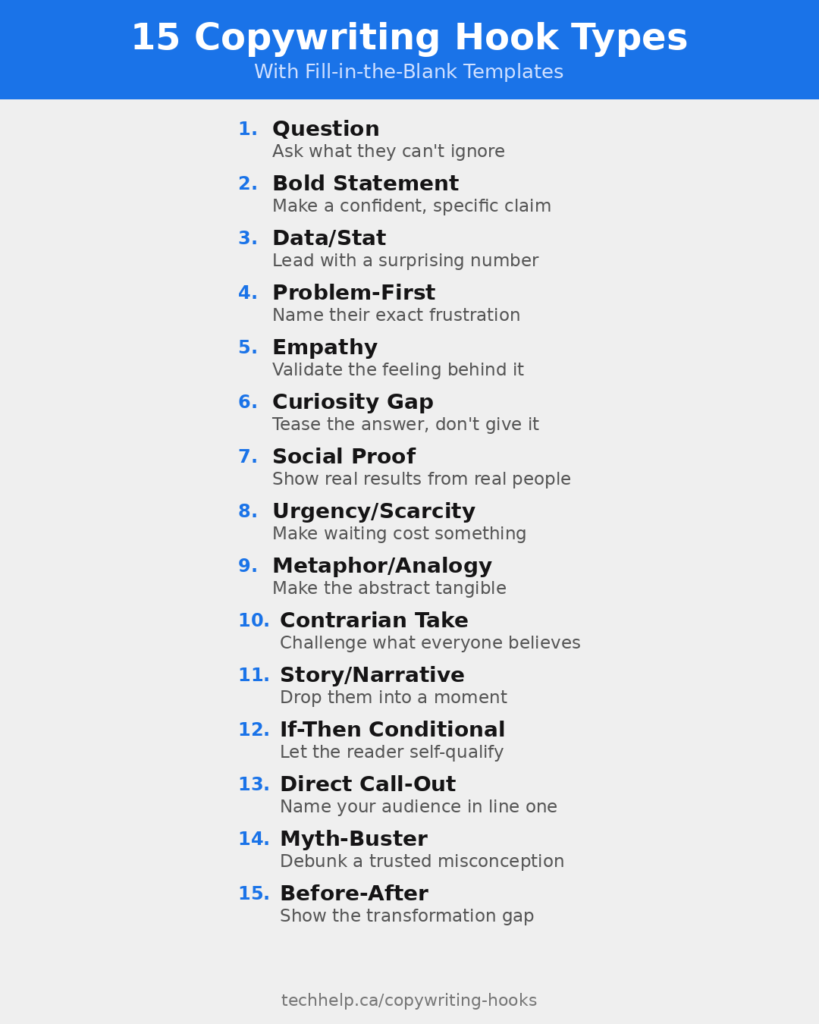
You’re about to get 15 hook types that consistently stop the scroll, each with a fill-in-the-blank template you can adapt in minutes. Plus the psychology behind why each one works, side-by-side makeovers showing weak hooks turned strong, and a framework for choosing the right hook for every platform and situation.
A hook is the opening line, sentence, or idea that pulls your reader into your copy. Its job is simple: earn the next sentence. If it does that, everything else gets a chance. If it doesn’t, nothing else matters.
The term comes from fishing — and the analogy holds. You’re not trying to catch every fish in the lake. You’re trying to catch the right one. A great hook doesn’t appeal to everyone. It speaks directly to a specific person’s curiosity, frustration, or desire.
But a hook isn’t just a clever opening. Clever lines that don’t connect to what follows are clickbait — and clickbait burns trust fast. A real hook is relevant. It promises something the reader cares about, and the content behind it delivers.
It’s also not limited to headlines. Hooks live in email subject lines, social media captions, blog intros, landing page headers, video openings, ad copy, and even calls to action. Anywhere your reader makes a split-second decision to stay or leave, that’s where a hook earns its keep.
And these decisions are getting faster. A well-written headline can swing traffic dramatically; Upworthy co-founder Peter Koechley told Wired that headline tests can show differences of 20%, 50%, even 500%. In email, current reporting citing Campaign Monitor puts personalized subject-line lift around 26%, while segmented campaigns can generate 30% more opens and 50% more click-throughs. The first line isn’t just important — it’s doing the heaviest lifting of any line in your copy.
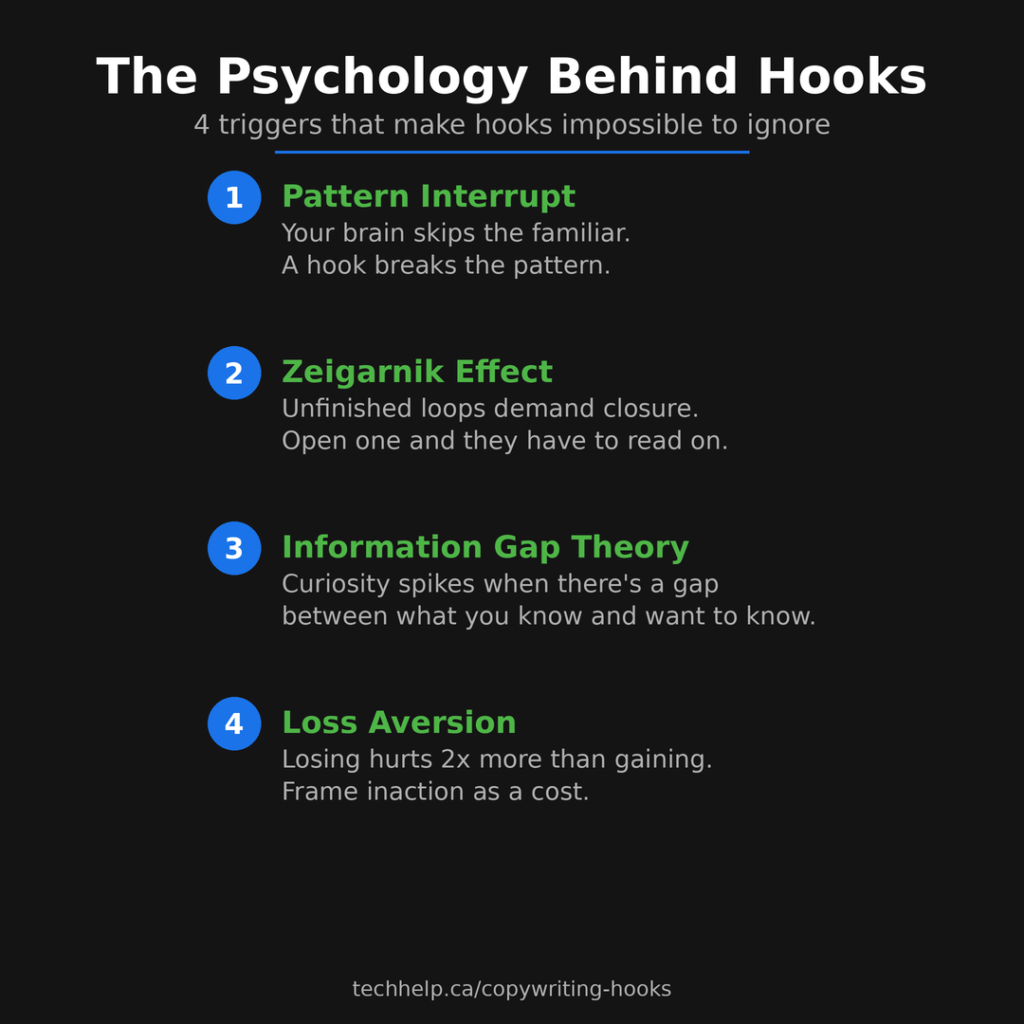
The Psychology Behind Hooks That Work
Hooks aren’t magic. They work because they exploit specific patterns in how your brain processes information. Understanding these patterns won’t just make you a better hook writer — it’ll help you diagnose why a hook falls flat and fix it.
Pattern Interrupt
Your brain is constantly filtering out the familiar. It matches what it sees against existing patterns and skips anything that fits. A hook works by breaking that pattern, presenting something unexpected enough that your brain can’t filter it out.
This is why “How to Improve Your Marketing” is invisible, but “Your Marketing Strategy Has a $50,000 Blind Spot” stops you. The first matches a thousand things you’ve already scrolled past. The second doesn’t fit any pattern, so your brain flags it.
The Zeigarnik Effect
In the 1920s, psychologist Bluma Zeigarnik discovered that people remember unfinished tasks far better than completed ones. Your brain treats an open loop like an itch it needs to scratch.
This is the engine behind every curiosity gap, every cliffhanger, every “here’s what happened next.” When a hook opens a loop — “The email mistake costing you 40% of your replies” — your brain won’t let it go until you close it.
Information Gap Theory
Psychologist George Loewenstein formalized this in 1994: curiosity spikes when there’s a gap between what you know and what you want to know. The key word is want. The gap has to feel relevant and close enough to be worth closing.
“There are 15 types of copywriting hooks” creates a small gap. “One of these 15 hook types outperforms the others by 3x in cold ads” creates a much larger one. The difference is specificity and stakes.
Loss Aversion
Kahneman and Tversky’s research showed that losing something is roughly twice as painful as gaining something of equal value. That asymmetry is what separates “Don’t let your competitors steal your best customers” from “Win more customers than your competitors.” Same idea, different framing, very different response.
Hooks that frame the reader’s inaction as a loss — missed revenue, wasted time, falling behind — tap into this asymmetry. It’s not about fear-mongering. It’s about reflecting a reality your reader already suspects.
The strongest hooks layer two or three of these triggers at once. “I almost deleted the campaign that 3x’d our revenue” combines a pattern interrupt (unexpected confession), an open loop (what happened?), and loss aversion (they almost lost something valuable). That combination is what makes it nearly impossible to scroll past.
15 High-Impact Hook Types With Templates
Before you pick a hook type, run it against five qualities. Does it feel relevant to what the reader cares about right now? Does it create an emotional response (curiosity, recognition, urgency, relief)? Is it clear enough that the reader doesn’t have to reread it? Does it disrupt the pattern of whatever they were scrolling through? And does it open a loop that the rest of your content closes?
Not every hook needs all five. But the best ones hit at least three.
1. The Question Hook
A question pulls the reader into an internal dialogue before they’ve consciously decided to engage. The best questions don’t have obvious answers — they challenge an assumption or make the reader confront something they’ve been avoiding.
When to use it: Opening a topic that’s personal, relatable, or slightly uncomfortable.
Why it works: Your brain is wired to answer questions reflexively. A well-framed question creates an information gap you can’t ignore.
Template: “[Provocative or unexpected question about reader’s situation]?”
Example: “What would your revenue look like if every landing page converted at twice its current rate?”
Strongest in: Blog intros, email subject lines, social media captions.
2. The Bold Statement
A bold statement comes out swinging. It makes a confident, sometimes provocative claim that positions you as someone with a strong point of view. The key: you have to back it up. Boldness without substance erodes trust faster than anything.
When to use it: Establishing authority, differentiating from the crowd, or disrupting consensus thinking.
Why it works: A confident claim forces a reaction. The reader either agrees (and wants validation) or disagrees (and wants to argue). Either way, they keep reading.
Template: “[Strong claim that challenges what the reader currently believes or does].”
Example: “Most businesses don’t have a traffic problem. They have a conversion problem pretending to be a traffic problem.”
Strongest in: Blog intros, LinkedIn posts, landing page headlines, thought leadership.
3. The Data/Stat Hook
Numbers give your claim weight. A well-placed statistic can do in one line what three paragraphs of explanation can’t. It makes the problem (or opportunity) feel real and measurable.
When to use it: Highlighting a problem, establishing credibility, or making an opportunity feel urgent and concrete.
Why it works: Specific numbers are a pattern interrupt in a sea of vague claims. They also trigger the information gap — the reader wants to know the context behind the number.
Template: “[Specific number or percentage] of [relevant group] [surprising outcome or behavior].”
Example: “73% of shopping carts get abandoned before checkout, and most businesses have no recovery strategy in place.”
Strongest in: Blog intros, email subject lines, ad headlines, landing pages.
4. The Problem-First Hook
Lead with a problem your reader already knows too well. When they see their exact frustration spelled out, it signals: “this person gets it.” They’ll keep reading to see what you recommend.
When to use it: When your audience is actively looking for solutions and wants to feel understood before being sold.
Why it works: Naming a specific pain point creates instant recognition. The reader self-selects — if this is their problem, they’re in.
Template: “[Specific frustration your audience experiences regularly].”
Example: “You’re spending hours writing email sequences that get a 2% open rate — and you’re not sure what’s going wrong.”
Where the problem-first hook names the issue, the empathy hook validates the feeling behind it. It says: “I know this is hard. I’ve been there.” This builds trust before you’ve offered a single solution.
When to use it: When your audience feels overwhelmed, frustrated, or stuck — and needs to know they’re not alone before they’re ready to hear advice.
Why it works: Emotional validation lowers defensiveness. When someone feels understood, they’re more open to what comes next.
Template: “You’ve [struggled with X]. You’ve tried [common solutions]. And you’re starting to wonder if [fear or doubt].”
Example: “You’ve rewritten that homepage three times. Each version felt right until you published it. And the bounce rate didn’t budge.”
This is the classic open loop. You tease a piece of information (a result, a technique, a revelation) without giving it away. The reader has to keep reading to close the gap.
When to use it: When you have a genuine insight, result, or story to share — and the reveal is strong enough to justify the tease.
Why it works: The Zeigarnik Effect and information gap theory working together. Your brain can’t leave the loop open.
Template: “The [unexpected method/discovery] that [desirable result] — and why [common approach] won’t get you there.”
Example: “The one-word change that turned a 1.2% click-through rate into 4.7%. It had nothing to do with the offer.”
Strongest in: Blog headlines, YouTube titles, email subject lines, social media posts.
7. The Social Proof Hook
Using real numbers, real names, or real results from other people creates instant credibility. Readers trust other users more than they’ll ever trust your sales pitch.
When to use it: When you have strong results, testimonials, or user numbers — and your audience’s primary objection is “does this actually work?”
Why it works:Social proof reduces uncertainty. If thousands of others made this choice, the perceived risk drops.
Template: “[Specific number] [people/companies] have [achieved result] using [method/product].”
Example: “11,000 freelancers use this proposal template — and their close rate averages 42%.”
A deadline or limited supply triggers faster decisions. This isn’t about manipulation. It’s about reflecting a genuine constraint that makes acting now more valuable than acting later.
When to use it: Limited-time offers, product launches, seasonal opportunities — situations where waiting genuinely costs the reader something.
Why it works: Loss aversion. The fear of missing out on something available right now is stronger than the desire to have it later.
Template: “[Time constraint or scarcity signal] — [what the reader stands to miss].”
Example: “This pricing disappears Friday at midnight. After that, the annual plan costs $200 more.”
Strongest in: Promotional emails, ad copy, landing pages, flash sale announcements.
A note on authenticity: Fabricated urgency gets spotted fast and destroys credibility. If the deadline isn’t real, don’t use this hook type.
9. The Metaphor/Analogy Hook
A strong metaphor takes an abstract concept and makes it tangible. It gives the reader a mental shortcut: they instantly get what you’re saying because you’ve connected it to something they already understand.
When to use it: Explaining complex products, services, or ideas — especially when your audience isn’t deeply familiar with the topic.
Why it works: Cognitive fluency. The easier something is to understand, the more credible and attractive it feels.
Template: “[Your product/concept] is like [familiar thing] — [key similarity that drives the point home].”
Example: “Your analytics dashboard without event tracking is like driving with a blindfold. You’ll get somewhere — you just won’t know where until you crash.”
Flip the script. Challenge a popular opinion, a common practice, or a piece of conventional wisdom your audience has heard a hundred times. Contrarian hooks work because they promise a perspective the reader hasn’t encountered before.
When to use it: Thought leadership, disrupting a saturated conversation, or when your audience has been following advice that isn’t working.
Why it works: Pattern interrupt meets information gap. The reader thinks they know the answer — and you just told them they don’t.
Template: “Why [popular belief or common practice] is [unexpected negative consequence].”
Example: “Why ‘write every day’ is the worst advice for most freelance copywriters.”
Strongest in: LinkedIn posts, blog intros, podcast episodes, newsletter openers.
11. The Story/Narrative Hook
Stories are the oldest persuasion tool we have. A narrative hook drops the reader into a specific, sensory, human moment and makes them want to see how it ends.
When to use it: When you have a real story (yours, your client’s, your customer’s) that mirrors the reader’s situation or illustrates a lesson.
Why it works: Stories activate multiple brain regions simultaneously — language processing, sensory cortex, motor cortex. They create empathy and emotional investment in a way abstract claims can’t.
Template: “I was [specific situation] when [unexpected thing happened]. [Set up the stakes or tension].”
Example: “I was sitting in a coffee shop rewriting the same Facebook ad for the fourth time when my phone buzzed. The client had pulled the budget.”
This hook lets the reader self-qualify. It presents a condition (“if you’re experiencing X”) and a promise (“then this is for you”). The right reader immediately thinks, “That’s me” — and they’re in.
When to use it: When your audience is segmented and you want to speak directly to a specific subset without alienating others.
Why it works: Self-identification is one of the strongest engagement triggers. When a reader recognizes themselves in the condition, the promise feels personally relevant.
Template: “If you [specific situation or behavior], [promise or reveal].”
Example: “If you’re getting traffic but not conversions, the problem is almost certainly on this one page.”
Strongest in: Ad copy, email segmentation, blog intros targeting specific audiences, course or product sales pages.
13. The Direct Call-Out
Skip the subtlety. Name your audience in the opening line. This works because it cuts through the noise — every other hook is trying to be clever, while you’re just saying, “Hey, this is for you.”
When to use it: When your audience is clearly defined and you want to filter for the right readers immediately.
Why it works: In a feed full of content aimed at “everyone,” a hook that names you by role, industry, or situation feels like a personal message. That specificity cuts through noise the way generic hooks can’t.
Template: “[Specific audience]: [relevant insight, question, or promise].”
Example: “SaaS founders spending over $10K/month on paid acquisition: your CAC is fixable without cutting budget.”
Strongest in: LinkedIn ads, Facebook ad targeting, email subject lines, niche blog content.
14. The Myth-Buster
Take a widely accepted “fact” and debunk it with evidence. This is different from a contrarian take — you’re not offering an opinion, you’re correcting a specific misconception. The reader trusted that information, and you’re about to show them why they shouldn’t have.
When to use it: When a common misconception is leading your audience to make poor decisions — and you have the data or evidence to prove it.
Why it works: Cognitive dissonance. When a trusted belief is challenged with credible evidence, the reader’s brain demands resolution. They have to keep reading.
Template: “You’ve been told [common belief]. [Evidence-based correction].”
Example: “You’ve been told email is dead. Meanwhile, Litmus reports that 35% of companies see $10-$36 back for every $1 spent on email marketing, 30% see $36-$50, and 5% see more than $50.”
Strongest in: Data-driven blog posts, email newsletters, LinkedIn thought leadership, educational content.
15. The Before-After Hook
Show the transformation. Paint a picture of where the reader is now (the “before”) and where they could be (the “after”). The gap between those two states creates desire and momentum.
When to use it: When your content, product, or service creates a clear, tangible transformation — and the before-state is something your reader is currently living.
Why it works: Contrast amplifies value. By placing the current pain next to the future gain, you make the gap feel both urgent and closable.
Template: “[Before state — current pain or frustration]. [After state — the result they want].”
Example: “Last quarter, your team spent 40 hours writing ad copy that converted at 0.8%. This quarter, same team, 10 hours, 3.2% conversion rate. The only difference was the brief.”
Strongest in: Case study intros, sales pages, product launch emails, transformation-driven content.
Weak vs. Strong: Hook Makeovers
Knowing the types is half the equation. The other half is execution. Here are five real-format hooks, each rewritten to show what “strong” actually looks like — and why the weak version missed.
Makeover #1: The Generic Question
Weak: “Want to improve your marketing strategy?” Strong: “What would change if your next email campaign doubled its click-through rate?”
What changed: The weak version is too broad — everyone “wants to improve.” The strong version gets specific (email campaign, click-through rate) and makes the reader picture a concrete outcome.
Makeover #2: The Vague Stat
Weak: “A lot of businesses struggle with customer retention.” Strong: “The average business loses 20% of its customers every year without knowing why. Replacing each one costs 5x more than keeping them.”
What changed: “A lot” does no work. The specific numbers (20%, 5x) create urgency and make the problem feel measurable. The “without knowing why” adds an information gap.
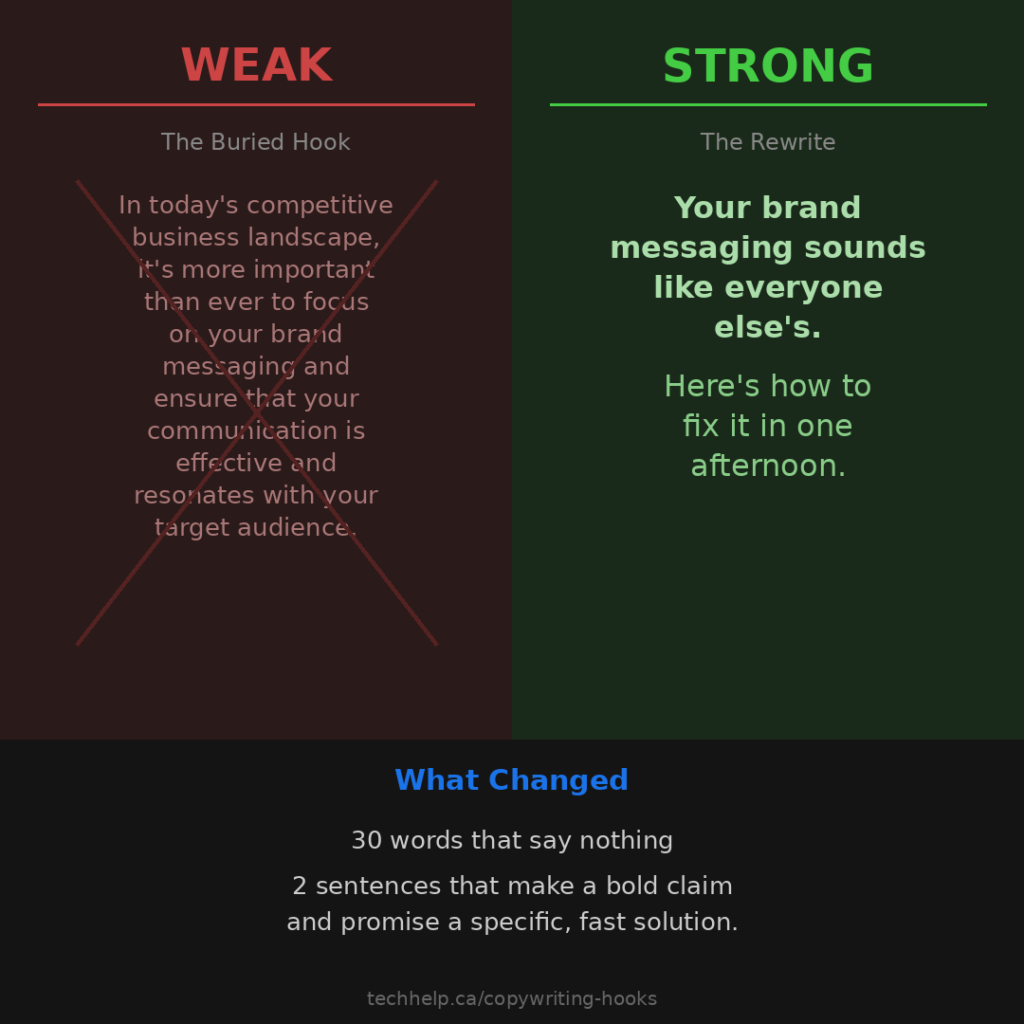
Makeover #3: The Buried Hook
Weak: “In today’s competitive business landscape, it’s more important than ever to focus on your brand messaging and ensure that your communication is effective and resonates with your target audience.” Strong: “Your brand messaging sounds like everyone else’s. Here’s how to fix it in one afternoon.”
What changed: The weak version takes 30 words to say nothing. The strong version makes a bold claim in the first sentence and promises a specific, fast solution in the second.
Makeover #4: The Cliché Empathy Hook
Weak: “We know how hard it can be to run a business.” Strong: “You said yes to another project you didn’t have capacity for. Again. And now it’s 11 PM and the proposal isn’t done.”
What changed: The weak version is generic sympathy that could come from any brand. The strong version paints a specific moment the reader has lived — it mirrors their experience so precisely they feel seen.
Makeover #5: The Overselling Promise
Weak: “This revolutionary system will transform your life and make you rich overnight!” Strong: “The 90-day system that took one agency from $8K months to $35K months — with the same team and the same clients.”
What changed: The weak version is all hype, zero credibility. The strong version uses specific numbers, a realistic timeframe, and grounding details (same team, same clients) that make the claim believable.
Where and When to Use Each Hook
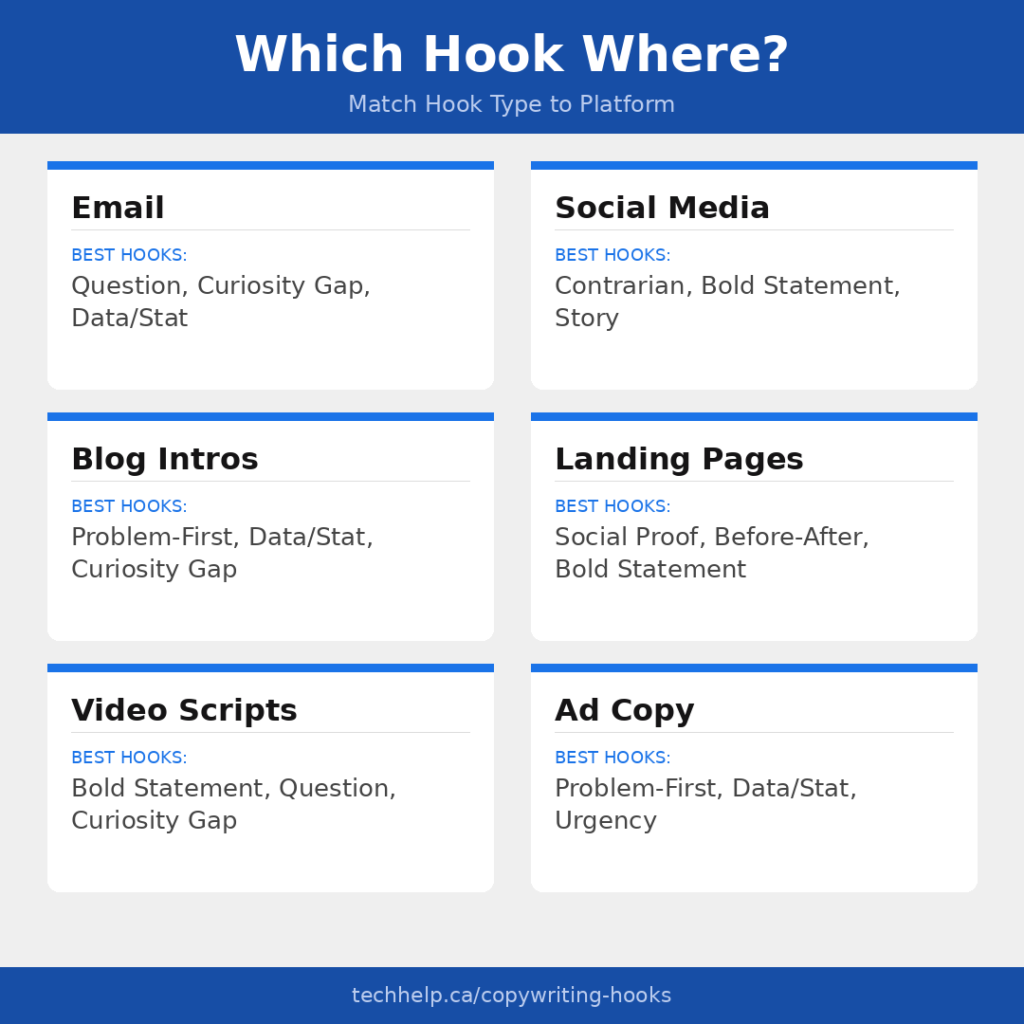
The same hook won’t work everywhere. A story that kills on LinkedIn might die in a subject line. An urgency hook that drives sales in email might feel manipulative in a blog post. Here’s how to match hook to context.
By Platform
Email subject lines demand brevity. You’re working with limited mobile space, and small wording changes can affect opens. Current reporting citing Campaign Monitor puts personalized subject-line lift around 26%, while segmented campaigns can generate 30% more opens and 50% more click-throughs. Question hooks, curiosity gaps, and data hooks tend to outperform here.
Social media is a pattern interrupt contest. You’re competing with photos, videos, and posts from friends. Contrarian takes, bold statements, and story hooks cut through because they don’t look or sound like everything else in the feed. On LinkedIn specifically, direct call-outs perform well because the audience self-selects by industry and role.
Blog intros have a little more room, but the opening still has to earn the next sentence. Chartbeat data cited by Time found that one in three visitors to article pages spent less than 15 seconds reading. Problem-first hooks, data hooks, and curiosity gaps work well here — they set up the rest of the article. The hook should make a promise that the article’s structure fulfills.
Landing pages are conversion environments. Social proof hooks and before-after hooks excel here because visitors are already evaluating whether to take action. Every line should reduce friction and increase confidence.
Video scripts have the tightest window. Facebook and Nielsen research cited by Wired found that up to 47% of a video campaign’s value was delivered in the first three seconds, and up to 74% in the first 10 seconds. Bold statements and questions that create immediate tension work best. Save the story hooks for after you’ve earned the first 10 seconds.
Ad copy varies by temperature. For cold audiences who don’t know you yet, problem-first hooks and data hooks build relevance fast. For warm audiences who’ve engaged before, curiosity gaps and social proof hooks deepen interest. For retargeting, urgency hooks close the loop.
By Funnel Stage
Awareness (top of funnel): Your audience is at the start of their customer journey. They don’t know they have a problem, or don’t know you exist. Use curiosity gaps, data hooks, and bold statements that surface problems or challenge assumptions.
Consideration (middle of funnel): They know the problem and they’re comparing options. Use social proof hooks, before-after hooks, and myth-busters that help them evaluate.
Decision (bottom of funnel): They’re ready to act but need a final push. Use urgency hooks, empathy hooks, and if-then conditionals that make the next step feel inevitable.
How to Write Hooks That Stick
Knowing the types and choosing the right one for the context are two thirds of the work. The last third is craft. Here’s the process.
Start With the Reader’s Pain or Desire
Your hook’s job is to reflect what the reader is already thinking or feeling. Before you write a single word, answer this: what’s keeping them up at night? What do they wish someone would just solve for them? Start there. If your hook is about you or your product first, it’s already lost.
Write 10+ Versions Before Committing
Your first draft is warm-up. The hook you publish should rarely be the first one you wrote. Write at least 10 versions — play with different types, different angles, different levels of specificity. The strongest option usually shows up around version 7 or 8, after the obvious ideas are out of your system. To speed up this step, use CopyHub to generate hook variations for ads, emails, landing pages, and social posts before choosing the version worth testing.
Use Sensory and Emotional Words
Words like “sting,” “blind spot,” “exposed,” and “finally” create a visceral reaction. They don’t describe — they make the reader feel. Choose words that mirror the reader’s emotional state. If they’re frustrated, use frustrated language. If they’re ambitious, use ambitious language.
Cut Until It Hurts
Long hooks die on mobile. Aim for under 15 words when you can. Every word in your hook should be load-bearing. If you can remove it without losing meaning, remove it. Punchy doesn’t mean shallow. It means efficient.
Mirror Your Audience’s Language
Read your audience’s reviews, support tickets, forum posts, and social comments. Pay attention to the exact phrases they use to describe their problems. Then use those phrases in your hooks. When a reader sees their own language reflected back, the hook feels personal — even if thousands of people are reading the same line.
Read It Out Loud
A hook should have rhythm. If you stumble over it when reading aloud, your reader will stumble over it mentally. Listen for awkward phrasing, unnecessary syllables, and places where the energy drops. The best hooks flow naturally and build toward a punch.
Test Against Real Metrics
Instinct only gets you so far. A/B test your hooks against each other and track what moves: click-through rates for ads and emails, scroll depth for blog posts, view-through rates for video. Patterns emerge fast. Double down on what’s working. Cut what isn’t.
Hook Mistakes That Kill Engagement
Even experienced writers fall into these traps. They’re subtle enough to feel right in the moment — and costly enough to tank your results.
Clickbait Without Payoff
A curiosity gap is powerful. A curiosity gap that leads to a letdown is destructive. If your hook promises a revelation and the content delivers something obvious or unrelated, you’ve just taught your audience not to trust your next headline. The rule: the bigger the hook’s promise, the stronger the payoff needs to be.
Burying the Hook After a Preamble
“Before we get into it, let me provide some context…” — and you’ve already lost them. Your hook belongs in the first sentence, not after a warm-up paragraph. Context can come second. Attention can’t wait.
Recycling the Same Hook Type Everywhere
If every email you send opens with a question, your audience will stop registering the pattern. If every blog post leads with a stat, the stats lose their punch. Vary your hook types across platforms and content pieces. Pattern disruption only works if there’s a pattern to disrupt.
Over-Promising What the Content Delivers
“This one trick will 10x your revenue” sets an expectation nothing short of a money printer can satisfy. Over-promising attracts clicks and erodes credibility. Match your hook’s intensity to what’s actually inside. Specificity without exaggeration always outperforms hype.
Great copy always starts with the first line. The rest of your message — your story, your offer, your call to action — only gets a chance if that first line earns the reader’s attention. Test your hooks. Measure what works. And remember: the goal isn’t to trick people into reading. It’s to give them a genuine reason to stay.
Frequently Asked Questions
How do I know if my hook is working?
Track the metrics that sit closest to the hook’s job. For email, that’s open rates and click-through rates. For blog posts, it’s scroll depth and time on page. For ads, it’s click-through rate and cost per click. For video, it’s 3-second and 30-second retention rates. If you’re testing two versions of a hook (and you should be), give each version enough volume to produce meaningful data — at least a few hundred impressions — before declaring a winner.
What tone should I use when writing hooks?
Match the tone to your brand and your audience’s current emotional state. A playful, informal hook works well for lifestyle brands and creative professionals. A direct, data-driven hook fits B2B and technical audiences better. The one universal rule: sound human. Hooks that feel robotic, overly polished, or corporate rarely stop the scroll.
Can I use humor in copywriting hooks?
Humor can be a powerful differentiator when it fits your audience. A clever or unexpected line disarms readers and makes your message stick. The risk: humor that misses feels awkward, and humor that’s unrelated to your message is a distraction, not a hook. If the punchline doesn’t connect back to the reader’s problem or your solution, cut it.
How long should a hook be?
The shorter, the better — but clarity always beats brevity. For email subject lines, aim for 6-10 words (28-50 characters). For social media, keep hooks under 125 characters before the “more” truncation. For blog intros, you can extend to 1-2 sentences. The real measure isn’t word count. It’s whether every word is earning its place.
Do hooks work differently for B2B vs. B2C?
The psychology is the same — curiosity, loss aversion, social proof, and pattern interrupts work on everyone. What changes is the specificity and the stakes. B2C hooks often tap into personal emotions (frustration, desire, fear of missing out). B2B hooks tend to emphasize business outcomes (revenue, efficiency, competitive advantage) and credibility (data, case studies, named companies). A B2B hook that says “SaaS companies with over 10,000 users are switching to this retention model” is doing the same psychological work as a B2C hook that says “Over 50,000 runners swear by this training plan” — social proof, audience targeting, and implied results.
We empower people to succeed through practical business information and essential services. If you’re looking for help with SEO, copywriting, or getting your online presence set up properly, you’re in the right place. If this piece helped, feel free to share it with someone who’d get value from it. Do you need help with something? Contact Us