Content writing services can cost less than $0.10 per word at the low end or more than $1.00 per word for specialist work. The difference isn’t only writing quality. Scope, research, strategy, editing, subject expertise, and project management all affect the price.
A cheap quote can become expensive if your team has to rebuild the brief, correct factual errors, or rewrite the draft. A higher quote can also be poor value when the provider adds services you don’t need. The best choice is the one that fits your goals, workflow, and internal capacity.
Use the following criteria to compare deliverables, understand common pricing models, and spot warning signs before you commit.
What content writing services include
Content writing services cover written material that helps a business attract, educate, or retain an audience. The exact deliverables depend on the provider.
Blog posts and SEO articles
Blog posts and SEO articles answer questions people search for and help a business build topical authority. A strong article can continue attracting qualified traffic after publication, although rankings and traffic aren’t guaranteed.
Website copy
Website copy includes homepages, about pages, service pages, location pages, and other core pages that explain what a business offers. These projects are often sold as web content writing services or website content services. The word count may be lower than a blog project, but each page has to support navigation, trust, and conversion. Our guide to website content writing explains how those elements work together.
Product descriptions and ecommerce content
Product descriptions and ecommerce content help shoppers understand what a product does, who it’s for, and why it may be a good fit. The work can range from short catalogue descriptions to detailed product pages that address objections.
Long-form assets
Long-form assets include white papers, case studies, ebooks, reports, and original research. These projects often require interviews, data review, subject-matter expertise, and more editorial work, so they tend to cost more than standard blog posts.
Email sequences and ad copy
Email sequences and ad copy are designed to move readers toward a specific action. Some content writing companies offer this work, while others treat it as a separate copywriting service.
Content for agencies
Content for agencies may include white-label blog posts, landing pages, service pages, or client campaigns. It often comes with extra requirements, such as matching several brand voices, working inside an agency’s project system, and meeting client approval deadlines.
What you should get beyond a draft
A finished document is only one part of a professional service. Ask which of the following steps are included in the quoted price.
Strategy and briefing: The provider should understand the audience, business goal, desired action, brand voice, and place of the piece within your broader content marketing strategy. Some providers create the brief. Others expect you to supply it.
SEO preparation: SEO content creation services may include keyword research, analysis of search intent, competitor review, topic clustering, headings, title tags, and meta descriptions. Ask which tasks are included instead of assuming that “SEO optimized” covers all of them.
Research and expert input: A good process identifies claims that need support, uses reliable sources, and incorporates interviews or internal expertise when the topic demands it. This is especially important in finance, health, law, cybersecurity, and other fields where mistakes carry higher risks.
Editing and quality assurance: At minimum, the work should receive a substantive edit, a factual review, and a final proofread. Those checks should happen in separate passes, whether they’re completed by another editor or by the original writer. Ask how the provider checks originality, links, citations, and AI-assisted material.
Publishing support: Some providers deliver a document. Others upload the article, format it in your content management system, add internal links, source images, and schedule publication. These services save internal time but should be stated in the scope.
Performance review: Reporting may include rankings, organic traffic, engagement, leads, or conversions. A writing provider doesn’t control every factor behind those results, but reviewing performance creates a feedback loop for future work.
Content writing vs. copywriting
Content writing usually focuses on education, trust, and sustained attention. Blog posts, guides, and thought-leadership articles help readers understand a problem and become familiar with the business that can solve it.
Copywriting focuses more directly on action. A landing page, sales email, or advertisement is written to earn a sign-up, purchase, booking, or another conversion.
The two disciplines overlap. A useful article still needs a clear angle and a relevant next step. A sales page still needs enough useful information to earn trust. Some providers handle both, while others specialize. Choose based on the work you need rather than the label on the service.
What content writing services cost in 2026
Writing prices vary by subject, format, research load, turnaround time, and the experience of the person doing the work. Published benchmarks are useful for orientation, but they aren’t fixed market prices.
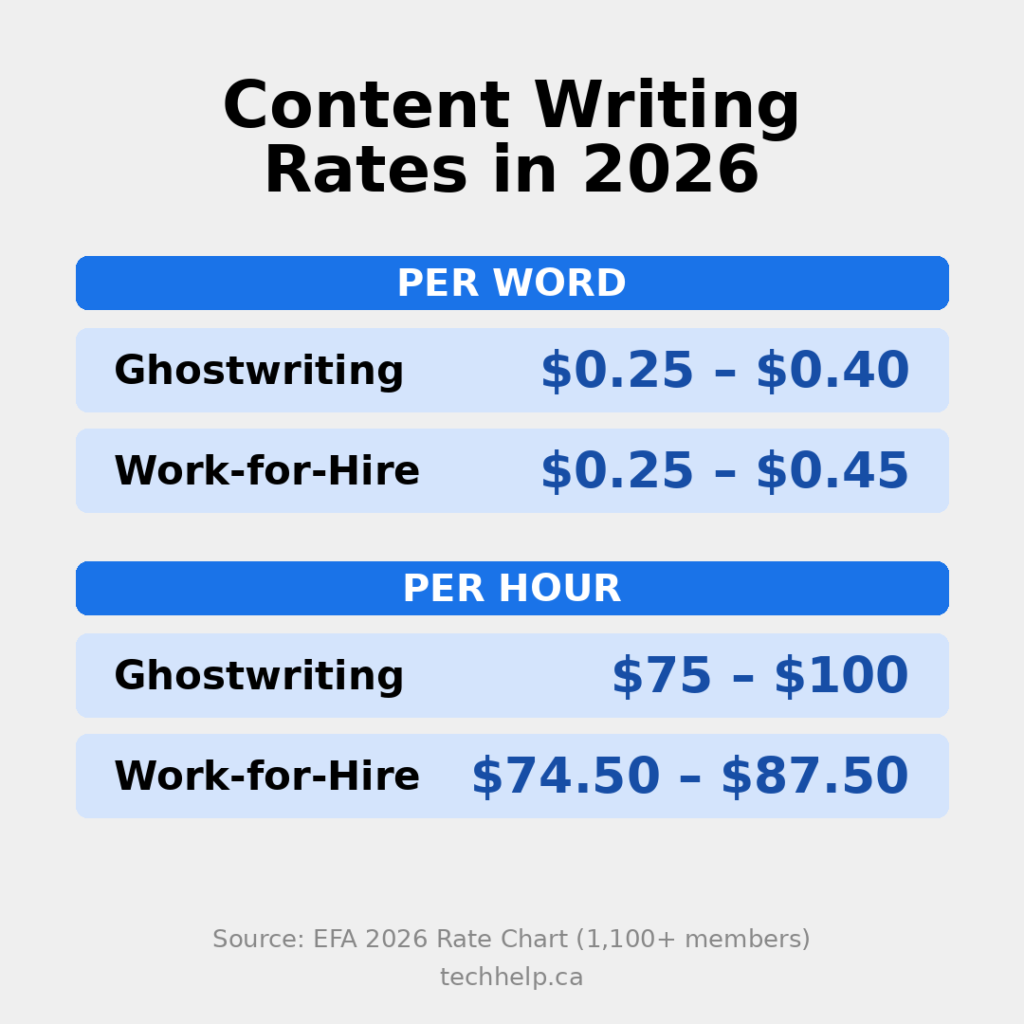
Per-word pricing is easy to compare, but it can hide differences in scope. The Editorial Freelancers Association’s 2026 rate chart is based on responses from more than 1,100 members about work completed in 2025. Its median ranges for blog-post writing were $0.25 to $0.40 per word for ghostwriting and $0.25 to $0.45 for work-for-hire. The EFA doesn’t set or recommend rates, and individual quotes may fall outside those ranges.
Hourly pricing works well for consulting, interviews, editing, and assignments whose scope may change. In the same EFA survey, median hourly ranges for blog-post writing were roughly $75 to $100 for ghostwriting and $74.50 to $87.50 for work-for-hire.
Per-project pricing gives both sides a defined cost for a defined scope. The quote should specify length, research, interviews, SEO work, revision rounds, deadlines, and deliverables. Project pricing is often easier to manage than counting words when the value lies in strategy or expertise.
Retainers reserve ongoing capacity for a monthly fee. They can work well when you publish consistently, but the agreement should explain how unused capacity, rush work, revisions, and scope changes are handled.
SEO writing services may cost more when the provider also handles content planning, search analysis, internal linking, optimization, or reporting. Specialist topics also command higher rates because they require deeper knowledge and more rigorous review.
The provider’s business model affects the quote too. An agency may include project management, multiple specialists, and backup capacity. A freelancer may offer direct access to the person doing the work and a leaner workflow. Neither option is automatically better or cheaper. Compare the people, process, and deliverables behind the price.
How to evaluate a content writing service
Review relevant samples
Industry experience can shorten the learning curve, but topic familiarity alone isn’t enough. Look for accurate reasoning, clear structure, useful examples, and a voice that fits the intended audience.
Ask who will do the work
The person on the sales call may not be the writer or editor assigned to your account. Find out who researches, writes, edits, and approves each piece. If subject-matter review is promised, ask who provides it.
Examine the briefing process
A strong provider asks about the reader, business goal, desired action, brand voice, sources, competitors, and boundaries before drafting. Vague inputs usually produce generic work.
Clarify the SEO scope
SEO content services can range from inserting a supplied keyword to developing an entire search-led content plan. Ask how the provider assesses intent, avoids keyword stuffing, selects internal links, and measures performance.
Check the research standard
Ask what sources the team prefers, how it verifies statistics, and what happens when reliable evidence isn’t available. A provider should be willing to soften or remove a claim that can’t be supported.
Confirm revisions, ownership, and confidentiality
The agreement should state how many revision rounds are included, what counts as a scope change, when ownership transfers, and how confidential information is handled.
Start with a paid test
One representative assignment reveals more than a long proposal. Evaluate the brief, communication, draft quality, fact-checking, revisions, and whether your team had to do unexpected work after delivery.
Red flags to take seriously
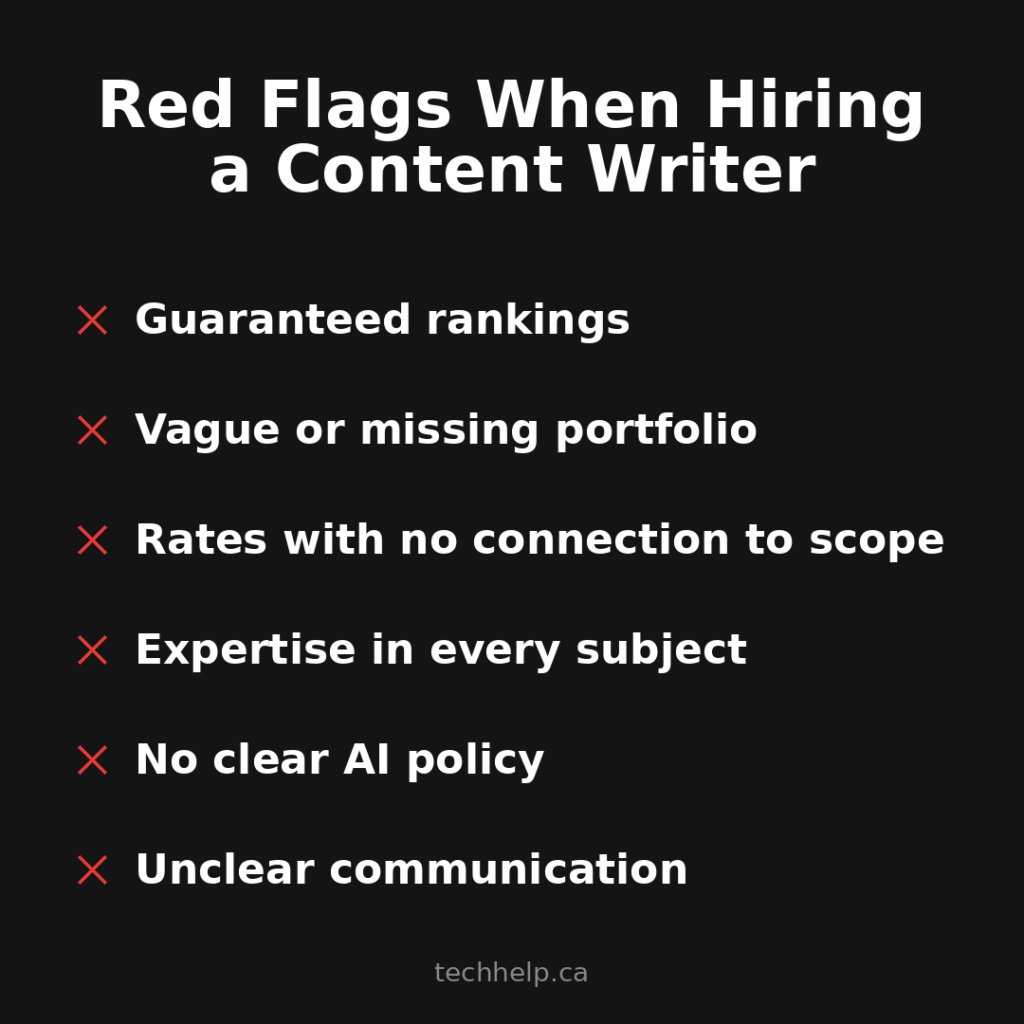
Guaranteed rankings: No provider controls Google’s results. Content quality matters, but rankings also depend on competition, site authority, technical health, backlinks, search intent, and other factors. A credible provider can explain its process and show past results without promising a specific position.
A vague or missing portfolio: New providers may have limited public samples, especially when client work is confidential. They should still be able to explain their process, provide anonymized examples, or complete a paid test.
Rates with no connection to scope: A low price isn’t automatically a problem. It becomes one when the provider promises extensive research, strategy, editing, and specialist expertise without enough time or budget to deliver them.
Expertise in every subject: Versatile writers can work across industries. Be cautious when a provider claims deep expertise in every field but can’t show how it researches unfamiliar topics or works with specialists.
No clear AI policy or human review: The provider should be able to explain where AI is used, what information enters those tools, and how a person verifies the result. This is especially important when projects contain confidential information or consequential claims.
Unclear communication and deadlines: The agreement should name the main contact, expected response times, milestones, and what happens when either side causes a delay.
How to assess the return on content
Content can create value long after the invoice is paid, but broad industry benchmarks can’t predict the return from a specific article.
An Omnibound 2026 research roundup cites organic search as the source of 53% of trackable website traffic. DemandSage reports that B2B businesses with blogs generate 67% more leads than those without. These are broad benchmarks, not forecasts for a specific company. Your results will depend on the offer, competition, site quality, distribution, sales process, and how well the content answers the reader’s question.
Set the measurement plan before production starts. Useful metrics may include qualified organic traffic, newsletter sign-ups, demo requests, sales-assisted conversions, influenced revenue, rankings for relevant queries, or links earned from other sites. Page views alone rarely show whether the content supported a business goal.
SEO content also needs time. New pages may take months to gain traction, and some never do. Review early signals, update useful pieces as information changes, and improve or retire content that consistently fails to serve readers or the business.
How AI fits into content writing services
AI can speed up research organization, outlining, first drafts, repurposing, and editing. It can also produce factual errors, generic phrasing, weak reasoning, and privacy risks when used without care.
Google’s current guidance focuses on helpful, reliable, people-first content rather than whether a person or an AI produced the first draft. Google also says using automation primarily to manipulate search rankings violates its spam policies. Its E-E-A-T framework is a way to assess signals of experience, expertise, authority, and trust. E-E-A-T itself isn’t a single ranking factor.
For many teams, a practical workflow uses AI for selected production tasks and people for strategy, original insight, source verification, brand voice, and final approval. The right balance depends on the subject and the risk of getting it wrong.
Ask potential providers four questions:
Where do you use AI in the workflow?
Does client information enter third-party AI tools?
Who verifies facts, sources, and originality?
Can you work without generative AI when a project requires it?
A provider’s willingness to answer clearly is more useful than a blanket claim that it uses AI for everything or never uses it at all.
When to outsource and when to hire in-house
Outsourcing is common. A 2026 DemandSage roundup reports that half of marketers outsource at least some content marketing. The right model still depends on the work.
Outsource when you need flexible capacity, specialist knowledge, or a defined set of deliverables without adding a permanent role. It works best when someone inside the business can supply context and approve the work.
Hire in-house when the writer needs frequent access to internal teams, proprietary information, customers, or a fast-changing product. A full-time role can also make financial sense when the workload is steady enough to justify it.
Use a hybrid model when your internal team wants to own strategy and quality control while external writers handle production. This is also a common approach to content writing for agencies, where the agency keeps the client relationship and editorial direction while a white-label partner supplies capacity.
Strong briefs make every model work better. Give the writer the target audience, business goal, desired action, brand guidance, required sources, subject-matter contacts, and approval process. CopyHub gives you another option: it works like a professional copywriter and produces complete copy. You can publish the finished draft as is or pass it to your team for further review.
Choose the provider behind the promise
The strongest content writing company for your business isn’t necessarily the cheapest, largest, or most specialized. It has a process you can understand, people you trust, evidence relevant to your needs, and a scope that matches the price.
Review samples, ask who will do the work, inspect the research and editing process, and start with a paid test. Those steps expose weak providers before a long contract does.
If you want SEO strategy, conversion-focused writing, and transparent rates in one service, explore Tech Help Canada’s copywriting services.
Get new small business insights by email
Practical ideas and useful articles to help you make better business decisions.
Tech Help Canada Staff researches, writes, and reviews practical content for business owners and professionals. Our coverage spans business, marketing, SEO, technology, and the tools and systems people use to grow and operate online. We focus on clear, useful information backed by research, hands-on experience, and editorial review. Learn more about our team and editorial standards. Need help with something? Contact Us