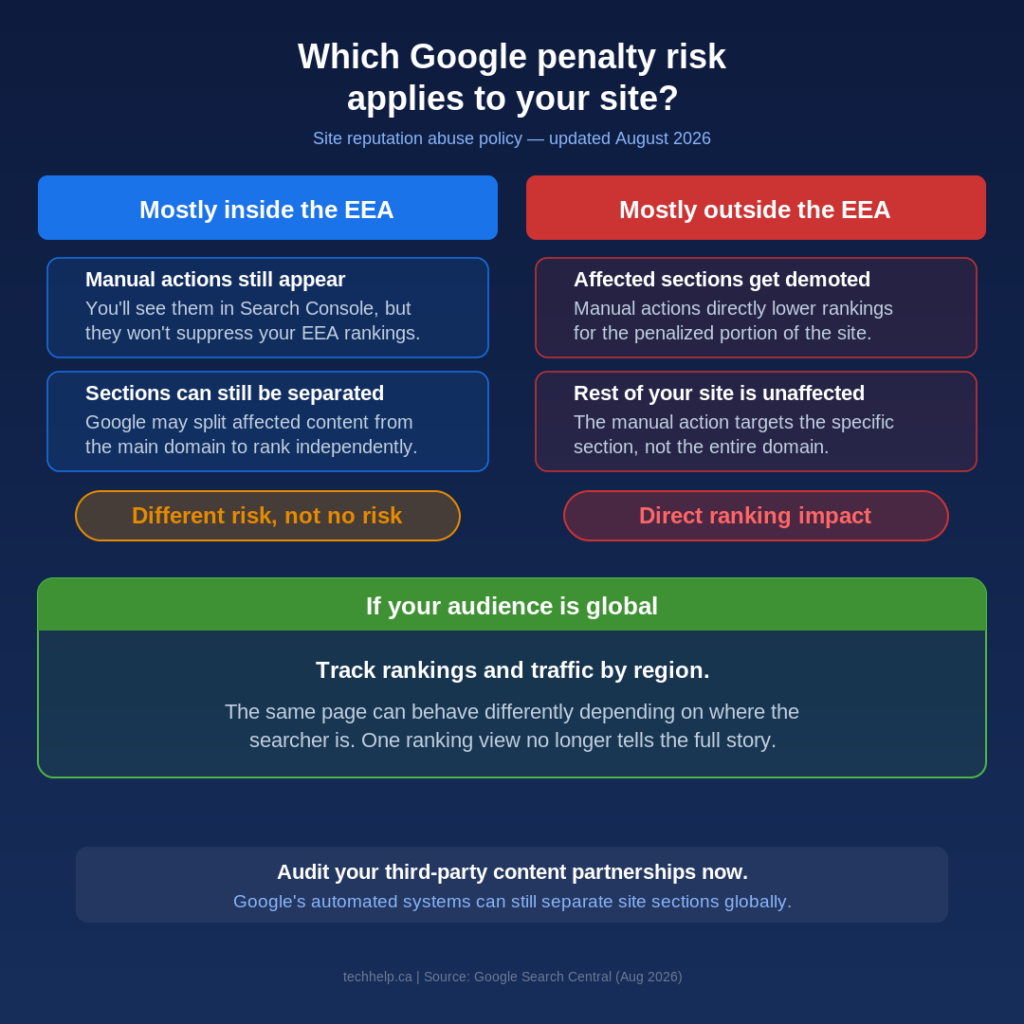
Google’s site reputation policy now has a regional fault line.
Starting August 30, 2026, a manual action under that policy can still demote affected pages for searchers outside the European Economic Area. For searchers inside the EEA, Google says the manual-action impact will not apply. The same page can carry a manual action in Search Console and avoid that specific ranking penalty for European search results.
That is a narrow change, but it creates a practical problem for publishers, affiliate teams, media brands, and businesses that rely on partner content: SEO risk now depends partly on where the audience searches from.
The policy still exists. Google still says it is targeting third-party content that uses a trusted domain’s ranking strength to perform better than it could on its own. What changed is enforcement, and only in one region.
The policy still exists in Europe
Google announced the change on August 28 after discussions with the European Commission. The new approach begins August 30.
Outside the EEA, the old manual-action outcome remains. If reviewers decide a section violates the site reputation policy, Google can directly affect the affected portion of the site in search results. The rest of the site is supposed to remain separate from that action.
Inside the EEA, Google says the impact of that manual action will not apply. Instead, the affected section may be separated in Google’s systems so that, over time, it ranks independently from the rest of the host domain.
Europe’s change still leaves Google room to classify and separate the content. A publisher can receive a Search Console notice, file a reconsideration request, and, if eligible in the EEA, move a dispute to mediation after that request.
The difference is what happens in the results. Outside the EEA, the manual action can push the affected section down. Inside the EEA, Google is leaning on separation rather than the direct manual-action impact.
Google is still targeting borrowed authority
Site reputation abuse is Google’s term for third-party pages published on a host site mainly because the host has already-earned ranking signals.
The simple version: someone wants their content to rank better, so they put it on a stronger domain.
That can show up as coupon sections, casino pages, loan pages, product roundups, “best of” pages, sponsored content, or white-label partnerships where the host brand gives the content a ranking advantage it would not have on its own site.
Google introduced the policy in March 2024, alongside other spam changes, and later clarified in November 2024 that first-party involvement does not automatically protect a page. A media company cannot solve the issue just by saying its editors had some input.
Google also leaves room for legitimate partnerships. Its spam policy specifically allows editorial work, syndicated news, user-generated content, native advertising that serves readers directly, and pages that use affiliate links appropriately.
For small businesses and publishers using affiliate marketing as a revenue stream, the warning is specific. The risk is lower when the page earns trust on its own and higher when it appears to exist mainly to borrow the host site’s authority.
The EU fight is about publisher revenue
The European Commission opened a Digital Markets Act investigation into Google on November 13, 2025. The Commission said it was looking at whether Google’s site reputation enforcement demoted media publishers and other publishers when their sites included content from commercial partners.
That tension drives the policy fight.
Google views the practice as a search quality issue. European regulators are asking whether enforcement also restricts legitimate publisher monetization, partnership models, and access to Google Search under fair, reasonable, and non-discriminatory terms.
The pressure is not theoretical. On July 23, 2026, the Commission fined Google 890 million euros for separate DMA breaches tied to self-preferencing in Search and steering restrictions in Google Play. That fine did not decide this site reputation investigation, but it shows the enforcement environment Google is operating in.
So the August 28 announcement is more than a Search Console update. It is a live example of search quality rules being reshaped by regional platform regulation.
Your risk now depends on where searchers are
A website with a global audience now has to think in two layers.
The first layer is policy exposure. Google can still issue a site reputation manual action. That notice can still appear in Search Console. If your audience is mostly in Canada, the United States, the U.K., Australia, or other non-EEA markets, the EEA change does not protect that traffic.
The second layer is performance exposure. A page could be treated differently for searchers inside and outside the EEA. Google said a page may have a manual action where the change only affects search results outside the EEA.
That means ranking reports, traffic drops, and recovery stories may get harder to interpret. A section could regain visibility in European search while remaining suppressed elsewhere. Or it could keep visibility in Europe because the manual-action impact does not apply, while Google’s systems gradually separate it from the main site and make it compete more directly on its own merits.
For SEO teams, the work becomes more operational. The same content partnership may need different monitoring for different regions. If you already track the SEO ranking factors that make a page credible, useful, and technically discoverable, add geography to that review.
How to audit third-party content now
Start with every section on your site that is not fully produced by your own team. Coupon hubs, sponsored guides, partner marketplaces, white-label directories, product reviews, financial offers, education pages, and local service roundups all deserve a closer look.
Then ask whether the page would make sense without the host domain’s authority. If the answer is no, the page is sitting in the risk zone.
Google says reviewers consider several signals together. They look at whether the content is integrated with the rest of the site, whether the design and user experience match the host, whether quality is consistent, whether authorship and editorial responsibility are clear, and whether the same or near-identical content appears across multiple sites.
That gives site owners a practical checklist:
Map every third-party or partner-produced section.
Separate audience geography for each section, especially EEA versus non-EEA traffic.
Confirm who wrote, edited, approved, and maintains the content.
Check whether the page matches the quality and usefulness of the rest of the site.
Review disclosures, sponsorship labels, and affiliate link treatment.
Search for near-duplicate versions of the same content on other domains.
Watch Search Console for manual actions, even if the affected pages serve EEA users.
Document why the content exists for readers, not just for rankings.
For publishers, this is also a business contract issue. If a partner owns the copy, controls updates, distributes the same page to multiple sites, or keeps editorial responsibility vague, the SEO risk should be visible before the agreement goes live.
The change is narrow, but the signal is not
The EEA update does not make site reputation abuse safe. It changes the penalty mechanics for one region.
Still, the signal is hard to miss. Google Search is now being pulled between two pressures: fighting low-value ranking manipulation and satisfying regulators who view some publisher partnerships as legitimate business activity.
For business owners, the safest response is to make every partnership page defensible on its own. If the content has clear ownership, real editorial value, useful information, and a reason to exist beyond the host site’s authority, it is easier to defend in any region.
If it only works because it borrowed someone else’s reputation, the regional carve-out is not much of a strategy. It is a temporary advantage in one market and an unresolved risk everywhere else.
Frequently asked questions
What changed in Google’s site reputation policy in the EEA?
Beginning August 30, 2026, manual actions under Google’s site reputation policy have a different ranking effect by searcher location. Outside the EEA, the manual action can affect the relevant portion of a site. Inside the EEA, that manual-action impact does not apply, though Google may treat the affected section separately over time.
Does Google still send Search Console notices for these manual actions?
Yes. Google says site owners will continue to receive Search Console notices when a manual action is applied. Site owners can submit a reconsideration request, and eligible EEA sites may move disputes to mediation after that request.
What is site reputation abuse?
Google uses the term for third-party pages published on a host site mainly to exploit that host site’s established ranking signals. The issue is borrowed authority, not the mere presence of third-party content.
Are affiliate reviews and sponsored content against Google’s policy?
No. Google says affiliate links, native advertising, syndicated news, editorial work, and user-generated content are not automatically site reputation abuse. The risk increases when the content exists mainly to manipulate rankings rather than serve readers.
What should publishers check after Google’s EEA update?
Publishers should audit third-party sections by audience geography, editorial control, disclosure, content quality, duplicate use across sites, and Search Console notices. If a section depends on the host domain’s authority to rank, it needs a deeper review.
Get new small business insights by email
Practical ideas and useful articles to help you make better business decisions.
Tech Help Canada Staff researches, writes, and reviews practical content for business owners and professionals. Our coverage spans business, marketing, SEO, technology, and the tools and systems people use to grow and operate online. We focus on clear, useful information backed by research, hands-on experience, and editorial review. Learn more about our team and editorial standards. Need help with something? Contact Us