On July 20, 2026, the White House signed three proclamations that would put a 50% tariff on a broad range of Canadian goods entering the United States.
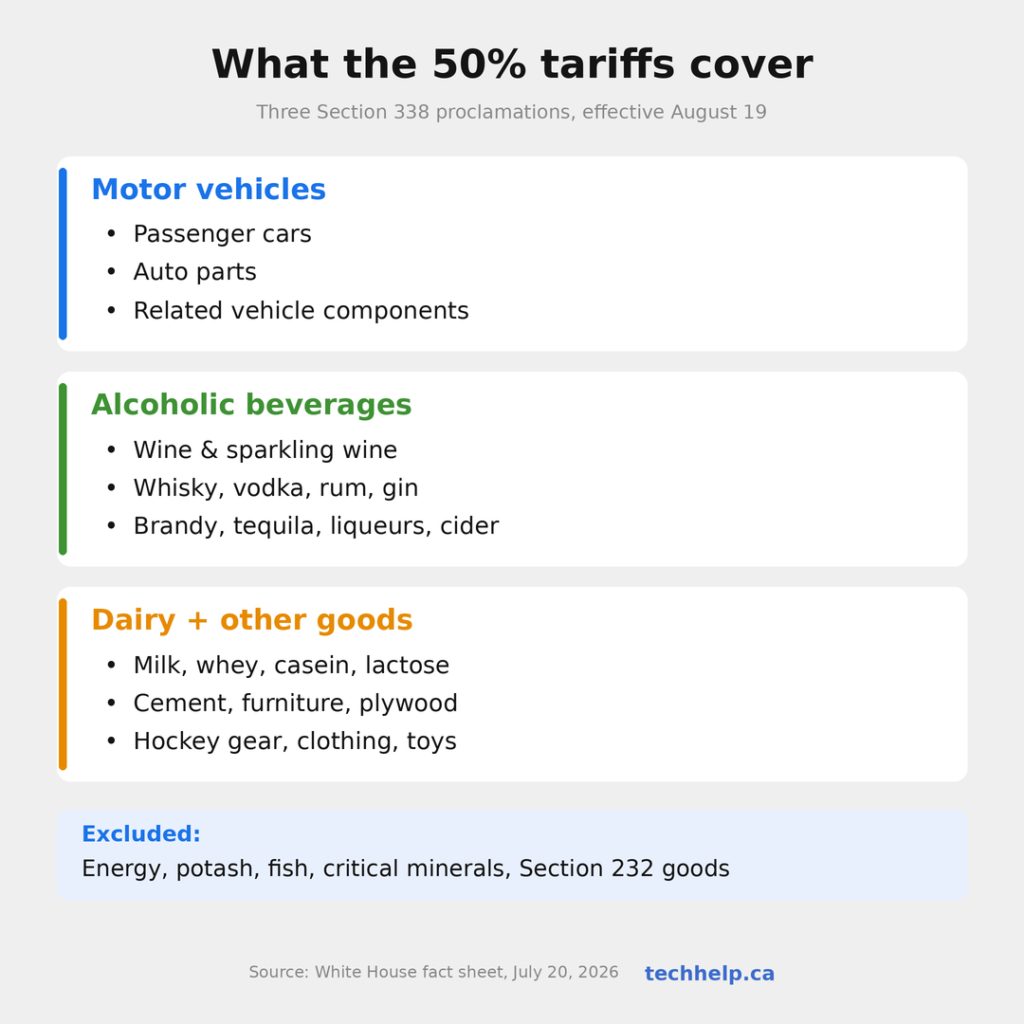
The tariffs are scheduled to take effect on August 19, 2026. They target Canadian goods tied to U.S. complaints about autos, alcohol, and dairy, but the product lists reach beyond those headline sectors. The White House fact sheet pointed to examples ranging from wine to hockey sticks to cement, and the duties apply to covered goods even if they qualify under USMCA.
USTR said the measures cover nearly US$20 billion in imports from Canada. AP, citing Desjardins, reported that the affected exports are worth about C$28 billion annually.
For Canadian businesses, this is more than another round of political noise. If you sell into the U.S., supply a company that does, price against cross-border alternatives, or rely on a North American supply chain, the next few weeks are a pricing, cash flow, and contract risk problem.
What changed on July 20
The White House framed the move as a response to Canadian treatment of U.S. autos, alcoholic beverages, and dairy products. Each proclamation uses Section 338 of the Tariff Act of 1930, a rarely used authority that allows the president to impose duties of up to 50% when another country is found to discriminate against U.S. commerce.
The three proclamations cover different sets of Canadian imports. One focuses on motor vehicles. One focuses on alcoholic beverages. One focuses on dairy. The White House fact sheet says the package covers products ranging from wine to hockey sticks to cement, so businesses shouldn’t rely on the headline category alone.
The broad exclusions are also important. According to the White House, the new Section 338 duties won’t apply to energy, potash, goods already subject to Section 232 tariffs, and certain other products, including fish and critical minerals.
That still leaves many businesses exposed. The safest move is to check your Harmonized Tariff Schedule codes against the proclamation annexes, not against a summary article or a product category label.
Why this round hits differently
Canadian businesses have been dealing with U.S. tariffs since 2025, but this round is different for one reason: USMCA status doesn’t shield covered goods.
Earlier tariff actions created separate rules for goods that did or didn’t qualify under the U.S.-Mexico-Canada Agreement. The White House’s July 20 fact sheet says these Section 338 tariffs apply to all covered goods regardless of whether a product originates under USMCA.
That change removes a layer of certainty many exporters had been using for planning. A product can meet the agreement’s rules of origin and still face the new 50% duty if it’s listed in the tariff annex.
The timing also adds pressure. On July 1, the United States declined to renew USMCA in its current form during the agreement’s six-year review. The pact remains in force, but it now moves into annual reviews unless the three countries agree to extend it. That keeps the trade framework alive, but it weakens the planning horizon for businesses that need supplier contracts, plant investments, and customer pricing to hold for more than a few months.
The U.S. case and Canada’s response
The White House gave three main reasons for the tariff package.
On autos, it says Canada has imposed tariff and quota treatment on U.S. motor vehicles that disadvantages U.S. commerce compared with imports from other countries. The White House said Canadian imports of U.S. motor vehicles fell about 22%, or $5.6 billion, from April 2025 through March 2026 compared with the previous year.
On alcohol, it pointed to provincial and territorial restrictions on U.S. alcoholic beverages after the trade conflict escalated in 2025. The White House said Canadian imports of U.S. alcoholic beverages fell about 81%, or $582 million, from March 2025 through February 2026 compared with the same period a year earlier.
On dairy, it argued that Canada’s tariff-rate quota rules treat U.S. cheese less favorably than comparable EU cheese under CETA.
Prime Minister Mark Carney called the planned tariffs a direct violation of CUSMA and said Canada has already made detailed proposals to resolve the dispute and modernize the agreement. After speaking with President Trump, Carney said both sides agreed to intensify negotiations during the 30-day window before the duties are scheduled to start.
Carney sharpened that message after meeting with Canada’s premiers and territorial leaders on July 23. He said Canada has a full range of possible responses if the tariffs take effect, but that it would be counterproductive to retaliate before August 19 while negotiations are still active.
That window matters. The tariffs are signed, but businesses still need to watch for changes before August 19. The scope could narrow, the date could move, or Canada could respond with additional measures if talks fail.
Large companies have trade counsel, customs teams, hedging strategies, and more room to absorb temporary shocks. Small businesses usually don’t.
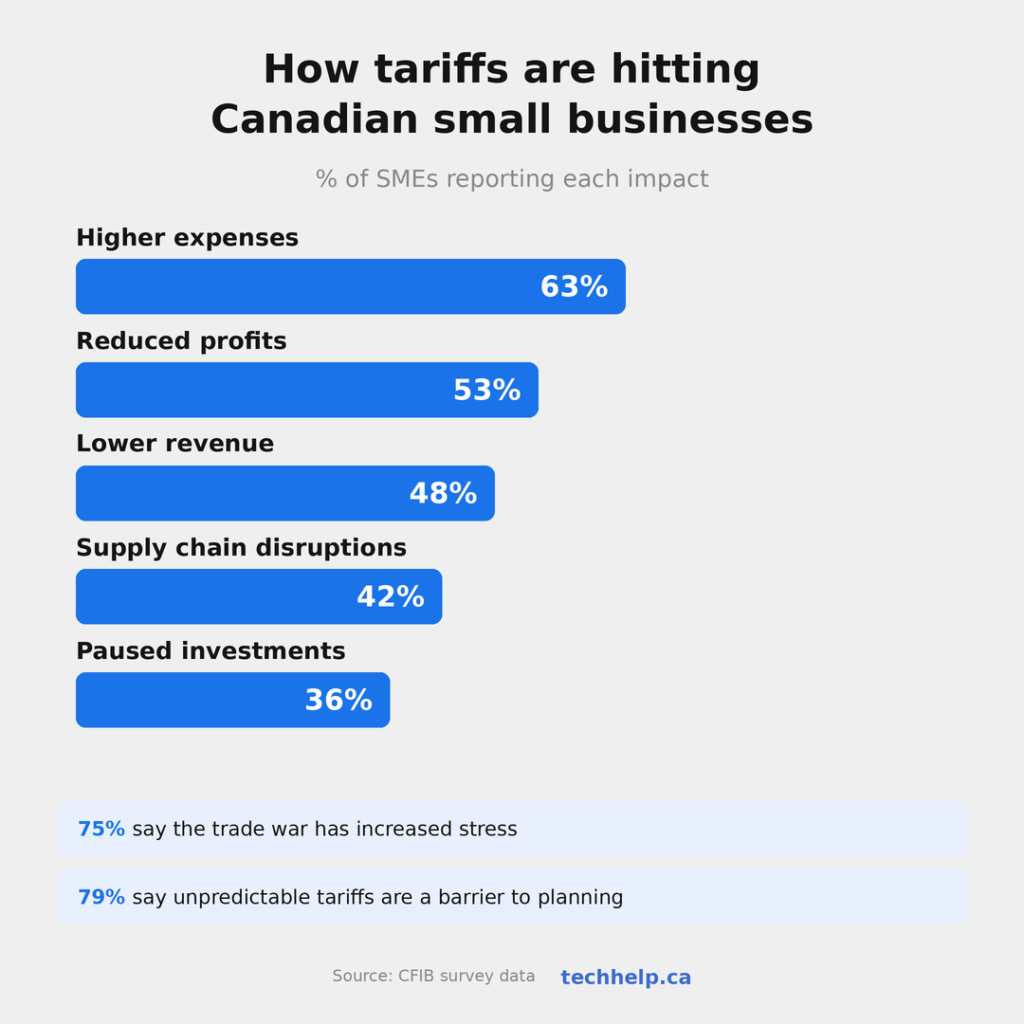
CFIB survey data from August 2025 shows how tariff costs have already been landing. Among affected businesses, 63% reported higher expenses, 53% reported reduced profits, 48% reported lower revenue, 42% reported supply chain disruptions, and 36% said they had paused investments. Only 7% reported positive effects.
The pressure isn’t only financial. CFIB also found that 75% of small businesses said the trade war had increased stress, while 79% said unpredictable tariffs had become a barrier to planning.
That’s the part business owners should take seriously. Tariffs don’t just raise a line item. They make it harder to quote customers, protect margins, sign supplier agreements, and decide whether to hire, buy equipment, or expand.
Consumers are also under pressure. Canada’s Food Price Report 2026 forecast overall food price increases of 4% to 6% and estimated that a family of four could spend up to $994.63 more on food in 2026. Statistics Canada reported that food purchased from stores was up 4.8% year over year in January 2026. If dairy costs rise further, restaurants, grocers, food manufacturers, and household budgets could all feel it.
How Canadian businesses are already adapting
The shift away from U.S. dependence has already started.
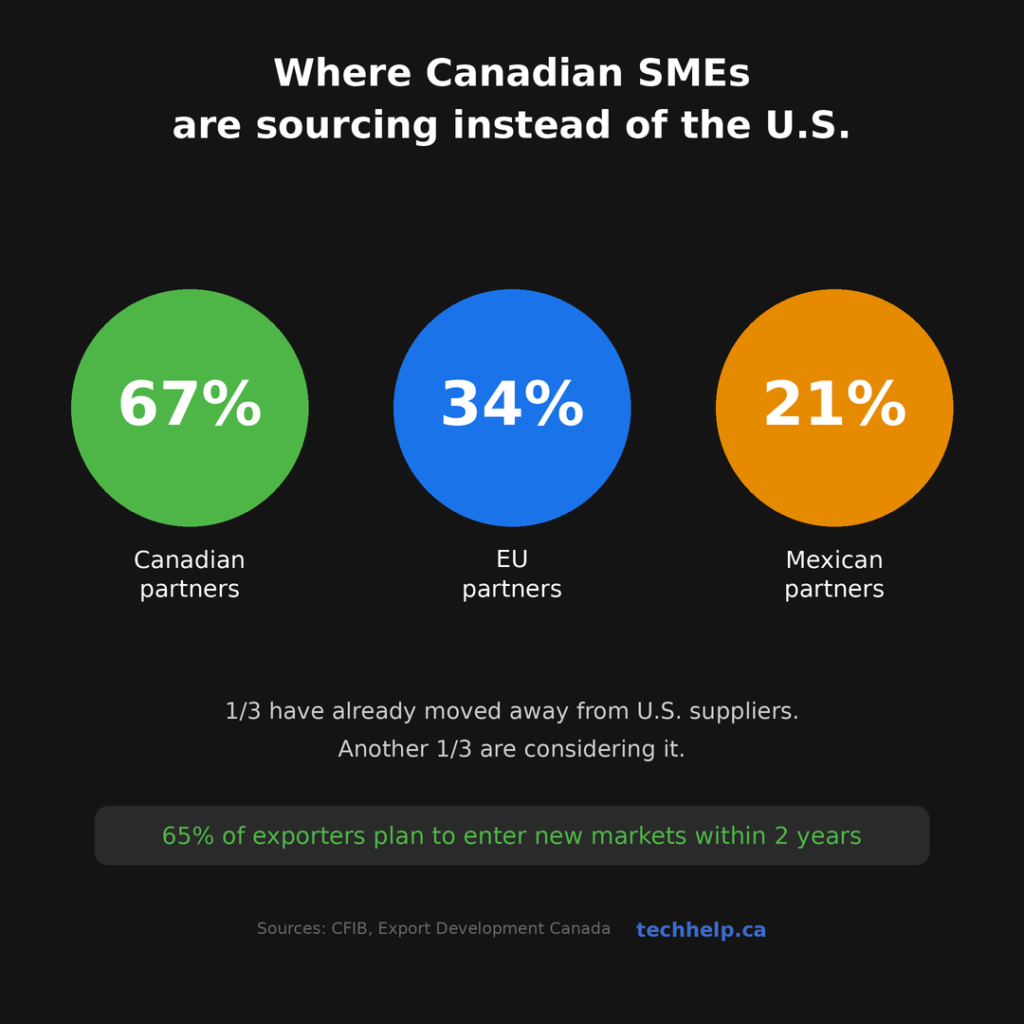
CFIB found that one-third of Canadian SMEs had moved away from U.S. suppliers or customers, with another third considering it. Among businesses looking for alternatives, 67% were turning to Canadian partners, 34% to the EU, and 21% to Mexico.
Export Development Canada’s March 2026 Trade Confidence Index also showed that 65% of Canadian exporters planned to enter new markets within two years. That isn’t a short-term workaround. It’s a broader diversification push.
The Buy Canadian movement is part of the same adjustment. Bank of Canada research found that Canadians took close to 10 million fewer trips to the United States in 2025 than in 2024, a 25% drop. Its grocery-store spending analysis also found that households shifted food spending away from U.S. products and toward Canadian ones after trade tensions escalated in March 2025.
On the operations side, the federal government’s Spring Economic Update said more firms are reconfiguring supply chains, sourcing from non-U.S. markets, adjusting pricing, and adopting advanced technologies. That includes AI and automation in manufacturing, where efficiency gains can help offset higher input costs. For businesses looking at that side of the response, BDC’s AI program for Canadian SMEs is one route worth reviewing.
Relief programs worth checking
The federal government has several tariff response programs in place, though the right fit depends on your industry, revenue, and project.
The Regional Tariff Response Initiative is the broadest option. The Government of Canada says the program now has $1.5 billion available through regional development agencies. It supports projects that improve productivity, lower costs, strengthen supply chain resilience, and open new markets. In British Columbia, for example, business projects can receive repayable contributions from $200,000 to $10 million, with smaller non-repayable contributions also available for some projects.
BDC is also running a $1 billion financing program for Canadian businesses in the steel, aluminum, or copper value chain that have been materially affected by U.S. tariffs. BDC says financing can range from $1 million to $50 million. Its program page lists minimum requirements, including Canadian operations, tariff exposure, at least three years in operation, and annual revenue of at least $5 million.
The Strategic Response Fund is built for larger, transformative projects in affected sectors such as steel, aluminum, automotive, forest products, food, AI, and advanced technologies. It won’t fit every small business, but it matters if you’re part of a supply chain tied to one of those sectors.
The practical point is simple: don’t assume you don’t qualify before checking. Funding pools move, eligibility rules change, and the businesses that apply early usually have more room to maneuver.
Practical moves before August 19
Start with exposure. Map every product, input, customer contract, supplier route, and margin assumption that could be affected. Then match your HTS codes against the official tariff annexes. If you’re not confident in the classification, talk to a customs broker or trade compliance consultant.
Next, model your pricing. A 50% duty doesn’t always translate into a 50% retail price increase, but it can erase margin fast. Revisit your pricing model with three scenarios: no change before August 19, partial modification after negotiations, and full implementation. For each one, decide what you absorb, what you pass through, and where you need to renegotiate.
Then look at concentration risk. If one supplier, one customer, one border route, or one tariff category can break your numbers, you need alternatives. Start with Canadian options where they exist, then look at EU, Mexican, or other trade-agreement partners. You don’t have to cut off U.S. relationships. You do need a backup plan that can move if the policy environment changes again.
Cash flow deserves its own pass. Tighten receivables. Review payment terms. Ask suppliers where they can hold pricing. Build a reserve for customs delays, duty payments, or temporary inventory changes. In a tariff shock, profitable businesses can still get squeezed if cash arrives too late.
Review contracts before new orders go out. Tariff adjustment clauses, price reopening language, delivery timing, and force majeure wording can decide who carries the cost if duties change between quote and delivery. This is especially important for cross-border orders placed before August 19 but delivered after the effective date.
Finally, assign someone to monitor the negotiations. The next few weeks could change the final scope. Waiting passively is risky, but overreacting before the rules settle can be expensive too. Your job is to build a plan that can adjust quickly.
Build for a less predictable border
The new tariff package may still change before August 19. Negotiations could narrow the product list, delay implementation, or create carve-outs.
But the larger signal is harder to ignore. North American trade is becoming less predictable, and Canadian businesses can’t build strategy around the hope that everything returns to the old pattern.
The better move is to treat this as a planning deadline. Audit exposure. Reprice where needed. Strengthen cash flow. Check funding programs. Diversify suppliers and customers. Put tariff language into new contracts.
The businesses that move now won’t eliminate the risk. They’ll give themselves more choices when the border gets harder to plan around.
Frequently Asked Questions
What products are covered by the new 50% U.S. tariffs on Canada?
The White House says the Section 338 tariffs target Canadian goods tied to autos, alcoholic beverages, and dairy, with examples ranging from wine to hockey sticks to cement. The final answer depends on the product’s HTS code and the official proclamation annexes. Energy, potash, goods already covered by Section 232 tariffs, and certain products such as fish and critical minerals are excluded.
When do the new tariffs take effect?
The proclamations were signed on July 20, 2026, and the tariffs are scheduled to take effect on August 19, 2026. The 30-day window gives Canada and the United States time to negotiate, so the scope, timing, or final details could still change before the effective date.
Do these tariffs apply to goods that qualify under USMCA/CUSMA?
Yes, if the product is covered by the new Section 338 tariff annexes. The White House says the duties apply regardless of whether a covered good originates under USMCA. That makes this round different from earlier tariff actions where USMCA qualification could protect some goods from added duties.
What is Section 338 and why does it matter?
Section 338 of the Tariff Act of 1930 allows the U.S. president to impose duties of up to 50% when another country is found to discriminate against U.S. commerce. It matters because the July 2026 tariffs use this rarely invoked authority and apply to covered goods even when those goods qualify under USMCA.
What government programs can help Canadian businesses deal with tariff costs?
Canadian businesses can check the Regional Tariff Response Initiative, BDC’s tariff financing programs, and the Strategic Response Fund. Eligibility depends on the business, sector, revenue, project type, and tariff exposure. The RTRI is delivered through regional development agencies, while BDC’s steel, aluminum, and copper financing program is aimed at companies in those value chains that have been materially affected by U.S. tariffs.
How are these tariffs different from the ones imposed in 2025?
The 2025 tariff actions had different legal foundations and created separate treatment for some USMCA-qualifying goods. The July 2026 tariffs use Section 338 and, according to the White House, apply to covered goods regardless of USMCA origin status. That means businesses can’t assume trade-agreement qualification is enough protection.
Should businesses wait to see if the tariffs get negotiated away?
No. Businesses should monitor negotiations, but they should also prepare now. That means checking tariff exposure, reviewing contracts, modeling price changes, protecting cash flow, and looking at supplier or market alternatives. If the tariffs change before August 19, a prepared business can adjust faster.
Get new small business insights by email
Practical ideas and useful articles to help you make better business decisions.
Tech Help Canada Staff researches, writes, and reviews practical content for business owners and professionals. Our coverage spans business, marketing, SEO, technology, and the tools and systems people use to grow and operate online. We focus on clear, useful information backed by research, hands-on experience, and editorial review. Learn more about our team and editorial standards. Need help with something? Contact Us