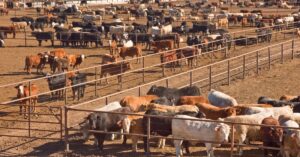
Recent immigration enforcement across southwest Kansas and neighboring cattle states has turned into a production problem for the U.S. beef industry, with livestock groups reporting worker absences, delayed cattle shipments and temporary slowdowns at processing plants.
The immediate lesson is operational rather than ideological: a policy action aimed at workers can hit throughput almost at once when production depends on concentrated plants, narrow schedules and specialized labour.
What happened in beef country
The Kansas Livestock Association, Oklahoma Cattlemen’s Association and Texas Cattle Feeders Association said in a Sept. 24 statement that reported ICE activity in Oklahoma, Kansas and Texas was affecting agricultural communities. The groups said cattle producers, feedyards, dairies, livestock markets, processors and rural businesses depend on a stable workforce to care for animals, protect food safety and keep the beef supply chain operating.
They reported delayed shipments of thousands of fed cattle to processors, millions of dollars in lost revenue and added costs, and workforce disruptions at feedyards, dairies, processors, feed and grain companies, transportation hubs and community services. The groups also warned that the disruption could raise consumer beef prices if processing volume falls below demand.
AP reported Friday that employees had missed work after heightened immigration activity in Texas, Kansas and Oklahoma. Scarlett Mabinger of the Kansas Livestock Association told AP that several meatpacking plants in Dodge City, Liberal and Garden City normally process thousands of cattle a day, but some had to shut down temporarily and send cattle back to feedlots.
Kansas News Service reported that the National Beef plant in Liberal adjusted some shift start times after federal immigration activity, and local officials and advocates described unmarked vehicles and enforcement activity near roads leading to processing facilities. The cities of Dodge City, Garden City and Liberal said local governing bodies and law enforcement agencies were not notified in advance of the increased federal activity.
By Sept. 29, High Plains Public Radio reported that Kansas officials were asking ICE to slow enforcement operations at meat processing plants as concern spread among politicians, advocates and business leaders.
Why one regional disruption matters
Southwest Kansas is not an ordinary production area. Reuters described the region as home to a large concentration of feedlots and slaughterhouses. DTN reported that plants operated by Cargill, National Beef and Tyson Foods in Dodge City, Garden City/Holcomb and Liberal have around 24,000 head of daily slaughter capacity, or more than 20% of daily U.S. fed-cattle slaughter.
That concentration changes the risk. If workers stay home, cattle do not simply move through another route the same day. Cattle scheduled for processing can be pushed back to feedlots, creating animal-welfare, feed, transport and cash-flow costs before consumers see anything at the meat case.
USDA’s daily livestock slaughter report showed cattle slaughter of 87,000 head on Friday, Sept. 25, compared with 101,000 a week earlier. The same report showed cattle slaughter of 95,000 head on Monday, Sept. 28, compared with 105,000 a week earlier and 112,314 a year earlier. The USDA report does not assign a cause, but it shows why the industry reaction was about capacity, not only immigration enforcement.
Beef prices were already exposed
The disruption landed in a beef market that was already tight. USDA’s Economic Research Service said in its September market outlook that fed cattle slaughter remains historically low, leading to lower beef production forecasts for 2026 and 2027.
Federal average-price data available through the Federal Reserve Bank of St. Louis’ FRED database shows ground beef, 100% beef, at $6.923 per pound in August 2026. A separate FRED series shows all uncooked ground beef at $7.158 per pound that month.
The White House had already issued an Aug. 26 proclamation increasing the 2026 tariff-rate quota for certain lean beef trimmings by 300,000 metric tons, with tranches opening from September through November, as part of an effort to address high ground beef prices.
That makes the timing of the labour disruption notable. One part of federal policy was trying to add beef supply while industry groups said enforcement activity was disrupting domestic processing chokepoints.
The government’s position
DHS Secretary Markwayne Mullin said ICE was not conducting worksite operations in Kansas and said law enforcement had targeted serious criminals and people with final orders of removal. AP reported that DHS confirmed a federal presence in Kansas but said it was not conducting worksite raids; AP also reported that Mullin did not provide a breakdown of arrests.
That distinction matters legally, but it does not remove the operating effect described by cattle groups and local reporting. A facility does not need a formal worksite raid to lose capacity if enough workers fear detention, miss shifts, or face delays getting to work.
The business signal
The narrow business signal is that workforce availability can become a production constraint faster than prices, contracts or import policy can adjust. Beef processing is a timed system. It depends on workers showing up, animals arriving, inspectors, trucks, feedlots and buyers all lining up.
When one part of that system is disrupted, the first visible result may not be an empty shelf. It may be slower slaughter, delayed cattle shipments, feedlot backups, missed shifts and new costs that move through the chain later.
For businesses watching cross-border suppliers, the Kansas disruption is a reminder that workforce enforcement, immigration policy and supply-chain capacity are not separate issues. In a concentrated production network, they can become the same issue within days.

I can suggest related Tech Help Canada articles based on the topic you’re reading now.

Tech Help Canada Staff researches, writes, and reviews practical content for business owners and professionals. Our coverage spans business, marketing, SEO, technology, and the tools and systems people use to grow and operate online. We focus on clear, useful information backed by research, hands-on experience, and editorial review. Learn more about our team and editorial standards. Need help with something? Contact Us