Google has a specific spam policy for parasite SEO called site reputation abuse, and it’s been actively enforced. Site reputation abuse occurs when a site that has earned trust in Google Search uses that trust to host third-party content, primarily to rank higher than it could on its own.
Google’s core point is user trust. People click expecting the host site’s usual standards, then land on content that appears to exist mostly for rankings (and revenue), not for the site’s real audience.
What Counts as Site Reputation Abuse
Google defines site reputation abuse as a tactic where third-party content is published on a host site mainly because of the host’s already-established ranking signals. In many cases, those signals were earned from first-party content.
And the nuance matters. Third-party content alone isn’t a violation. It becomes a violation when the main reason it’s hosted there is to borrow the host site’s ranking power.
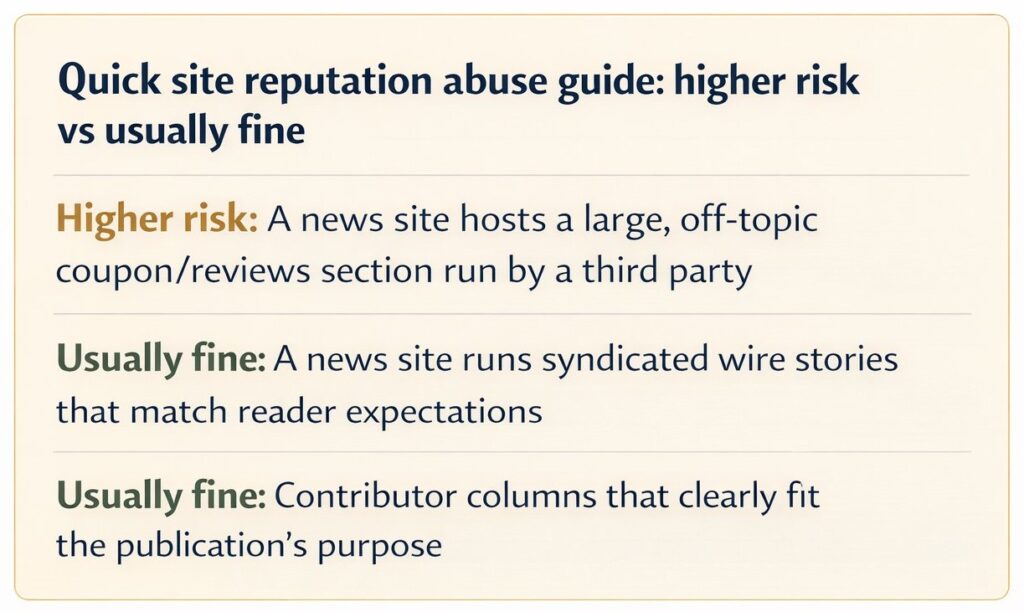
Google has pointed to patterns like hidden or unrelated coupon pages on news sites, or off-topic “best X” sections living under an established domain’s authority.
The Timeline and What Enforcement Looks Like in Practice
March 5, 2024: Google announced new spam policies, including site reputation abuse, and said the policy would take effect May 5, 2024.
May 5, 2024: The site reputation abuse policy took effect (enforcement begins from this date).
November 19, 2024: Google published an updated clarification expanding guidance around third-party content arrangements (including white-label/licensing style setups).
December 6, 2024: Google added FAQs to that Nov 19 policy post.
January 21, 2025: Google updated the policy language and the manual actions documentation to reflect FAQ guidance, calling it an editorial clarification (no substantive policy change).
Many people assume enforcement means a whole site disappears. Often, it doesn’t.
Manual actions can affect parts of a site, and affected site owners are notified in Search Console, with a reconsideration process available.
So if a site has a trusted main offering and a separate commercial section that behaves like a different business, that section can become the target. Google has also indicated that systems can treat portions of a site differently when they appear independent of the rest of the site. This matters because the parasite play depends on automatic trust transfer.
If a section stops inheriting the same trust, the shortcut loses its edge even before any manual action happens.
What Doesn’t Count as Site Reputation Abuse (and Why People Panic)
Google explicitly says third-party content isn’t automatically disallowed. It’s about intent and use.
In practice, many things can still be normal and legitimate when they match audience expectations and editorial intent, such as:
Contributor columns and guest perspectives that fit the publication’s purpose
Syndicated content that serves readers
Forums and user-generated content platforms (where that’s the point of the site)
The decision line isn’t really first-party vs. third-party. It’s whether the content belongs here for the reader, or whether it’s mainly here because it can rank here.
Who’s Most Exposed (and Why)
This enforcement tends to hit business models built around renting authority.
Publishers running white-label commerce at scale: Large shopping, coupons, or review sections that feel detached from a site’s core identity are the obvious pressure point.
Agencies selling authority transfer as a product: If the pitch is essentially “we can get you under a powerful domain,” this site reputation abuse policy attacks the product itself.
Brands buying placements mainly for rankings: A brand can feel the impact when placements become less durable, sections get demoted, or pages get removed after enforcement.
The Real Business Impact Isn’t Technical
Parasite SEO worked because it allowed people to borrow trust rather than earn it.
This enforcement changes the ROI equation. The upside (fast rankings) is less predictable, and the downside (manual actions, cleanup, lost visibility) is more plausible. The middle is also harder because Google is regularly monitoring the pattern.
The site reputation abuse policy’s real impact is economic. It changes how publishers monetize, how agencies sell, and how brands think about “placements.”
How to Pressure Test Your Decisions
You can pressure-test a section, partnership, or content program by asking:
Would we still publish this section in its current form if the only goal was to build audience trust?
If the answer is “probably not,” it suggests the section may be positioned more as a ranking asset than a reader asset, which is what Google says it’s targeting.
Tech Help Canada Staff researches, writes, and reviews practical content for business owners and professionals. Our coverage spans business, marketing, SEO, technology, and the tools and systems people use to grow and operate online. We focus on clear, useful information backed by research, hands-on experience, and editorial review. Learn more about our team and editorial standards. Need help with something? Contact Us