
You’ve got a problem, though most people wouldn’t recognize it as one.
You love learning. Maybe too much.
One month it’s marketing psychology. The next it’s video editing, AI automation, supply chains, personal finance, or how niche communities grow. You go deep, consume everything you can find, connect a few dots, then drift toward the next interesting thing.
Your browser has too many tabs open. Your saved posts are a museum of unfinished rabbit holes. Somewhere along the way, someone probably told you this means you’re unfocused. Pick a lane. Specialize. Stop jumping around.
That advice isn’t always wrong, but it’s incomplete.
If you’re trying to get hired for one narrow role, scattered curiosity can look messy. But if you’re trying to build a one-person business, curiosity can become an unfair advantage. The business isn’t built from everything you know. It’s built from the parts you can turn into a useful transformation for someone else.
That’s the shift: stop treating your curiosity as private entertainment and start treating it as raw material.
Why curious people have more leverage now
Leverage is the gap between what you put in and what you get out. A factory gives leverage because one system can produce thousands of units. Software gives leverage because one product can serve people while you sleep. Content gives leverage because one idea can reach someone you never meet.
For a long time, building that kind of leverage required capital, employees, distribution, or technical skill. Now a single person can research, publish, sell, deliver, automate, and support a small business from a laptop.
That doesn’t make it easy. It makes it possible.
The U.S. Census Bureau’s Nonemployer Statistics program exists because millions of businesses operate without paid employees. These aren’t all creators, consultants, or online entrepreneurs, but they show that very small businesses are a real economic category, not an internet fantasy.
Independent work is also growing up. MBO Partners’ 2025 State of Independence report estimates 72.9 million independent workers in the U.S., with 5.6 million earning more than $100,000. The same report says 74% of independents use AI, and 61% say it saves time and increases output.
Microsoft and LinkedIn’s 2024 Work Trend Index found that 75% of global knowledge workers use AI at work, with users saying it helps them save time, focus, and be more creative. For a solo operator, that matters. AI won’t build a business for you, but it can reduce the drag around research, drafting, analysis, customer support, planning, and operations.
The result is a new kind of opening. A curious person who can learn fast, explain clearly, and package a useful process doesn’t need to wait for a company to create the perfect job. They can build a small business around the problems they understand best.
The business is the transformation, not the topic
Most people start with the wrong question.
They ask, “What should my niche be?”
That leads to a list of topics: productivity, marketing, fitness, AI, personal finance, writing, design, career growth. Topics are useful, but they don’t make a business by themselves. Nobody wakes up wanting to buy “productivity.” They want to stop missing deadlines, feel less scattered, manage a team better, or finally finish the project that keeps following them around.
Your business isn’t your topic. Your business is the transformation you help someone create.
That transformation can be practical, emotional, financial, or professional. A freelancer helps a founder turn messy positioning into a clear offer. A coach helps new managers stop avoiding hard conversations. A course creator helps creators turn raw ideas into a consistent publishing system. A consultant helps local businesses turn scattered marketing into a repeatable lead engine.
The topic is the container. The transformation is the reason people pay.
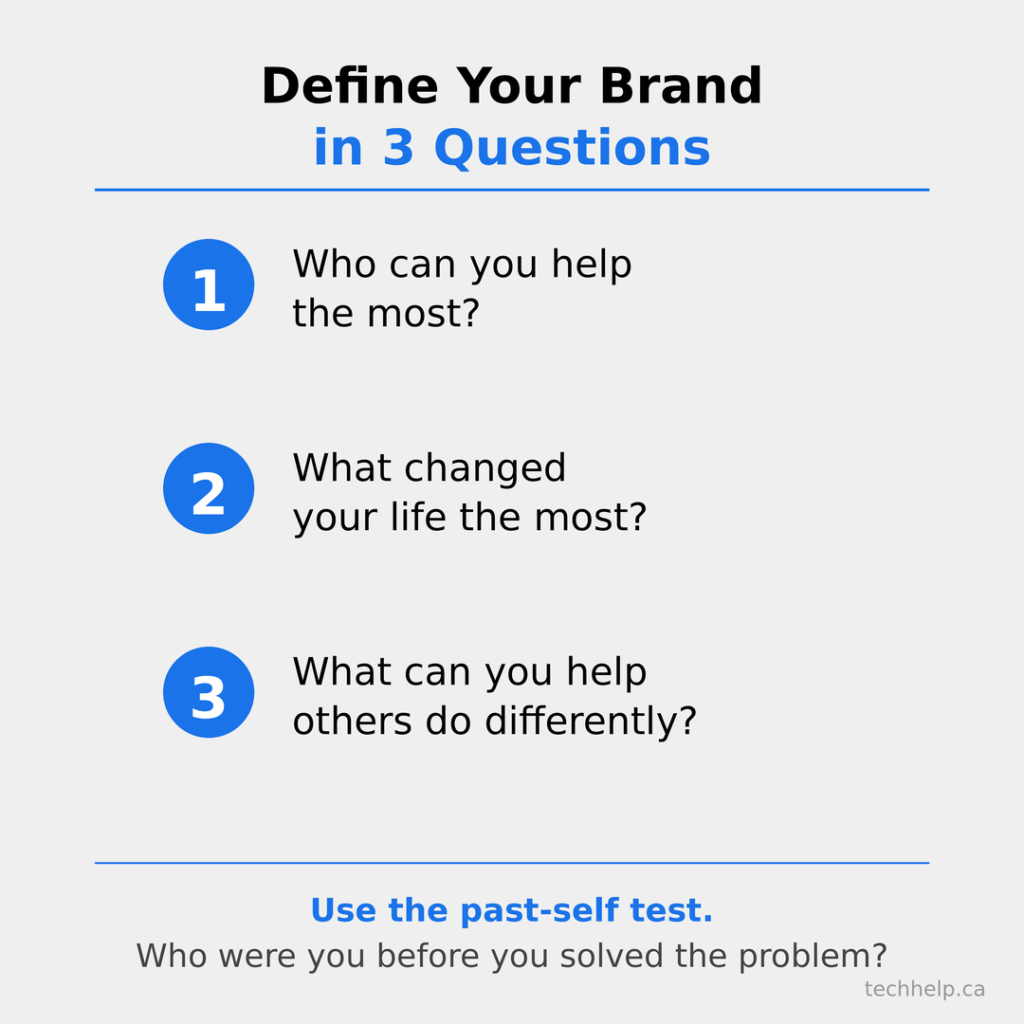
Start with three questions:
| Question | What you’re looking for |
|---|---|
| Who can you help the most? | People who are stuck where you used to be, or where your experience gives you unusual clarity. |
| What changed your life the most? | Interests that led to real behavior change, better decisions, stronger results, or hard-earned insight. |
| What can you help others do differently? | A repeatable change in action, thinking, workflow, confidence, skill, or outcome. |
If that still feels vague, use the past-self test. Think about who you were two years ago, five years ago, or before you solved a problem the hard way. What did you need to understand? What would have saved you months of trial and error? What language would have reached you then?
Your past self is often the first audience you can serve honestly. Not because you’re the only person who struggled, but because you know the problem from the inside.
Turn your learning into public proof
If you already spend your free time learning, you’re doing the hardest part of content creation. You’re finding ideas, testing them against your own life, and connecting them to other things you know.
The missing step is publishing.
Content isn’t separate from the business. For a one-person business, content does three jobs at once. It shows how you think, attracts people with the problem you understand, and gives future buyers proof that you can help.
The strongest content for a curious person usually comes from synthesis. You take an idea from one area and apply it to a problem in another.
For example, you might learn a behavioral psychology principle about habit formation. If your audience is freelancers trying to land better clients, that idea becomes a piece about making outreach less dependent on motivation. If your audience is managers, it becomes a piece about making feedback a normal weekly rhythm instead of a dreaded event. If your audience is creators, it becomes a piece about building a publishing habit that survives low-energy weeks.
The same source idea becomes different content because the audience and problem change.
That is your edge. You don’t need to repeat what everyone else says about your niche. You can bring your range of interests into a specific problem and explain it in a way only you would.
To make this repeatable, build a simple idea capture system:
| Capture field | Example |
|---|---|
| Source idea | People stick with habits when the cue is obvious and the reward is immediate. |
| Where it came from | Behavioral psychology, habit design, personal experience. |
| Audience problem | Freelancers avoid outreach because it feels uncomfortable and uncertain. |
| Application | Make outreach a daily two-message routine with a visible tracker and quick feedback loop. |
| Content angle | “The outreach habit that doesn’t depend on confidence.” |
This is how research becomes public proof. You’re not just sharing notes. You’re showing the reader how your mind turns raw knowledge into useful action.
Pick one publishing platform to start. A blog, newsletter, YouTube channel, LinkedIn account, podcast, or short-form video channel can all work. Don’t spread yourself across five platforms because you’re afraid to choose. Consistency on one channel beats scattered effort everywhere.
If writing is your easiest medium, start with a blog or newsletter. If you want to build the habit and learn the basics, our guide on starting a blog is a useful next step.
Choose one audience before you choose the offer
Curious people often resist choosing an audience because it feels like cutting off possibilities. But focus isn’t a prison. It’s a starting point.
You can always expand later. In the beginning, a clear audience makes every decision easier: what to write, what examples to use, what offer to create, what language to use, where to publish, and how to know whether your work is landing.
An audience should be specific enough that you can picture their day.
“Entrepreneurs” is too broad. “Solo service providers who are good at delivery but inconsistent at marketing” is workable.
“Creators” is too broad. “YouTube educators with small audiences who want to turn expertise into paid products” gives you traction.
“Professionals” is too broad. “Mid-career operators who want to move from employee to independent consultant” gives you a real person to write for.
Once you choose the audience, listen before you build. Read their Reddit threads, LinkedIn comments, reviews, community posts, support questions, and sales calls if you have them. Notice the exact words they use. People will tell you what they want, what they fear, what they have tried, and what they don’t believe anymore.
Your job isn’t to invent a problem. Your job is to notice a problem clearly enough that people feel recognized when you describe it.
Start with a service, not a product
Content builds trust. A service builds understanding. A product scales what you’ve learned.
Most new one-person businesses should start with a service because services create the fastest feedback. You don’t need a polished course, a big audience, or a complicated funnel. You need a person with a painful problem and a clear way to help.
The service can be consulting, coaching, implementation, audits, done-for-you work, workshops, or a short diagnostic offer. The format matters less than the feedback it creates.
When you work with real people, you hear the details that never show up in theory. You learn what they misunderstand, what they avoid, what they tried before, what they value, and what language makes them lean in. That is the information you can’t get from guessing.
This is also where your curiosity becomes more disciplined. You stop learning everything equally and start learning what helps the client get a result.
If you’re not sure which model fits you, our breakdown of solopreneur types can help you compare service, creator, consultant, freelancer, and product-led paths.
Start small. Offer a focused outcome, not open-ended access to your brain.
Weak offer: “I can help with marketing.”
Stronger offer: “I’ll help you turn your scattered expertise into three clear service offers and a simple landing page outline.”
Weak offer: “I do productivity coaching.”
Stronger offer: “I’ll help you rebuild your weekly workflow so your most important work gets scheduled before client requests take over.”
Specificity makes the offer easier to buy and easier to deliver.
Package the repeatable part
After you’ve worked with a handful of people, patterns will show up. You’ll hear the same questions, fix the same misunderstandings, and walk clients through the same steps.
That repeatable part is the beginning of a product.
A product isn’t always a course. It can be a template, toolkit, checklist, workshop, paid newsletter, membership, mini-course, cohort, diagnostic, software tool, or recorded training. The right format depends on what the buyer needs to do.
If the buyer needs knowledge, a guide or course may work.
If the buyer needs speed, a template or toolkit may work.
If the buyer needs accountability, a cohort or coaching program may work.
If the buyer needs repeated support, a membership or community may work.
If the buyer needs a task done repeatedly, software or automation may work.
The mistake is building the product before you understand the process. That’s how people spend months creating something nobody buys. Start with the service, document the process, then package the parts that repeat.
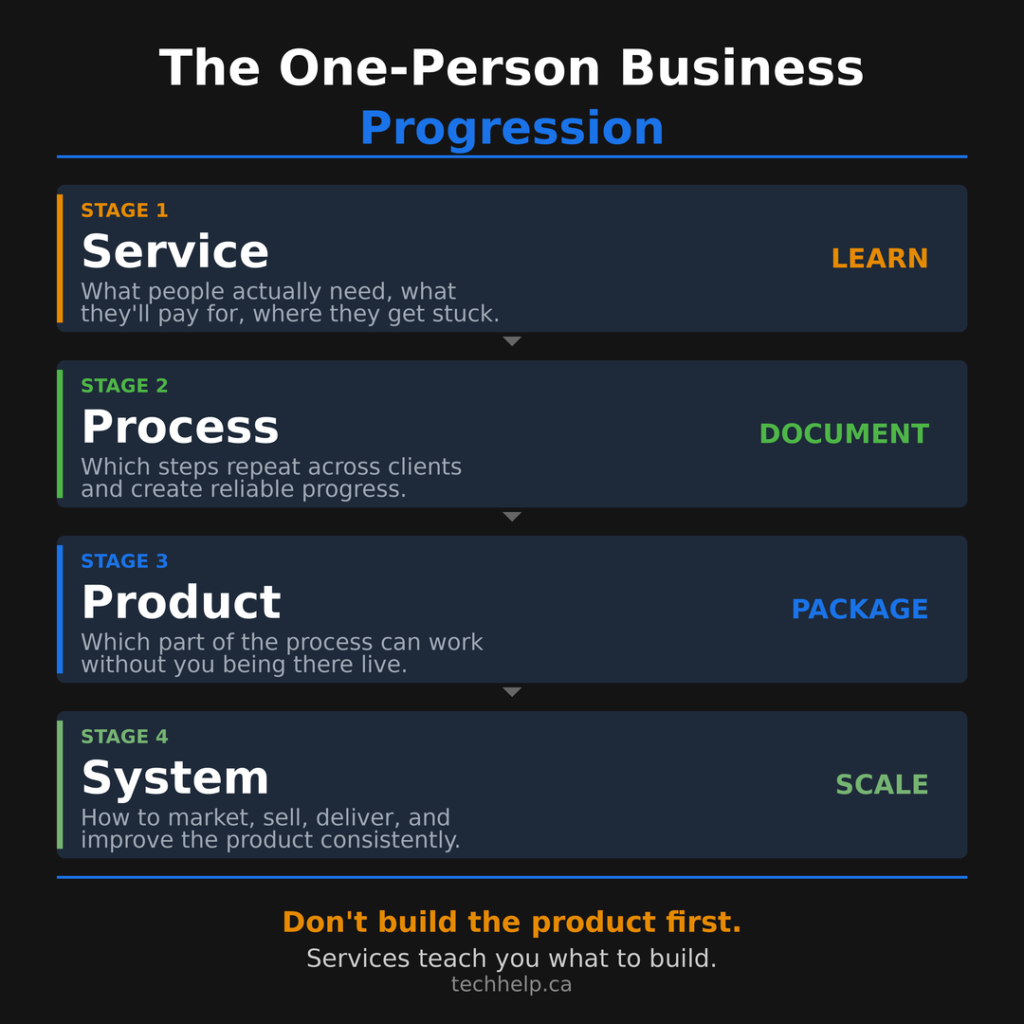
The path usually looks like this:
| Stage | What you’re learning |
|---|---|
| Service | What people actually need, what they will pay for, and where they get stuck. |
| Process | Which steps repeat across clients and create reliable progress. |
| Product | Which part of the process can work without you being there live. |
| System | How to market, sell, deliver, and improve the product consistently. |
Services trade time for money. Products trade process for money. A strong one-person business often uses both: services for high-touch revenue and learning, products for scale and leverage.
If you’re wondering what income can realistically look like across these paths, we already covered that in our guide on how much solopreneurs make.
Build a solo operating system
A one-person business breaks when everything lives in your head. You need a simple operating system that turns curiosity into output, output into conversations, and conversations into offers.
Keep it boring. Boring systems get used.
Your operating system needs five loops.
The learning loop captures what you’re studying and where it can help. Save ideas, examples, customer language, questions, and patterns in one place.
The publishing loop turns those notes into useful content. Set a cadence you can keep for at least 90 days. One strong article or newsletter per week is better than a heroic week followed by silence.
The conversation loop puts you in contact with real people. Reply to comments, ask questions, book calls, send thoughtful messages, and listen for repeated pain.
The offer loop turns repeated pain into a paid way to help. Keep your first offer narrow. You can always expand once people buy and succeed.
The feedback loop improves everything. After each piece of content, call, client project, or sale, ask what you learned. What got attention? What confused people? What made someone ask for help? What result did the work create?
AI can support each loop, but it shouldn’t replace your judgment. Use it to summarize notes, brainstorm angles, draft outlines, analyze customer language, create checklists, and clean up repetitive work. Don’t use it to sand away the strange, specific parts of your perspective. Those are often the parts people remember.
A 30-day plan to start
You don’t need to redesign your life before you begin. Give yourself 30 days and run a small experiment.
In week one, choose the audience and transformation. Write down who you want to help, what problem they have, what outcome they want, and why you’re credible enough to help. Don’t worry about sounding polished. Aim for clarity.
In week two, publish three pieces of content around the same problem. One can explain the pain, one can teach a small fix, and one can share a personal story or lesson. Watch what people respond to.
In week three, talk to five people who fit the audience. Don’t pitch immediately. Ask what they have tried, what’s still frustrating, what they wish were easier, and what would make a solution worth paying for.
In week four, make one focused offer. Keep it simple: a paid audit, a consulting session, a done-for-you setup, a short coaching package, or a workshop. The goal isn’t to build the final business. The goal is to create your first real feedback loop.
By the end of 30 days, you may not have a polished brand. That’s fine. You should have a clearer audience, sharper language, three public proof points, five real conversations, and one offer you can improve.
That is far more useful than another month of private research.
The real shift
You don’t need another course before you’re allowed to start. You don’t need to read five more books, wait for a perfect niche, or prove that you’re an expert in everything you’ve ever been curious about.
You already do a large part of the work required to build a one-person business. You learn. You research. You synthesize. You notice patterns. You get interested enough to keep going when other people get bored.
Now you need to make that work useful to someone else.
Share what you’re learning. Aim it at a real audience. Turn repeated questions into a service. Turn repeated service work into a process. Turn the process into a product when the pattern is strong enough.
The obsessive learning wasn’t a detour. It was preparation.
Now put it to work.
Frequently asked questions
Can you build a business from learning random topics?
Yes, but the business can’t stay random. The key is turning what you learn into a useful outcome for a specific audience. Curiosity gives you raw material, but the business comes from helping people solve a clear problem.
What is the best one-person business to start first?
For most people, a focused service is the best place to start. Consulting, coaching, audits, implementation, or freelance work can validate the problem quickly and teach you what people will pay for before you spend months building a product.
Do you need a large audience to start a one-person business?
No. A large audience can help, but a small group of the right people is enough to start. Early on, direct conversations, referrals, and a narrow offer often matter more than follower count.
How do you choose a niche if you have too many interests?
Choose the audience and transformation first, then use your interests as source material. You don’t need to abandon your curiosity. You need to aim it at one problem long enough to create trust and results.
Should you create content before selling anything?
Create enough content to show how you think and attract the right conversations, but don’t hide behind publishing forever. Once people are responding to the problem you talk about, make a simple offer and learn from the market.
When should a service become a product?
A service is ready to become a product when the same problem, questions, steps, and outcomes appear across multiple clients. Package the repeatable part only after real conversations and delivery have shown you what people actually need.
Sources
- https://www.census.gov/programs-surveys/nonemployer-statistics.html
- https://www.mbopartners.com/state-of-independence/
- https://www.microsoft.com/en-us/worklab/work-trend-index/ai-at-work-is-here-now-comes-the-hard-part
I can suggest related Tech Help Canada articles based on the topic you’re reading now.

Tech Help Canada Staff researches, writes, and reviews practical content for business owners and professionals. Our coverage spans business, marketing, SEO, technology, and the tools and systems people use to grow and operate online. We focus on clear, useful information backed by research, hands-on experience, and editorial review. Learn more about our team and editorial standards. Need help with something? Contact Us