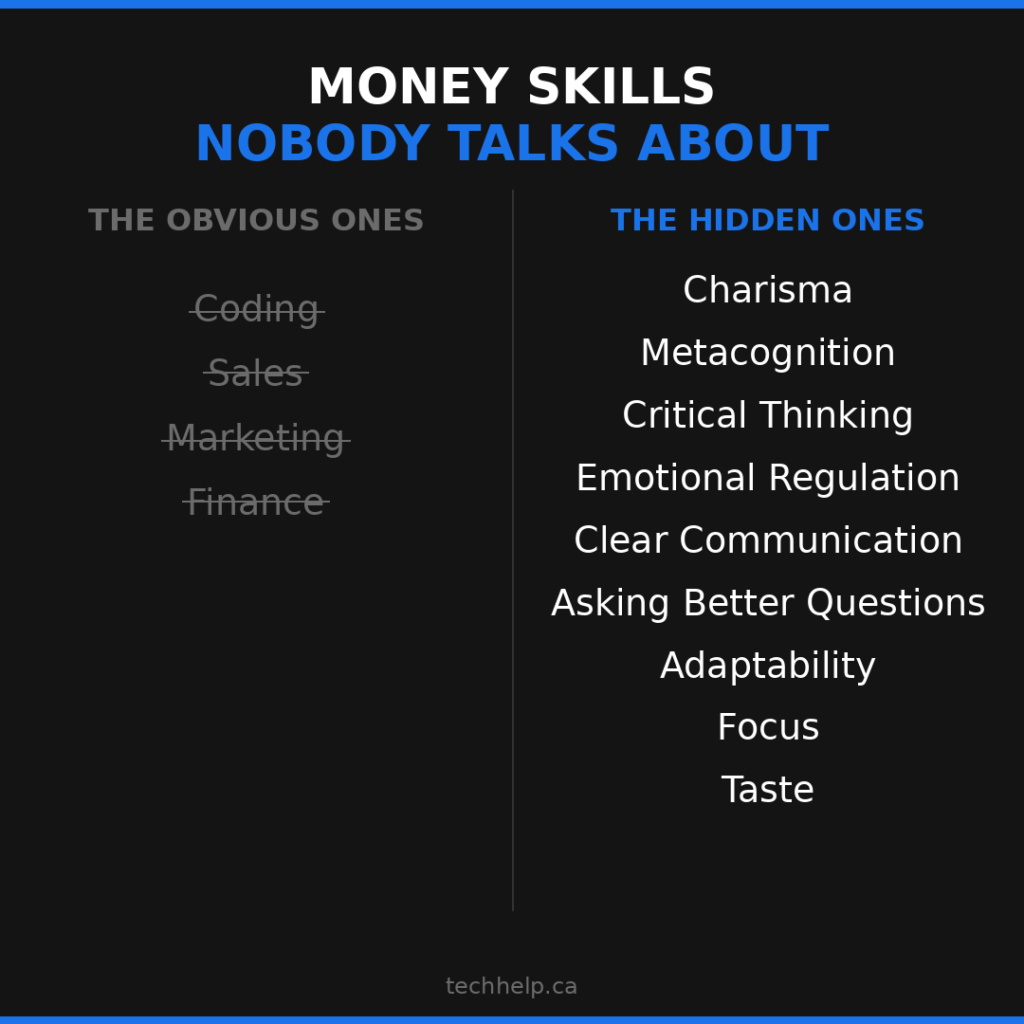
You’ve probably seen the standard advice: learn to code, get better at sales, study digital marketing, understand finance. Those are real skills. They can absolutely increase your income, grow a business, and open better opportunities, but they’re not the whole picture.
Some of the most valuable money skills don’t look like money skills at all. They usually don’t come with certifications. They don’t always fit neatly on a resume. Not many employers write job ads asking for “better judgment under pressure” or “the ability to ask questions that reveal the truth.” Still, these skills can decide whether your effort turns into money or just more effort.
They affect whether people trust you. Whether you spot a bad deal before you sign it. Whether you can communicate your value clearly enough for someone to buy. Whether you stay calm when a negotiation gets uncomfortable. Whether you keep improving instead of defending ideas that already stopped working.
Most of these skills don’t look flashy. That’s exactly why people underestimate them.
Charisma
Charisma isn’t about being loud, charming, or permanently “on.” The useful version is much simpler: it’s the ability to make people feel seen, understood, and comfortable enough to keep talking to you.
That has a direct financial impact because most opportunities arrive through people. Promotions, referrals, partnerships, investor introductions, client trust, job offers, speaking invitations, and deal flow all move through human connection before they show up as money.
If people enjoy being around you, they bring you into rooms you didn’t know existed. They mention your name when someone asks for help. They trust you faster because you’ve made the interaction feel easier and more human.
This doesn’t mean performing some fake version of confidence. It means learning how to listen well, hold eye contact without making things weird, tell a clear story, and make the other person feel like the conversation isn’t just a transaction. If you’re working a room, charisma is the difference between collecting contacts and creating real openings.
The good news is that charisma isn’t fixed. Research on charismatic leadership tactics has shown that specific behaviors, such as using vivid examples, speaking with conviction, and connecting ideas to shared values, can be trained. You don’t need to become a different person. You need to become easier to trust, easier to understand, and easier to remember.
Metacognition
Metacognition means thinking about how you think. That sounds academic, but the practical version is simple: can you pause in the middle of a decision and notice what’s driving it?
That’s a money skill because many expensive mistakes don’t start with ignorance. They start with unexamined thinking. You overhire because you’re trying to prove the business is growing. You underprice because you don’t want the discomfort of charging more. You keep funding a project because you’ve already put so much into it. You buy a tool because a competitor uses it, not because it solves a real problem.
None of those choices feel irrational in the moment. They feel justified. That’s what makes them dangerous.
Metacognition gives you a second layer of awareness. Instead of only asking, “What should I do?” you also ask, “Why do I want to do this? What assumption am I making? What would change my mind? Am I solving the real problem or trying to escape discomfort?”
That pause can save you from months of wasted work or thousands of dollars in avoidable decisions. It can also make good decisions stronger because you’re not just choosing a path; you’re checking the quality of your reasoning before you commit.
A simple way to build this skill is to keep a decision log. Before a meaningful choice, write down what you believe, what outcome you expect, what risks you see, and what evidence would prove you wrong. Revisit it later. Over time, you’ll start seeing your own patterns more clearly.
Critical thinking
Critical thinking is the ability to evaluate information instead of simply absorbing it. That’s become a career and business advantage because everyone is surrounded by more advice than they can possibly use. There’s always another trend, tactic, framework, guru, tool, market prediction, or “proven” strategy. If you can’t sort signal from noise, you’ll spend your money and energy chasing whatever sounds convincing this week.
The World Economic Forum’s Future of Jobs Report 2025 places analytical thinking among the core skills employers expect workers to need. NACE’s career readiness framework also lists critical thinking as a core competency, alongside communication, professionalism, leadership, and technology.
That tracks with real life. The person who can slow down, examine evidence, and ask, “Does this actually follow?” becomes valuable fast. Critical thinking protects you from expensive nonsense. It helps you question projections before investing. It helps you notice when a vendor is selling complexity instead of value. It helps you avoid business models that look attractive only because the hard parts are hidden.
It also makes you more useful to other people. A team doesn’t only need someone with ideas. It needs someone who can stress-test the ideas before money, time, and reputation get attached to them.
If you want to sharpen this skill, start with better assumptions. Before you accept a claim, ask what would need to be true for it to work. Ask what evidence is missing. Ask who benefits if you believe it. That habit alone will put you ahead of people who treat confidence as proof.
For a deeper look at the thinking patterns behind this, Tech Help Canada’s guide to the characteristics of critical thinkers is a useful companion piece.
Emotional regulation
Money brings emotion to the surface. Negotiations feel personal. Pricing feels exposing. Rejection stings. A bad month can trigger panic. A client complaint can make you defensive. A market downturn can push people into decisions they’d never make when calm.
Emotional regulation doesn’t mean you stop feeling those things. It means you don’t let the strongest feeling in the room take control of the decision.
That distinction is worth money. If you panic during a negotiation, you may discount too quickly. If you get defensive during feedback, you may miss the truth that could improve your product. If you chase every emotional high, you may abandon the boring strategy right before it starts working.
Harvard Business School’s work on emotional intelligence in leadership points to self-awareness, self-regulation, motivation, empathy, and social skill as core leadership capabilities. Those aren’t soft extras. They’re what keep judgment intact when pressure rises.
Strong emotional regulation also changes how people experience you. Clients trust steadiness. Teams trust leaders who don’t swing wildly from enthusiasm to fear. Partners trust people who can hear bad news without turning every conversation into damage control.
You build this skill by creating space between trigger and response. Pause before replying to the difficult email. Take a walk before making the pricing decision. Sleep on the big purchase. Ask one more question before reacting to criticism. That little bit of space is where better decisions happen.
If this section hits close to home, the article on emotional intelligence in business goes deeper into why this shows up so often in leadership, sales, hiring, and customer relationships.
Clear communication
Clear communication turns value into something other people can understand, trust, and buy. You can be brilliant and still lose opportunities if people can’t follow your thinking. You can have a strong offer and still lose the sale if the buyer can’t see the reason to care. You can do excellent work and still be passed over if your results stay buried in vague updates and scattered explanations.
Communication reduces friction. It helps people make decisions faster because they don’t have to work as hard to understand you.
This shows up everywhere money changes hands. A clear proposal wins more often than a confusing one. A clear scope prevents costly misunderstandings. A clear sales conversation helps the buyer see the problem and the next step. A clear internal update keeps a project from drifting.
The mistake is thinking communication means sounding polished. It doesn’t. It means making the other person’s next thought easier.
If you’re pitching an idea, explain the problem, the cost of leaving it alone, the proposed path, and what happens next. If you’re writing copy, show the reader why the message connects to something they already want. If you’re leading a team, say what matters, what changed, and what decision needs to be made.
The better you communicate, the less value gets lost in translation. That’s why storytelling matters too. A clear story can make an abstract idea land faster than another paragraph of explanation. Tech Help Canada’s guide to storytelling in copywriting covers that bridge between clarity, emotion, and action.
Asking better questions
The quality of your questions controls the quality of your information. The quality of your information controls the quality of your decisions. Bad questions produce rehearsed answers. Good questions reveal the thing you actually need to know.
This is especially valuable in business because so many costly decisions depend on hidden information. Hiring, vendor selection, partnerships, customer discovery, pricing, strategy, and investing can all improve when you ask questions that go beneath the surface.
Harvard Business Review has written about the power of questions in conversations, including how follow-up questions can increase liking and improve information exchange. That makes sense. Thoughtful questions show attention. They also help you move past the answer someone prepared and into the answer that reveals how they think.
In hiring, for example, “Tell me about yourself” rarely tells you enough. A better question might be, “Tell me about a time you had to fix a problem you caused. What happened next?” That gives you a view into ownership, judgment, and honesty. Those details lead to better hiring decisions, and hiring decisions are among the most expensive choices any business makes.
Better questions also help you avoid weak deals. Before signing a contract, ask what could go wrong, who owns the handoff, what isn’t included, and what would make the project fail. Those questions may feel uncomfortable now. They cost far less than learning the answers after the invoice is paid.
Updating when you’re wrong
Being wrong isn’t the expensive part. Staying wrong is. Most people defend ideas longer than they should because changing their mind feels like losing. They confuse a strategy with their identity. They treat feedback as an insult instead of information. They keep going because stopping would mean admitting the original plan wasn’t as strong as they hoped.
That gets expensive fast. Updating when you’re wrong means you can separate yourself from the idea. The campaign didn’t work. The hire isn’t right. The pricing model is confusing buyers. The market doesn’t want the offer in its current form. None of that means you’re a failure. It means the evidence changed, and now your job is to respond.
This skill saves money because it shortens the time between evidence and correction. The faster you can say, “This isn’t working,” the faster you can move resources toward what might.
It also makes you easier to coach, manage, partner with, and promote. People trust someone who can hear hard truth and improve. They don’t trust someone who needs every correction wrapped in ten layers of reassurance.
One practical habit helps: decide in advance what evidence would make you change course. If you wait until the moment of failure, emotion will negotiate on behalf of the old plan. If you define the signal ahead of time, it’s harder to pretend the signal isn’t there.
Focus
Focus is becoming rare enough to feel like a competitive advantage. Most people don’t lose the day in one dramatic collapse. They lose it through constant fracture: messages, notifications, meetings, tabs, half-finished tasks, quick checks, and mental residue from the last interruption.
Research from Gloria Mark and colleagues at UC Irvine found that interruptions fragment attention and are associated with higher stress, frustration, time pressure, and effort. That matches what most people already feel. Fragmented work doesn’t just take longer; it feels heavier.
Focus creates money in two ways. First, it increases output quality. Two uninterrupted hours on the right task can produce better work than a full day of scattered effort. Deep work lets you build strategy, write better, solve hard problems, improve a skill, or make a decision that requires real thought.
Second, it protects compounding. The people who get unusually good at something aren’t always the most talented. Often, they’re the ones who stayed with the work long enough for improvement to stack.
For entrepreneurs, this is especially important. Many businesses don’t fail because the idea was terrible. They stall because the founder keeps switching direction before anything has enough time to work. Focus is what lets a good strategy survive the boring middle.
If this is a recurring problem, start smaller than you think. Protect one block of time each day for the highest-value task, with notifications off and no switching. That’s not a productivity hack. It’s a way to keep your attention from being spent by default.
Tech Help Canada’s guide to personal productivity methods can help if you need a more structured system around that habit.
Taste
Taste is the ability to recognize quality before a market report tells you it’s quality. It’s knowing when a design feels off. When a headline sounds desperate. When an offer is technically clear but emotionally flat. When a hire interviews well but doesn’t fit the work. When a product has features but no point of view.
People rarely call taste a money skill, but it affects what customers, clients, partners, and employees feel when they encounter your work.
This is more important now because production has become cheap. AI can generate drafts. Templates can produce websites. Tools can help almost anyone create content, ads, logos, slide decks, workflows, and product mockups.
When production gets easier, judgment becomes the bottleneck. The question isn’t only, “Can we make this?” It’s, “Is this actually good? Does it create trust? Does it fit the audience? Does it feel like something worth paying for?”
Taste shows up in pricing pages, onboarding emails, client proposals, hiring decisions, customer support scripts, and the way a product feels after the sale. It decides whether the work feels intentional or patched together.
You build taste through exposure and comparison. Study strong examples. Study weak ones. Ask what makes one better than the other. Look at the details: structure, rhythm, pacing, layout, clarity, restraint, emotional payoff. The more quality you can recognize, the more quality you can create or approve. That pays off because customers may not be able to explain why something feels trustworthy, but they can feel the difference.
The skills behind the skills
Few of these skills show up in course catalogs under “How to make more money.” But they sit underneath almost every financial outcome that compounds. Charisma helps people trust you. Metacognition improves your decisions. Critical thinking protects you from bad advice. Emotional regulation keeps pressure from hijacking your judgment. Clear communication makes your value easier to buy. Better questions improve the information you act on. Updating faster saves you from defending weak strategies. Focus lets improvement stack. Taste raises the quality of what you build.
The best part is that these aren’t fixed traits. You can practice them. You can get better at them. You can track the difference in your conversations, decisions, opportunities, and income over time.
If you’re looking for an edge, don’t only ask which hard skill to learn next. Ask which hidden skill would make everything you already know more valuable.
That’s where the real leverage often is.
Frequently asked questions
What are money skills?
Money skills are the abilities that help you earn, keep, grow, and protect financial value. Some are obvious, like budgeting, sales, investing, and negotiation. Others are less obvious, including clear communication, focus, critical thinking, emotional regulation, and the ability to make better decisions under pressure.
Why do soft skills affect income?
Soft skills affect income because money usually moves through trust, judgment, communication, and relationships. If people trust you, understand your value, and believe you can handle responsibility, you’re more likely to earn better opportunities, win clients, negotiate well, and grow into higher-value work.
Which hidden money skill should I build first?
Start with the skill causing the most visible friction right now. If people don’t understand your value, build clearer communication. If you keep reacting emotionally, work on emotional regulation. If you’re chasing too many directions, build focus. The best first skill is the one that removes the biggest bottleneck from your current work.
Can charisma really be learned?
Yes. Charisma isn’t only natural charm. It includes behaviors you can practice, such as listening closely, speaking with clarity, using examples, showing conviction, and making people feel respected in conversation. You may not become the loudest person in the room, but you can become more trusted and memorable.
How do I practice better financial decision-making?
Use a simple decision log. Before a major choice, write down what you believe, what outcome you expect, what risks you see, and what evidence would change your mind. Revisit the decision later. This helps you notice patterns in your thinking instead of relying only on memory or emotion.
Tech Help Canada Staff researches, writes, and reviews practical content for business owners and professionals. Our coverage spans business, marketing, SEO, technology, and the tools and systems people use to grow and operate online. We focus on clear, useful information backed by research, hands-on experience, and editorial review. Learn more about our team and editorial standards. Need help with something? Contact Us