You open an app for one quick check, then come back to yourself 40 minutes later with no real memory of what you were looking for.
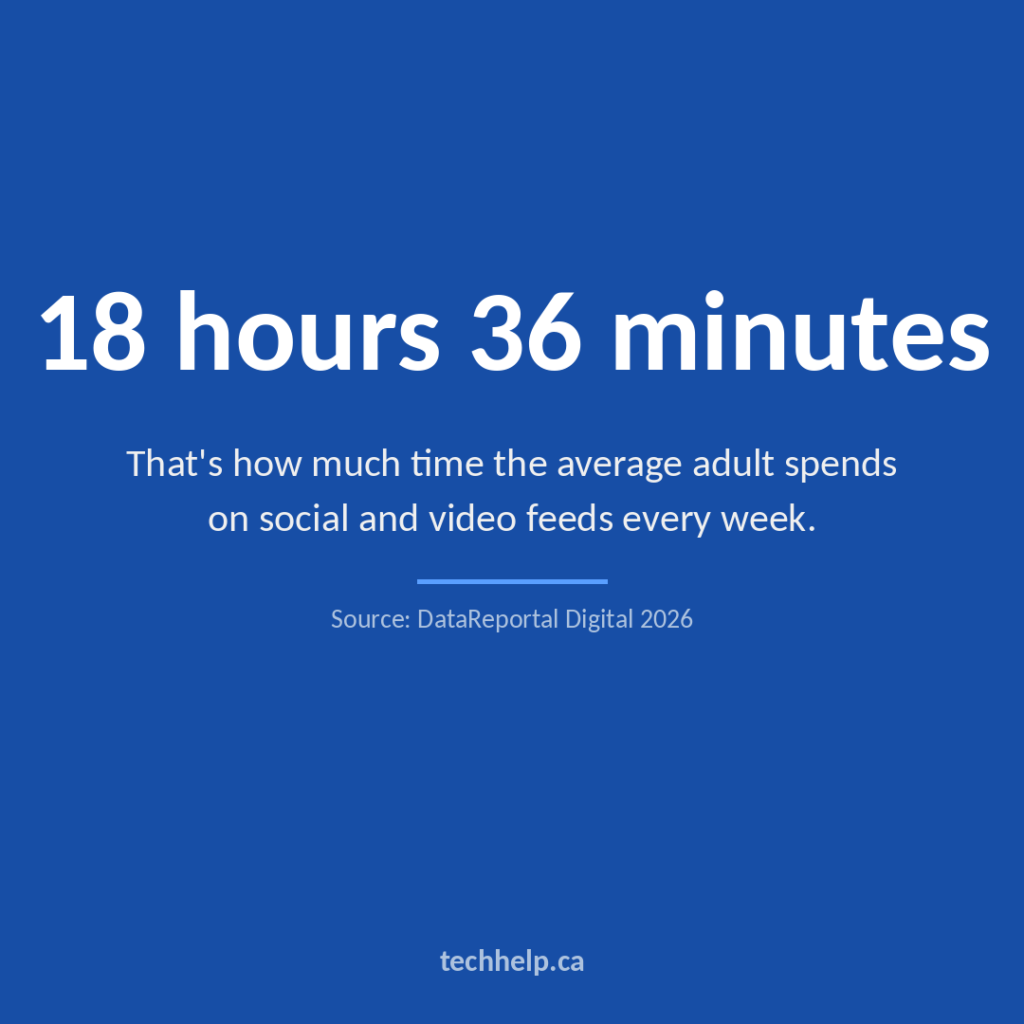
That experience is common enough that it can feel normal. DataReportal’s Digital 2026 report found that the typical online adult spends roughly 18 hours and 36 minutes per week consuming social and video feeds. Pew Research Center has also found that nearly half of U.S. teens say they’re online almost constantly.
Heavy use alone doesn’t automatically mean addiction. Social media can help people stay connected, learn, promote a business, find community, and follow the news. The problem begins when use becomes hard to control and keeps crowding out sleep, work, school, relationships, focus, physical activity, or emotional stability.
This article won’t diagnose you. It will help you tell the difference between normal use, unhealthy use, and patterns that may deserve professional support.
Before calling it addiction, understand the difference
“Social media addiction” is widely used in everyday language, but the clinical picture is more careful. The American Psychiatric Association says Internet Gaming Disorder appears in the DSM-5-TR section for conditions needing more research, and that proposed condition doesn’t include general internet use, social media, or smartphones.
That doesn’t mean social media can’t become seriously disruptive. The U.S. Surgeon General’s 2026 screen-use advisory says some harmful screen-use patterns may resemble addiction features when they include reduced control and continued use despite harm. Cleveland Clinic describes social media addiction as an uncontrollable urge to use social media even when it creates negative consequences.
For practical purposes, the question isn’t whether the label fits perfectly. The better question is whether social media is still serving your life, or whether your life is starting to serve social media.
Healthy use vs. problematic use
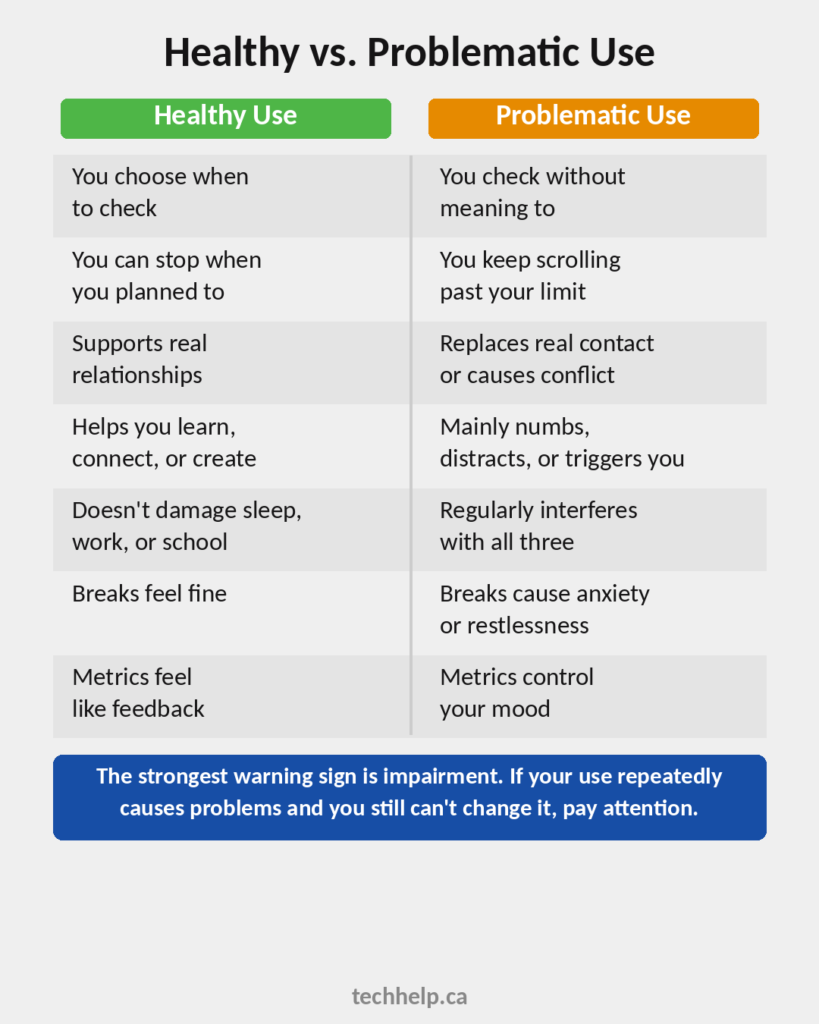
The line isn’t the number of minutes by itself. Two people can spend the same amount of time online and have completely different outcomes. A social media manager may spend hours on platforms for work, then log off without emotional distress. Someone else may spend less total time but feel unable to stop, sleep poorly, and avoid real responsibilities. Use this comparison as a quick reality check.
Healthy social media use
Problematic social media use
You choose when to check
You check automatically without meaning to
You can stop when you planned to
You keep scrolling after deciding to stop
It supports real relationships
It replaces real contact or causes conflict
It helps you learn, connect, or create
It mainly numbs, distracts, or triggers you
It doesn’t damage sleep, work, or school
It regularly interferes with sleep, work, or school
You can take breaks without distress
You feel restless, anxious, or irritable when you can’t check
Metrics feel like feedback
Likes, views, or replies control your mood
The strongest warning sign is impairment. If your use repeatedly causes problems and you still can’t change it, pay attention.
Signs of social media addiction
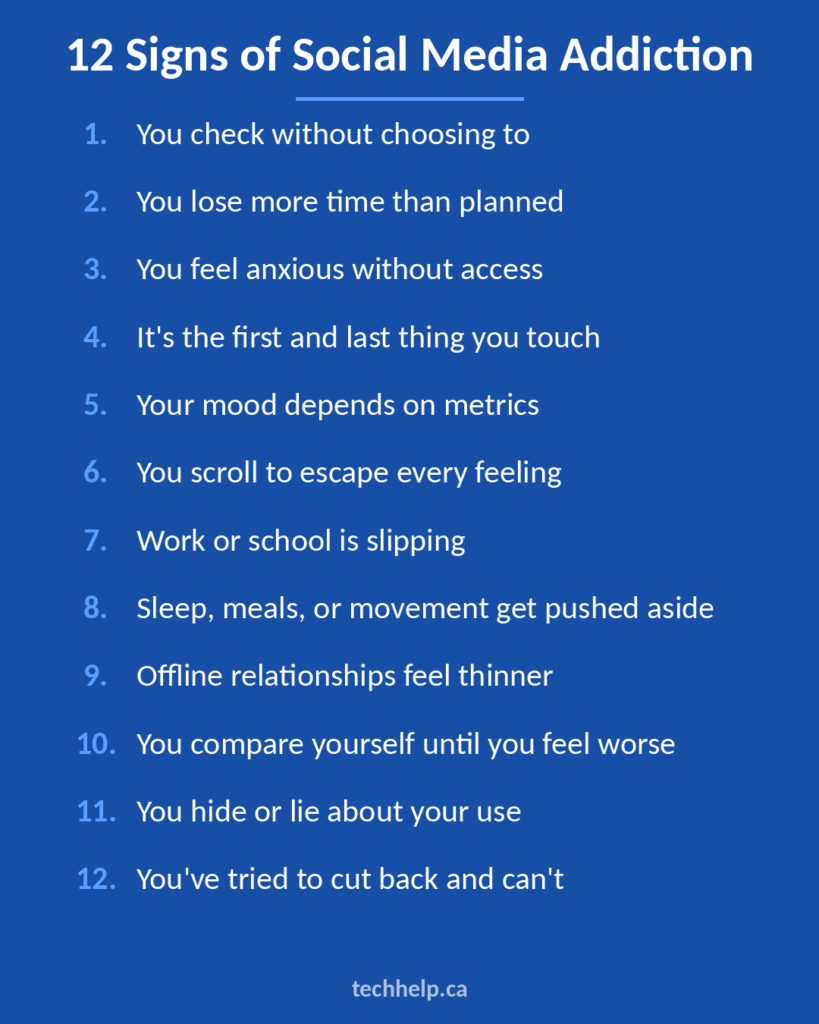
The signs below aren’t a checklist for self-diagnosis. They’re patterns that suggest your relationship with social media may need boundaries, a reset, or outside help.
1. You check without choosing to
The app opens before you fully realize what you’re doing. You unlock your phone, tap the icon, refresh the feed, and only then notice that the behavior was automatic.
This is different from intentional use. Intentional use has a reason: replying to a message, posting something, checking an event time, researching a topic, or catching up with someone specific. Automatic use often happens in the spaces between life: waiting in line, walking across a room, sitting at a red light, avoiding a task, or feeling a small wave of boredom.
If you reach for social media before your brain has even named a need, the habit loop is running the show.
2. You lose more time than you meant to
One of the clearest signs is time distortion. You planned to check one notification, but the feed pulled you into comments, videos, suggested posts, and profiles you didn’t care about five minutes earlier.
Losing time occasionally is normal. Losing time daily, especially when it makes you late, sleep-deprived, behind on work, or annoyed with yourself, points to a deeper issue.
Pay attention to the gap between your intention and the outcome. “I’ll check for five minutes” becoming 45 minutes isn’t a time-management quirk if it keeps happening. It’s a control problem.
3. You feel anxious, irritable, or restless when you can’t check
Pew’s 2024 screen-time research found that 44% of U.S. teens often or sometimes feel anxious when they don’t have their smartphone. Anxiety without a phone doesn’t always mean social media addiction, but it does show how emotionally attached many people have become to constant access.
If being away from social media makes you tense, distracted, angry, panicky, or unable to enjoy the moment, that’s worth taking seriously. The issue may be fear of missing out, loneliness, social comparison, boredom, uncertainty, or the discomfort of being alone with your thoughts.
The emotion is information. Don’t shame it. Study it.
4. Social media is the first and last thing you touch
Checking social media before getting out of bed and right before sleep can turn the platform into the frame around your day. You wake up to other people’s lives, opinions, emergencies, achievements, arguments, and ads before you’ve had a moment with your own thoughts.
At night, the problem gets sharper. The American Psychological Association advises that social media use shouldn’t interfere with sleep or physical activity, and the U.S. Surgeon General’s youth advisory connects social media and technology use near bedtime with sleep disruption.
If your day begins with scrolling and ends with scrolling, build a boundary around those two moments first. They set the tone for everything else.
5. Your mood depends on likes, views, comments, or replies
Social feedback is designed to feel rewarding. A like can feel like approval. A comment can feel like proof that you matter. A lack of response can feel like rejection, even when nobody meant anything by it.
This becomes unhealthy when metrics start controlling your mood. You feel high after a post performs well and embarrassed or irritated when it doesn’t. You keep checking whether someone watched your story. You reread comments looking for approval or threat.
The problem isn’t wanting connection. That’s human. The problem is handing your self-worth to a dashboard that updates every few seconds.
6. You use social media to escape every uncomfortable feeling
Many people scroll when they’re tired, lonely, stressed, angry, bored, embarrassed, or overwhelmed. A little distraction can be harmless. But if social media becomes your default way to avoid every uncomfortable feeling, it starts blocking emotional processing.
You may notice this pattern when you reach for your phone the moment a task gets difficult, a conversation feels awkward, or a quiet moment appears. The app becomes less about enjoyment and more about escape.
Escaping occasionally is human. Escaping constantly keeps the original problem alive.
7. Work, school, or responsibilities are slipping
Problematic use often shows up in output before it shows up in self-awareness. Deadlines start moving. Focus gets thinner. Assignments take longer. Meetings become harder to follow. You tell yourself you can multitask, but the work tells another story.
The 2026 Surgeon General screen-use advisory notes that multitasking with digital media in classroom settings can interfere with attention and concentration. The same principle applies outside school. Switching between a task and a feed breaks focus, even when the switch feels tiny.
If social media keeps turning deep work into scattered fragments, the cost is no longer invisible.
8. Sleep, meals, movement, or basic care get pushed aside
The body usually notices the problem before the calendar does. You stay up late scrolling. You eat while watching feeds without tasting much. You skip movement because you’re stuck in a content loop. You delay showers, chores, errands, homework, or bedtime because the next post keeps pulling you forward.
The U.S. Surgeon General’s 2026 advisory emphasizes sleep, physical activity, daily responsibilities, and in-person relationships as areas that can suffer when screen use becomes harmful.
Your phone doesn’t have to ruin your life to deserve boundaries. It only has to keep stealing from the basics.
9. Offline relationships feel thinner
Social media can support relationships, but it can also create the illusion of connection while reducing real contact. You know what people posted, but you haven’t had a meaningful conversation with them. You’re physically present with family or friends, but part of your attention stays on the feed.
Another warning sign is conflict. People complain that you’re always on your phone. You hide your use. You get defensive when someone asks you to put it away. You feel more emotionally invested in online reactions than in the person sitting across from you.
The platform may be social. The pattern may still be isolating.
10. You compare yourself until you feel worse
Comparison is one of social media’s sharpest emotional hooks. Someone else seems more successful, attractive, loved, disciplined, wealthy, connected, productive, or happy. Even when you know the feed is edited, your nervous system may still react as if you’re losing.
The APA advisory specifically warns about social media use centered on appearance comparison, especially for adolescents. The Surgeon General’s youth advisory also points to concerns around body dissatisfaction, harmful content exposure, and mental health risk.
If you regularly leave social media feeling smaller, uglier, behind, angry, or ashamed, the issue isn’t just time spent. It’s what the content is doing to your sense of self.
11. You hide, minimize, or lie about your use
Secrecy is a signal. You may say you’ve been working when you’ve been scrolling, hide screen-time reports, delete usage history, or downplay how often you check.
This doesn’t mean you’re a bad person. It usually means part of you already knows the habit is causing friction. Instead of using shame as a reason to hide more, use it as a reason to get honest. Accurate information is the first step toward control.
12. You’ve tried to cut back and keep returning to the same pattern
Failed attempts matter. Maybe you deleted apps and reinstalled them. Maybe you set limits and ignored them. Maybe you promised yourself no scrolling after 9 p.m. and broke the promise by 9:12.
Relapse doesn’t mean you’re hopeless. It means the plan didn’t match the strength of the habit. Willpower alone rarely beats an environment designed for frictionless return.
If you’ve tried to stop several times and keep slipping back into the same loop, you need a system, not another vague promise.
A 10-minute self-audit
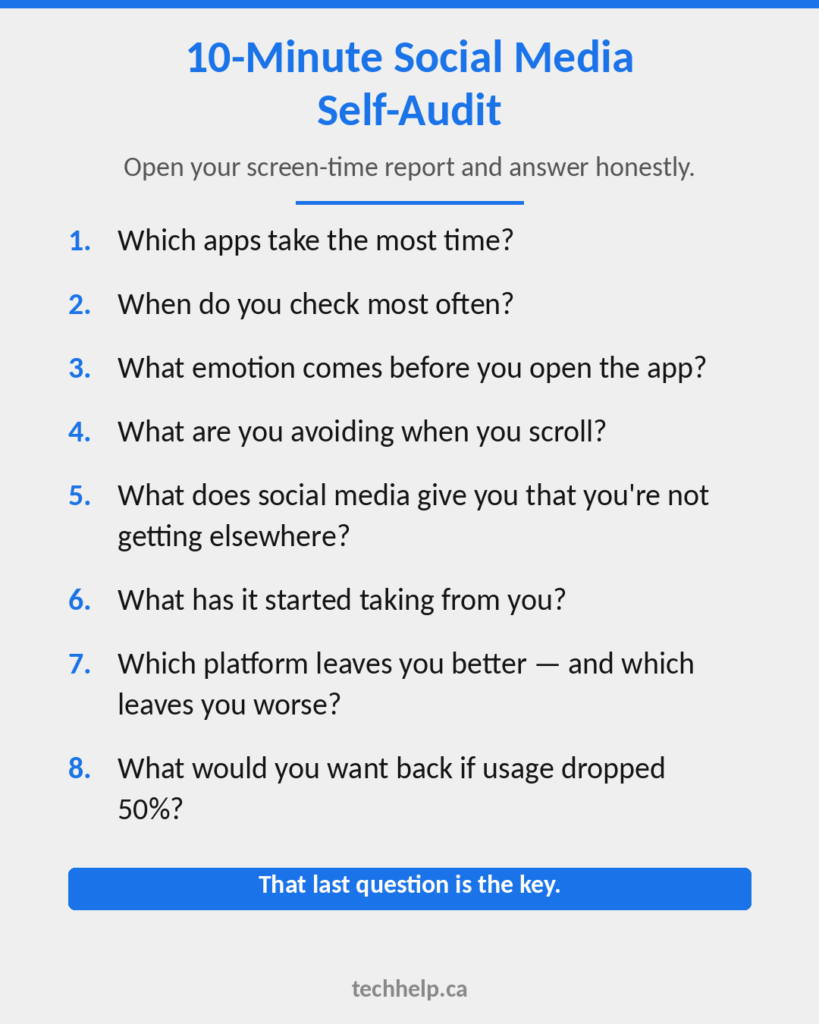
Before changing anything, get a clear picture of the pattern. Open your screen-time report and answer these questions honestly:
Which apps take the most time?
When do you check most often?
What emotion usually comes right before you open the app?
What are you avoiding when you scroll?
What does social media give you that you’re not getting elsewhere?
What has social media started taking from you?
Which platform leaves you feeling better, and which one leaves you feeling worse?
What would you want back if your usage dropped by 50%?
That last question is the key. You don’t break a habit by staring only at what you’re losing. You break it by getting clear about what you’re trying to recover.
How to break free from social media addiction
Breaking free doesn’t always mean deleting every account. For some people, a full break is the right move. For others, social media is tied to work, community, school, or family. The goal is control, not performance purity.
Start by making the habit visible, then make it harder to repeat, then replace it with something that actually meets the need underneath it.
1. Decide what you want back
“Use social media less” is too vague. Give the change a real target.
Maybe you want your mornings back. Maybe you want better sleep, steadier focus, more time with your partner, more study time, more reading, more exercise, less comparison, or fewer emotional crashes. Naming the gain makes the sacrifice easier.
Write one sentence: “I’m cutting back on social media so I can get back __.” Keep it somewhere visible.
2. Measure the real baseline
Don’t guess. Look at your actual screen-time data for the last seven days. Write down total daily use, top apps, pickup count, first pickup time, and late-night use.
This may feel uncomfortable, but it turns a vague problem into a measurable one. If you’re spending four hours a day across platforms, cutting to three is still a meaningful first step. If Instagram is the issue but YouTube is fine, don’t treat every app the same. Your baseline tells you where to start.
3. Turn off non-essential notifications
Notifications are invitations. Most of them don’t need immediate attention.
Turn off likes, follows, suggested posts, memories, trending alerts, shopping reminders, and algorithmic nudges. Keep only human messages or work-critical alerts if needed. If every vibration sends you back into the app, your phone is managing your attention for you. This one change can reduce checking without requiring much willpower.
4. Create friction before the feed
The easier the app is to open, the more often you’ll open it. Add small barriers.
Remove apps from your home screen. Log out after each session. Use website versions instead of apps. Put your phone in another room during deep work. Use app blockers during high-risk hours. Set grayscale mode at night. Charge your phone outside the bedroom.
None of these tactics is dramatic. That’s why they work. They interrupt the automatic motion long enough for choice to return.
5. Protect the first and last hour of the day
If a full detox feels too hard, start with the edges of the day.
No social media for the first hour after waking. No social media for the last hour before sleep. Use those windows for basic care: water, light, movement, breakfast, planning, reading, showering, stretching, talking, journaling, or preparing for bed.
The goal isn’t to become a perfect morning person. It’s to stop letting the feed decide your mood before the day starts and keep your brain from carrying the feed into sleep.
6. Build no-phone zones
Pick a few places where social media doesn’t belong. Good starting points are the bed, bathroom, dinner table, car, classroom, meetings, and focused work blocks.
The bed boundary is especially useful because sleep affects everything else. The meal boundary helps you reconnect with your body and the people around you. The work boundary protects attention.
Make the rule physical, not just mental. Put the phone somewhere else.
7. Replace the need, not just the app
If social media gives you relief, stimulation, connection, novelty, or escape, removing it creates a gap. You need a replacement that fits the same need without the same cost.
If you scroll because you’re lonely, schedule a call or send one real message. If you scroll because you’re stressed, take a walk, breathe for two minutes, tidy one surface, or write down the problem. If you scroll because you’re bored, keep a short list of low-effort alternatives nearby. Tech Help Canada’s guide to personal productivity methods can help if the deeper problem is focus, task overload, or decision fatigue.
8. Use scheduled windows
Instead of checking all day, create planned social media windows. For example: 20 minutes at lunch and 20 minutes after dinner. If you use social media for work, create separate work windows and personal windows.
Scheduled use works because it removes the constant negotiation. You don’t have to decide 80 times a day whether to check. You already decided.
If you break the window, don’t spiral. Adjust the system. You may need shorter windows, stronger app blockers, or a better replacement activity.
9. Curate the feed
The feed isn’t neutral. It trains your attention and mood.
Unfollow accounts that trigger comparison, rage, shame, compulsive checking, or endless arguments. Mute people you don’t want to unfollow. Block accounts that pull you into harmful content. Follow accounts that make you feel informed, grounded, capable, creative, or connected.
You don’t have to justify every unfollow. Your attention isn’t a public resource.
10. Tell one person what you’re changing
Private goals are easier to abandon. Tell a friend, partner, roommate, coworker, therapist, or family member what you’re trying to change.
Keep it simple: “I’m trying to cut social media down because it’s messing with my sleep. Can I check in with you once a week?” Accountability works better when it’s specific and low-drama.
If social media has become tied to shame, secrecy, or conflict, outside support can make the change feel less lonely.
A 7-day reset plan
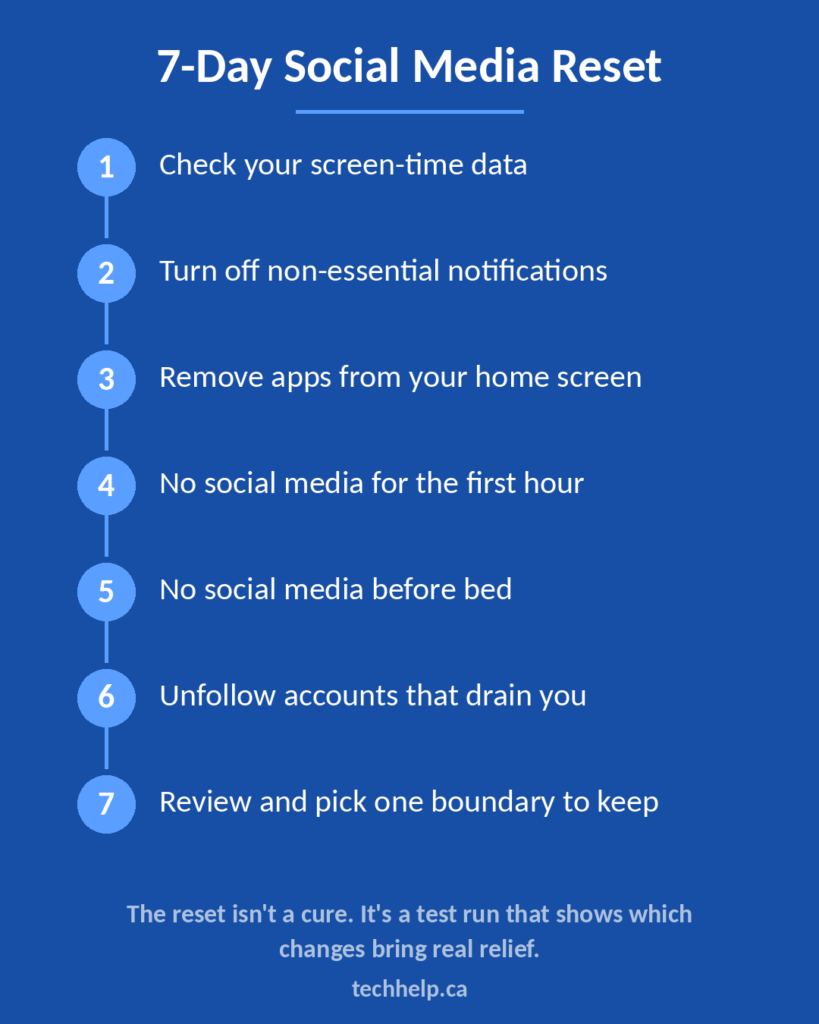
Use this if you need structure but don’t want to disappear from the internet completely:
Day
Focus
What to do
1
Baseline
Check screen-time data and write down your top apps, pickup count, and late-night use.
2
Notifications
Turn off all non-essential social notifications. Keep only messages you truly need.
3
App friction
Remove social apps from your home screen, log out, or use blockers during work and bedtime.
4
Morning boundary
No social media for the first hour after waking. Replace it with a real morning cue.
5
Night boundary
No social media for the last hour before sleep. Charge your phone away from the bed.
6
Feed curation
Unfollow, mute, or block accounts that reliably leave you worse.
7
Review
Compare your mood, sleep, focus, and time use. Choose the one boundary you’ll keep next week.
The reset isn’t a cure. It’s a test run. It shows which changes create relief and which parts of the habit fight back hardest.
If you use social media for work
Cutting back is trickier when social media is part of your job. Marketers, creators, founders, customer support teams, recruiters, journalists, and small business owners may need platforms to publish, monitor, reply, and sell.
In that case, the goal is separation. Work use should have a purpose, time block, task list, and exit point. Personal scrolling shouldn’t sneak in through a work excuse.
Try logging work activity in a simple format: platform, task, start time, stop time, outcome. “Reply to customer comments for 20 minutes” is work. “Check Instagram for inspiration” may be a trap unless you define what you’re looking for.
If you’re managing social channels professionally, Tech Help Canada’s A to Z social media guide can help turn platform use into a more intentional system. The better the workflow, the less you need to hover inside the feed all day.
How parents can respond without turning it into a fight
For teens, the conversation needs more than “put your phone away.” Pew found that about a quarter of teens say they spend too much time on social media, while 39% say they’ve cut back on social media use. Many already know there’s tension. They may not know how to change it.
Start with curiosity. Ask what they like about social media, what makes them feel worse, which apps are hardest to stop, and when the phone causes stress. If the first move is accusation, the likely response is hiding.
Set boundaries around sleep, school, meals, driving, and harmful content. The APA recommends limiting social media so it doesn’t interfere with sleep, physical activity, or in-person interaction. The 2026 Surgeon General advisory also recommends family media plans and removing devices from children’s bedrooms overnight.
Parents should model the same boundaries. A teen is unlikely to take “no phones at dinner” seriously from an adult who checks every notification at the table.
When to get professional help
Consider professional support if social media use is damaging your life and self-directed changes aren’t working. That may mean talking to a therapist, doctor, school counselor, employee assistance program, or mental health clinic.
Get help sooner if social media use is tied to severe anxiety, depression, panic, self-harm thoughts, eating disorder symptoms, bullying, harassment, sextortion, gambling, substance use, or major relationship conflict.
If you or someone else may be in immediate danger, contact emergency services. If you’re in the U.S., call or text 988 for the Suicide and Crisis Lifeline. If you’re in Canada, call or text 9-8-8 for the Suicide Crisis Helpline.
Getting help doesn’t mean you failed. It means the problem has become heavy enough that you shouldn’t have to carry it by yourself.
What breaking free actually looks like
Breaking free from social media addiction doesn’t have to look dramatic. It may look like sleeping with your phone outside the bedroom. It may look like deleting one app, not five. It may look like checking twice a day instead of 40 times. It may look like a walk when you want to scroll, a call when you feel lonely, or one honest conversation when you’re tempted to hide.
The goal isn’t to hate social media. The goal is to put it back in its place.
Start with one boundary today. Make it small enough to keep and meaningful enough to feel. Then protect it long enough for your attention to remember what life feels like without the feed constantly pulling at it.
Frequently asked questions
Is social media addiction a real diagnosis?
Social media addiction is a common phrase, but it isn’t a formal DSM diagnosis. Clinicians may still take problematic social media use seriously when it involves loss of control, distress, continued use despite harm, or major disruption to sleep, work, school, relationships, or mental health.
How much social media use is too much?
There isn’t one number that applies to everyone. The better test is impact. Social media use becomes a problem when it repeatedly interferes with sleep, responsibilities, focus, in-person relationships, physical activity, emotional stability, or your ability to stop when you planned to stop.
What is the biggest warning sign of social media addiction?
The biggest warning sign is continued use despite negative consequences. If social media is hurting your sleep, work, school, relationships, mood, or self-worth and you still feel unable to cut back, it’s time to set stronger boundaries or seek support.
Do I have to delete all social media to recover control?
No. Some people benefit from a full break, but many people need a more realistic plan. You can start by turning off notifications, removing apps from your home screen, creating no-phone zones, setting scheduled check-in windows, and cleaning up your feed.
Why is social media so hard to stop checking?
Social platforms are built around rewards such as novelty, social feedback, messages, comments, and endless feeds. Those rewards can train automatic checking, especially during boredom, stress, loneliness, or avoidance. Adding friction and replacing the underlying need makes cutting back easier than relying on willpower alone.
When should someone get professional help?
Professional help is worth considering when social media use causes serious distress or keeps damaging sleep, work, school, relationships, body image, or mental health. Get help sooner if it’s connected to depression, anxiety, self-harm thoughts, eating disorder symptoms, bullying, harassment, sextortion, gambling, or substance use.
Tech Help Canada Staff researches, writes, and reviews practical content for business owners and professionals. Our coverage spans business, marketing, SEO, technology, and the tools and systems people use to grow and operate online. We focus on clear, useful information backed by research, hands-on experience, and editorial review. Learn more about our team and editorial standards. Need help with something? Contact Us