A social media manager plans and manages a brand’s social presence across platforms.
In practice, the job is bigger than publishing posts. It can include strategy, content planning, community management, social listening, analytics, customer care coordination, creator partnerships, paid social support, reporting, and governance.
A good one makes the brand behave coherently in public. They connect social activity to business goals, protect the brand’s voice, learn from audience behavior, and help the company decide what to say next.
The scope can sound manageable until it starts collecting every online task nobody else owns, such as captions, short videos, complaints, trends, reports, creator briefs, reach drops, and reputation issues.
Hiring a social media manager is not the same as hiring someone to “run the accounts.”
The role needs a clear job description, a realistic workload, useful metrics, and enough authority to make decisions quickly. Without that, even a talented person gets trapped in reactive posting and public inbox management.
Use this as a practical scoping guide before you hire, manage, or pursue the role. It will help you decide what the person should own, what pay range is realistic, which skills to test, and which KPIs belong in the job.
Why the role matters more now
Social media is still one of the largest public communication systems businesses can use.
DataReportal’s Digital 2026 Mid-Year Global Update estimated 5.79 billion active social media user identities at the start of April 2026, equal to 69.9% of the global population. The same report warns that user identities are not the same as unique people, but the scale still matters for business planning.
The issue is not only audience size. Social platforms now affect discovery, customer support, reputation, recruiting, and market research.
DataReportal’s report said 93.8% of online adults in the markets surveyed had visited a social network within the past month, while Sprout Social’s Q2 2026 Pulse Survey found that 50% of consumers were most likely to hear about a brand crisis first on social media. Sprout also found that 84% of consumers said response speed affects how they perceive a crisis.
That creates a bigger role than content scheduling.
A social media manager may be the first person to notice an emerging complaint, the person who spots a recurring buyer question, the person who sees which product claim people misunderstand, and the person who can tell whether the latest trend is useful or embarrassing for the brand.
Hootsuite’s 2026 Social Media Trends report points in the same direction: social is becoming a research engine, a discovery channel, and a place where social search, creators, AI workflows, and cultural timing all affect performance.
So yes, the person still needs to publish. But publishing is only one part of the job.
Social media manager responsibilities
The exact responsibilities depend on company size, budget, industry, and whether the team has designers, writers, customer support, PR, analytics, and paid media help. Still, most strong roles include the same core ownership areas.
Responsibility
What the work includes
What the business gets from it
Strategy
Set platform priorities, audience focus, content themes, goals, and campaign direction
Less random posting and better decisions about where time goes
Content planning
Build calendars, briefs, creative angles, recurring series, and campaign assets
Consistency without making every post feel interchangeable
Publishing
Schedule and publish posts across the right platforms and formats
Reliable execution and fewer missed moments
Community management
Reply to comments, DMs, tags, reviews, and audience questions
Stronger trust, faster answers, and better public presence
Social listening
Watch questions, objections, competitor activity, trends, sentiment, and brand mentions
Better market intelligence and earlier risk detection
Analytics
Report reach, engagement, traffic, conversions, saves, shares, response time, sentiment, and learnings
Better choices about what to repeat, stop, or improve
Customer care coordination
Escalate complaints, support issues, refunds, safety problems, and sensitive topics
Less public friction and fewer issues left hanging
Creator and partner coordination
Brief influencers, partners, employees, founders, or subject-matter experts
More credible content and stronger distribution
Paid social support
Coordinate boosted posts, paid tests, creative variations, and campaign learnings
If the role includes all of this, it is not an entry-level posting job. It is a marketing operations role with public-facing judgment built in.
What a social media manager should own
One of the easiest ways to ruin the role is to make the social media manager responsible for everything that happens online while giving them no authority over anything that causes the results.
They may be blamed for weak engagement even though the offer is unclear. They may be blamed for low conversions even though the landing page is poor. They may be blamed for slow replies even though customer service never gave them response rules.
The fix is ownership clarity.
Area
Social media manager should own
Social media manager should influence
Platform priorities
Which social channels get active effort
Whether the website, email list, and ad plan support those channels
Content calendar
Timing, themes, formats, publishing workflow
Product launches, promotions, events, and campaign offers
Brand voice on social
Caption tone, reply style, post framing, community norms
Wider brand messaging and public communications
Reporting
Social metrics, learnings, tests, and audience insights
Revenue attribution, CRM reporting, and executive dashboards
Final decisions on sensitive, legal, safety, or crisis communications
A strong role has room to make daily judgment calls. A sensitive issue still needs escalation, but every reply should not wait for a meeting.
How the role changes by business size
Small businesses often hire one person and expect one person to be the strategy team, content team, video team, support team, and reporting team. That can work for a narrow scope. It breaks when the company expects agency-level output from one generalist.
Use this as a reality check before writing the job post.
Business stage
Best version of the role
Common mistake
Solo founder or microbusiness
Part-time social manager or freelancer who turns founder expertise into consistent posts and replies
Expecting daily videos, full analytics, customer support, design, ads, and strategy from a tiny budget
Local small business
Social media manager who handles core platforms, local proof, customer questions, reviews, promotions, and simple reporting
Chasing national trends while ignoring local buyers and repeat customers
Growing ecommerce or service brand
Social media manager who coordinates content, community, creators, UGC, social search, paid tests, and product questions
Measuring only follower count instead of traffic, saved posts, DMs, conversion signals, and customer insights
Mid-size company
Social media manager who leads channel strategy, briefs specialists, manages workflow, and reports learnings to marketing leadership
Hiring a strategist but burying them in nonstop content production
Large or regulated organization
Social media manager who works with PR, legal, customer care, product, HR, and executives through clear response rules
Moving too slowly because every public moment needs too many approvals
The smaller the team, the more the role needs trade-offs. You can hire for strategy, production, community, paid social, or analytics, but one person will rarely be excellent at every piece at the same time.
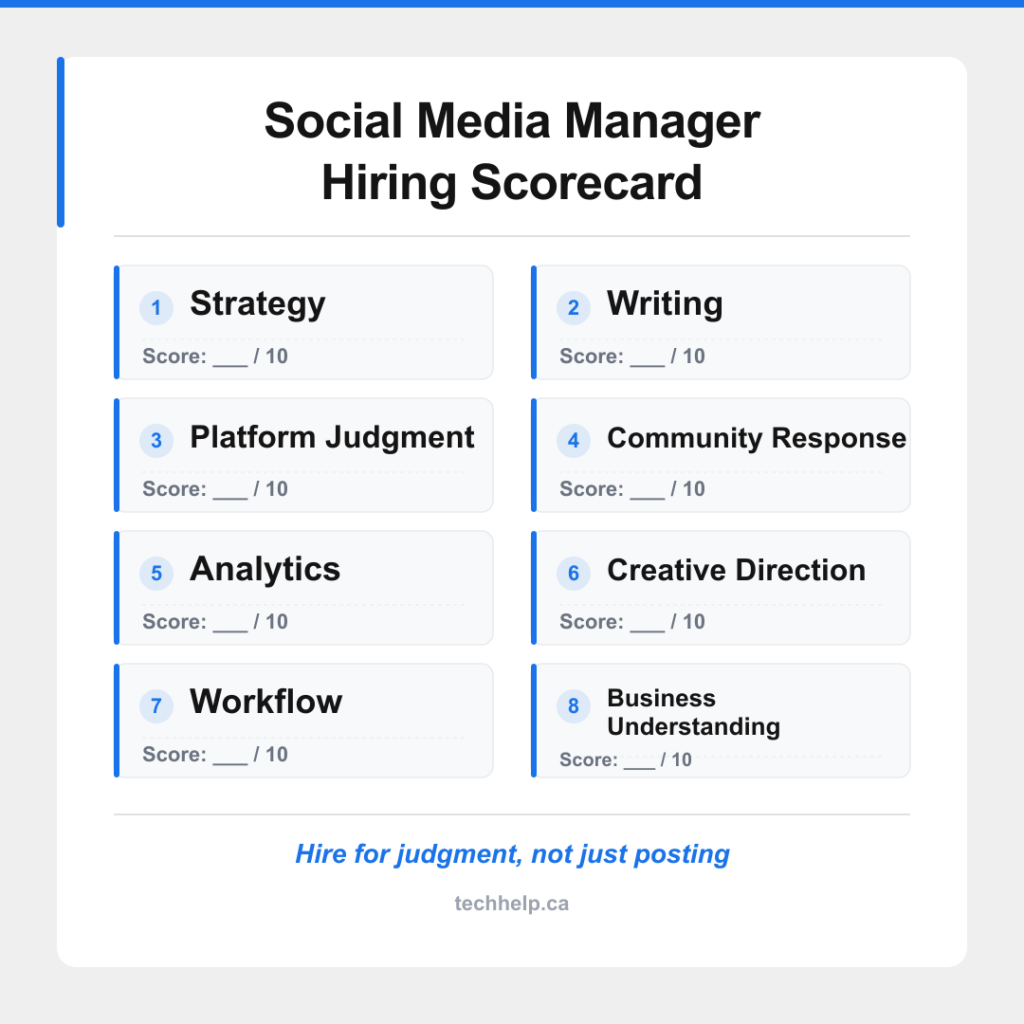
The social media manager scorecard
Before you hire, decide what the role needs to prove.
Use this scorecard to keep the role from becoming a junk drawer.
Capability
Good looks like
Weak looks like
Strategy
Can explain who the account is for, what each platform does, and which outcomes matter
Talks mainly about posting frequency, trends, or follower growth
Writing and editing
Can make posts sound human, specific, and useful in the brand’s voice
Writes generic captions that could belong to any company
Platform judgment
Understands how format, audience behavior, search, and recommendation systems differ by platform
Cross-posts the same thing everywhere and hopes the algorithm helps
Community judgment
Knows when to reply, when to ignore, when to hide, and when to escalate
Responds emotionally, over-promises, or leaves questions unanswered
Analytics
Connects performance to decisions and next tests
Reports likes and impressions without explaining what should change
Creative direction
Can brief designers, creators, or founders clearly
Sends vague requests such as “make it pop” or “do something viral”
Operational reliability
Keeps calendars, approvals, assets, passwords, and reports organized
Misses deadlines, loses assets, or creates confusion around ownership
Business understanding
Understands offers, audience objections, margins, customer lifecycle, and sales handoff
Treats social as entertainment detached from the rest of the business
For most businesses, the best hire is not the person with the flashiest personal profile. It is the person who can show judgment, structure, and evidence of learning.
Social media manager salary benchmarks
Salary varies by country, city, industry, company size, seniority, platform mix, and whether the job includes paid social, creator management, customer care, or reporting.
Do not compare a basic social media coordinator job with a role that owns strategy, content, analytics, and public response. Those are different jobs.
Source
Role or category
Current benchmark
Useful caveat
Robert Half 2026 Salary Guide
Social media manager, U.S.
Low $62,500, mid $78,750, high $95,500
Robert Half describes these as starting compensation levels that vary by market, skills, experience, certifications, industry, and company size
Robert Half 2026 marketing job market research
Social media specialist, U.S.
Low $51,000, mid $61,250, high $72,500
Useful for comparing a hands-on specialist role with a manager role
Job Bank Canada
Social media manager in Canada, grouped under NOC 10022
Median wage $55.29 per hour
This is a broad Canadian occupational group covering advertising, marketing, public relations, and e-business managers, not a narrow social-only salary figure
U.S. Bureau of Labor Statistics
Marketing managers, broader U.S. category
Median annual wage $166,790 in May 2025
This is a more senior and broader management category than a typical social media manager
Robert Half’s 2026 salary guide also says 78% of marketing and creative leaders typically offer higher salaries to candidates with specialized skills. The listed skills include digital marketing strategy, AI and machine learning, marketing automation, marketing research and analytics, and web and mobile development and design.
That explains why pay can swing so much. A social media manager who only schedules posts sits in one market. A manager who can run campaigns, direct creators, use AI without losing brand judgment, report business outcomes, and coordinate with customer care sits in another.
Skills a social media manager needs
The role rewards range, but it should not reward chaos. A good social media manager brings a mix of creative, analytical, operational, and interpersonal skills.
Skill
Business value
Social strategy
The manager needs to know what each platform is supposed to do for the business
Audience understanding
Good content starts with what people care about, not what the company wants to announce
Writing
Captions, replies, scripts, briefs, hooks, and updates all need clear language
Editing
The manager must know when to shorten, reframe, cut, rewrite, or ask for better source material
Creative direction
Many social posts are visual or video-led, even when the manager is not the designer
Social search awareness
Captions, on-screen text, keywords, and platform search behavior now affect discovery
Analytics
The manager has to translate performance data into decisions
Customer care judgment
Public replies can reduce friction or make the issue worse
Community sense
The role requires knowing how people speak inside a platform or niche
Project management
Calendars, approvals, assets, creators, reports, and launches need order
AI workflow judgment
AI can speed drafting and repurposing, but someone still has to protect voice, accuracy, taste, and context
Risk awareness
The manager needs to understand disclosures, sensitive topics, access control, and escalation paths
O*NET’s Search Marketing Strategists profile supports this range. It lists work such as managing tracking and reporting, analyzing web metrics, identifying KPIs, creating digital media content strategies, conducting social media campaigns, analyzing popular social media topics, and implementing online customer service processes.
That is a useful warning for employers. If your job description asks for all of that, pay and support should match the scope.
Social media manager vs social media specialist
These titles overlap, but they should not be treated as identical.
A social media specialist is usually more execution-focused. The specialist may create posts, schedule content, respond to comments, pull reports, watch trends, and support campaigns.
A social media manager usually has more ownership. The manager may set strategy, prioritize platforms, lead campaigns, manage workflow, coordinate with other teams, approve content, shape reporting, and decide how social supports broader goals.
Content execution, platform activity, community management, trend awareness, reporting support
Hands-on role for a company with strategy already in place
Social media manager
Strategy, calendar, campaigns, community standards, reporting, team coordination, escalation workflow
Business that needs someone to own social as a channel
Director of social media
Multi-brand or multi-team strategy, budget, governance, staffing, executive reporting
Larger organization with high social volume or risk
If your business mostly needs execution, do not dress it up as a manager role. If your business needs strategic ownership, do not hire a junior person and hope they can invent the system alone.
When a small business should hire a social media manager
A small business should hire a social media manager when social is important enough to need consistent ownership.
That does not always mean a full-time employee. Sometimes the right move is a freelancer, consultant, agency, or part-time contractor.
You may be ready to hire when:
Your customers already ask questions through social channels.
You have enough proof, offers, expertise, or customer stories to publish consistently.
Social content can support sales, service, recruiting, retention, events, or local visibility.
The owner or marketing lead is spending too much time managing posts and replies.
You need better reporting than “that post did well.”
Public response time affects customer trust.
You have a clear approval path for sensitive questions.
You can give the person enough context to answer accurately.
You may not be ready if the business has no clear offer, no customer understanding, no decision-maker available for approvals, or no budget for the work you expect.
This is where a broader social media strategy helps. Hire the role after you know what social is supposed to do.
Should you hire an employee, freelancer, or agency?
The right structure depends on the job, not the title.
Option
Best when
Watch out for
Part-time freelancer
You need basic publishing, light content creation, simple reporting, or temporary help
Scope can get messy fast if you expect strategy, customer care, and daily creative production
Full-time social media manager
Social is a steady channel that needs brand voice, response, content planning, analytics, and coordination
One person still needs limits, tools, approvals, and support from the business
Agency
You need a team for strategy, production, paid social, design, reporting, or multi-platform campaigns
Agencies still need access to internal knowledge, fast approvals, and a real offer
Consultant
You need strategy, audit, training, workflow design, or hiring help
A consultant can design the system, but someone still has to run it
In-house specialist plus outside support
You need daily brand presence and occasional help with campaigns, video, ads, or analytics
Ownership must be clear so work does not fall between people
For many small businesses, the best first step is not “hire someone to post.” It is “define the job social media needs to do, then choose the right kind of help.”
If social is one part of a wider visibility problem, Tech Help Canada’s digital marketing solutions page explains how SEO, copywriting, site support, and digital marketing fit together.
A practical social media manager job description template
Use this as a starting point. Edit it to match the actual role, platforms, team, budget, and decision authority.
Role summary
We are hiring a social media manager to lead our day-to-day social media presence and help turn social channels into a stronger source of trust, visibility, customer insight, and business support.
This role owns the social calendar, platform execution, community response, performance reporting, and coordination with internal or external partners. The right person can write clearly, understand audience behavior, manage workflow, interpret data, and protect the brand’s voice in public.
Responsibilities
Build and manage the social media content calendar.
Plan platform-specific content for the channels that matter to our audience.
Write and edit captions, post copy, short video concepts, replies, and campaign messaging.
Coordinate creative assets with designers, video editors, founders, employees, creators, or agencies.
Publish and schedule content across approved platforms.
Monitor comments, direct messages, tags, mentions, reviews, and relevant conversations.
Respond to routine audience questions using approved guidelines.
Track performance and explain what the data suggests we should repeat, change, or stop.
Support product launches, events, promotions, hiring campaigns, and customer education.
Watch platform changes, social search behavior, competitor activity, and audience questions.
Maintain organized assets, briefs, passwords, approvals, and reporting notes.
Required skills
Strong writing and editing skills.
Good judgment in public conversations.
Experience managing brand social accounts.
Comfort with analytics and performance reporting.
Familiarity with major social platforms and format differences.
Ability to plan content around business goals, not only trends.
Project management and calendar discipline.
Ability to collaborate with customer service, sales, design, leadership, and outside partners.
Nice-to-have skills
Short-form video planning or editing experience.
Paid social campaign support.
Creator or influencer coordination.
Social listening or community management experience.
Canva, CapCut, Adobe, Hootsuite, Buffer, Sprout Social, Google Analytics, or similar tool experience.
AI-assisted content workflow experience with strong human editing judgment.
Success measures
Success in this role will be measured by the quality of content, consistency of execution, response time, audience learning, useful engagement, traffic or lead contribution where relevant, and the clarity of reporting.
Interview questions for a social media manager
Good interview questions should test judgment, not just tool familiarity.
Interview question
What a strong answer should reveal
Walk me through a social campaign you planned. What was the goal, and how did you judge performance?
The candidate can connect content to business outcomes and explain trade-offs
Which metrics do you trust least, and which do you use most?
They know the difference between visible activity and useful signals
Tell me about a time a post did not perform. What did you change?
They can learn without blaming the algorithm for everything
How would you respond to a public customer complaint that is partly fair and partly inaccurate?
They can balance empathy, accuracy, escalation, and brand risk
How do you decide whether a trend fits a brand?
They have taste, audience sense, and restraint
What would you audit in your first 30 days?
They understand platforms, content, workflow, audience, competitors, and measurement
How do you use AI in social media work?
They can speed up drafts or repurposing without outsourcing judgment
What do you need from leadership to do this job well?
They understand approvals, access, priorities, and decision rights
Ask for work samples, but do not judge only by prettiness. Ask what the content was supposed to do and what happened after it went live.
KPIs for a social media manager
Followers and likes are easy to count. They are not enough to judge the role.
Useful KPIs depend on the job social media needs to do.
Goal
Better KPIs
Awareness
Qualified reach, video views with retention, profile visits, branded searches, follower growth from target markets
Do not expect a new hire to fix everything immediately. A serious social media manager needs time to understand the audience, brand, offer, constraints, and internal workflow.
The first month should reveal where the system is weak. The second should make the work repeatable. The third should show what is worth improving next.
Common mistakes when hiring a social media manager
Many bad hires start with bad scoping.
Mistake 1: Hiring for vibes only
A candidate with good taste can still be weak at reporting, customer response, workflow, or business judgment.
Look for evidence of thinking, not only attractive posts.
Mistake 2: Expecting one person to be a full agency
One person can manage a focused social system. One person cannot be a strategist, designer, copywriter, videographer, editor, analyst, paid ads buyer, customer support rep, creator manager, and crisis communicator at full strength every day.
Pick the role’s most important jobs before hiring.
Mistake 3: Measuring the wrong outcomes
If the business needs leads, do not judge only likes. If the business needs trust, do not judge only follower count. If the business needs customer care, do not judge only reach.
Match the metric to the job.
Mistake 4: Giving responsibility without access
A social media manager needs source material, product information, customer questions, promotions, event details, approvals, assets, and decision-makers. Without those inputs, the work becomes guesswork.
Mistake 5: Ignoring response rules
Social media is public. A simple comment can become a service issue, legal issue, PR issue, or safety issue.
Write down what the manager can answer, what they should ignore, what they should hide or report, and what they must escalate.
If you want to become a social media manager, build proof that shows judgment.
A portfolio should not just display screenshots. It should explain the context.
For each sample, include:
The goal.
The audience.
The platform.
Your role.
The constraint.
The result.
What you learned.
If you do not have client or employer work yet, create sample audits, content calendars, rewrite exercises, platform breakdowns, or campaign briefs for a fictional brand. Make the thinking visible.
Hiring managers are not only looking for someone who can use Canva, schedule posts, or follow trends. They are looking for someone they can trust with public judgment.
For a wider view of marketing career paths, our guide to careers in marketing can help you compare social media management with content marketing, SEO, brand, analytics, and other roles.
The role should not live alone
Social media works best when it is connected to the rest of the marketing system.
The social media manager should know what is happening in SEO, content, email, sales, customer support, product, events, and public relations. Otherwise, the social calendar becomes a separate performance instead of a useful part of the business.
Strong social content can send people to articles, product pages, email signups, events, demos, reviews, case studies, and support resources. Strong articles can become social posts, videos, carousels, newsletter sections, and sales follow-up material.
That is where content repurposing helps. One useful idea can travel across formats, but the social media manager still has to adapt it to the platform and audience.
Final take
A social media manager should not be hired as a posting machine.
The role works when the business defines what social media is supposed to do, gives the manager enough authority and context to act, and measures performance against useful outcomes.
If the business needs awareness, say that. If it needs customer care, say that. If it needs sales support, say that. If it needs market intelligence, say that.
Then hire for the skills that match the job.
The best social media manager is not the person who promises to be everywhere at once. It is the person who can help the business show up with judgment, consistency, and a reason people should care.
Frequently asked questions
What does a social media manager do?
A social media manager plans and manages a brand’s social presence. The role can include strategy, content planning, publishing, community management, social listening, analytics, customer care coordination, creator partnerships, and reporting.
How much does a social media manager make?
Robert Half’s 2026 Salary Guide lists U.S. social media manager starting compensation at $62,500 on the low end, $78,750 at the midpoint, and $95,500 on the high end. Pay varies by market, industry, seniority, skills, and role scope.
What skills does a social media manager need?
A social media manager needs writing, editing, platform judgment, social strategy, analytics, community management, customer care judgment, creative direction, project management, and enough business sense to connect social activity to useful outcomes.
When should a small business hire a social media manager?
A small business should hire a social media manager when social media needs consistent ownership, customers already use social channels to ask questions or compare options, and the business can provide enough context, approvals, and budget for the work.
What is the difference between a social media manager and a social media specialist?
A social media specialist is usually more focused on hands-on execution, such as publishing, content creation, community management, and reporting support. A social media manager usually has more ownership over strategy, workflow, campaigns, reporting, and cross-team coordination.
Should I hire a social media manager, freelancer, or agency?
Hire a freelancer for focused execution, a full-time social media manager when the channel needs steady ownership, an agency when you need a broader production or paid social team, and a consultant when you need strategy, audit, training, or hiring help.
Get new small business insights by email
Practical ideas and useful articles to help you make better business decisions.
Tech Help Canada Staff researches, writes, and reviews practical content for business owners and professionals. Our coverage spans business, marketing, SEO, technology, and the tools and systems people use to grow and operate online. We focus on clear, useful information backed by research, hands-on experience, and editorial review. Learn more about our team and editorial standards. Need help with something? Contact Us