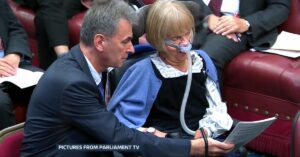
Baroness Campbell of Surbiton, a Crossbench peer and disability rights campaigner who has spinal muscular atrophy, used an AI-generated recreation of her own voice in the House of Lords on 13 October 2026.
According to the House of Lords, it was the first time a Member of Parliament or peer had used an AI voice generator to deliver a speech in Parliament. The speech took place during the Health Bill’s second reading. ElevenLabs provided the AI voice system.
The House of Lords announced before the debate that its Procedure Committee had approved Campbell’s use of the AI voice as an accommodation for her participation in the chamber. The voice spoke words she had written, allowing her to address peers despite a disability that has increasingly affected her natural speech.
The accommodation followed an earlier 2012 decision that allowed Campbell to bring a personal assistant into the chamber to read her speeches when required. The House said that decision departed from Standing Order 12, a rule dating from 1707 that restricted non-peers from crossing the bar and speaking in the chamber.
In Hansard, Campbell thanked the Procedure Committee, the technical department and House of Lords staff before introducing peers to “Baroness Campbell mark 2.”
How ElevenLabs recreated the voice
ElevenLabs said Campbell used old clips of herself speaking to create an AI voice that replicates the tone, rhythm and pitch of her original voice. She then used the company’s text-to-speech generator to create an audio version of the speech, which was played in the House of Lords through an assistive device.
AFP reported that an ElevenLabs representative said the company worked with Campbell to fine-tune the voice clone so it matched how she wanted it to sound.
The speech focused on personal health budgets
The historic format did not make the speech a technology demo. In the Hansard transcript, Campbell used the intervention to support the Health Bill’s ambition for integrated and personalised care, while warning against what she described as the possible return of an institutional medical model.
She told peers that NHS personal health budgets were designed to support ordinary lives “on their own terms” and said direct payments allow people to hire personal assistants and decide how and when they are supported. Campbell also said she depends on a personal health budget herself.
Her closing argument placed the AI voice inside the same wider issue: independence. Campbell said she was not a medical diagnosis, but a wife, grandparent and working member of the House of Lords.
The key distinction is voice delivery, not AI authorship
The case lands differently from many concerns about synthetic media because authorship, consent and disclosure were clear. The Procedure Committee approved the use. The chamber was told that an AI-generated voice would be used. Campbell made clear that the speech, arguments and views were hers.
That distinction will matter for other public institutions considering voice AI. The test is not simply whether a voice is synthetic. It is whether the person whose voice is being used has control over the content, consented to the use, and is not being misrepresented.
Lord Forsyth of Drumlean, the Lord Speaker, acknowledged “justifiable concerns” about some uses of AI, while framing Campbell’s speech as an example of technology enabling fuller participation.
What happens next
According to UK Parliament’s 14 October update, the Health Bill’s committee stage is scheduled for 28 October 2026. Campbell said she would scrutinise the bill to ensure integration and devolution to integrated care boards do not weaken protections and freedoms tied to personal health budgets.
Related: Campbell’s use of synthetic speech shows one practical side of voice AI. For a broader look at what the technology can do, see Tech Help Canada’s ElevenLabs review.

I can suggest related Tech Help Canada articles based on the topic you’re reading now.

Tech Help Canada Staff researches, writes, and reviews practical content for business owners and professionals. Our coverage spans business, marketing, SEO, technology, and the tools and systems people use to grow and operate online. We focus on clear, useful information backed by research, hands-on experience, and editorial review. Learn more about our team and editorial standards. Need help with something? Contact Us